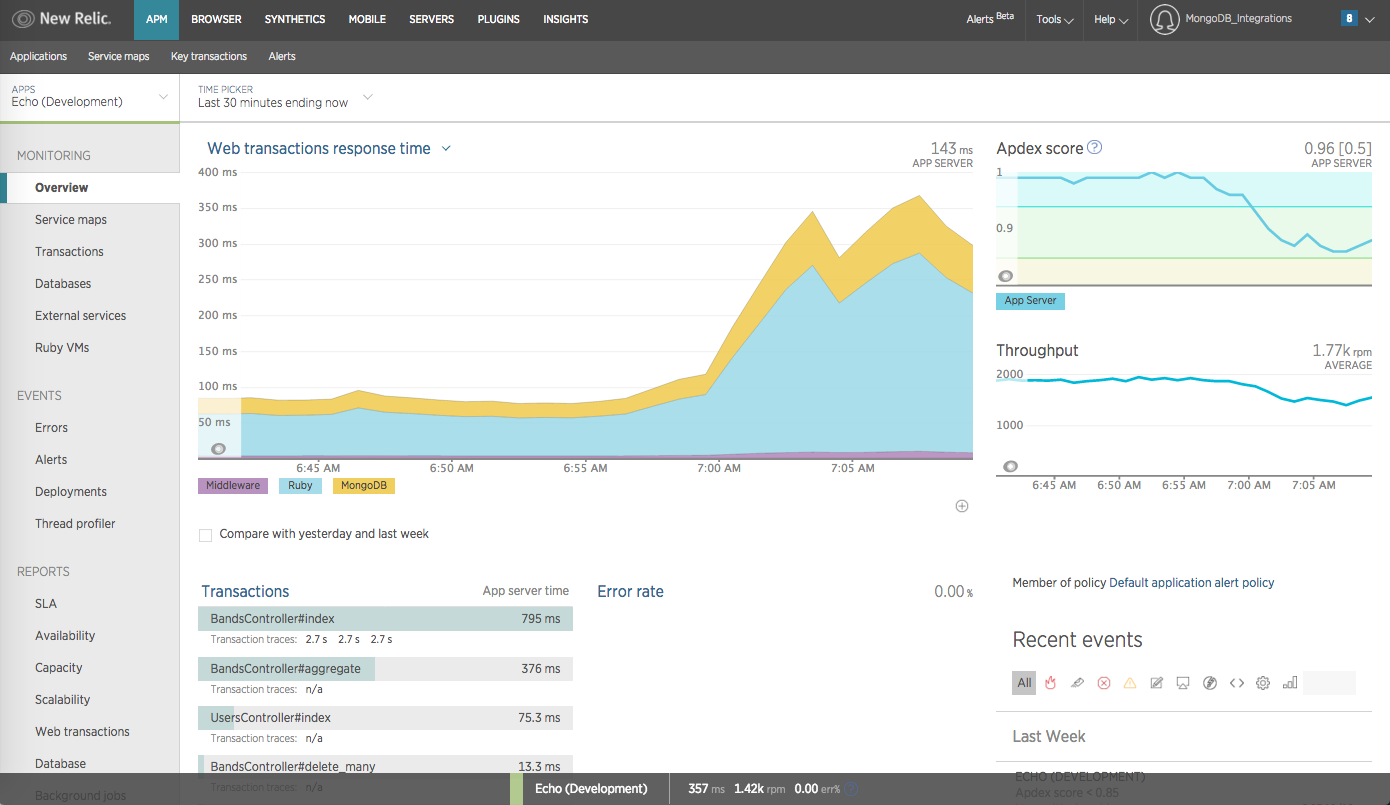
MongoDB is an open source document-oriented database system. It is part of the NoSQL family of database systems. Instead of storing data in tables as is done in a "classical" relational database, MongoDB stores structured data as JSON-like documents with dynamic schemas (MongoDB calls the format BSON), making the integration of data in certain types of applications easier and faster.
$0.10
million reads
MySQL
Score8.4 out of 10
N/A
MySQL is a popular open-source relational and embedded database, now owned by Oracle.
N/A
Microsoft SQL Server
Score8.7 out of 10
N/A
Microsoft SQL Server is a relational database.
$1,418
Per License
Pricing
MongoDB
MySQL
Microsoft SQL Server
Editions & Modules
Shared
$0
per month
Serverless
$0.10million reads
million reads
Dedicated
$57
per month
No answers on this topic
Subscription
$1,418.00
Per License
Enterprise
$13,748.00
Per License
Offerings
Pricing Offerings
MongoDB
MySQL
Microsoft SQL Server
Free Trial
Yes
No
No
Free/Freemium Version
Yes
No
No
Premium Consulting/Integration Services
No
No
No
Entry-level Setup Fee
No setup fee
No setup fee
No setup fee
Additional Details
Fully managed, global cloud database on AWS, Azure, and GCP
Senior System Engineer in Engineering at General Dynamics Information Technology (Information Technology & Services, 201-500 employees)
Chose MongoDB
The environment I work in is somewhat unique in that we use both MySQL and MongoDB. However, each is used for specific purposes that the other is not well suited for. MongoDB is not a relational database like MySQL, so it serves as the perfect place to dump key bits of data for …
A de minimis incentive was given to thank the reviewer for their time. The incentive was not used to bias or drive a particular response, nor was the incentive contingent on a positive endorsement. More Info
Lead Developer in Engineering at SaaSquatch (Marketing and Advertising, 11-50 employees)
Chose MongoDB
In our early development days we weighed NoSQL databases like MongoDB with RDBMS solutions like MySQL. We were more familiar with MySQL from past experience but also were wary of painful data migrations that slowed down development iterations and increased the risk of outages …
A de minimis incentive was given to thank the reviewer for their time. The incentive was not used to bias or drive a particular response, nor was the incentive contingent on a positive endorsement. More Info
Senior Software Engineer in Engineering at Rocketrip (Computer Software, 11-50 employees)
Chose MongoDB
MongoDB is the best NoSQL database out there. There are others, but Mongo has the largest community, is very easy to set up, and is extremely performant. Compared to a relational DB (like MySQL or Postgres) is like comparing apples and oranges. One isn't better or worse than …
A de minimis incentive was given to thank the reviewer for their time. The incentive was not used to bias or drive a particular response, nor was the incentive contingent on a positive endorsement. More Info
Verified User
Chose MongoDB
I love MySQL, but again, it's a totally different use-case. For something with so much varied data in no particular form or structure that needs to be pooled together in a "data lake," a NoSQL solution like MongoDB is an easy choice. It makes it so much easier not having to …
A de minimis incentive was given to thank the reviewer for their time. The incentive was not used to bias or drive a particular response, nor was the incentive contingent on a positive endorsement. More Info
Freelance web developer in Engineering at Jasny (Internet, 1-10 employees)
Chose MongoDB
MySQL is a great for querying related data, but it's unable to store structured data and has a fixed schema. Also SQL can be non-intuitive. DynamoDB, CouchDB and Redis all make querying the data quite difficult and lack important features. The problem CouchDB tries to solve is …
A de minimis incentive was given to thank the reviewer for their time. The incentive was not used to bias or drive a particular response, nor was the incentive contingent on a positive endorsement. More Info
Verified User
Chose MongoDB
I have used KairosDB, Cassandra and MySQL and mongodb proves out to be the best of them. Mainly due to it being a document-oriented database.
A de minimis incentive was given to thank the reviewer for their time. The incentive was not used to bias or drive a particular response, nor was the incentive contingent on a positive endorsement. More Info
Java Software Engineer in Information Technology at EPAM Anywhere (Information Technology & Services, 10,001+ employees)
Chose MongoDB
We have [measured] the speed in reading/write operations in high load and finally select the winner = MongoDBWe have [not] too much data but in case there will be 10 [times] more we need Cassandra. Cassandra's storage engine provides constant-time writes no matter how big your …
A de minimis incentive was given to thank the reviewer for their time. The incentive was not used to bias or drive a particular response, nor was the incentive contingent on a positive endorsement. TR verified that a representative sample of customers was invited. More Info
Verified User
Chose MongoDB
The flexible structure underlying MongoDB's construction is not found in other competitors; the ability to easily change the structure without affecting other stored documents. It is very ideal for projects that you cannot predict that the structure will change this way. Of …
A de minimis incentive was given to thank the reviewer for their time. The incentive was not used to bias or drive a particular response, nor was the incentive contingent on a positive endorsement. More Info
Software Engineer && Security researcher in Research & Development at UA - Universidad de Alicante / Universitat d'Alacant (Computer Software, 51-200 employees)
Chose MongoDB
MongoDB is more of a general purpose nosql database, while Elasticsearch is a search engine oriented nosql solution.
A de minimis incentive was given to thank the reviewer for their time. The incentive was not used to bias or drive a particular response, nor was the incentive contingent on a positive endorsement. More Info
A de minimis incentive was given to thank the reviewer for their time. The incentive was not used to bias or drive a particular response, nor was the incentive contingent on a positive endorsement. More Info
Verified User
Chose MongoDB
Also, using DocumentDB, and both are good, each was chosen based on the developer's expertise. So take advantage of in-house skills.
A de minimis incentive was given to thank the reviewer for their time. The incentive was not used to bias or drive a particular response, nor was the incentive contingent on a positive endorsement. More Info
Trainee software engineer in Quality Assurance at Speed IT net (Computer Software, 1-10 employees)
Chose MongoDB
It's very fast and easiest to use. Many companies are using this nowadays. It's helped to complete many software products very quickly so the year income has increased compared with last years. Many programmers are now leaning this tool as back end developers so that we changed …
A de minimis incentive was given to thank the reviewer for their time. The incentive was not used to bias or drive a particular response, nor was the incentive contingent on a positive endorsement. More Info
Verified User
Chose MongoDB
MongoDB is our go-to database solution for any project, and the more we work with it the more we love it. Some say that NoSQL is pointless... Our developers wholeheartedly disagree, because they love working with it. Though both NoSQL and SQL have their purposes, in most …
A de minimis incentive was given to thank the reviewer for their time. The incentive was not used to bias or drive a particular response, nor was the incentive contingent on a positive endorsement. More Info
Verified User
Chose MongoDB
We wanted to use free ware relational database for our need. MongoDB was perfect fit.
A de minimis incentive was given to thank the reviewer for their time. The incentive was not used to bias or drive a particular response, nor was the incentive contingent on a positive endorsement. More Info
Verified User
Chose MongoDB
We tend to choose MongoDB when we're faced with a particular situation: we know that we need a NoSQL database in general, and want an open-source implementation that allows us to prevent against platform lock-in. Amazon's new DocumentDB product even allows us to choose to use …
A de minimis incentive was given to thank the reviewer for their time. The incentive was not used to bias or drive a particular response, nor was the incentive contingent on a positive endorsement. More Info
Verified User
Chose MongoDB
MongoDB is very easy to use and the best advantage is the NoSQL database. No concept of the relational database.
A de minimis incentive was given to thank the reviewer for their time. The incentive was not used to bias or drive a particular response, nor was the incentive contingent on a positive endorsement. More Info
User support technician at IBM (Computer Software, 10,001+ employees)
Chose MongoDB
MongoDB is the most complete database of NoSQL type. In my opinion, it has all the tools for a good development of a database. I have not had problems when using the application.
A de minimis incentive was given to thank the reviewer for their time. The incentive was not used to bias or drive a particular response, nor was the incentive contingent on a positive endorsement. More Info
A de minimis incentive was given to thank the reviewer for their time. The incentive was not used to bias or drive a particular response, nor was the incentive contingent on a positive endorsement. More Info
A de minimis incentive was given to thank the reviewer for their time. The incentive was not used to bias or drive a particular response, nor was the incentive contingent on a positive endorsement. More Info
MongoDB DBA in Information Technology at Grupo Undanet S.L. (Automotive, 11-50 employees)
Chose MongoDB
You can use MongoDB with the same use cases you use other relational databases, the difference is that with MongoDB you can do the same but easier and faster.
A de minimis incentive was given to thank the reviewer for their time. The incentive was not used to bias or drive a particular response, nor was the incentive contingent on a positive endorsement. TR verified that a representative sample of customers was invited. More Info
Senior Leader in Engineering at GHX (Hospital & Health Care, 501-1000 employees)
Chose MongoDB
MongoDB was the most full-featured NoSQL database we evaluated - that offered atomic transactions at a document level, built-in HA & DR, open source, robust queries, and enterprise level support.
Other platforms had specific parts of what we were looking for - MongoDB had it all.
A de minimis incentive was given to thank the reviewer for their time. The incentive was not used to bias or drive a particular response, nor was the incentive contingent on a positive endorsement. More Info
Senior Software Engineer in Information Technology at Accion Labs (Information Technology and Services, 1001-5000 employees)
Chose MongoDB
From the beginning, we thought we would have a large volume of data, so MongoDB was a natural choice. Next we started the project and found MongoDB is also developing new features that are more like SQL which was very nice for us. As data volume is growing with time, no need to …
A de minimis incentive was given to thank the reviewer for their time. The incentive was not used to bias or drive a particular response, nor was the incentive contingent on a positive endorsement. More Info
Software Engineer in Information Technology at Rochester Institute of Technology (Information Technology and Services, 10,001+ employees)
Chose MongoDB
Relational DB are not efficient when storing data structure like JSON. Different data structure can be stored without defining the schema. Most relational db might store data like Json as blobs. One single entry would store the entire JSON as blob and you can't query the …
A de minimis incentive was given to thank the reviewer for their time. The incentive was not used to bias or drive a particular response, nor was the incentive contingent on a positive endorsement. More Info
Oracle
Verified User
Chose MySQL
I like the structured nature of MySQL over MongoDB.
A de minimis incentive was given to thank the reviewer for their time. The incentive was not used to bias or drive a particular response, nor was the incentive contingent on a positive endorsement. More Info
Verified User
Chose MySQL
In terms of capabilities, Microsoft SQL Server is one of the leaders in the database market. It provides a lot of features for high availability, disaster recovery, performance and security. The primary reason why MySQL 8 was chosen was due to the open source nature of the …
A de minimis incentive was given to thank the reviewer for their time. The incentive was not used to bias or drive a particular response, nor was the incentive contingent on a positive endorsement. More Info
Senior System Engineer in Engineering at General Dynamics Information Technology (Information Technology & Services, 201-500 employees)
Chose MySQL
The primary reason we use MySQL instead of MongoDB is because we are in a large, legacy enterprise environment. MySQL works well and has all the necessary integrations with the various other software tools in our company's suite. Additionally, MySQL is a relational database …
A de minimis incentive was given to thank the reviewer for their time. The incentive was not used to bias or drive a particular response, nor was the incentive contingent on a positive endorsement. More Info
Verified User
Chose MySQL
MongoDB has a dynamic schema for how data is stored in 'documents' whereas MySQL is more structured with tables, columns, and rows. MongoDB was built for high availability whereas MySQL can be a challenge when it comes to replication of the data and making everything redundant …
A de minimis incentive was given to thank the reviewer for their time. The incentive was not used to bias or drive a particular response, nor was the incentive contingent on a positive endorsement. More Info
Verified User
Chose MySQL
Having used both PostgreSQL and Microsoft SQL Server, I can tell that MySQL performs admirably in a Linux setting. When compared to Microsoft SQL Server, the extra benefit is the minimal or nonexistent licence fee. We find that MySQL's programming interface is particularly …
A de minimis incentive was given to thank the reviewer for their time. The incentive was not used to bias or drive a particular response, nor was the incentive contingent on a positive endorsement. More Info
Software Engineer in Information Technology at MothersonSumi INfotech & Designs Ltd. (MIND) (Computer Software, 501-1000 employees)
Chose MySQL
I have also used Microsoft SQL Server. It is quite similar to MySQL. However, MySQL has always been my first choice, I have been using it for a very long time. I have also worked with PostgreSQL in a DevOps project. It is good too but a bit hard to learn and understand.
A de minimis incentive was given to thank the reviewer for their time. The incentive was not used to bias or drive a particular response, nor was the incentive contingent on a positive endorsement. TR verified that a representative sample of customers was invited. More Info
Software Engineer && Security researcher in Research & Development at UA - Universidad de Alicante / Universitat d'Alacant (Computer Software, 51-200 employees)
Chose MySQL
MongoDB is an application oriented solution with unstructured data. Percona Server for MySQL is a good solution when looking for performance peaks and the amount of data grows continuously over time. MySQL is the ideal solution when we have a data schema defined and we do not …
A de minimis incentive was given to thank the reviewer for their time. The incentive was not used to bias or drive a particular response, nor was the incentive contingent on a positive endorsement. More Info
Verified User
Chose MySQL
Is not a drop-in replacement for any of the things listed above. MySQL has it's purpose and use-cases, same as those. It's a low-cost solution for high read/low write applications and works very well when used in the right circumstances. Support can be purchased from various …
A de minimis incentive was given to thank the reviewer for their time. The incentive was not used to bias or drive a particular response, nor was the incentive contingent on a positive endorsement. More Info
Verified User
Chose MySQL
MySQL was the first option due to the existing knowledge, and after using other databases, it also appeared to be the most predictable in terms of costs
A de minimis incentive was given to thank the reviewer for their time. The incentive was not used to bias or drive a particular response, nor was the incentive contingent on a positive endorsement. More Info
Data Analyst in Quality Assurance at Gfactors (Information Services, 11-50 employees)
Chose MySQL
Each of the products has its own merits and demerits. however since MySQL is a very good documentation and global community its easy to learn and apply in different stages for analytics work. compare to other data bases its simple for setup and work on it. MySQL is cost …
A de minimis incentive was given to thank the reviewer for their time. The incentive was not used to bias or drive a particular response, nor was the incentive contingent on a positive endorsement. More Info
Verified User
Chose MySQL
Rest all the big brand databases incure high licensing cost giving almost the same value that MySQL is giving being an open source database. Other databases like Oracle, MS SQL servers need extensive resource along with a huge team to manage those databases. However, thats not …
A de minimis incentive was given to thank the reviewer for their time. The incentive was not used to bias or drive a particular response, nor was the incentive contingent on a positive endorsement. More Info
Verified User
Chose MySQL
We chose MySQL because of its open-source nature and its compatibility with various systems, languages, and databases. It is easy to use and fast. Additionally, it has been in the market for more than 30 years now which makes it a reliable option when compared to its …
A de minimis incentive was given to thank the reviewer for their time. The incentive was not used to bias or drive a particular response, nor was the incentive contingent on a positive endorsement. More Info
IT in Information Technology at PETROQUIM (Building Materials, 201-500 employees)
Chose MySQL
As I have been commenting in our company, we have solved our performance problems and responses obtaining speed in the queries occupies less disk space, in addition to its price and all the tools of great Scope it possesses.
A de minimis incentive was given to thank the reviewer for their time. The incentive was not used to bias or drive a particular response, nor was the incentive contingent on a positive endorsement. More Info
Verified User
Chose MySQL
We let go SQL server as We don't want to use Windows server and bare the cost of Windows licensing.
A de minimis incentive was given to thank the reviewer for their time. The incentive was not used to bias or drive a particular response, nor was the incentive contingent on a positive endorsement. More Info
Verified User
Chose MySQL
MySQL is open source and reduces development costs drastically.
A de minimis incentive was given to thank the reviewer for their time. The incentive was not used to bias or drive a particular response, nor was the incentive contingent on a positive endorsement. More Info
Verified User
Chose MySQL
Microsoft SQL and SQLite i have used for different scenarios. SQLite is very small database which is more easy to work with low profile devices like mobiles. MySQL is not suitable for that level and MSSQL mainly comparable with MYSQL. MSSQL has complex installations and …
A de minimis incentive was given to thank the reviewer for their time. The incentive was not used to bias or drive a particular response, nor was the incentive contingent on a positive endorsement. More Info
Senior Associate Technology in Information Technology at Publicis Sapient (Banking, 10,001+ employees)
Chose MySQL
So the main reason i would stack up Mysql from rest of the others is that it is open source which can be helpful for doing any POC on the products and learning new technologies and it is also compatible with all other softwares like Microsoft SQL serve and Postgre Sql
A de minimis incentive was given to thank the reviewer for their time. The incentive was not used to bias or drive a particular response, nor was the incentive contingent on a positive endorsement. More Info
A de minimis incentive was given to thank the reviewer for their time. The incentive was not used to bias or drive a particular response, nor was the incentive contingent on a positive endorsement. More Info
Systems Developer in Information Technology at Christians Against Poverty (Non-profit Organization Management, 51-200 employees)
Chose MySQL
I would say that in a Linux environment MySQL works great compared to both PostgreSQL and MS SQL. The added benefit compared to MS SQL is the low or absent licensing cost. As we use it mainly from PHP the programming interface is great for MySQL. PostgreSQL has many of the …
A de minimis incentive was given to thank the reviewer for their time. The incentive was not used to bias or drive a particular response, nor was the incentive contingent on a positive endorsement. More Info
Verified User
Chose MySQL
MySQL is relatively easier to use and than PostgreSQL or SQL Server; it's also cheap to use in production compared to SQL Server. For a beginner who wants to ship something quickly, MySQL is really suited for it.
A de minimis incentive was given to thank the reviewer for their time. The incentive was not used to bias or drive a particular response, nor was the incentive contingent on a positive endorsement. More Info
Administrador de Servidores in Information Technology at Ministerio de Salud de El Salvador (Hospital & Health Care, 10,001+ employees)
Chose MySQL
MySQL offers best conditions for a rapid adoption at the organization. Also because it's free software, you can scale up in implementations without worrying about licenses fees.
A de minimis incentive was given to thank the reviewer for their time. The incentive was not used to bias or drive a particular response, nor was the incentive contingent on a positive endorsement. TR verified that a representative sample of customers was invited. More Info
Verified User
Chose MySQL
MySQL has most of the functionality of other, very costly, alternatives without the big price tag. It is open-source with improvements coming at a relatively good rate. It is not as robust as those other offerings and can have some challenging points at scale for large …
A de minimis incentive was given to thank the reviewer for their time. The incentive was not used to bias or drive a particular response, nor was the incentive contingent on a positive endorsement. More Info
Verified User
Chose MySQL
Microsoft SQL can be considered as an enterprise level software since it is recommended for large businesses. Microsoft SQL has some unique categories like big data processing, DBMS, etc. whereas MySQL is not capable of handling such features. I guess this is how these both …
A de minimis incentive was given to thank the reviewer for their time. The incentive was not used to bias or drive a particular response, nor was the incentive contingent on a positive endorsement. TR verified that a representative sample of customers was invited. More Info
Verified User
Chose MySQL
I've been using MySQL for so long that it's my go-to RDBMS. I really like MySQL Workbench in conjunction with MySQL. I've experimented with Amazon DynamoDB in my personal time.
A de minimis incentive was given to thank the reviewer for their time. The incentive was not used to bias or drive a particular response, nor was the incentive contingent on a positive endorsement. More Info
Microsoft
Verified User
Chose Microsoft SQL Server
You could consider i did use MySQL since i worked with some websites that were using a MySQL database. I could not give a side by side comparision since i don't use those like i use the Microsoft SQL , but so far it worked well. I prefer Microsoft SQL due to support and info …
A de minimis incentive was given to thank the reviewer for their time. The incentive was not used to bias or drive a particular response, nor was the incentive contingent on a positive endorsement. More Info
Verified User
Chose Microsoft SQL Server
Microsoft SQL is slower than MySQL and Access but far more feature-rich and reliable. Access is almost obsolete nowadays, so not too many people are considering it, but unless budget or an open-source ethos is a factor, Microsoft SQL is superior in every way. Many commonly used …
A de minimis incentive was given to thank the reviewer for their time. The incentive was not used to bias or drive a particular response, nor was the incentive contingent on a positive endorsement. More Info
Verified User
Chose Microsoft SQL Server
The first database application taught when I was in school was Microsoft SQL Server. Microsoft SQL Server was used where I first started, so I had the opportunity to improve myself in MySQL. SQL is also used in my current workplace. It is widely used in very large projects due …
A de minimis incentive was given to thank the reviewer for their time. The incentive was not used to bias or drive a particular response, nor was the incentive contingent on a positive endorsement. More Info
Product Manager, Partnerships & Data Services in Engineering at ProfitSword, LLC (Hospitality, 51-200 employees)
Chose Microsoft SQL Server
Microsoft SQL Server is a comprehensive solution as transactional database, data warehouse, analytics, reporting, and ETL. It also integrates with the cloud well (Azure). The ease of use and setup makes this better than Oracle Database because the query syntax is also different …
A de minimis incentive was given to thank the reviewer for their time. The incentive was not used to bias or drive a particular response, nor was the incentive contingent on a positive endorsement. More Info
Verified User
Chose Microsoft SQL Server
[Microsoft] SQL Server has a much better community and professional support and is overall just a more reliable system with Microsoft behind it. I've used MySQL in the past and SQL Server has just become more comfortable for me and is my go to RDBMS.
A de minimis incentive was given to thank the reviewer for their time. The incentive was not used to bias or drive a particular response, nor was the incentive contingent on a positive endorsement. More Info
Software Engineer in Information Technology at King-ICT (Computer Software, 501-1000 employees)
Chose Microsoft SQL Server
We used MySQL for some smaller projects because this RDBMS works better with a small amount of data and a lot of young workers, especially students, can handle MySQL very well because they learned it at the university. One important thing to keep in mind is that MySQL is …
A de minimis incentive was given to thank the reviewer for their time. The incentive was not used to bias or drive a particular response, nor was the incentive contingent on a positive endorsement. More Info
Cloud Consultant in Information Technology at Integra Connect (Hospital & Health Care, 5001-10,000 employees)
Chose Microsoft SQL Server
SQL Server is better for large databases containing structured relational data. It makes it easy to group and order, to sum and create tables of data from any data stored in a table or related tables. While Dynamodb is very good at STORING huge amounts of unstructured data, it …
A de minimis incentive was given to thank the reviewer for their time. The incentive was not used to bias or drive a particular response, nor was the incentive contingent on a positive endorsement. More Info
Verified User
Chose Microsoft SQL Server
UI of the Microsoft SQL Server makes it easy to use and learn. The better technical support and documentation give it an extra edge over other databases. The Microsoft ecosystem provides additional advantages, as we can seamlessly use other Microsoft products, such as Power …
A de minimis incentive was given to thank the reviewer for their time. The incentive was not used to bias or drive a particular response, nor was the incentive contingent on a positive endorsement. More Info
Verified User
Chose Microsoft SQL Server
Microsoft SQL Server is faster and more compatible, but it does cost more, so you're paying for those features. I use the others in many other places where critical transaction processing time and compatibility aren't of great concern.
A de minimis incentive was given to thank the reviewer for their time. The incentive was not used to bias or drive a particular response, nor was the incentive contingent on a positive endorsement. More Info
Verified User
Chose Microsoft SQL Server
Microsoft SQL Server providers a more user friendly experience when it comes to Microsoft SQL Server components management via its unique SQL Server management Studio. It is also a production ready, resilient, highly available and tested database management system (DBMS). The …
A de minimis incentive was given to thank the reviewer for their time. The incentive was not used to bias or drive a particular response, nor was the incentive contingent on a positive endorsement. More Info
Consultant \ Support in Information Technology at Rick Hahn Tech Services (Computer Software, 1-10 employees)
Chose Microsoft SQL Server
It just boils down to why learn anther product when you are going to run across it so seldom. Developers determine what database engine I am going to need so I just tend to pick products for implementation that use a well know product that has lots of support resources …
A de minimis incentive was given to thank the reviewer for their time. The incentive was not used to bias or drive a particular response, nor was the incentive contingent on a positive endorsement. More Info
Salesforce Developer in Information Technology at Mondo (Information Services, 51-200 employees)
Chose Microsoft SQL Server
[Microsoft SQL Server] offers a full solution, Inhouse Applications and hosted application continue to use SQL as backend database. Allows easy creation of development environments and continuous feature release.
A de minimis incentive was given to thank the reviewer for their time. The incentive was not used to bias or drive a particular response, nor was the incentive contingent on a positive endorsement. More Info
Database Administrator in Information Technology at System Crew GmbH (Information Technology & Services, 11-50 employees)
Chose Microsoft SQL Server
The free version is very powerfull and easy to install and use for small companies. Going to Professional and Standard, gives you all the support and the flexibility needed. It is known within the Database Administrator crew, and you can get support very easily over the …
A de minimis incentive was given to thank the reviewer for their time. The incentive was not used to bias or drive a particular response, nor was the incentive contingent on a positive endorsement. More Info
Supervisor, Information Technology in Information Technology at Real Estate Council of Ontario (Non-Profit Organization Management, 51-200 employees)
Chose Microsoft SQL Server
Native to Windows and being required for other MS apps puts it above others in terms of usage. If we were not heavily dependent on Microsoft applications or OS, we might have considered other database solutions. It's an expensive solutions but it is a solid reliable solution. …
A de minimis incentive was given to thank the reviewer for their time. The incentive was not used to bias or drive a particular response, nor was the incentive contingent on a positive endorsement. More Info
Verified User
Chose Microsoft SQL Server
Microsoft SQL Server is one of the fastest RDBMS systems available in the market. Pricing is a bit on the higher side but all the features it provides pretty much justifies it. It can be integrated with a large number of frameworks thus enabling to work on multiple frameworks …
A de minimis incentive was given to thank the reviewer for their time. The incentive was not used to bias or drive a particular response, nor was the incentive contingent on a positive endorsement. More Info
Verified User
Chose Microsoft SQL Server
Microsoft SQL Server is still the industry standard for the type of development we do, and the types of applications that we use. Almost every developer or analyst we hire has at least a reasonable grounding in the use of SQL servers, and it is almost universally compatible …
A de minimis incentive was given to thank the reviewer for their time. The incentive was not used to bias or drive a particular response, nor was the incentive contingent on a positive endorsement. More Info
A de minimis incentive was given to thank the reviewer for their time. The incentive was not used to bias or drive a particular response, nor was the incentive contingent on a positive endorsement. More Info
Verified User
Chose Microsoft SQL Server
For a single vendor solution, SQL Server is the best choice in my opinion. Most of the other solutions do not offer the full range of products in a single package. Also, for a largely Microsoft shop, there are additional integrations which increase the value proposition. …
A de minimis incentive was given to thank the reviewer for their time. The incentive was not used to bias or drive a particular response, nor was the incentive contingent on a positive endorsement. More Info
Programmer Analyst in Information Technology at Referencia Laboratorio Clínico (Health, Wellness and Fitness, 1001-5000 employees)
Chose Microsoft SQL Server
Microsoft SQL Server is a DBMS that can be used in any situation, from small projects to big ones, and the latest versions now can be used in several OS platforms. It is a great product with many features over its competitors. It's a mature and robust product. It's easy and …
A de minimis incentive was given to thank the reviewer for their time. The incentive was not used to bias or drive a particular response, nor was the incentive contingent on a positive endorsement. More Info
Verified User
Chose Microsoft SQL Server
Compared to free versions, SQL Server just blows away the free/open-source software. Things just run faster, and better, and at less overhead. This is truer and truer with the later versions. Microsoft just invests so much into research and development into their product. And …
A de minimis incentive was given to thank the reviewer for their time. The incentive was not used to bias or drive a particular response, nor was the incentive contingent on a positive endorsement. More Info
Product Owner, Business Intelligence in Product Management at Answer Financial Inc. (Insurance, 201-500 employees)
Chose Microsoft SQL Server
Amazon Redshift is a cloud-based data warehouse. It does what it says it will do, but my experience is that for a cloud data warehouse, it is a little slow and I'd hope for performance to be insanely fast. Plus, it is also very costly. Same performance for much less cost in …
A de minimis incentive was given to thank the reviewer for their time. The incentive was not used to bias or drive a particular response, nor was the incentive contingent on a positive endorsement. More Info
Verified User
Chose Microsoft SQL Server
MS SQL Server is easier to use compared to other RDBMS which really speeds up development time and relatively easier to find a problem when it happens as well. It's also pretty quick to run a query, especially in a large table make it pretty convenient if we need to monitor the …
A de minimis incentive was given to thank the reviewer for their time. The incentive was not used to bias or drive a particular response, nor was the incentive contingent on a positive endorsement. More Info
Verified User
Chose Microsoft SQL Server
Microsoft SQL Server stacks up pretty well - it is well established and has a large userbase. The main reason we selected Microsoft SQL Server over any other RDMS was because of its well established place in the market for such tools and large number of users (easy to hire …
A de minimis incentive was given to thank the reviewer for their time. The incentive was not used to bias or drive a particular response, nor was the incentive contingent on a positive endorsement. More Info
If asked by a colleague I would highly recommend MongoDB. MongoDB provides incredible flexibility and is quick and easy to set up. It also provides extensive documentation which is very useful for someone new to the tool. Though I've used it for years and still referenced the docs often. From my experience and the use cases I've worked on, I'd suggest using it anywhere that needs a fast, efficient storage space for non-relational data. If a relational database is needed then another tool would be more apt.
A de minimis incentive was given to thank the reviewer for their time. The incentive was not used to bias or drive a particular response, nor was the incentive contingent on a positive endorsement. More Info
MySQL is best suited for applications on platform like high-traffic content-driven websites, small-scale web apps, data warehouses which regards light analytical workloads. However its less suited for areas like enterprise data warehouse, OLAP cubes, large-scale reporting, applications requiring flexible or semi-structured data like event logging systems, product configurations, dynamic forms.
A de minimis incentive was given to thank the reviewer for their time. The incentive was not used to bias or drive a particular response, nor was the incentive contingent on a positive endorsement. More Info
Microsoft SQL is ubiquitous, while MySQL runs under the hood all over the place. Microsoft SQL is the platform taught in colleges and certification courses and is the one most likely to be used by businesses because it is backed by Microsoft. Its interface is friendly (well, as pleasant as SQL can be) and has been used by so many for so long that resources are freely available if you encounter any issues.
A de minimis incentive was given to thank the reviewer for their time. The incentive was not used to bias or drive a particular response, nor was the incentive contingent on a positive endorsement. More Info
Being a JSON language optimizes the response time of a query, you can directly build a query logic from the same service
You can install a local, database-based environment rather than the non-relational real-time bases such a firebase does not allow, the local environment is paramount since you can work without relying on the internet.
Forming collections in Mango is relatively simple, you do not need to know of query to work with it, since it has a simple graphic environment that allows you to manage databases for those who are not experts in console management.
A de minimis incentive was given to thank the reviewer for their time. The incentive was not used to bias or drive a particular response, nor was the incentive contingent on a positive endorsement. More Info
A de minimis incentive was given to thank the reviewer for their time. The incentive was not used to bias or drive a particular response, nor was the incentive contingent on a positive endorsement. More Info
A de minimis incentive was given to thank the reviewer for their time. The incentive was not used to bias or drive a particular response, nor was the incentive contingent on a positive endorsement. More Info
An aggregate pipeline can be a bit overwhelming as a newcomer.
There's still no real concept of joins with references/foreign keys, although the aggregate framework has a feature that is close.
Database management/dev ops can still be time-consuming if rolling your own deployments. (Thankfully there are plenty of providers like Compose or even MongoDB's own Atlas that helps take care of the nitty-gritty.
A de minimis incentive was given to thank the reviewer for their time. The incentive was not used to bias or drive a particular response, nor was the incentive contingent on a positive endorsement. More Info
Learning curve: is big. Newbies will face problems in understanding the platform initially. However, with plenty of online resources, one can easily find solutions to problems and learn on the go.
Backup and restore: MySQL is not very seamless. Although the data is never ruptured or missed, the process involved is not very much user-friendly. Maybe, a new command-line interface for only the backup-restore functionality shall be set up again to make this very important step much easier to perform and maintain.
A de minimis incentive was given to thank the reviewer for their time. The incentive was not used to bias or drive a particular response, nor was the incentive contingent on a positive endorsement. More Info
Microsoft SQL Server Enterprise edition has a high cost but is the only edition which supports SQL Always On Availability Groups. It would be nice to include this feature in the Standard version.
Licensing of Microsoft SQL Server is a quite complex matter, it would be good to simplify licensing in the future. For example, per core vs per user CAL licensing, as well as complex licensing scenarios in the Cloud and on Edge locations.
It would be good to include native tools for converting Oracle, DB2, Postgresql and MySQL/MariaDB databases (schema and data) for import into Microsoft SQL Server.
A de minimis incentive was given to thank the reviewer for their time. The incentive was not used to bias or drive a particular response, nor was the incentive contingent on a positive endorsement. More Info
I am looking forward to increasing our SaaS subscriptions such that I get to experience global replica sets, working in reads from secondaries, and what not. Can't wait to be able to exploit some of the power that the "Big Boys" use MongoDB for.
A de minimis incentive was given to thank the reviewer for their time. The incentive was not used to bias or drive a particular response, nor was the incentive contingent on a positive endorsement. More Info
For teaching Databases and SQL, I would definitely continue to use MySQL. It provides a good, solid foundation to learn about databases. Also to learn about the SQL language and how it works with the creation, insertion, deletion, updating, and manipulation of data, tables, and databases. This SQL language is a foundation and can be used to learn many other database related concepts.
A de minimis incentive was given to thank the reviewer for their time. The incentive was not used to bias or drive a particular response, nor was the incentive contingent on a positive endorsement. More Info
We understand that the Microsoft SQL Server will continue to advance, offering the same robust and reliable platform while adding new features that enable us, as a software center, to create a superior product. That provides excellent performance while reducing the hardware requirements and the total cost of ownership of our solution.
A de minimis incentive was given to thank the reviewer for their time. The incentive was not used to bias or drive a particular response, nor was the incentive contingent on a positive endorsement. More Info
NoSQL database systems such as MongoDB lack graphical interfaces by default and therefore to improve usability it is necessary to install third-party applications to see more visually the schemas and stored documents. In addition, these tools also allow us to visualize the commands to be executed for each operation.
A de minimis incentive was given to thank the reviewer for their time. The incentive was not used to bias or drive a particular response, nor was the incentive contingent on a positive endorsement. More Info
I give MySQL a 9/10 overall because I really like it but I feel like there are a lot of tech people who would hate it if I gave it a 10/10. I've never had any problems with it or reached any of its limitations but I know a few people who have so I can't give it a 10/10 based on those complaints.
SQL Server mostly 'just works' or generates error messages to help you sort out the trouble. You can usually count on the product to get the job done and keep an eye on your potential mistakes. Interaction with other Microsoft products makes operating as a Windows user pretty straight forward. Digging through the multitude of dialogs and wizards can be a pain, but the answer is usually there somewhere.
A de minimis incentive was given to thank the reviewer for their time. The incentive was not used to bias or drive a particular response, nor was the incentive contingent on a positive endorsement. More Info
A de minimis incentive was given to thank the reviewer for their time. The incentive was not used to bias or drive a particular response, nor was the incentive contingent on a positive endorsement. More Info
A de minimis incentive was given to thank the reviewer for their time. The incentive was not used to bias or drive a particular response, nor was the incentive contingent on a positive endorsement. More Info
Finding support from local companies can be difficult. There were times when the local company could not find a solution and we reached a solution by getting support globally. If a good local company is found, it will overcome all your problems with its global support.
A de minimis incentive was given to thank the reviewer for their time. The incentive was not used to bias or drive a particular response, nor was the incentive contingent on a positive endorsement. More Info
We have never contacted MySQL enterprise support team for any issues related to MySQL. This is because we have been using primarily the MySQL Server community edition and have been using the MySQL support forums for any questions and practical guidance that we needed before and during the technical implementations. Overall, the support community has been very helpful and allowed us to make the most out of the community edition.
A de minimis incentive was given to thank the reviewer for their time. The incentive was not used to bias or drive a particular response, nor was the incentive contingent on a positive endorsement. More Info
We managed to handle most of our problems by looking into Microsoft's official documentation that has everything explained and almost every function has an example that illustrates in detail how a particular functionality works. Just like PowerShell has the ability to show you an example of how some cmdlet works, that is the case also here, and in my opinion, it is a very good practice and I like it.
A de minimis incentive was given to thank the reviewer for their time. The incentive was not used to bias or drive a particular response, nor was the incentive contingent on a positive endorsement. More Info
A de minimis incentive was given to thank the reviewer for their time. The incentive was not used to bias or drive a particular response, nor was the incentive contingent on a positive endorsement. More Info
A de minimis incentive was given to thank the reviewer for their time. The incentive was not used to bias or drive a particular response, nor was the incentive contingent on a positive endorsement. More Info
While the setup and configuration of MongoDB is pretty straight forward, having a vendor that performs automatic backups and scales the cluster automatically is very convenient. If you do not have a system administrator or DBA familiar with MongoDB on hand, it's a very good idea to use a 3rd party vendor that specializes in MongoDB hosting. The value is very well worth it over hosting it yourself since the cost is often reasonable among providers.
A de minimis incentive was given to thank the reviewer for their time. The incentive was not used to bias or drive a particular response, nor was the incentive contingent on a positive endorsement. More Info
A de minimis incentive was given to thank the reviewer for their time. The incentive was not used to bias or drive a particular response, nor was the incentive contingent on a positive endorsement. TR verified that a representative sample of customers was invited. More Info
Other than SQL taking quite a bit of time to actually install there are no problems with installation. Even on hardware that has good performance SQL can still take close to an hour to install a typical server with management and reporting services.
A de minimis incentive was given to thank the reviewer for their time. The incentive was not used to bias or drive a particular response, nor was the incentive contingent on a positive endorsement. More Info
We have [measured] the speed in reading/write operations in high load and finally select the winner = MongoDBWe have [not] too much data but in case there will be 10 [times] more we need Cassandra. Cassandra's storage engine provides constant-time writes no matter how big your data set grows. For analytics, MongoDB provides a custom map/reduce implementation; Cassandra provides native Hadoop support.
MongoDB has a dynamic schema for how data is stored in 'documents' whereas MySQL is more structured with tables, columns, and rows. MongoDB was built for high availability whereas MySQL can be a challenge when it comes to replication of the data and making everything redundant in the event of a DR or outage.
A de minimis incentive was given to thank the reviewer for their time. The incentive was not used to bias or drive a particular response, nor was the incentive contingent on a positive endorsement. More Info
[Microsoft] SQL Server has a much better community and professional support and is overall just a more reliable system with Microsoft behind it. I've used MySQL in the past and SQL Server has just become more comfortable for me and is my go to RDBMS.
A de minimis incentive was given to thank the reviewer for their time. The incentive was not used to bias or drive a particular response, nor was the incentive contingent on a positive endorsement. More Info
A de minimis incentive was given to thank the reviewer for their time. The incentive was not used to bias or drive a particular response, nor was the incentive contingent on a positive endorsement. More Info
Open Source w/ reasonable support costs have a direct, positive impact on the ROI (we moved away from large, monolithic, locked in licensing models)
You do have to balance the necessary level of HA & DR with the number of servers required to scale up and scale out. Servers cost money - so DR & HR doesn't come for free (even though it's built into the architecture of MongoDB
A de minimis incentive was given to thank the reviewer for their time. The incentive was not used to bias or drive a particular response, nor was the incentive contingent on a positive endorsement. More Info
Increased accuracy - We went from multiple users having different versions of an Excel spreadsheet to a single source of truth for our reporting.
Increased Efficiency - We can now generate reports at any time from a single source rather than multiple users spending their time collating data and generating reports.
Improved Security - Enterprise level security on a dedicated server rather than financial files on multiple laptop hard drives.
A de minimis incentive was given to thank the reviewer for their time. The incentive was not used to bias or drive a particular response, nor was the incentive contingent on a positive endorsement. More Info