Overview
ProductRatingMost Used ByProduct SummaryStarting Price
MongoDB
Score 8.9 out of 10
N/A
MongoDB is an open source document-oriented database system. It is part of the NoSQL family of database systems. Instead of storing data in tables as is done in a "classical" relational database, MongoDB stores structured data as JSON-like documents with dynamic schemas (MongoDB calls the format BSON), making the integration of data in certain types of applications easier and faster.
$0.10
million reads
Oracle Database
Score 8.3 out of 10
N/A
Oracle Database, currently in edition 23ai, is a converged, multimodel database management system. It is designed to simplify development for AI, microservices, graph, document, spatial, and relational applications.
$0.05
per hour
RavenDB
Score 8.1 out of 10
N/A
RavenDB is a NoSQL Document Database that is fully transactional (ACID) across the database and throughout clusters. The database minimizes the need for third party addons, tools, or support to boost developer productivity and get projects into production fast. Users can setup and secure a data cluster deploy in the cloud, on-premise or in a hybrid environment. RavenDB offers a Database as a Service solution, allowing users to pass on all…N/A
Pricing
MongoDBOracle DatabaseRavenDB
Editions & Modules
Shared
$0
per month
Serverless
$0.10million reads
million reads
Dedicated
$57
per month
Oracle Base Database Service - Standard
$0.0538
per hour
Oracle Base Database Service - Enterprise
$0.1075
per hour
Oracle Base Database Service - High Performance
$0.2218
per hour
Standard Edition
Contact Sales
Enterprise Edition
Contact Sales
Personal Edition
Contact Sales
No answers on this topic
Offerings
Pricing Offerings
MongoDBOracle DatabaseRavenDB
Free Trial
YesYesYes
Free/Freemium Version
YesYesYes
Premium Consulting/Integration Services
NoNoYes
Entry-level Setup FeeNo setup feeNo setup feeNo setup fee
Additional DetailsFully managed, global cloud database on AWS, Azure, and GCP
More Pricing Information
Community Pulse
MongoDBOracle DatabaseRavenDB
Considered Multiple Products
MongoDB
Chose MongoDB
MongoDB is the most reliable and fastest for storing document-based data. It has a place among the most popular DB's these days.
Chose MongoDB
Relational DB are not efficient when storing data structure like JSON. Different data structure can be stored without defining the schema. Most relational db might store data like Json as blobs. One single entry would store the entire JSON as blob and you can't query the …
Chose MongoDB
We chose MongoDB because it fit our specific use cases better than the other two NoSQL products that I've identified. There are some use cases where those products would be better. Be sure to use the right tool for the job, for us, it was MongoDB, for you it might not be.
Oracle Database
Chose Oracle Database
I have selected Oracle database from other databases as this database is relational database which stored the data in structural and tabular format which is better than any other databases which I have used in my carrier. Also MongoDB is no SQL database where we can use SQL …
Chose Oracle Database
Oracle is placed in a good spot against its competitors. It has advantages over its competitors in its legacy stability and high availability. A common engine to handle relational, JSON, Vector, and graph data makes it more cost-effective. Given all the good features, the …
Chose Oracle Database
The Oracle database was selected before I started working on the project, so I can't tell the reasons behind the choice. However, it was recognized as the best suited for holding several million records for related entities and was preferred over NoSQL options.
Chose Oracle Database
Oracle 12c is good for all business applications but still consider Microsoft SQLServer for internal/other applications to save on cost.
Chose Oracle Database
Exadata is expensive and we decided to switch to 12c for the sake of consolidating and keep up with Oracles initiative to move towards cloud. Maybe in the future.
Chose Oracle Database
We use IBM DB2 in AS400 to handle part of our accounting system and our legacy ERP. We are migrating all functionalities to Oracle Database 12c because it is more secure and stable. We have some applications using SQL Server but we want to handle those systems in it because at …
Chose Oracle Database
Oracle is serving a different segment with respect to those above. Till now, we have stuck with Oracle and continued to support our internal customers. Other DBs are serving a few targeted applications by a few application teams.
Chose Oracle Database
We currently use all of the above database technologies in different applications, but where the application is mission-critical we use Oracle. Microsoft SQL Server is good for canned applications such as back-office or HR. MySQL does not have the same level of logging or …
Chose Oracle Database
Oracle 12c is able to support daily operations that might be required. Of course, Exadata is a powerful machine that is definitely fit for big scale but requires high demand of both CPU, IO, and memory processing. Also the one engineered system saves lots of time to build the …
RavenDB
Chose RavenDB
Once I had got my head around the concept of a document database it was a happy bye-bye to SQL Server.
Firebird - far too fiddly - I found myself writing a silly API to sit on top of Firebird just to do the most basic things.
MongoDB - in the very short time I spent with it, it …
Chose RavenDB
While MongoDB is in general more popular, I cannot fathom why that is. If you want ACID support (and as a developer, you'll always want that), MongoDB is way slower when compared to RavenDB. Furthermore, RavenStudio is just integrated, while

Chose RavenDB
RavenDB is just smarter than the competitors. The mapping reduction sorting is head and shoulders above everything else I've used. Nothing really approaches comparable in terms of complexity. Because of the searching of predetermined categories, read efficiency is terrible. …
Chose RavenDB
Much better support, more transparent pricing, much more easy setup process, native integration into c# / net core. We also tried to set up a Mongo Atlas cluster by self-study but weren't able to get this running. There is a much better response when searching in google, but a …
Chose RavenDB
Installing and configuring. We had some big issues with indexing the data after the documents were created and wanted to expand the index, with millions of records this task mostly did not complete despite a dedicated server.
Chose RavenDB
Being that ACID and cluster transaction support is a big plus against all of them. Cool prices on Azure and AWS is another plus. The ability to search between millions of documents.
Chose RavenDB
Better .NET integration among all of them
Chose RavenDB
RavenDB has a richer API, has security out of the box (via certificates), produces indexes automatically and updates them when data changes.
Chose RavenDB
We chose Raven over Mongo because it has robust support for multi-document transactions, first-class .NET and LINQ support, a well-designed API that has inspired imitation and has better tooling out of the box. We chose Raven over Redis because Raven is a full persistent …
Features
MongoDBOracle DatabaseRavenDB
NoSQL Databases
Comparison of NoSQL Databases features of Product A and Product B
MongoDB
10.0
39 Ratings
12% above category average
Oracle Database
-
Ratings
RavenDB
9.1
24 Ratings
2% above category average
Performance10.039 Ratings00 Ratings9.024 Ratings
Availability10.039 Ratings00 Ratings8.923 Ratings
Concurrency10.039 Ratings00 Ratings8.023 Ratings
Security10.039 Ratings00 Ratings9.223 Ratings
Scalability10.039 Ratings00 Ratings9.623 Ratings
Data model flexibility10.039 Ratings00 Ratings9.924 Ratings
Deployment model flexibility10.038 Ratings00 Ratings9.423 Ratings
Relational Databases
Comparison of Relational Databases features of Product A and Product B
MongoDB
-
Ratings
Oracle Database
8.4
6 Ratings
6% above category average
RavenDB
-
Ratings
ACID compliance00 Ratings8.76 Ratings00 Ratings
Database monitoring00 Ratings8.76 Ratings00 Ratings
Database locking00 Ratings8.56 Ratings00 Ratings
Encryption00 Ratings9.45 Ratings00 Ratings
Disaster recovery00 Ratings9.05 Ratings00 Ratings
Flexible deployment00 Ratings6.36 Ratings00 Ratings
Multiple datatypes00 Ratings8.06 Ratings00 Ratings
Best Alternatives
MongoDBOracle DatabaseRavenDB
Small Businesses
IBM Cloudant
IBM Cloudant
Score 7.4 out of 10
InterSystems IRIS
InterSystems IRIS
Score 8.0 out of 10
IBM Cloudant
IBM Cloudant
Score 7.4 out of 10
Medium-sized Companies
IBM Cloudant
IBM Cloudant
Score 7.4 out of 10
InterSystems IRIS
InterSystems IRIS
Score 8.0 out of 10
IBM Cloudant
IBM Cloudant
Score 7.4 out of 10
Enterprises
IBM Cloudant
IBM Cloudant
Score 7.4 out of 10
SAP IQ
SAP IQ
Score 10.0 out of 10
IBM Cloudant
IBM Cloudant
Score 7.4 out of 10
All AlternativesView all alternativesView all alternativesView all alternatives
User Ratings
MongoDBOracle DatabaseRavenDB
Likelihood to Recommend
10.0
(79 ratings)
9.0
(190 ratings)
8.1
(24 ratings)
Likelihood to Renew
10.0
(67 ratings)
9.0
(6 ratings)
9.5
(5 ratings)
Usability
10.0
(15 ratings)
7.4
(5 ratings)
8.2
(20 ratings)
Availability
9.0
(1 ratings)
-
(0 ratings)
-
(0 ratings)
Support Rating
9.6
(13 ratings)
7.0
(5 ratings)
8.1
(21 ratings)
Implementation Rating
8.4
(2 ratings)
9.6
(3 ratings)
7.3
(1 ratings)
Configurability
-
(0 ratings)
-
(0 ratings)
10.0
(1 ratings)
User Testimonials
MongoDBOracle DatabaseRavenDB
Likelihood to Recommend
MongoDB
If asked by a colleague I would highly recommend MongoDB. MongoDB provides incredible flexibility and is quick and easy to set up. It also provides extensive documentation which is very useful for someone new to the tool. Though I've used it for years and still referenced the docs often. From my experience and the use cases I've worked on, I'd suggest using it anywhere that needs a fast, efficient storage space for non-relational data. If a relational database is needed then another tool would be more apt.
Read full review
Oracle
We migrated from NoSQL to an Oracle database. One of the reasons was robust backup and recovery options available in the Oracle database, which provide zero data loss. A transactional database like Oracle is a better fit for our use case than NoSQL. On a large scale, deployment was evaluated as a cheaper option than the NoSQL engine. This conclusion came even after considering Oracle license is expensive.
Read full review
RavenDB
If you're a.NET developer searching for a system other than SQL Server for business assessment, then you must try RavenDB. RavenDB is a fantastic document-oriented system that has been specifically developed to work with all.NET or Windows systems. Developers are continually working on such systems to eliminate their flaws while also providing a few benefits. We must refresh ourselves on a regular basis since the free software system is like an open area where anybody may stand up with a brilliant solution to the issue. RavenDB is absolutely worth a look
Read full review
Pros
MongoDB
  • Being a JSON language optimizes the response time of a query, you can directly build a query logic from the same service
  • You can install a local, database-based environment rather than the non-relational real-time bases such a firebase does not allow, the local environment is paramount since you can work without relying on the internet.
  • Forming collections in Mango is relatively simple, you do not need to know of query to work with it, since it has a simple graphic environment that allows you to manage databases for those who are not experts in console management.
Read full review
Oracle
  • Supports most of the Operating Systems like Unix, Linux and Windows Server.
  • It works well in high load environment under intense parallel transactions setup.
  • Highly reliable DBMS, especially RAC is very much reliable.
  • Well managed and predictable release of security patches.
  • We have highly scaled it from on-prem to a cloud cluster environment for our product.
  • One of the best-performing DBMSs on Linux machines under test delivers high throughput (QPS).
Read full review
RavenDB
  • Document Database - no Object-Relational Impedance Mismatch
  • ACID support that is optimized for performance
  • Can be easily integrated into automated tests (unit tests)
  • Easily configurable via C# code
  • Comes directly with RavenStudio - no SSMS or SQL Developer required
  • In general low footprint when it comes to memory and disk consumption
  • Useful safety nets for new developers - e.g. by default an exception is thrown when you make too many requests within a session
Read full review
Cons
MongoDB
  • An aggregate pipeline can be a bit overwhelming as a newcomer.
  • There's still no real concept of joins with references/foreign keys, although the aggregate framework has a feature that is close.
  • Database management/dev ops can still be time-consuming if rolling your own deployments. (Thankfully there are plenty of providers like Compose or even MongoDB's own Atlas that helps take care of the nitty-gritty.
Read full review
Oracle
  • The memory demand and management makes it impossible to run it in a container.
  • It is hard to perform local unit testing with Oracle even using the personal edition (aggressive all the available memory grab for itself).
  • Lack of built in database migrations (e.g. as Flyway).
  • The need to install the Oracle client in addition to its drivers.
  • The cost of running it, especially in the Cloud.
  • Comes with very spartan community grade client/management tools whereas the commercial offerings tend to demand a premium price.
Read full review
RavenDB
  • The documentation is very good, but it's sometimes hard to find the topic I'm looking for.
  • Updating references is done manually. It would be nice if there was a feature to help with that. I'm not sure that's even possible though.
Read full review
Likelihood to Renew
MongoDB
I am looking forward to increasing our SaaS subscriptions such that I get to experience global replica sets, working in reads from secondaries, and what not. Can't wait to be able to exploit some of the power that the "Big Boys" use MongoDB for.
Read full review
Oracle
There is a lot of sunk cost in a product like Oracle 12c. It is doing a great job, it would not provide us much benefit to switch to another product even if it did the same thing due to the work involved in making such a switch. It would not be cost effective.
Read full review
RavenDB
We've had an excellent experience using RavenDB. Internally we are testing the newer features in 5.0 such as time series, which will effect the con specified previously dependent on the real world performance. We foresee that BattleCrate will continue to use RavenDB as we grow.
Read full review
Usability
MongoDB
NoSQL database systems such as MongoDB lack graphical interfaces by default and therefore to improve usability it is necessary to install third-party applications to see more visually the schemas and stored documents. In addition, these tools also allow us to visualize the commands to be executed for each operation.
Read full review
Oracle
Many of the powerful options can be auto-configured but there are still many things to take into account at the moment of installing and configuring an Oracle Database, compared with SQL Server or other databases. At the same time, that extra complexity allows for detailed configuration and guarantees performance, scalability, availability and security.
Read full review
RavenDB
Really good .NET client that is very easy to use. The management studio is excellent and puts anything that Microsoft or Oracle have to shame. Very quick to develop with once the complexity hurdle has been overcome. Initially using it can be a bit painful until you fully grasp the event sourced nature of the indexing.
Read full review
Support Rating
MongoDB
Finding support from local companies can be difficult. There were times when the local company could not find a solution and we reached a solution by getting support globally. If a good local company is found, it will overcome all your problems with its global support.
Read full review
Oracle
1. I have very good experience with Oracle Database support team. Oracle support team has pool of talented Oracle Analyst resources in different regions. To name a few regions - EMEA, Asia, USA(EST, MST, PST), Australia. Their support staffs are very supportive, well trained, and customer focused. Whenever I open Oracle Sev1 SR(service request), I always get prompt update on my case timely. 2. Oracle has zoom call and chat session option linked to Oracle SR. Whenever you are in Oracle portal - you can chat with the Oracle Analyst who is working on your case. You can request for Oracle zoom call thru which you can share the your problem server screen in no time. This is very nice as it saves lot of time and energy in case you have to follow up with oracle support for your case. 3.Oracle has excellent knowledge base in which all the customer databases critical problems and their solutions are well documented. It is very easy to follow without consulting to support team at first.
Read full review
RavenDB
The support is really fast and flexible. Since one single working day, we got a response to our first request, only 4 days later we got a technical demonstration for our complete developer team to get in touch with raven and its performance. Also during our development, we got a quick response to questions.
Read full review
Implementation Rating
MongoDB
While the setup and configuration of MongoDB is pretty straight forward, having a vendor that performs automatic backups and scales the cluster automatically is very convenient. If you do not have a system administrator or DBA familiar with MongoDB on hand, it's a very good idea to use a 3rd party vendor that specializes in MongoDB hosting. The value is very well worth it over hosting it yourself since the cost is often reasonable among providers.
Read full review
Oracle
Overall the implementation went very well and after that everything came out as expected - in terms of performance and scalability. People should always install and upgrade a stable version for production with the latest patch set updates, test properly as much as possible, and should have a backup plan if anything unexpected happens
Read full review
RavenDB
RavenFS changed along the way and made us change the codes.
Read full review
Alternatives Considered
MongoDB
We have [measured] the speed in reading/write operations in high load and finally select the winner = MongoDBWe have [not] too much data but in case there will be 10 [times] more we need Cassandra. Cassandra's storage engine provides constant-time writes no matter how big your data set grows. For analytics, MongoDB provides a custom map/reduce implementation; Cassandra provides native Hadoop support.
Read full review
Oracle
Because of a rich user base and support for any critical issue, this is one of the best options to choose. In case the project has a TCO issue, it can compromise and choose Postgres as the best alternative. SQL server is also good and easy to code and maintain but performance is not as good as the Oracle
Read full review
RavenDB
The given alternatives are also powerful and really good noSQL databases but the highest availability of RavenDB allows me/us to know it a lot better. RavenDB is encrypted by default wherever we use it in production and it has a high level of documents compression.
Read full review
Return on Investment
MongoDB
  • Open Source w/ reasonable support costs have a direct, positive impact on the ROI (we moved away from large, monolithic, locked in licensing models)
  • You do have to balance the necessary level of HA & DR with the number of servers required to scale up and scale out. Servers cost money - so DR & HR doesn't come for free (even though it's built into the architecture of MongoDB
Read full review
Oracle
  • Multiple applications can use the same database and still get high performance
  • Licensing cost is still a concern compared to the other options available in the market that are very very inexpensive
  • Almost a maintenance free database
  • Oracle Grid makes life easy in terms of monitoring and managing the databases
Read full review
RavenDB
  • RavenDB has saved my customers a lot of money with their cloud services' tiered model. The database is able to grow with the project/company and can start out small at a low cost.
  • RavenDB is free for three nodes and three CPUs, which makes it great for development scenarios. You're able to start rapidly building applications without having to worry about licensing.
  • Scaling out has allowed us to use three small cloud servers when starting out and get the performance and throughput of a single larger server.
Read full review
ScreenShots

MongoDB Screenshots

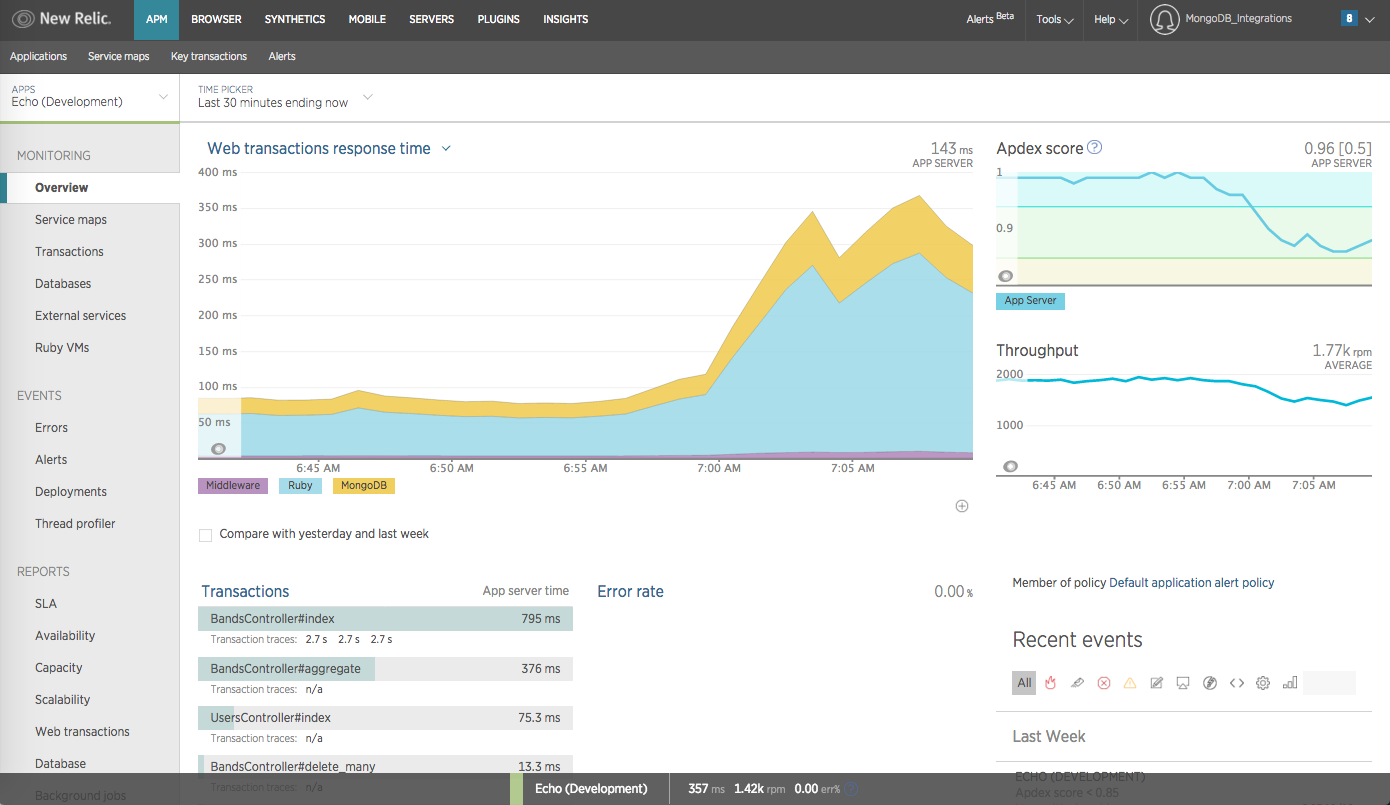
Screenshot of Screenshot of Screenshot of Screenshot of Screenshot of Screenshot of