New Relic vs. Releem

Overview
ProductRatingMost Used ByProduct SummaryStarting Price
New Relic
Score 8.0 out of 10
N/A
New Relic is a SaaS-based web and mobile application performance management provider for the cloud and the datacenter. They provide code-level diagnostics for dedicated infrastructures, the cloud, or hybrid environments and real time monitoring.
$0
No credit card required; 100 GB free ingest per month, 1 free full user + unlimited basic users, 8 days retention, 100 Synthetics Checks
Releem
Score 0.0 out of 10
N/A
Database performance management was a major pain point for developers: sifting through endless metrics and alerts, calculating variables, dealing with tons of documentation, query optimization, and index management. Releem is an AI-powered MySQL performance monitoring tool that helps keep database servers fast, secure and reliable. According to the vendor, its features beyond database performance monitoring and management include: 📊 Quick and simple to use with all the…
$0
per month 1 DB instance
Pricing
New RelicReleem
Editions & Modules
Free (Forever)
$0
No credit card required; 100 GB free ingest per month, 1 free full user + unlimited basic users, 8 days retention, 100 Synthetics Checks
Telemetry Data Platform
$0.25
per month per extra GB data ingest (after first free 100GB per month)
Incident Intelligence
$0.50
per month per event (after first 1000 free events per month)
Standard
$99
per month per full user (after first free full user - unlimited free basic users)
Pro
Contact sales team
Enterprise
Contact sales team
Free
$0
per month 1 DB instance
Premium
$79
per database/month Upgrade up to 9 DB instances
BUSINESS
Contact Sales
> 4 DB instances
BUSINESS
Contact us
> 4 DB instances
Offerings
Pricing Offerings
New RelicReleem
Free Trial
NoYes
Free/Freemium Version
YesYes
Premium Consulting/Integration Services
NoYes
Entry-level Setup FeeNo setup feeOptional
Additional Details25% discount for annual plan.
More Pricing Information
Community Pulse
New RelicReleem
Best Alternatives
New RelicReleem
Small Businesses
InfluxDB
InfluxDB
Score 8.8 out of 10

No answers on this topic

Medium-sized Companies
Sumo Logic
Sumo Logic
Score 8.8 out of 10
LogicMonitor
LogicMonitor
Score 9.0 out of 10
Enterprises
NetBrain Technologies
Score 9.2 out of 10
LogicMonitor
LogicMonitor
Score 9.0 out of 10
All AlternativesView all alternativesView all alternatives
User Ratings
New RelicReleem
Likelihood to Recommend
7.9
(145 ratings)
-
(0 ratings)
Likelihood to Renew
8.8
(16 ratings)
-
(0 ratings)
Usability
8.3
(11 ratings)
-
(0 ratings)
Availability
9.1
(2 ratings)
-
(0 ratings)
Performance
9.1
(2 ratings)
-
(0 ratings)
Support Rating
9.0
(7 ratings)
-
(0 ratings)
Implementation Rating
8.0
(9 ratings)
-
(0 ratings)
Configurability
7.3
(3 ratings)
-
(0 ratings)
Ease of integration
9.0
(1 ratings)
-
(0 ratings)
Product Scalability
9.1
(2 ratings)
-
(0 ratings)
Vendor post-sale
8.2
(2 ratings)
-
(0 ratings)
Vendor pre-sale
8.2
(2 ratings)
-
(0 ratings)
User Testimonials
New RelicReleem
Likelihood to Recommend
New Relic
I have used New Relic in different scenarios like monitoring my production infrastructure and applications which helps us to reduce the downtime of my applications and websites and also I have used the synthetic monitoring feature which helps to proactively monitor our websites availability. Along with this I have also used New Relic for cloud resources cost monitoring which helps to reduce my cloud cost. Also I have used mobile application monitoring which helps me to trace the sessions easily and I can easily reduce my RCA through the help of that.
Read full review
Releem
No answers on this topic
Pros
New Relic
  • New Relic APM allows us to follow up transactions across services and trace performance bottlenecks in real-time, crucial when monitoring the processing of energy loads or predictive maintenance algorithms.
  • It gives us deep visibility into our cloud servers, containers and IOT gateways, so we can catch CPU spikes or memory leaks which can impact the data we ingest from the field devices.
  • We develop custom dashboards for monitoring trends of power consumption, abnormality in sensors and API health. In conjunction with alerting, it makes sure we are fixing issues before customers even see them.
Read full review
Releem
No answers on this topic
Cons
New Relic
  • Support for SQL like query with more functional features of analysis while viewing distributed tracing.
  • support for very low level specific integration from APIs to classes to functions to piece of code
  • More detailed documentation, as we faced issues while integrating for the first time.
Read full review
Releem
No answers on this topic
Likelihood to Renew
New Relic
The only issue that we have had with New Relic is that the price might be a little expensive for smaller companies. The amount of data you store in New Relic impacts the cost, and can get away from you if you don't work closely with the vendor. Overall though the application is top notch.
Read full review
Releem
No answers on this topic
Usability
New Relic
I have given this much rating as I am used New Relic in different sectors and for different use cases like its K8s monitoring, infra monitoring, full stack monitoring as compare to other tools New Relic gives data in a formatted and connected way, and also it is giving us value for money. It also launches new features day by day which helps users to track the issue very quickly. It also supports OTel integrations which is the latest trend of observability tools. thats why I had given this much rating to New Relic.
Read full review
Releem
No answers on this topic
Reliability and Availability
New Relic
Never observed an outage
Read full review
Releem
No answers on this topic
Performance
New Relic
there are times where browser cache will cause issues that require you to clear your browser before continuing.
Read full review
Releem
No answers on this topic
Support Rating
New Relic
The support team has been really helpful and resolved most of the issues on time. However, for a couple of issues, several follow-ups were needed to elicit a reasonable response. The issue was deeply technical and could have been investigated only by their Architects, and bringing them into the ticket took longer than needed
Read full review
Releem
No answers on this topic
Implementation Rating
New Relic
It's better to start by implementing New Relic in one project and test everything. Try to follow best recommended practices and read all the official documentation. Everything seems well tested. Then, start by installing agents to the rest of your projects and keep a close look to all logs and metrics New Relic gives you.
Read full review
Releem
No answers on this topic
Alternatives Considered
New Relic
New Relic has full stack visibility and gives us all options for observability like one stop shop. It gives you front end, backend as well synthetic monitoring capabilities. Every other feature built into one cost model (usually) which ties to data that you send, it helps you leverage all features without having to pay additional charge for feature
Read full review
Releem
No answers on this topic
Scalability
New Relic
Agent deployment is easily integrated into our workflow. Adding the agent to new servers is quick and painless
Read full review
Releem
No answers on this topic
Return on Investment
New Relic
  • We were able to quickly identify our most time consuming APIs. In some cases we were able to bring down times for some apis from 4s to 200ms.
  • We were able to identify our slowest database queries and optimize them for quicker response times.
Read full review
Releem
No answers on this topic
ScreenShots

Releem Screenshots

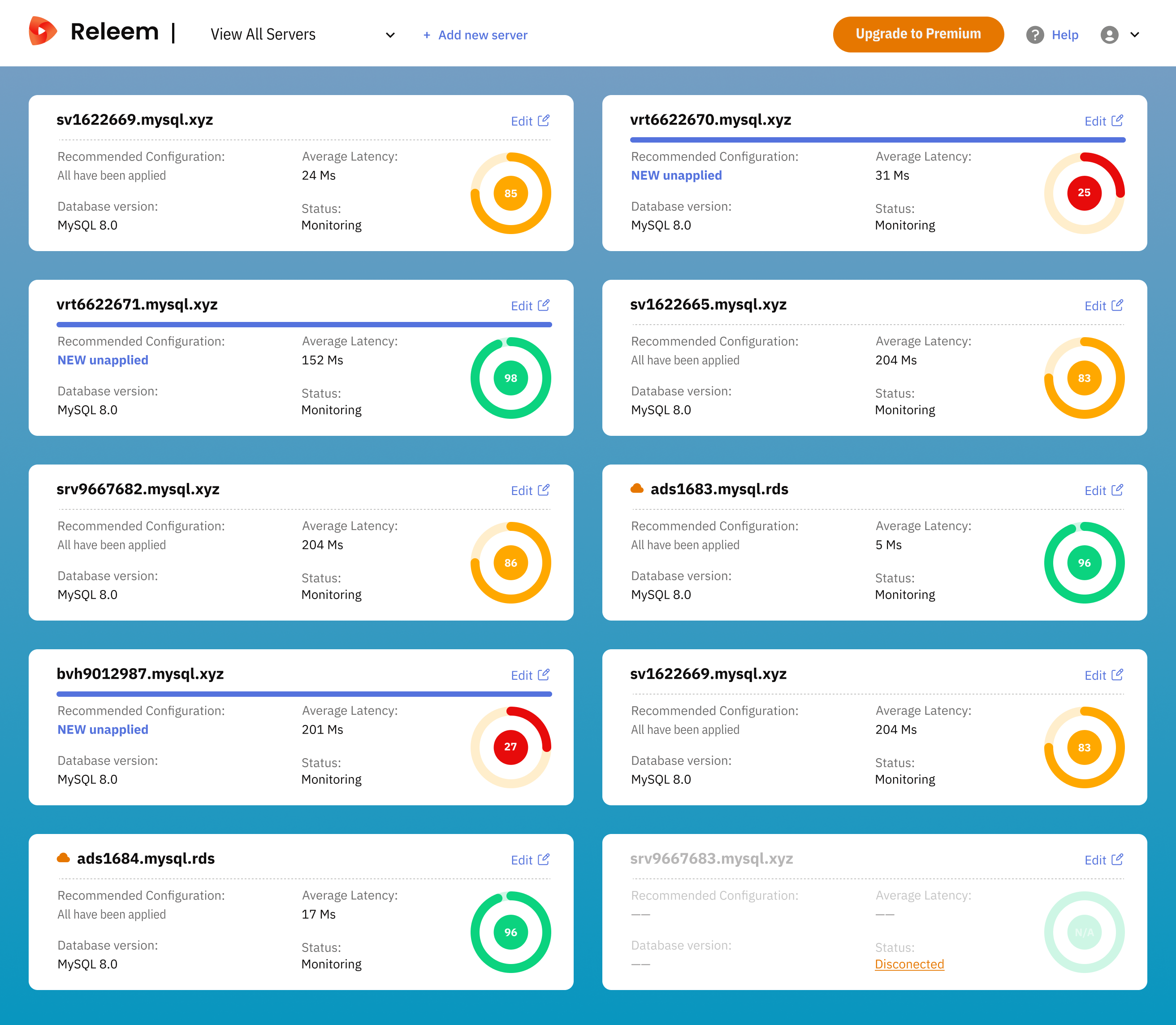
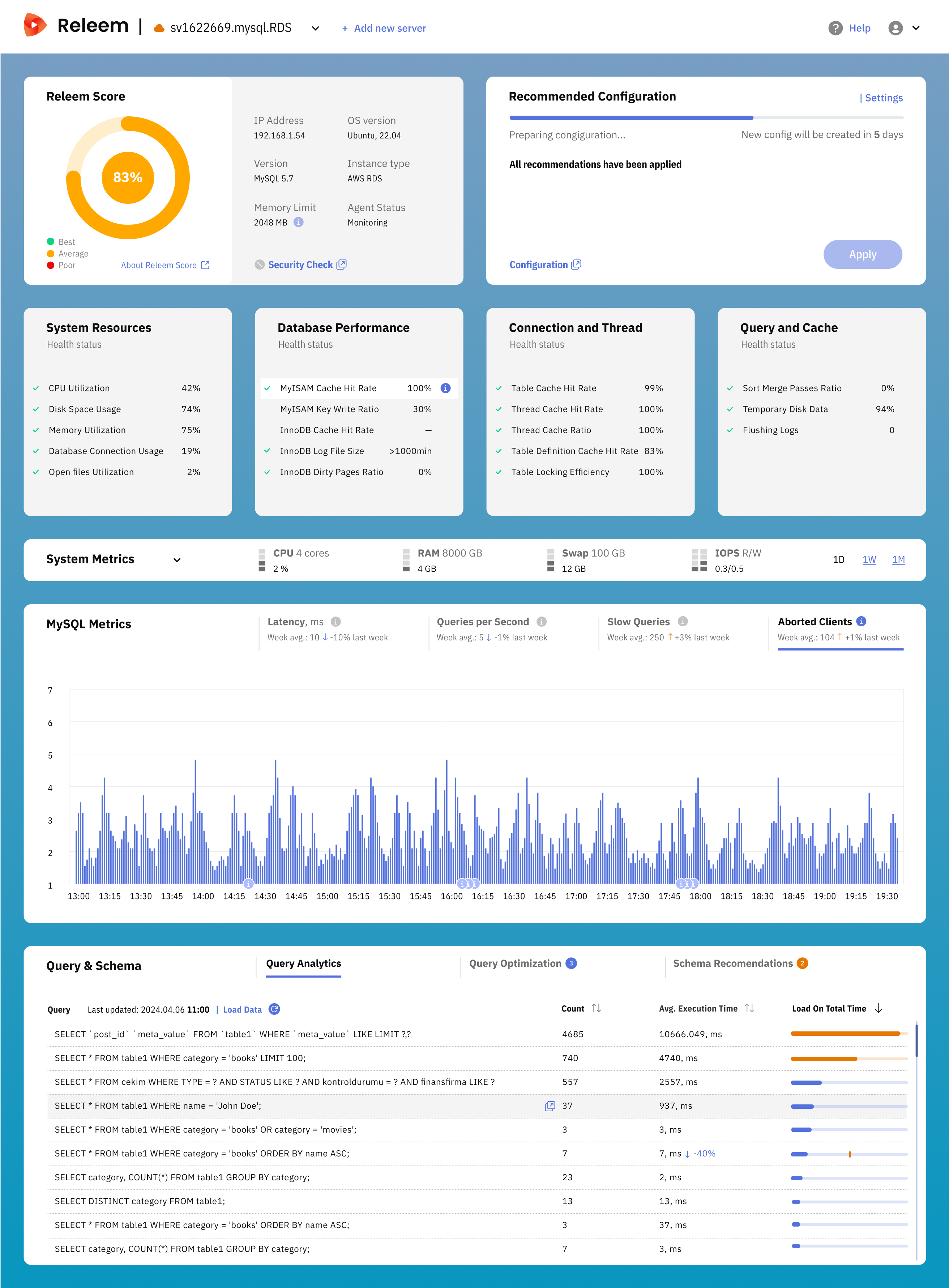
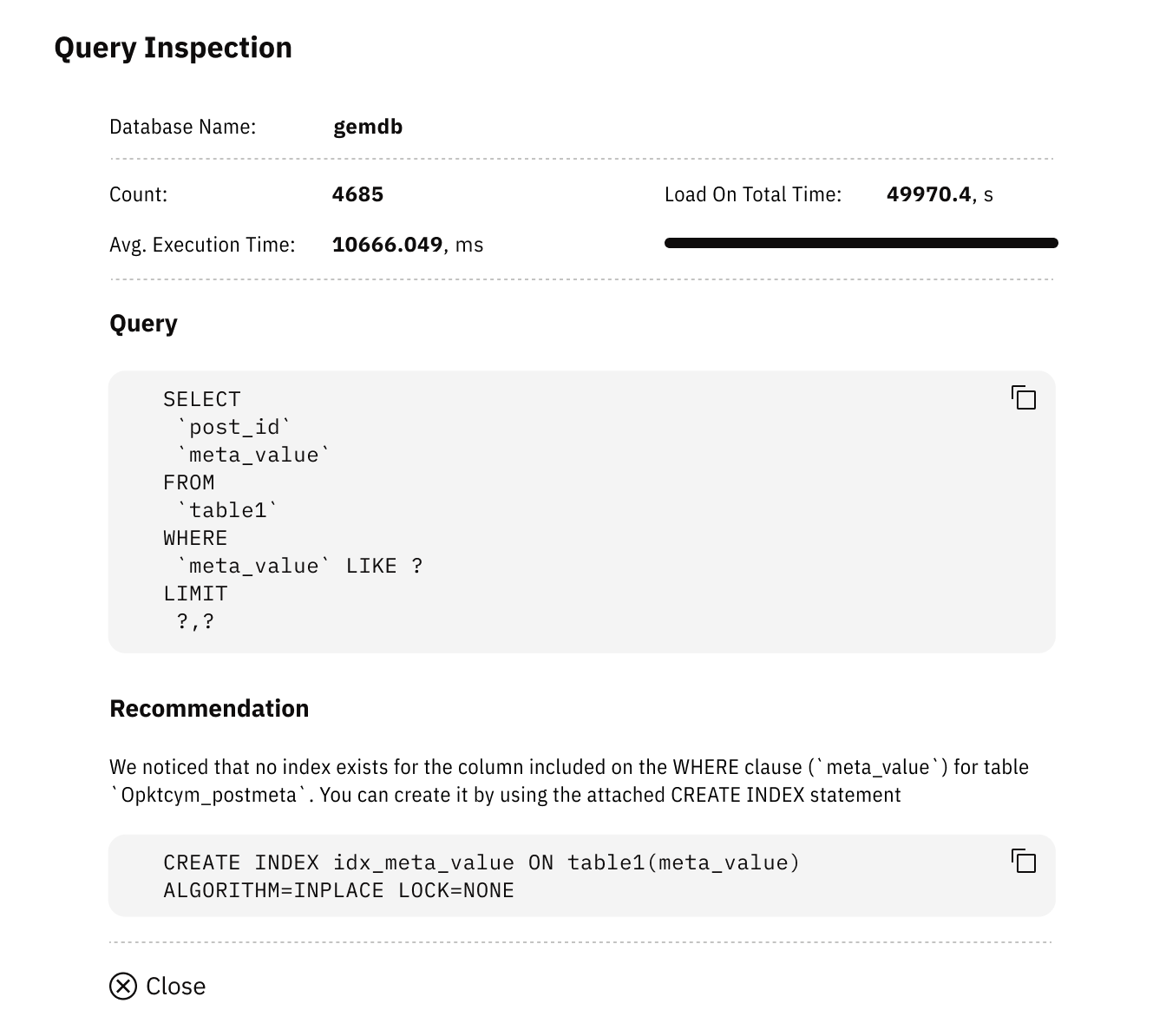
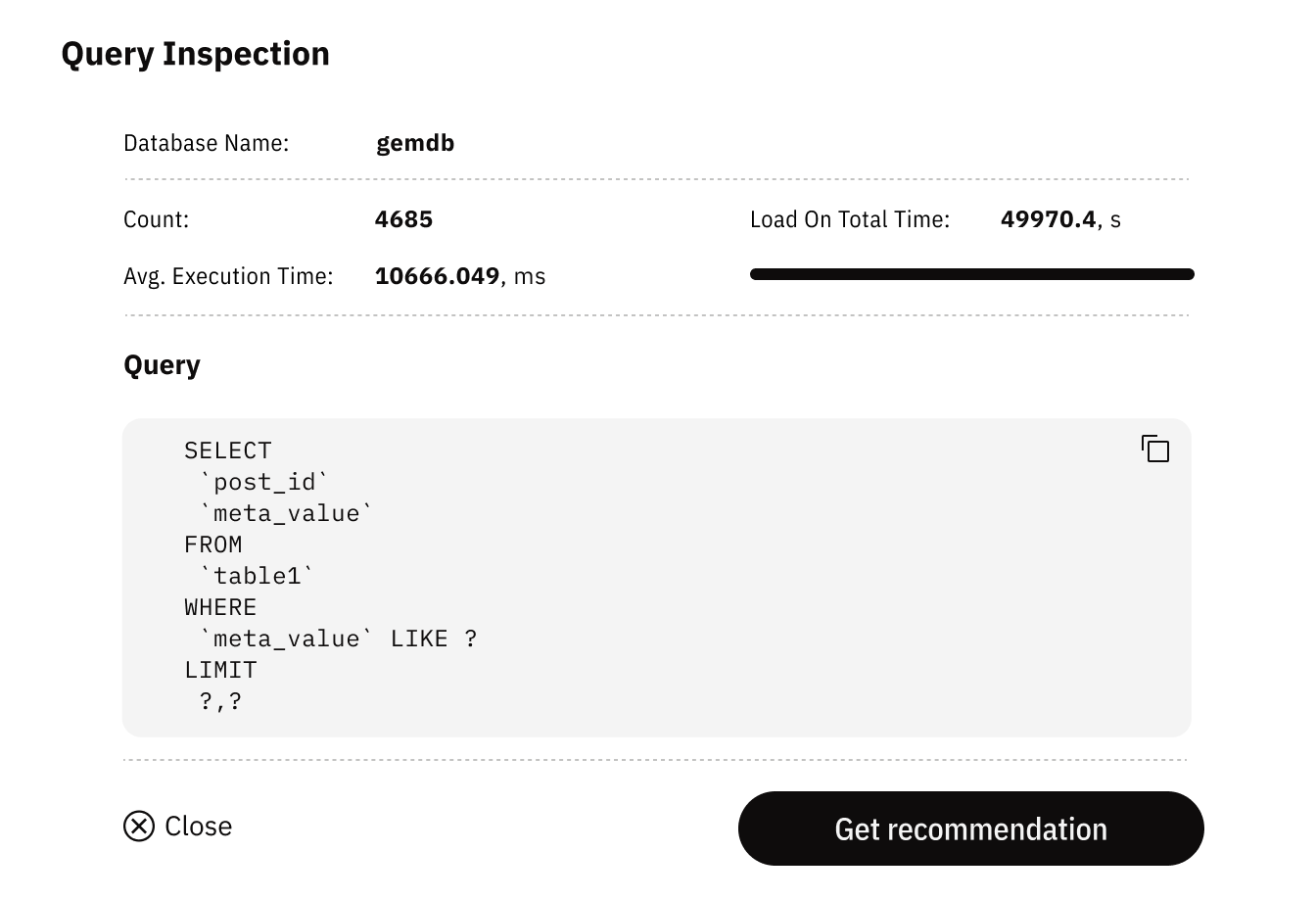
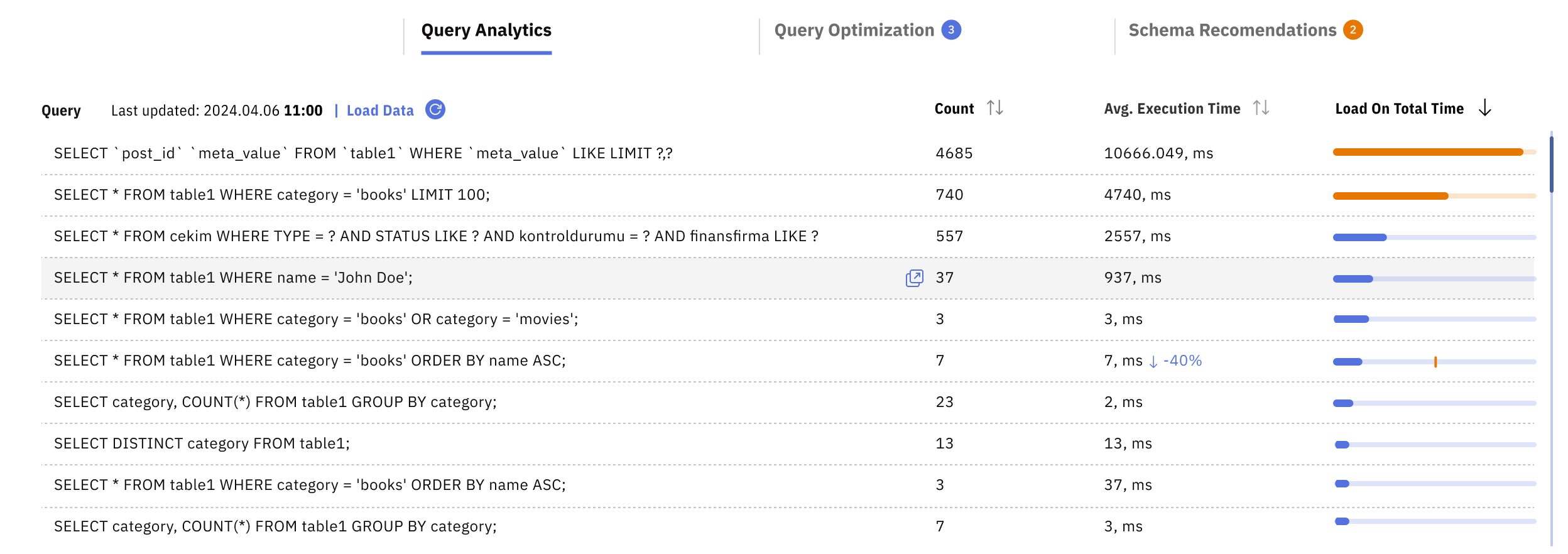
Screenshot of the dashboard, which displays an overview of multiple MySQL servers. Each server card shows the server name, database version, performance status (e.g., "Monitoring"), recommended configuration status (e.g., "All have been applied" or "NEW unapplied"), average latency, and a performance health score visualized through a color-coded progress circle.Screenshot of Screenshot of a screen providing detailed insights into a specific database query. It includes:

The database name ("gemdb").
Query execution stats (e.g., count, average execution time, total load time).
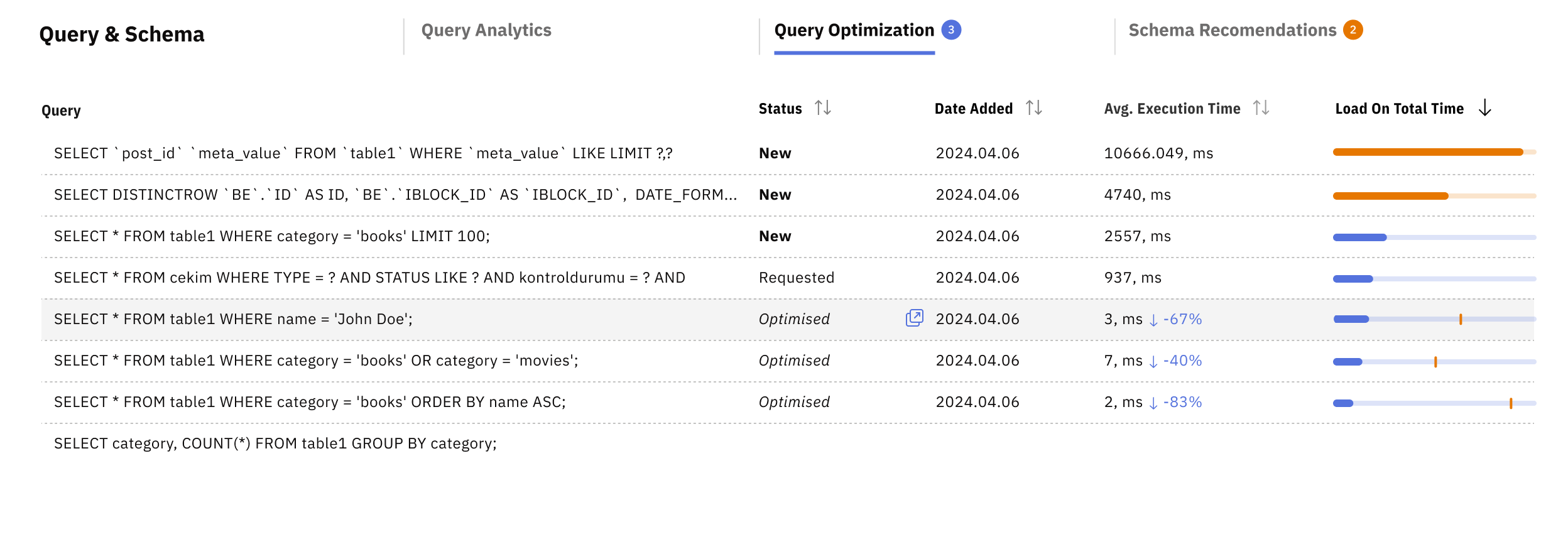
The problematic query text.
An automated recommendation for improvement, such as creating an index, along with the suggested SQL statement to apply.Screenshot of Screenshot of Screenshot of