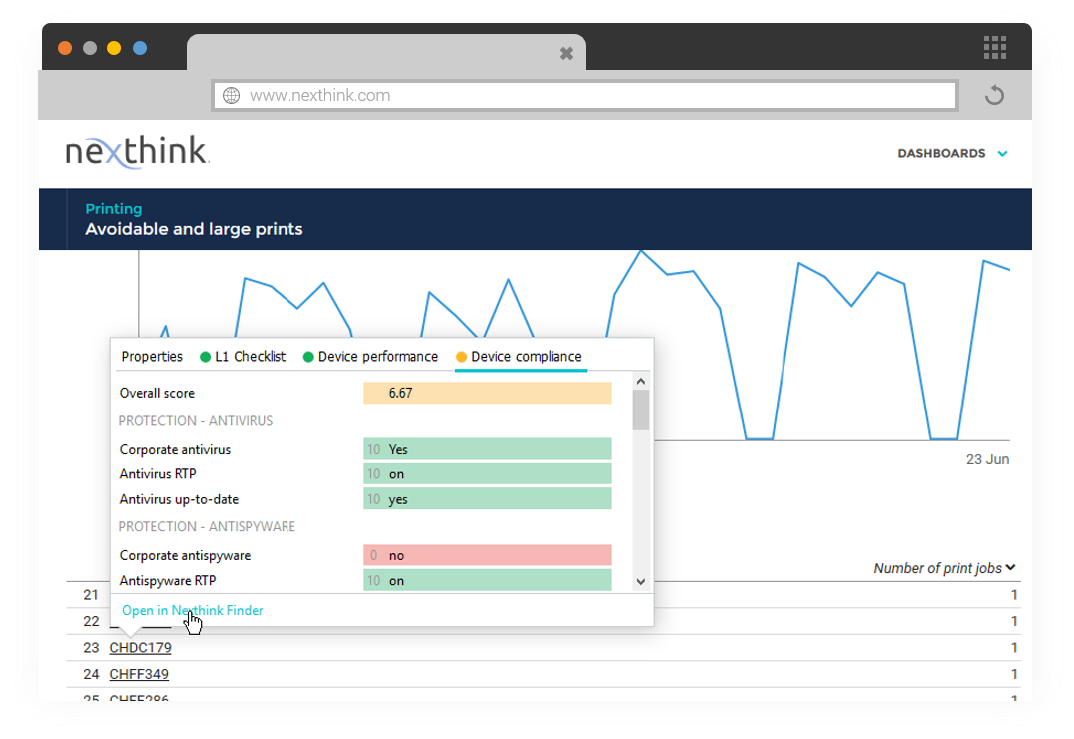
Nexthink Workplace Experience is a cloud-native platform allowing IT teams to manage the Digital Employee Experience (DEX) by providing insights across devices, applications, users, operating systems, locations and organizational units.
N/A
OpsGenie (sunset)
Score7.4 out of 10
N/A
OpsGenie is an IT monitoring and incident response platform for development and operations teams, providing alerts and schedule management escalations. OpsGenie became part of Atlassian since the late 2018 acquisition, and Atlassian scheduled OpsGenie for sunsetting in April of 2027. Former users and those needing IT Alert Management capabilities are encouraged to migrate to Jira Service…
I've been managing desktops for 20+ years and Nexthink was the missing tool out of my toolbox. Just to give some perspective, if you were building and maintaining a house, Nexthink would be comparable to switching up from a hammer and nails and to full blown using a nailgun. Nexthink is a solution accelerator and a well thought out toolset to give you the customer experience at a glance. It allows for so much more visibility just with the default set of data points the Collector (agent) gathers, which is A LOT, and grants you the ability to gather even more data with remote actions. All of this evidence cuts how the "it could possibly be this" and "maybe it's that" discussions when you're troubleshooting an issue. It may not provide the exact answer all the time, but it gives you a "compass point" on where you need to start looking to resolve the issue. Also the service monitoring, activity monitoring, and critical event thresholds really empower the teams to know when a problem is happening and they can get ahead of it before the first call even reaches the Help Desk. Nexthink is a cornerstone tool in our environment for end user experience and I'm excited to see where the go next.
Incident response is well suited to OpsGenie, and this is where it really shines—whether it's an outage, a security incident, or similar. My experience is mostly with security, and it offers a great audit trail. It minimises the need to cut and paste from different platforms when creating reports and ensures that what was said and what was done (along with any evidence) is persisted and reflected in the incident detail.
A de minimis incentive was given to thank the reviewer for their time. The incentive was not used to bias or drive a particular response, nor was the incentive contingent on a positive endorsement. More Info
A de minimis incentive was given to thank the reviewer for their time. The incentive was not used to bias or drive a particular response, nor was the incentive contingent on a positive endorsement. More Info
The on-premise solution can be slow at times and resource-demanding even on newer laptops. (This isn't the case with the cloud offering.)
Some useful features are only available to cloud customers.
Library pack configuration could be made easier, often these packs require some customization and it's not always clear how to get them up and running after importing.
OpsGenie New Jira design has made it difficult for those not familiar with that style.
OpsGenie could benefit from nested escalation flows for team schedules. Creating a product alert that uses and Tech Schedule as well as an Incident Manager Schedule that already exists would create less overhead and ease management.
A de minimis incentive was given to thank the reviewer for their time. The incentive was not used to bias or drive a particular response, nor was the incentive contingent on a positive endorsement. More Info
In general terms OpsGenie is a well done tool for solving the alert incident management, the usability is super ok during the configuration and during the alert. The main opportunity I found is the reporting and analytics section which is a little difficult to understand at a first sight and the refresh is not automatic, some little frictions but frictions at all
A de minimis incentive was given to thank the reviewer for their time. The incentive was not used to bias or drive a particular response, nor was the incentive contingent on a positive endorsement. More Info
A de minimis incentive was given to thank the reviewer for their time. The incentive was not used to bias or drive a particular response, nor was the incentive contingent on a positive endorsement. More Info
Nexthink had better integration and a better user interface. 1E did not have the engagement capability which is so critical to many of the actions we complete using Nexthink. Nexthink had better trending data capabilities. 1E did not capture and hold data the way Nexthink does so all data assumes you are able to pull information from all systems at any time. with remote systems it is unlikely you will capture all systems at the same time so it makes any actions less effective. this review was performed 4 years ago so 1E may have addressed some of these limitations but Nexthink has also grown and continues to add and improve on their industry-leading capabilities.
A de minimis incentive was given to thank the reviewer for their time. The incentive was not used to bias or drive a particular response, nor was the incentive contingent on a positive endorsement. More Info
We also looked at PagerDuty but decided to go with OpsGenie as it had more features on the plan we needed compared to PagerDuty which would have required us to spend a lot more for what we felt were non-premium features. Everything felt like an add-on - automation for an additional $20 a user per month seemed like a lot on top of the base plan
A de minimis incentive was given to thank the reviewer for their time. The incentive was not used to bias or drive a particular response, nor was the incentive contingent on a positive endorsement. More Info
SCCM proactive remediation: Automatically resolving hundreds of SCCM issues per month
Hardware: Identification of over $5m cost avoidance by seeing a lack of usage for 128GB SSDs - no need to upgrade to 256GB... coupled with OneDrive migration packs in the Nexthink library this is valuable.
A de minimis incentive was given to thank the reviewer for their time. The incentive was not used to bias or drive a particular response, nor was the incentive contingent on a positive endorsement. More Info
Helped us track bugs and issues that came up during product launch periods which reduced overhead that normally came with needing to manually contact the right team members
Prevented last minute breaking issues from falling through the cracks, decreased time to fix by automatically alerting the team members and allowing the product and project teams to easily see what active alerts are in progress
A de minimis incentive was given to thank the reviewer for their time. The incentive was not used to bias or drive a particular response, nor was the incentive contingent on a positive endorsement. More Info