Planful is a cloud-based enterprise performance management (EPM) suite. It includes financial applications for modeling, planning, consolidation, reporting and analytics.
N/A
TransUnion TruValidate
Score 7.0 out of 10
N/A
TruValidate fraud prevention and identity proofing products that secure trust across channels and deliver seamless experiences for consumers. In addition to all of TransUnion’s fraud products, TruValidate has expanded to include all fraud offerings from Neustar.
N/A
Workday Adaptive Planning
Score 8.0 out of 10
Mid-Size Companies (51-1,000 employees)
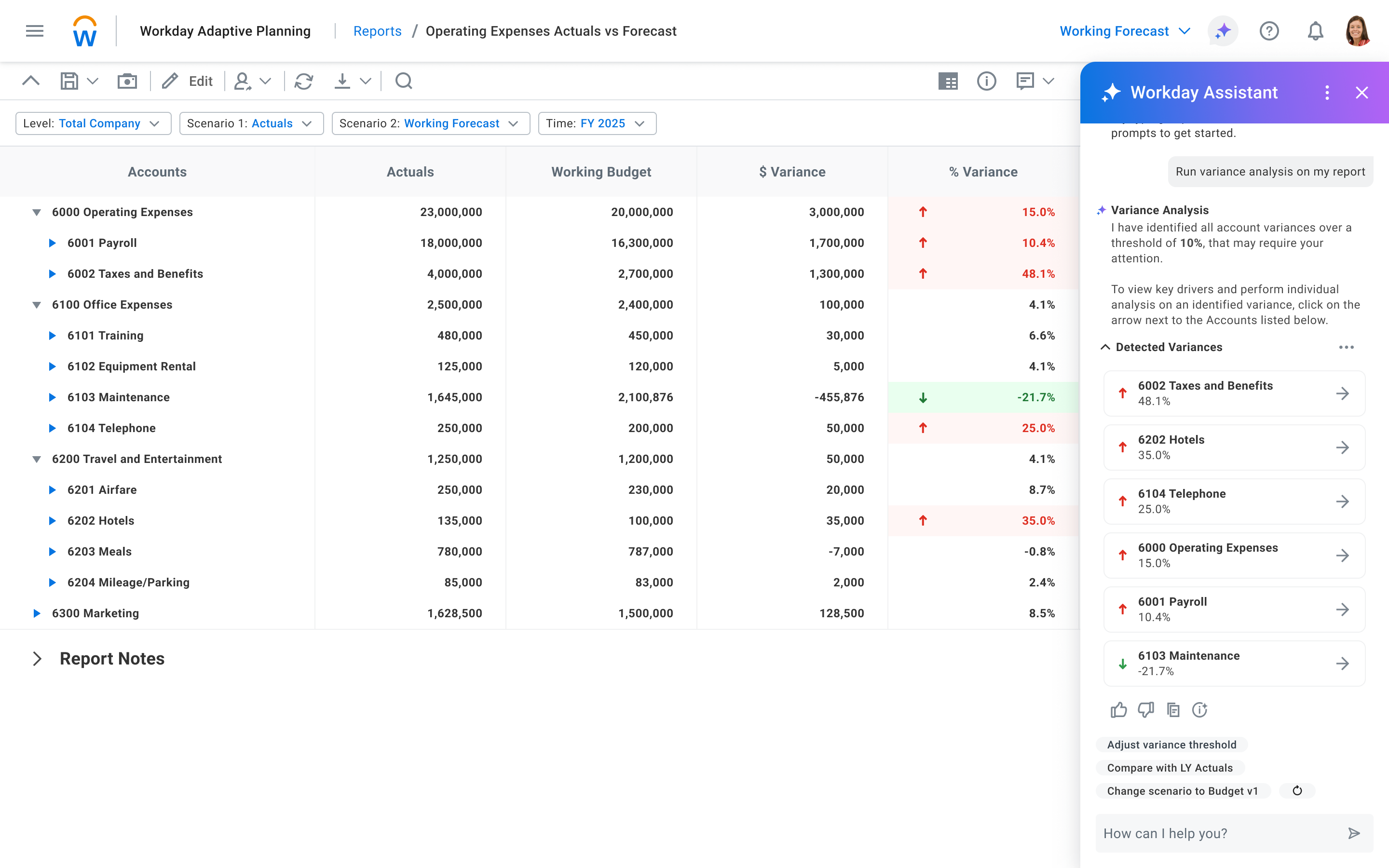
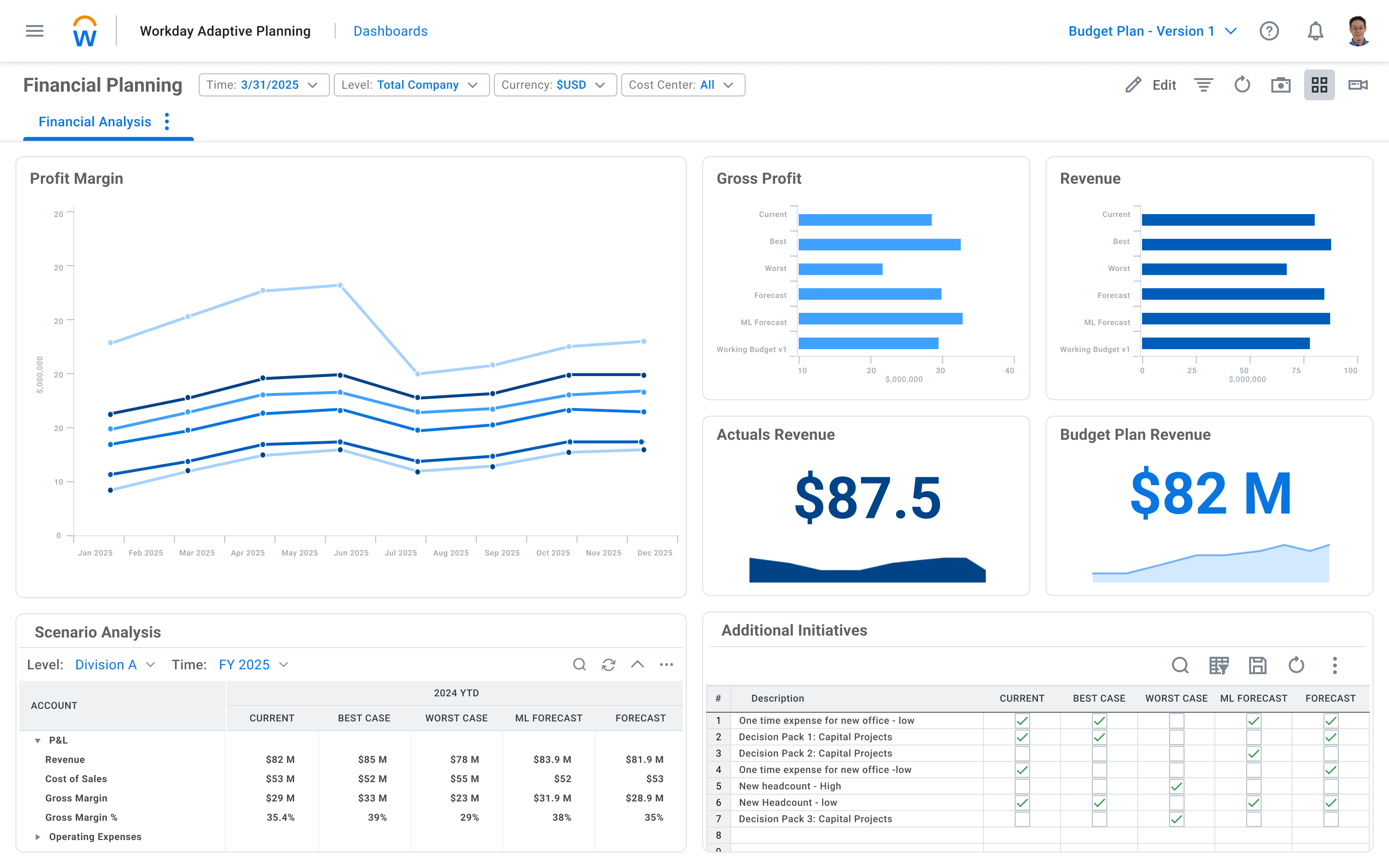
Workday Adaptive Planning streamlines planning workflows, using AI and real-time data integration to improve collaboration and provide predictive forecasts for better strategic analysis.
N/A
Pricing
Planful
TransUnion TruValidate
Workday Adaptive Planning
Editions & Modules
No answers on this topic
No answers on this topic
No answers on this topic
Offerings
Pricing Offerings
Planful
TransUnion TruValidate
Workday Adaptive Planning
Free Trial
No
No
Yes
Free/Freemium Version
No
No
No
Premium Consulting/Integration Services
No
No
No
Entry-level Setup Fee
Required
No setup fee
Optional
Additional Details
Pricing is highly dependent on the complexity and scope of the implementation.
Planful solved our problem (avoid manual data entry) with competitive pricing. Data rails and Anaplan were expensive for a pre-revenue biopharma company.
Mosaic was very rigid and not flexible for our needs. It was difficult to manage and not user friendly. Planful allows us to customize various fields that allows for more robust and efficient reporting. The user interface is easy to digest and use. The Planful team is also a …
Planful is one of the best solutions because of its easy of reporting capabilities that a business user can develop without consulting assistance. The other tools I have used require a more technical base knowledge.
This was the most cost effective for the features our business needed. Centage and Microsoft's PowerBI did not offer everything we wanted. One Stream was a good alternative but very expensive for what our business needed.
EPM tools are all pretty close in general functionality in that they are tables of your data with a finance focused UI stacked on top. The last 5% is what the difference. Planful has a very modern UI and does a great job of updating the system over time, including things like …
Planful was great for its price point. Although workday and hyperion are the more popular bunch, our use case is mostly met through Planful's functionality.
Personally I have only used essbase in my work. Planful has a much easier platform to use both to put together results and to load data compared to the financial reporting platforms that I have used. Planful also has better dedicated tools to create reports and build in a …
We enjoy planful and have preferred it compared to similar products because of the personability, helpfulness form customer service, easy sign on, ability to customize reports, and run easy consolidation process.
Most financial folks user-friendly less technical support needed; most efficient and automated; data host in US; most automated with both the core application and excel spotlight in sync, you can view and sync in web or excel. Process time is fast.
Prior to joining the company, we tried to implement Vena but were unsuccessful. There we're a few reasons it didn't work out, but a lot of it related to the implementation team they provided. In just the first week with Planful, we achieved more progress than we did in several …
Planful's user interface is much more user-friendly than OneSteam. I wasn't as heavy of a Onestream user as Planful so can't fully compare. I am Power User and building system for Planful whereas I was purely end user for Onestream.
We liked the Excel-based interface and Planful's reporting capabilities. The dashboarding feature also offers a visual look at KPIs without purchasing another software, saving the company money.
Google has an open source version of this, but its updates are based on the user community. Since Neustar's IP Intelligence is a paid solution, the updates are regular, the interface is streamlined with a REST API, and there is a help desk you can consult for onboarding and …
Compared to Vena, Adaptive Planning appeared to be better at scaling with us as a business. Vena uses Microsoft Dynamics as its platform and are somewhat limited in its roadmap due to what's available from Microsoft. Vena is much more linked to an Excel solution than Adaptive …
While we have looked at various other platforms and even tried them out in the past, we eventually selected Workday Adaptive Planning to help with our headcount planning as we have a lot of entities especially international ones and we felt that Workday was the best suited for …
For best-in-class capabilities, you'll very likely need to split the various HR and financial systems into separate systems rather than using a consolidated platform like Workday. However, a consolidated platform provides benefits by being a single location for employees and a …
Workday Adaptive Planning is similar to payroll and workforce management by implementing constant and new changes to finances, workplace changes and the people changing in rolls and employment. Both tools are very useful and practical in a company setting and mainly in …
Like I said in a previous question, the fact that there was downtime that was needed to update all the data that was entered in a day was not ideal. This caused for hours lost on the data update and didn't allow our leaders to see the affects immediately like Workday Adaptive …
Overall being familiar with the Workday Adaptive Planning tool's flexibility and ease of use our finance and ops team saw this as the easiest and most robust tool that they could admin and maintain without outside IT resources.
In my opinion, Spreadsheet Server is not even in the same game as Workday Adaptive Planning. While it is flexible in Excel, it still requires a lot of back and forth for analysis.
Our previous platform was patchwork tools and unintegrated. We were clunky and poorly organized. The system was slow and
difficult to use, and it was either overhaul it or start over. We evaluated our
options holistically and went with Workday. It works better and faster, and …
Workday provides adaptive and intuitive planning that does not has disruptions when there is any change in system or migrations of servers, users or systems. Workday integrates with CRM, ERP and other database engines to source data and provides insights that can be exported to …
It doesn't have the same standard fulfillment modeling as the true workforce planning products, it equals the other core HCM systems and beats them on ease of use.
Workday Adaptive Planning is not as robust as SAP Ariba, but it is certainly better than BadgePass. The trouble with BadgePass is that it can be a but clunky in some modules that seem like clear bolt ons to the main product UI. Whereas, Ariba was clearly built to satisfy …
Workday became our choice because it is fully web-based and easily integrates with other systems. The learning curve for Workday was shorter than that of Dynamics. The reporting tools in Workday are more user-friendly than that of Dynamics. However Workday did not have Check …
From our initial findings, Workday Adaptive seemed like it was going to be easier to get up and running out of the box and fit the needs of our company more.
There are still times that I find myself thinking that "I would have been done with this already" in Excel. Most (possibly all) the colleagues I know in our industry haven't outgrown using Excel yet... Overall, now that I feel I (mostly) "know what I'm doing" and am thru the learning stage the system I'm seeing benefit...however also feel like I haven't 'scratched the surface' of what it's capable of. Dynamic Planning, Predict/Signals, AI ...I feel we have a huge learning curve still ahead. I've explored Signals and AI Analyst and haven't been able to get reliable results to drive me to use it more...which leads me to believe we have core implementation related issues.
Neustar IP Intelligence is quick to deploy using their REST API, the data is automatically updated against one of the most robust datasets available on the market. It is well suited for developers trying to integrate with an out-of-the-box solution to lookup geolocation of website visitors in real time, and possibly build alerts or 2F-Authentication mechanisms based on suspicious activity.
If your company requires headcount and enterprise initiative planning across departments, it really helps to see the impacts at the company level. It is well-suited for conducting what-if scenarios and beneficial if you already have Workday HCM with position management. It may not be well-suited to companies that require custom dashboards.
Creating forecasts for the month, quarter, and year
Creating new variables by using variables pre-defined and that are new in the system
Having a very simple setup in the reports section - not straying away from the old Excel model which most people are used to. I can speak for a lot of people when I say that tools that look new can easily be frightening! 😅
Version Management. Adaptive lets us manage many versions/scenarios all in one platform with the robust ability to compare them to each other.
Processing Performance. With the Elastic Hypercube technology that was implemented a few years back, we can watch changes flow through a complex web of formulas and arrive at an answer within seconds.
Audit Trail. Our administrators love the ability to see and report on who made what changes when, which leads to real accountability within the organization.
Expense reporting aspects are repetitive and hard to fully optimize.
Finance tracking is limited to basic reports with multiple levels or drill-down...hard to fully grasp without exporting data and massaging in something else (like Excel).
Our new Comptroller understands the value of Planful, and we plan to utilize it further in the organization to enhance external reporting. Strangely enough, Planful had not previously been embraced by the former CFO, who argued that we were running two sets of books (of course, we were not). Fortunately, the before mentioned reconciliation of EBITDA to Net Income demonstrated that to the banks.
For one we're in way too deep to not move forward with Adaptive. We're integrated with Workday, we do a ton of reporting with Adaptive, and it's working very well for planning and forecasting. No reason to look back or change course.
The tool is extremely adaptable, and it enables very quick querying to give us opportunity to gain live insights into the business. Given its adaptability, we are also able to create scenario analyses very quickly in rapidly changing environments. The formatting also enables us to provide this information in a very consumable manner.
Love, love, love, love the OfficeConnect interface as well as the Planning tab within Excel. OfficeConnect is so flexible, gets immediate updated data (after integrations are run). No need to recreate workbooks every month, just refresh the data. This really is the lifeblood for my CFO and leadership team. The Planning tab in Excel allows us to look at a Sheet with many, many rows and perform analysis, even sending it back to Workday Adaptive Planning.
I only give a 9 rating rather than a 10 rating because it seems that every day around 2pm we see a slowdown in the use of Planful. I have requested our internal IT department verify that it is not an internal issue and have been assured it is the tool. We have not yet reached out to Planful to do extensive research to solve this issue.
There haven't been any lately. The only one issue I can think of is when there was an update in Adaptive that altered our reports. Before I realized there was an issue, Adaptive reached out to let me know, so that it could be fixed.
Again, the system is very reliable and, for the most part, runs very quick and smooth. When running larger queries, it does take some time, and during budgeting season our users experienced slower loading times, but nothing that raises concerns outside of normal network issues. Occasionally, as with any software we use, it will crash and you have to restart, but that does not happen very often.
All aspects of Adaptive Insights perform well. One area that I wish was quicker was integration. When importing data from Intacct our accounting ERP platform, it can sometimes take 4 hours for the import to process. The earlier imports are done, the quicker they complete. My estimate for a quick upload is about two hours.
Sometimes we get great help when using Planful's support team and other times we don't. In particular, there is one person that often responds to our support tickets who is less than helpful, hence the reason for the 5 out of 10 rating. As a result, most of the time we reach out to our Planful consulting group as they provide faster and better support
Whenever we have had any questions, issues, or concerns, the support has been quick and thorough. [This] allow[s] us to be able to fully resolve any issues, or be connected with the right group quickly to attain the result we were after; be it from simple formatting to adding new detailed reporting.
My team has attended training offered several times before/during the Planful Perform conference. This training has been extremely useful and we always learn something we didn't know prior to the training. The trainers are always very knowledgeable and more than willing to help each and every user after the training with specific questions regarding their environment. Planful also offers training and certifications on their training hub. I have completed a couple of the certifications. The courses are easy to follow along with and very informative. Additionally, Planful schedules webinars pretty regularly. They'll email their customers and allow you to register to participate live. They also record these sessions so you can refer back to them at a later date or if you are unable to attend at the time the webinar is offered, you can register anyway and get access to the recording. Their training has improved year over year!
This was extremely helpful so that they could walk you through the model and teach you more about the complexity of various areas. It is most helpful when it is specific to your organization's model. The larger in-person trainings were helpful but they tended to be more generic and entry level. The trainings that are more tailored to your specific needs are the most helpful.
Planful provides a lot of online training support. There's so many options for training. Admin Learning Courses, User Learning Courses. Plus they have several webinars devoted to the tool and the new features they release. New Releases can be practiced in a Sandbox Environment prior to going live in Production
They often times tended to be way too generic or entry level. They would also become sales pitches to upgrade or get new Adaptive Planning products. The questions in the training would be very niche and specific to other organizations. They were rarely helpful to the group at large.
Most of the issues in the implementation were self inflicted, the team at Top Down was great and did a good job managing hours and teaching our team how to best handle the system. The implementation went longer than expected as they always do but the GL and erp link was up and running quickly so we could build reporting
Trust the expertise of very strong 3rd party implementers. Having deployed Adaptive at a separate company before, I thought I knew it all (hubris, I know). Fortunately, I began to (very quickly) trust the judgment of our Carlson implementation team, and they provided invaluable insights and best-in-class processes that have benefitted me and my team greatly.
Personally I have only used essbase in my work. Planful has a much easier platform to use both to put together results and to load data compared to the financial reporting platforms that I have used. Planful also has better dedicated tools to create reports and build in a dedicated software that is built to report on rather than building from scratch in an excel environment
Google has an open source version of this, but its updates are based on the user community. Since Neustar's IP Intelligence is a paid solution, the updates are regular, the interface is streamlined with a REST API, and there is a help desk you can consult for onboarding and questions if there are issues.
Compared to Vena, Adaptive Planning appeared to be better at scaling with us as a business. Vena uses Microsoft Dynamics as its platform and are somewhat limited in its roadmap due to what's available from Microsoft. Vena is much more linked to an Excel solution than Adaptive Planning and we felt getting our Commercial Finance Business Partners out of Excel would be beneficial to move the mindset away from being analysts to being advisors to the business. OneStream's key selling point was its ability to merge together multiple ERPs into one single platform. This looked powerful but since we were on a single ERP, we wouldn't have benefited from that key feature. The OneStream user interface also looked very dated, as did their reporting outputs. Adaptive Planning had a much more modern and appealing reporting environment.
From our experience, Planful is only used in 2 overhead departments in our organization. We easily added another overhead department, but they decided against using Planful for their workforce and financial planning. Removing them from our environment was extremely easy.
We went from 2 users to 70+ users over a 2 year period of time. The application scaled wonderfully. 65 of those users were non-finance users so they were able to quickly learn the software and prepare budgets quickly and efficiently. That is the power of Adaptive and its ability to scale