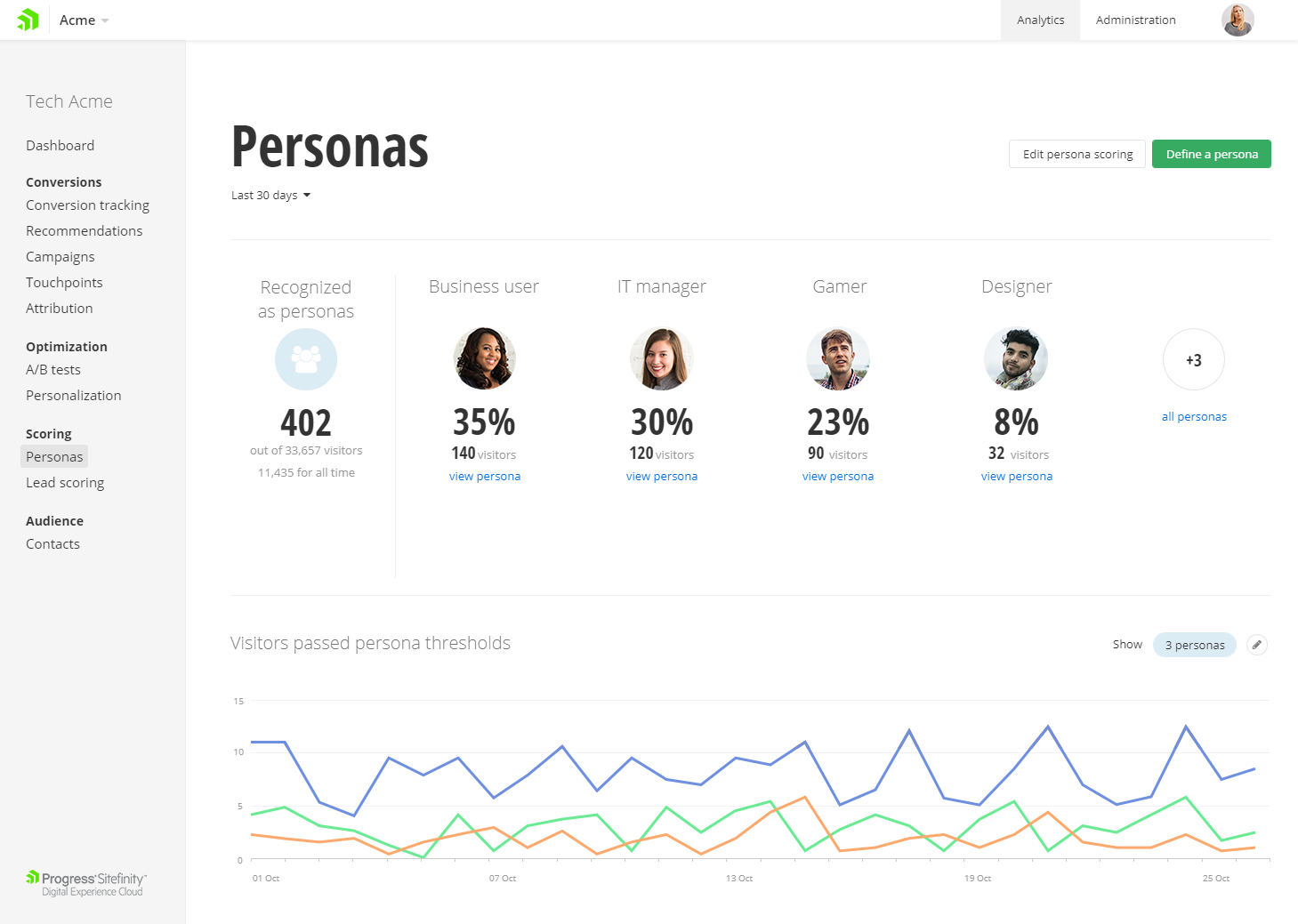
Progress Sitefinity is a content management and customer analytics platform. It supports content management, tailored marketing, multi-channel management, and ecommerce sites.
N/A
Sitecore Digital Experience Platform
Score8.9 out of 10
N/A
The Sitecore Experience Platform (Sitecore XP) is a digital experience platform used to build websites and create customer experiences online. The solution boasts fast content authoring, built-in personalization features, testing and other optimizations, as well as analytics and marketing features.
Senior Project Manager in Information Technology at Murdoch University (Higher Education, 1001-5000 employees)
Chose Progress Sitefinity
We evaluated a range of other platforms before selecting Progress Sitefinity. While many other platforms had a powerful range of features, Progress Sitefinity provided to be a comparable product at a price far more suited to our budget. Above all else, its ease of use gained …
A de minimis incentive was given to thank the reviewer for their time. The incentive was not used to bias or drive a particular response, nor was the incentive contingent on a positive endorsement. More Info
CEO (Chief Executive Officer) in Corporate at Smooth Fusion, Inc. (Internet, 11-50 employees)
Chose Progress Sitefinity
In addition to being a user of Sitefinity, my company is also a Sitefinity Partner. More than a decade ago, we were supporting several CMS platforms and decided we wanted to pick one and be great at it. After analyzing many content management systems, we decided that Sitefinity …
A de minimis incentive was given to thank the reviewer for their time. The incentive was not used to bias or drive a particular response, nor was the incentive contingent on a positive endorsement. TR verified that a representative sample of customers was invited. More Info
CTO in Information Technology at Team SI (Marketing & Advertising, 51-200 employees)
Chose Progress Sitefinity
It is hands down just easier for our customers to use. The interface and the page builder experience is much better than what we have used in the past and has many enterprise features even in the lower price-point.
A de minimis incentive was given to thank the reviewer for their time. The incentive was not used to bias or drive a particular response, nor was the incentive contingent on a positive endorsement. More Info
Verified User
Chose Progress Sitefinity
Sitefinity has its advantages and disadvantages. We view it as a useful tool in our toolbox and are always happy to develop a new Sitefinity site when its features align with the needs of our clients. From a content management standpoint, it is easier to work in than some and a …
A de minimis incentive was given to thank the reviewer for their time. The incentive was not used to bias or drive a particular response, nor was the incentive contingent on a positive endorsement. More Info
Verified User
Chose Progress Sitefinity
It stacks up very well and in many areas is a lot easier to use and develop.
A de minimis incentive was given to thank the reviewer for their time. The incentive was not used to bias or drive a particular response, nor was the incentive contingent on a positive endorsement. More Info
Director of Integrated Marketing in Marketing at ETAP - Operation Technology, Inc. (Computer Software, 201-500 employees)
Chose Progress Sitefinity
Best system from a feature/cost point of view. We had specific requirements, one of which was that the system had to be based in a IIS/.net environment.
Price was another factor and ease of implementation with the existing development staff another.
A de minimis incentive was given to thank the reviewer for their time. The incentive was not used to bias or drive a particular response, nor was the incentive contingent on a positive endorsement. More Info
Verified User
Chose Progress Sitefinity
In terms of feature set, Sitefinity offers more out-of-the-box features as compared to Umbraco. In comparison to Kentico, Sitefinity has a better back-end admin set of tools. In comparison to Sitecore, Sitefinity is cheaper and easier to use.
A de minimis incentive was given to thank the reviewer for their time. The incentive was not used to bias or drive a particular response, nor was the incentive contingent on a positive endorsement. More Info
Vice President of Operations in Information Technology at Azavar Technologies (Internet, 11-50 employees)
Chose Progress Sitefinity
We prefer Sitefinity to any of the open source solutions out there for the basic arguments you will typically hear. Additionally, Sitefinity fit well into our .NET development stack and competency we have on staff. Relative to Sitecore, Sitefinity seemed to offer better value …
A de minimis incentive was given to thank the reviewer for their time. The incentive was not used to bias or drive a particular response, nor was the incentive contingent on a positive endorsement. More Info
Technical Lead in Information Technology at Impact Proximity (Impact BBDO) (Banking, 5001-10,000 employees)
Chose Progress Sitefinity
Umbraco is good for a campaign website, whereas Sitecore provides rich feature and is suitable for enterprise websites, but compared to Sitefinity it's more expensive.
Sitefinity provides features which are suitable for many enterprise websites. It also has different types of …
A de minimis incentive was given to thank the reviewer for their time. The incentive was not used to bias or drive a particular response, nor was the incentive contingent on a positive endorsement. More Info
Sr Marketing Communications Manager in Marketing at Data Sciences International (Biotechnology, 201-500 employees)
Chose Progress Sitefinity
It's been six years since I evaluated all of the possible CMS platforms. I really liked Sitecore but it was substantially more expensive. I really like Joomla but felt it would be most successful if you have a web designer/developer on staff. I also looked at a lot of other …
A de minimis incentive was given to thank the reviewer for their time. The incentive was not used to bias or drive a particular response, nor was the incentive contingent on a positive endorsement. More Info
Verified User
Chose Progress Sitefinity
We wanted a CMS that is based on the dot net framework to leverage existing on-site expertise. Also, ease of use for content editors was important. An API to interface with other systems was important as well.
A de minimis incentive was given to thank the reviewer for their time. The incentive was not used to bias or drive a particular response, nor was the incentive contingent on a positive endorsement. More Info
Web Communications Manager in Marketing at Materials Research Society (Non-Profit Organization Management, 11-50 employees)
Chose Progress Sitefinity
I previously used Ektron. It felt clunky and outdated and wasn't keeping current with browser updates. We looked at Sitefinity, Sitecore and Ingeniux when it was time to upgrade. Sitefinity stood out from the rest namely because of the personalization features, content editing …
A de minimis incentive was given to thank the reviewer for their time. The incentive was not used to bias or drive a particular response, nor was the incentive contingent on a positive endorsement. More Info
A de minimis incentive was given to thank the reviewer for their time. The incentive was not used to bias or drive a particular response, nor was the incentive contingent on a positive endorsement. More Info
Website Manager in Sales at International Medical Group, Inc. (Insurance, 201-500 employees)
Chose Progress Sitefinity
The cost of Sitefinity compared to other enterprise level CMS systems along with their built-in functions makes this a one stop solution for most companies. We also have the ability to easily create other content types and tools.
A de minimis incentive was given to thank the reviewer for their time. The incentive was not used to bias or drive a particular response, nor was the incentive contingent on a positive endorsement. More Info
Verified User
Chose Progress Sitefinity
SharePoint was too limited. Sitecore was too expensive. Sitefinity was just right.
A de minimis incentive was given to thank the reviewer for their time. The incentive was not used to bias or drive a particular response, nor was the incentive contingent on a positive endorsement. More Info
Senior ASP.NET Web Application Engineer in Information Technology at Bross Group (Computer Software, 11-50 employees)
Chose Progress Sitefinity
We've used Sitecore in the past and the interface was very unintuitive and difficult to use. Since then we have experimented with DotNetNuke and Umbraco, but are not satisfied only being supported by a community of volunteers. Customers have requirements and Sitefinity is able …
A de minimis incentive was given to thank the reviewer for their time. The incentive was not used to bias or drive a particular response, nor was the incentive contingent on a positive endorsement. More Info
Verified User
Chose Progress Sitefinity
We currently use ElementCMS and it is slow to use and slow to upgrade. We evaluated Kentico, Sitecore and a few others when looking for Sitefinity. Sitefinity was the easiest to use and offered all the features we wanted.
It was important to us the company stayed up to date and …
A de minimis incentive was given to thank the reviewer for their time. The incentive was not used to bias or drive a particular response, nor was the incentive contingent on a positive endorsement. More Info
Verified User
Chose Progress Sitefinity
I have never used Sitecore, but we are using it on a new project. I know it is comparatively very expensive to Sitefinity and they have been very proactive with sending me information regarding certification and training courses for our development team. Many projects we have …
A de minimis incentive was given to thank the reviewer for their time. The incentive was not used to bias or drive a particular response, nor was the incentive contingent on a positive endorsement. More Info
General Manager Software Services in Professional Services at Affirma Consulting (Computer Software, 201-500 employees)
Chose Progress Sitefinity
Umraco, SharePoint, DotNetNuke, Sitecore.
I prefer Sitefinity in almost every instance. Sitecore is more enterprise level but overkill for most clients.
A de minimis incentive was given to thank the reviewer for their time. The incentive was not used to bias or drive a particular response, nor was the incentive contingent on a positive endorsement. More Info
A de minimis incentive was given to thank the reviewer for their time. The incentive was not used to bias or drive a particular response, nor was the incentive contingent on a positive endorsement. More Info
Digital Marketing Coordinator in Marketing at MAPEI S.P.A. (Chemicals, 5001-10,000 employees)
Chose Progress Sitefinity
We have also evaluated Sitecore CMS, but we choose Sitefinity because of its support and a big software company as Progress has convinced us more. We hope to see quick support from Progress, and new cool development of Sitefinity with a lot a new features in the news releases.
A de minimis incentive was given to thank the reviewer for their time. The incentive was not used to bias or drive a particular response, nor was the incentive contingent on a positive endorsement. More Info
A de minimis incentive was given to thank the reviewer for their time. The incentive was not used to bias or drive a particular response, nor was the incentive contingent on a positive endorsement. More Info
A de minimis incentive was given to thank the reviewer for their time. The incentive was not used to bias or drive a particular response, nor was the incentive contingent on a positive endorsement. More Info
Director Of Engineering in Information Technology at QC Holdings Inc (Financial Services, 1001-5000 employees)
Chose Progress Sitefinity
We chose Sitefinity because it was the only CMS framework that was built on ASP.Net MVC web pages and we believed it was going to be a much easier implementation than the others, since our site was already written in that language.
A de minimis incentive was given to thank the reviewer for their time. The incentive was not used to bias or drive a particular response, nor was the incentive contingent on a positive endorsement. More Info
Verified User
Chose Progress Sitefinity
Sitefinity combines the benefits of being easy to use, extremely customizable, and has great support. None of the other products we evaluated or have used in the past had everything we needed. Cost is comparable with other non open source products we evaluated, but the free …
A de minimis incentive was given to thank the reviewer for their time. The incentive was not used to bias or drive a particular response, nor was the incentive contingent on a positive endorsement. More Info
Sitecore
Verified User
Chose Sitecore Digital Experience Platform
Other tools lack one or the other and fail to provide a comprehensive best experience for everyone - content authors, marketers and developers. Sitecore comes with out of the box authoring host, best content authoring and WYSIWYG editing experience and much more.
A de minimis incentive was given to thank the reviewer for their time. The incentive was not used to bias or drive a particular response, nor was the incentive contingent on a positive endorsement. More Info
Web Tech Manager in Engineering at Avid Technology (Media Production, 1001-5000 employees)
Chose Sitecore Digital Experience Platform
Its is simply by far the most advanced system. Using other CMS you will soon be blocked with advanced customizations specially to their back office but Sitecore enables you to do whatever you want and hook into the pipelines and embed your own code/business logic.
A de minimis incentive was given to thank the reviewer for their time. The incentive was not used to bias or drive a particular response, nor was the incentive contingent on a positive endorsement. More Info
Verified User
Chose Sitecore Digital Experience Platform
Sitefinity is improving but at the time of decision making it had nothing that could compare with the A/B testing and personalisation features that Sitecore offers. This was a key differentiator and ultimately ensured Sitecore was purchased. WordPress isn't really comparable …
A de minimis incentive was given to thank the reviewer for their time. The incentive was not used to bias or drive a particular response, nor was the incentive contingent on a positive endorsement. More Info
Tech Director in Information Technology at Liberty Concepts (Internet, 11-50 employees)
Chose Sitecore Digital Experience Platform
Of all the competitors listed above, Sitecore owned, by far, the best combination of power, easy-of-use, and extensibility. It easily outperformed the other paid-for CMS systems. Its power is especially noticeable in its ability to handle very complex workflows, security …
A de minimis incentive was given to thank the reviewer for their time. The incentive was not used to bias or drive a particular response, nor was the incentive contingent on a positive endorsement. More Info
Progress Sitefinity remains a little heavyweight for sites that require basic text content, or a limited number of pages. However, its flexibility (including the range of different content types if supports) make it a good choice for any organization requiring advanced content management capabilities at an affordable price.
A de minimis incentive was given to thank the reviewer for their time. The incentive was not used to bias or drive a particular response, nor was the incentive contingent on a positive endorsement. More Info
Sitecore offers Content Hub with Product Content Management and Content Management Platform. The Digital Experience Platform and Content Hub can both host structured content and publish the finalized version to Experience Edge. Both platforms offer different ways to manage content. During a technical and business evaluation, the evaluation panel must understand the difference between a Content Modelling focused approach, or a layout management focused approach. Sitecore Digital Experience Platform is also best not to be used to host many files and images in the Media Library. That responsibility should be offloaded to a digital asset management company like Sitecore Content Hub DAM. The technology evaluation panel must also understand how to work with a Headless CMS, where the HEAD needs to be hosted, and the costs associated with the HEAD. Composable DXP is fantastic, but everyone must understand the various cost components. Marketers and the data team will need to go into the CDP and Personalize the platform with an excellent understanding of how a composable "installation" works. All the Martech vendors have similar challenges that data and development teams need to work through with a full experience. Any CDP/analytics platform will, at some stage, require further data enrichment from other sources. Understanding the Sitecore Search features and limitations is also essential.
A de minimis incentive was given to thank the reviewer for their time. The incentive was not used to bias or drive a particular response, nor was the incentive contingent on a positive endorsement. More Info
'Low-code structured content' (dynamic content types) is one of Sitefinity's most powerful features that allows you to structure content according to business needs, while at the same time dampening editorial freedom to ensure accessibility, meta enhancement, SEO and API consumption can be achieved.
Sitefinity's content provider model allows us to flexibly (by means of admin interface) easily aggregate or separate content sharing within a multi-site instance.
This proofs particularly powerful in emerging situations where there suddenly is a demand for content sharing across countries or regions.
Adaptability at its core.
While there's never a perfect fit for everything, it allows for easy code customization and extension being a .NET application at heart. Giving it a corporate edge over other custom solutions, whether it is on the development side or deployment side (on premise, IaaS or Azure DevOps Paas). And it has enabled us to put the system to use in its core feature - which is to manage content, where on other occasions we were able to take full advantage of its features such as A/B testing and personalization.
Comprehensive Solution: Sitecore offers a fully integrated suite of products that cover the full spectrum of DXP capabilities, including search, personalization experimentation and more, delivering a complete composable DXP solution for customers.
Beyond Headless: XM Cloud provides more than just headless capabilities, featuring in-built tools like authoring host, page editor, etc., enabling faster and more powerful implementations.
Focus on AI: Sitecore has now got an excellent AI offering called Stream; it looks promising; however, it would be too early to give feedback on the same.
Customization: Sitecore's backend is highly customizable, allowing for deep modifications through pipelines and patch configurations.
A de minimis incentive was given to thank the reviewer for their time. The incentive was not used to bias or drive a particular response, nor was the incentive contingent on a positive endorsement. More Info
Diagram or illustrate more use cases for server setups, and managing of upgrades.
I'd like to see the ability to synchronize from one server to multiple others at once.
Implementation assistance as part of the purchase rather than farming out to 3rd party, although they did answer every question we asked in order to determine our best architecture setup.
A de minimis incentive was given to thank the reviewer for their time. The incentive was not used to bias or drive a particular response, nor was the incentive contingent on a positive endorsement. More Info
Experience Editor is a little old fashioned and sometimes slow to use.
Bulk operations in the Content Editor
Sitecore serialization is should be part of the Content Editor to provide visual reference for items which are serialized and will be overwritten by future deployments similar to what Unicorn does so well
A de minimis incentive was given to thank the reviewer for their time. The incentive was not used to bias or drive a particular response, nor was the incentive contingent on a positive endorsement. More Info
A de minimis incentive was given to thank the reviewer for their time. The incentive was not used to bias or drive a particular response, nor was the incentive contingent on a positive endorsement. More Info
Sitecore has proven that it can deliver on its promise of a robust, reliable enterprise CMS solution with plenty of features. Also, they keep updating it with more and better features. Now that we are highly trained on it we have started on getting the most out of it and we plan to keep doing more of that in the future.
Very big fan of this CMS, as it allows scalability, performance, and everything else. The support is great whenever we need it. As a marketer, the digital/marketing side of things is very easy to use and we've seen strong results from an SEO and marketing perspective. I can't speak to the developer/creative side too much, but in talking with these teams, they do recommend the tool as well.
A de minimis incentive was given to thank the reviewer for their time. The incentive was not used to bias or drive a particular response, nor was the incentive contingent on a positive endorsement. More Info
We use Sitecore extensively because it provides a single platform for managing content, personalization, and digital experiences across multiple web properties and customer journeys. At our scale, the biggest value is consistency, governance, and the ability for marketing teams to manage experiences without needing engineering support for every change. It also integrates well with the broader CRM/marketing stack, so it becomes quite embedded once deployed.
A de minimis incentive was given to thank the reviewer for their time. The incentive was not used to bias or drive a particular response, nor was the incentive contingent on a positive endorsement. TR verified that a representative sample of customers was invited. More Info
Support can be pretty good, even though, depending on the level of licensing, it can take longer to hear back from their team. They do have a phone option, which works well. Overall, they are knowledgeable, and helpful when needed. At times, support is able to access the system directly and troubleshoot critical items when needed.
1. Customized software development & maintenance. 2. Technology Consulting - Consulting-based services for technology solutions data engineering or cloud solutions. 3. Used for tapping into multiple data sources such as CRM and marketing automation systems and, creating automated data extracts with a high-end visual representation of data. 4. Implemented for scheduling an existing report to automatically refresh and be delivered to specific users at a specific regular interval.
A de minimis incentive was given to thank the reviewer for their time. The incentive was not used to bias or drive a particular response, nor was the incentive contingent on a positive endorsement. More Info
Sitecore captures and remembers every single interaction your customers and prospects have in any part of the system, allowing you to build comprehensive, ever-learning profiles of each individual. From email marketing, to social media, to online shopping, Sitecore remembers where each interaction left off so you can automatically continue the conversation. Sitecore helps you manage your content for each and every experience your customers enjoy. Customize what content you want and the system will take care of how it's displayed.
N/A - I was not part of the implementation team. We have had this internally for over 5 years. Based on my experience, ensure that you have documentation on the initial implementation and subsequent upgrades. I would also recommend to have all the documentation on how and why the system was implemented the way it was
A de minimis incentive was given to thank the reviewer for their time. The incentive was not used to bias or drive a particular response, nor was the incentive contingent on a positive endorsement. More Info
Make sure you work with a partner that can help you take advantage of the entire platform. Specifically we see a lot of customers not taking advantage of Sitecore DMS and thus missing a huge opportunity. Sitecore is a platform that is meant to be constantly optimized and improved upon.
It is hands down just easier for our customers to use. The interface and the page builder experience is much better than what we have used in the past and has many enterprise features even in the lower price-point
A de minimis incentive was given to thank the reviewer for their time. The incentive was not used to bias or drive a particular response, nor was the incentive contingent on a positive endorsement. More Info
Really the only comparable product to Sitecore DXP is Adobe Experience Manager. Both are very well established and robust content management platforms. Products like Contentful and Contentstack are very lightweight and do not have as many built-in features like DXP, so it is not a fair comparison. For highly complex enterprise type engagements, Sitecore DXP and AEM are always brought to the table together for consideration.
A de minimis incentive was given to thank the reviewer for their time. The incentive was not used to bias or drive a particular response, nor was the incentive contingent on a positive endorsement. More Info
A de minimis incentive was given to thank the reviewer for their time. The incentive was not used to bias or drive a particular response, nor was the incentive contingent on a positive endorsement. More Info
Since moving the site to Sitecore we have had an increase in conversion - that's the ultimate goal of all these things. It's likely to be partly tied in to the re-design that happened at the same time, but the way in which you can personalise and change things really helps give the best customer journey.
The negative impact we've seen is mainly due to expectations around how easily things can be shared between separate instances of Sitecore - if you haven't built stuff sharable it won't be sharable, but the business have been sold Sitecore (partly) on the basis that things would be easily sharable.
My developers don't all like working in Sitecore - it takes time to learn, takes a long time to build and run as well as requiring a few processes around it, like Unicorn Sync, etc. One of my devs has actually asked to not work on it again! So, a potential recruitment issue.
A de minimis incentive was given to thank the reviewer for their time. The incentive was not used to bias or drive a particular response, nor was the incentive contingent on a positive endorsement. More Info