Splunk Cloud Platform is a data platform service thats help users search, analyze, visualize and act on data. The service can go live in as little as two days, and with an IT backend managed by Splunk experts.
N/A
Splunk Observability Cloud
Score 8.4 out of 10
N/A
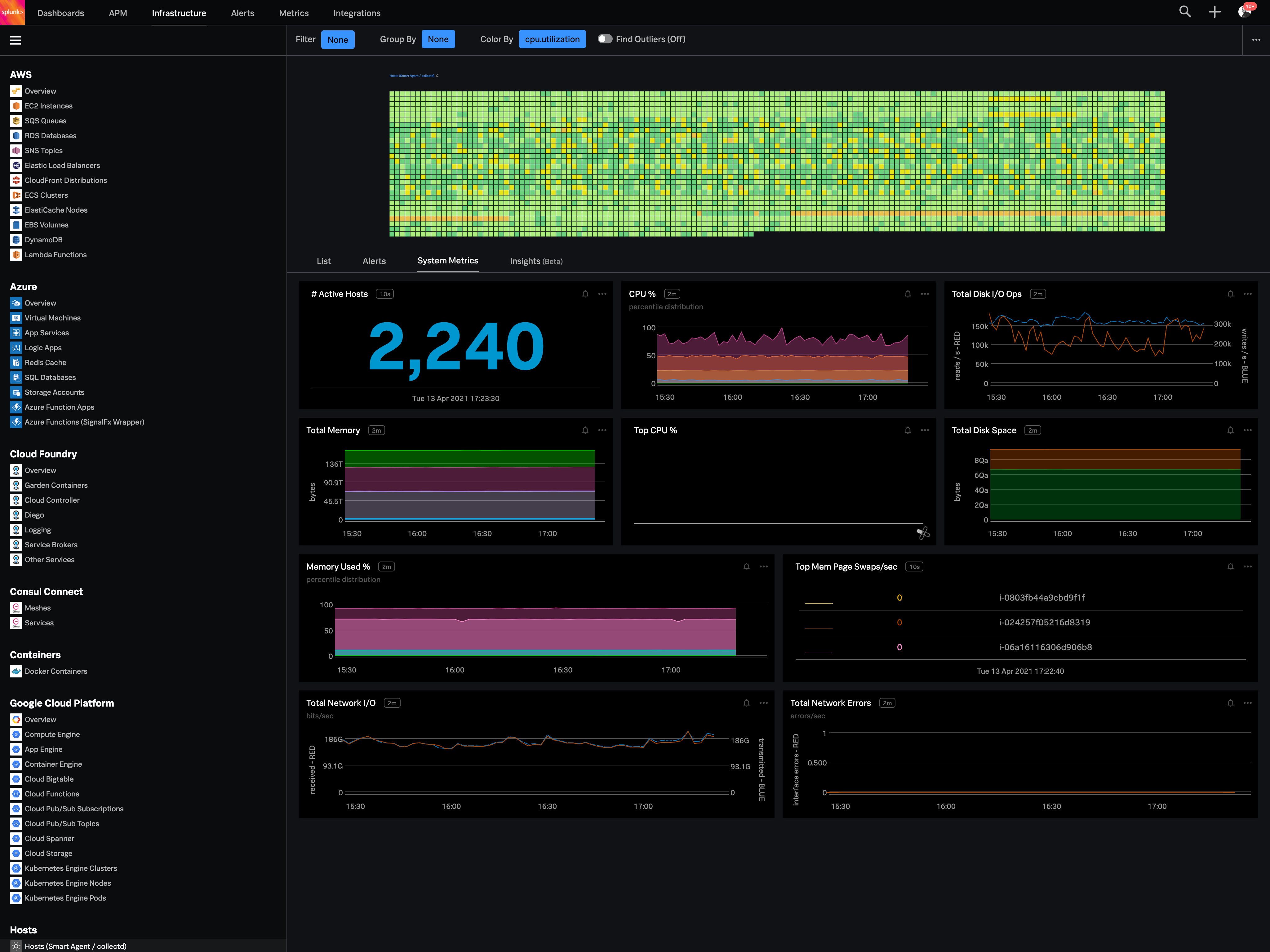
Splunk Observability Cloud aims to enable operational agility and better customer experience through real-time AI-driven streaming analytics allowing accurate alerts in seconds. It is designed to shorten MTTD and MTTR by providing real-time visibility into cloud infrastructure and services.
$180
per year per host
Sumo Logic
Score 8.8 out of 10
N/A
Sumo Logic is a log management offering from the San Francisco based company of the same name.
Splunk Cloud blows Sumo Logic out of the water. The experience is night and day. We went from several highly stressed IT security professionals who were unsure if the data they were getting was valuable, to very happy IT security professionals who can now be more proactive and …
I have selected Splunk Cloud because Sumo Logic is blown away by Splunk Cloud. It's a night and day difference. My experience with Splunk Cloud is faster and more reliable. It consists of more features than Sumo Logic.
SignalFX is a strong competitor in the monitoring SaaS space and provide the basic necessities for production grade monitoring and alerting. Other solutions may offer easier adoption and other helpful features, but will have trouble competing for cost for organizations that …
Sumo Logic works very well out of the gate. For a small business it has given us what we need. I worked at a larger company previously, and we produced so many logs we had to create a custom logging service to handle them all. Cost and availability are big issues when …
We felt the features were comparable and Sumo Logic offered a better price. This was our first log aggregation tool so we don't have a lot of insight for competing products. I speak with many others specifically regarding Splunk and it seems to be comparable in many ways except …
Splunk is excellent when all your data is in one location. Its ability to correlate all that data is intuitive (once the hurdle of learning the query language is overcome). It is also easy to standardize the presentation of information to the company. When data is siloed/standalone, other systems can be cheaper and faster to implement.
Its great if you need real-time visibility across complex or regulated environments. Also strong for hybrid or multi-cloud setups where uptime, observability and fast IR are required. It’s probably overkill for smaller teams or environments that don’t have constant changes or compliance reporting needs. It's expensive and has a steep learning curve. Also, in my opinion, do not get yourself into a consumption based model. Costs can certainly get out of control quickly.
SumoLogic is a fantastic log aggregator and analysis tool, a fine alternative to Splunk. Searching is powerful and mostly intuitive and results come fast. If you have application logs in clusters or Kubernetes pods that lose their logs every time they're restarted, Sumo is the solution for you
This SIEM consolidates multiple data points and offers several features and benefits, creating custom dashboards and managing alert workflows.
Splunk Cloud provides a simple way to have a central monitoring and security solution. Though it does not have a huge learning curve, you should spend some time learning the basics.
Splunk Cloud enables me to create and schedule statistical reports on network use for Management.
The first one is its Kubernetes container monitoring.
I really like this features because as we know how much K8s is vast and to manually monitor each part of the Kubernetes it takes so much time but Splunk Observability Cloud makes it easier. And even once we integrate K8s with Splunk Observability Cloud it gives us some prebuilt dashboards which gives holistic view of our Cluster and its nodes, pods, etc.
The dashbaord feature of Splunk Observability Cloud, it gives us full flexibility to customize our dashboard with a wide range of predefined chart types.
Now it also supports OTEL, which is a plus point for observability. As now everyone is moving towards Otel and in current market there are only few tools who supports OTEL based integrations, Splunk Observability Cloud is one out of them.
Sumo Logic allowed for our InfoSec team to ingest logs from our CDN directly, in real-time, instead of massive compressed archives that were sent every two-hours (the only alternative at the time). Sumo Logic had an app for these logs, that allowed us to easily get an immediate payoff from the data, with canned dashboard and saved searches.
Sumo Logic has a fairly extensive REST API when it comes to log sources, source configurations, dashboard data, searches, etc. Their wiki for the API is usually kept up to date.
Sumo Logic, during the period of time I had used their product, had added the ability to configure agents via configuration files. This allowed customers to configure their endpoints, and modify the endpoints, with configuration management tools like Chef / Puppet / Salt. Beforehand, the only option was to always make changes either via the web portal or REST API.
The solutions engineers were extremely helpful, and easily reachable when issues would occur.
Users at our company found it easy to get started, working on new dashboards, scheduled searches, and alerting. The alerting worked well with our third-party paging tool.
You can use table-like functionality to generate dashboards, but these queries are heavy on the system.
It could be easier to give insight into what type of line parsing is used for specific documents in a company-managed environment and/or show ways to gain the insights needed.
I would like to see ways to anonymize specific data for shared reports without pre-formatting this in a dashboard on which reports could be based.
Good: Stable system with low error rate Easy to use for simple use cases Bad: UI is not very clear for complex usage Mobile view (when logged in from phone) is bad No library for .net
When there is an issue, it’s a win if one can easily identify the root cause. To do the same, it should allow the user to dig deep with multiple data points and compare the data and identify the anomaly. In this use case, it’s good to drive from Splunk 011y.
Sumo Logic is very powerful but definitely requires some configuration work to get the most out of it. You can get a certification related to this, but it is definitely not something you can just throw together.
Splunk Cloud support is sorely lacking unfortunately. The portal where you submit tickets is not very good and is lacking polish. Tickets are left for days without any updates and when chased it is only sometimes you get a reply back. I get the feeling the support team are very understaffed and have far too much going on. From what I know, Splunk is aware of this and seem to be trying to remedy it.
I would give this rating because I attended a free Sumo Logic training at a WeWork in Chicago. I found the training very useful, and I learned a lot of features that I was not aware of before I went to the training. I like the idea that SumoLogic provides free training seminars. I am certified in level1, and I plan on certifying to level2.
I was satisfied with the implementation, as at the time, it was the best way to implement the product with the available feature sets in Sumo Logic. User creation and management became more of an issue during continued use, instead of it being an issue related to deploying the product in our environment.
Search Processing Language really is a game changer for writing easy-to-understand and maintainable queries on your data base logs. Once understood, setting up and validating a query can be done in no time- which leaves us the option to focus on more monitoring and improved services. We have no other tools that utilizes data this efficiently
Splunk Infrastructure Monitoring provides far superior options for anybody using a complex hybrid multi-cloud environment and allows both your SOC and NOC to work together on the same data while driving their own insights. We found other products are still in the old world view of servers and agents residing together within a single data centre, but modern apps are no longer like this.
Sumo Logic works very well out of the gate. For a small business it has given us what we need. I worked at a larger company previously, and we produced so many logs we had to create a custom logging service to handle them all. Cost and availability are big issues when deciding between the different services, whether self maintained and hosted, or provided by another company.