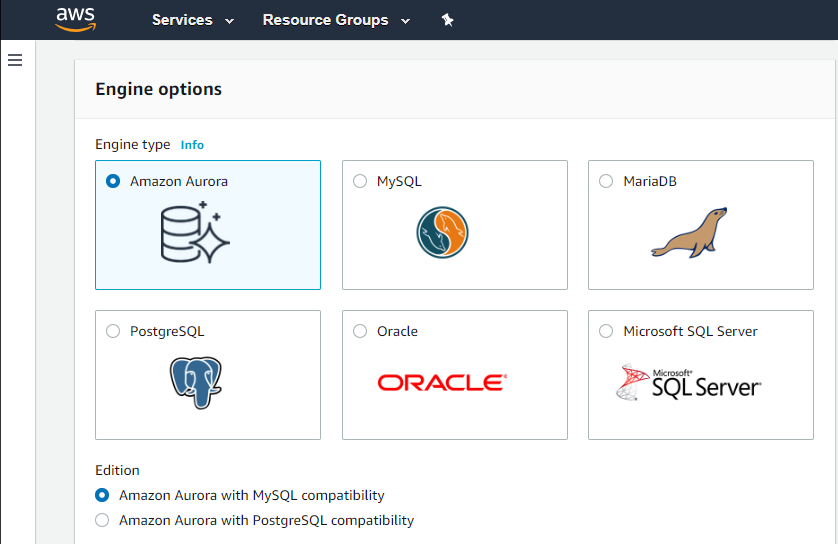
Main advantage of DynamoDB is Amazon's offering as SaaS. This removes the need for managing the database. DynamoDB is well suited for querying simple and flat JSON objects.
Compared to PostgresSQL, I would pick Postgres over Dynamo considering that Postgres is very mature and …
DynamoDB is a natural fit for anyone using the AWS environment for their code. If we were using Google or not tied to anything then Firebase might have been a better choice as it supports pub / sub among other things. It doesn't really act as a cache like redis does, but it can …
Amazon DynamoDB supports larger throughput, with better SLA, also, we are considering unstructured data, so Amazon DynamoDB has become the final decision
Comparing RDS and Dynamo is not fully Apples to Apples comparison. RDS is a more flexible cloud-native solution that supports a wide range of engines that are relational. It is great for running older DB types like Oracle in the Cloud. Because it supports multiple engines, it …
DynamoDB is slightly different than both the above-stated DBs, with RDS being a relational database and Redshift being a data warehouse used for heavier jobs and analytics and vast data. DynamoDB lies in between both, with it being a no SQL base that can relatively store …
Mongo services are outside of our Vpc and are on a different network. Since most of our infra is on AWS, dynamo by AWS was a natural choice. Most of our engineers are familiar with AWS sdk and the console so that brought in a much smaller learning curve for our engineering team
DynamoDB provided an easy to use, schema-less, out of the box solution that can be used to spin up a full working implementation very easily. It doesn't require extra knowledge such as MongoDB query functions
MongoDB vs. Amazon DynamoDB:• MongoDB requires more human management than DynamoDB, which is a fully managed service.• DynamoDB's scalability is automatic, whereas MongoDB's horizontal scaling may require more work.• When compared to DynamoDB, MongoDB offers more extensive data …
We started using DynamoDB because of the AWS ecosystem; it integrates well with everything. The IAM for role management as well. But using MongoDB with other AWS products was not seamless; we had to create custom APIs to make it work. But if the need for your organization is …
MongoDB is mostly document store while Amazon DynamoDB supports both key/value and document store making it more versatile. Azure Cosmos DB is multi-modal like Amazon DynamoDB and it makes more sense when you have data already in Azure Cloud. If you are mostly using AWS then …
We have been preferring DynamoDB over Redis for persistent data. It has a better encryption model and is operationally simpler.
For materialized views we've been using Elasticsearch, but are starting to consider using DynamoDB there too.
When you compare database systems it's easy to have an apples to apples comparison. However, when comparing two No-SQL systems it isn't as easy because they are built with different purposes in mind. DynamoDB has been easier to implement because it comes as a Service from …
I've used SQL and NoSQL solutions, such as MongoDB and MySQL. I would not choose Dynamo to be a primary datastore and one of the others is likely a better option. Dynamo is good as almost viewed as a large cache. If you want something that is more supported and easier to work …
I wish I could speak more towards this, but I did not take the time to evaluate any other options. As I've mentioned earlier in this review, our entire infrastructure is already inside of AWS - we use dozens of their services - so it was a no brainer for us to keep with that …
DynamoDB is more flexible than key-value stores like Redis-flavored Elasticache. They both offer high-availability. Elasticache requires a little more management, and lacks on-demand scaling and pricing. DynamoDB is not a relational database, but can replace RDS for simple …
As a fully managed NoSQL service, DynamoDB provides a lot of functionality for relatively low cost. Scaling, sharding, throughput performance is managed for you, and you only pay for the bandwidth you provision.
9/10 times I would recommend using MongoDB over DynamoDB. The only real benefit of DynamoDB over MongoDB is that it's already deeply nested in the Amazon ecosystem with tight integration with other AWS tools. Working with Amazons sdks is clunky compared to Mongo, it lacks a …
When compared to SQL and many other No SQL databases out in the market, I guess DynamoDB is a perfect stack for developing quick websites. More than that it's highly scalable which is offered by DynamoDB
Sql is much more feature rich yet costly and harder to maintain. Requires physical servers while dynamo everything is in the cloud across multiple AZs. Redis is actually great to put on top of dynamo to use as a read cache which is much faster and cheaper, but the storage and …
Because we have our whole architecure on AWS cloud so to provide close connectivity we have choose AWS RDS and also due to Features offered by AWS RDS.
MongoDB is nosql database and some clients prefer it. In our presentation we try to persuade them to use RDS with its pros and cons. The type of selection depends upon the actual need.
We have a strong preference for AWS managed services, and we find that RDS offers excellent integration with various AWS services, making it a seamless choice for our infrastructure. Furthermore, RDS supports integration with automation tools such as Terraform, enhancing our …
1: If your company is already deeply involved in the AWS ecosystem, such as AWS Lambda, Amazon S3, or Amazon Redshift, leveraging Amazon RDS might result in a more seamless integration of services. AWS offers a broad set of cloud services, which makes it easier to design and …
We prefer RDS to spin up our own MySQL instances via traditional servers, EC2 instances, or containers, and RDS provides all of our DB needs compared to other database products AWS offers. As mentioned, the manageable, operational, security, and reliability features of RDS that …
I've used on-site MSSQL, Oracle, and IBM DB2 as well as MSSQL and postgresql in Azure, and RDS is much easier to setup than any of those aforementioned engines/setups. This includes initial setup, maintenance, security, and configurations. RDS also makes it easy to get …
People use both RDS and Redshift and both allow you to use your traditional database over cloud. But both RDS and Redshift have their own different usages. RDS is particularly suit[ed] for Online Transaction processing systems ( OLTP) whereas, Redshift is used for analytics and …
MS-SQL Server in Azure costs more and/or is slower...but even if you were in a position where the costs were close, you'd still have the fact that Amazon Relational Database Service is more mature and resilient in the Cloud Managed Database environment to tip the scales toward …
It's hard to identify how Amazon RDS stacks up against the databases they support, because to install and use a relational database in a production environment you need a Database Administrator to help install, configure and manage. Amazon RDS keeps the details simple enough …
We mainly used RDS because our infrastructure was already up and running on AWS so the networking between the systems was quite easy to set up and manage. For our Azure infrastructure, we used their SQL database option instead for the same reasons. If AWS made it easier to use …
Our other application components are all hosted within Amazon's systems already, and the tight coupling of RDS with the security groups and virtual private cloud offerings made locking down privacy and security much easier than integrating with an outside provider. The deeper …
Though you could get similar functionality using Docker, Amazon RDS offers a more comprehensive SaaS solution.
With Docker, you still need to have an EC2 instance to install the Docker and manage backup scripts using EC2 snapshots or S3. But RDS provides that solution …
Initially, we planned to move everything to Dynamo DB, however, we had our initial architecture with MySQL, so we thought it would be a good option to migrate and use AWS RDS which seemed to be a good idea actually. I feel the security and the placing it in a VPC, is one …
DynamoDB is a fully managed key-value store by Amazon. It provides more powerful indexing to the tables, which certainly increases the performance if searching is what you need. However, it is also a lot more expensive to use compared to Redis. If your use case is more on the …
We evaluated Oracle and at first it seems competitive but after the contract term pricing would jump. Heard this from business associates and online communities
Couchbase doesn't keep up with what they offer and what really does. MongoDB just doesn't scale out, reads are performed across multiple nodes but writes still go to the single master. DynamoDB is good overall but just way too expensive.
Redis is had higher performance at a cheaper cost than any of these alternatives. The downside is the data is not as durable as these alternatives. Redis is like SQL where you pay of the instance running 24/7 where dynamo and s3 you pay per usage. Redis schema most closely …
It’s great for server less and real-time applications. It would be great for gaming and mobile apps. However, if you need relational database and have fixed budget, do not use it. While budget can be managed, you need to be careful. Also this is not a tool for storing big data, there are other wide-column database types you could use for it ins the ad
If your application needs a relational data store and uses other AWS services, AWS RDS is a no-brainer. It offers all the traditional database features, makes it a snap to set up, creates cross-region replication, has advanced security, built-in monitoring, and much more at a very good price. You can also set up streaming to a data lake using various other AWS services on your RDS.
Redis has been a great investment for our organization as we needed a solution for high speed data caching. The ramp up and integration was quite easy. Redis handles automatic failover internally, so no crashes provides high availability. On the fly scaling scale to more/less cores and memory as and when needed.
Automated Database Management: We use it for streamlining routine tasks like software patching and database backups.
Scalability on Demand: we use it to handle traffic spikes, scaling both vertically and horizontally.
Database Engine Compatibility: It works amazingly with multiple database engines used by different departments within our organization including MySQL, PostgreSQL, SQL Server, and Oracle.
Monitoring: It covers our extensive monitoring and logging, and also has great compatibility with Amazon CloudWatch
Easy for developers to understand. Unlike Riak, which I've used in the past, it's fast without having to worry about eventual consistency.
Reliable. With a proper multi-node configuration, it can handle failover instantly.
Configurable. We primarily still use Memcache for caching but one of the teams uses Redis for both long-term storage and temporary expiry keys without taking on another external dependency.
Fast. We process tens of thousands of RPS and it doesn't skip a beat.
It is a little difficult to configure and connect to an RDS instance. The integration with ECS can be made more seamless.
Exploring features within RDS is not very easy and intuitive. Either a human friendly documentation should be added or the User Interface be made intuitive so that people can explore and find features on their own.
There should be tools to analyze cost and minimize it according to the usage.
We had some difficulty scaling Redis without it becoming prohibitively expensive.
Redis has very simple search capabilities, which means its not suitable for all use cases.
Redis doesn't have good native support for storing data in object form and many libraries built over it return data as a string, meaning you need build your own serialization layer over it.
It's core to our business, we couldn't survive without it. We use it to drive everything from FTP logins to processing stories and delivering them to clients. It's reliable and easy to query from all of our pipeline services. Integration with things like AWS Lambda makes it easy to trigger events and run code whenever something changes in the database.
We do renew our use of Amazon Relational Database Service. We don't have any problems faced with RDS in place. RDS has taken away lot of overhead of hosting database, managing the database and keeping a team just to manage database. Even the backup, security and recovery another overhead that has been taken away by RDS. So, we will keep on using RDS.
We will definitely continue using Redis because: 1. It is free and open source. 2. We already use it in so many applications, it will be hard for us to let go. 3. There isn't another competitive product that we know of that gives a better performance. 4. We never had any major issues with Redis, so no point turning our backs.
Functionally, DynamoDB has the features needed to use it. The interface is not as easy to use, which impacts its usability. Being familiar with AWS in general is helpful in understanding the interface, however it would be better if the interface more closely aligned with traditional tools for managing datastores.
I've been using AWS Relational Database Services in several projects in different environments and from the AWS products, maybe this one together to EC2 are my favourite. They deliver what they promise. Reliable, fast, easy and with a fair price (in comparison to commercial products which have obscure license agreements).
It is quite simple to set up for the purpose of managing user sessions in the backend. It can be easily integrated with other products or technologies, such as Spring in Java. If you need to actually display the data stored in Redis in your application this is a bit difficult to understand initially but is possible.
It works very well across all the regions and response time is also very quick due to AWS's internal data transfer. Plus if your product requires HIPPA or some other regulations needs to be followed, you can easily replicate the DB into multiple regions and they manage all by it's own.
I have only had good experiences in working with AWS support. I will admit that my experience comes from the benefit of having a premium tier of support but even working with free-tier accounts I have not had problems getting help with AWS products when needed. And most often, the docs do a pretty good job of explaining how to operate a service so a quick spin through the docs has been useful in solving problems.
The support team has always been excellent in handling our mostly questions, rarely problems. They are responsive, find the solution and get us moving forward again. I have never had to escalate a case with them. They have always solved our problems in a very timely manner. I highly commend the support team.
The only thing that can be compared to DynamoDB from the selected services can be Aurora. It is just that we use Aurora for High-Performance requirements as it can be 6 times faster than normal RDS DB. Both of them have served as well in the required scenario and we are very happy with most of the AWS services.
Amazon Relational Database Service (RDS) stands out among similar products due to its seamless integration with other AWS services, automated backups, and multi-AZ deployments for high availability. Its support for various database engines, such as MySQL, PostgreSQL, and Oracle, provides flexibility. Additionally, RDS offers managed security features, including encryption and IAM integration, enhancing data protection. The pay-as-you-go pricing model makes it cost-effective. Overall, Amazon RDS excels in ease of use, scalability, and a comprehensive feature set, making it a top choice for organizations seeking a reliable and scalable managed relational database service in the cloud.
We are big users of MySQL and PostgreSQL. We were looking at replacing our aging web page caching technology and found that we could do it in SQL, but there was a NoSQL movement happening at the time. We dabbled a bit in the NoSQL scene just to get an idea of what it was about and whether it was for us. We tried a bunch, but I can only seem to remember Mongo and Couch. Mongo had big issues early on that drove us to Redis and we couldn't quite figure out how to deploy couch.
I have taken one point away due to its size limits. In case the application requires queries, it becomes really complicated to read and write data. When it comes to extremely large data sets such as the case in my company, a third-party logistics company, where huge amount of data is generated on a daily basis, even though the scalability is good, it becomes difficult to manage all the data due to limits.
Some developers see DynamoDB and try to fit problems to it, instead of picking the best solution for a given problem. This is true of any newer tool that people are trying to adopt.
It has allowed us to add more scalability to some of our systems.
As with any new technology there was a ramp up/rework phase as we learned best practices.
Redis has helped us increase our throughput and server data to a growing amount of traffic while keeping our app fast. We couldn't have grown without the ability to easily cache data that Redis provides.
Redis has helped us decrease the load on our database. By being able to scale up and cache important data, we reduce the load on our database reducing costs and infra issues.
Running a Redis node on something like AWS can be costly, but it is often a requirement for scaling a company. If you need data quickly and your business is already a positive ROI, Redis is worth the investment.