JMP® is statistical analysis software with capabilities that span from data access to advanced statistical techniques, with click of a button sharing. The software is interactive and visual, and statistically deep enough to allow users to see and explore data.
$1,320
per year per user
Looker
Score 8.3 out of 10
N/A
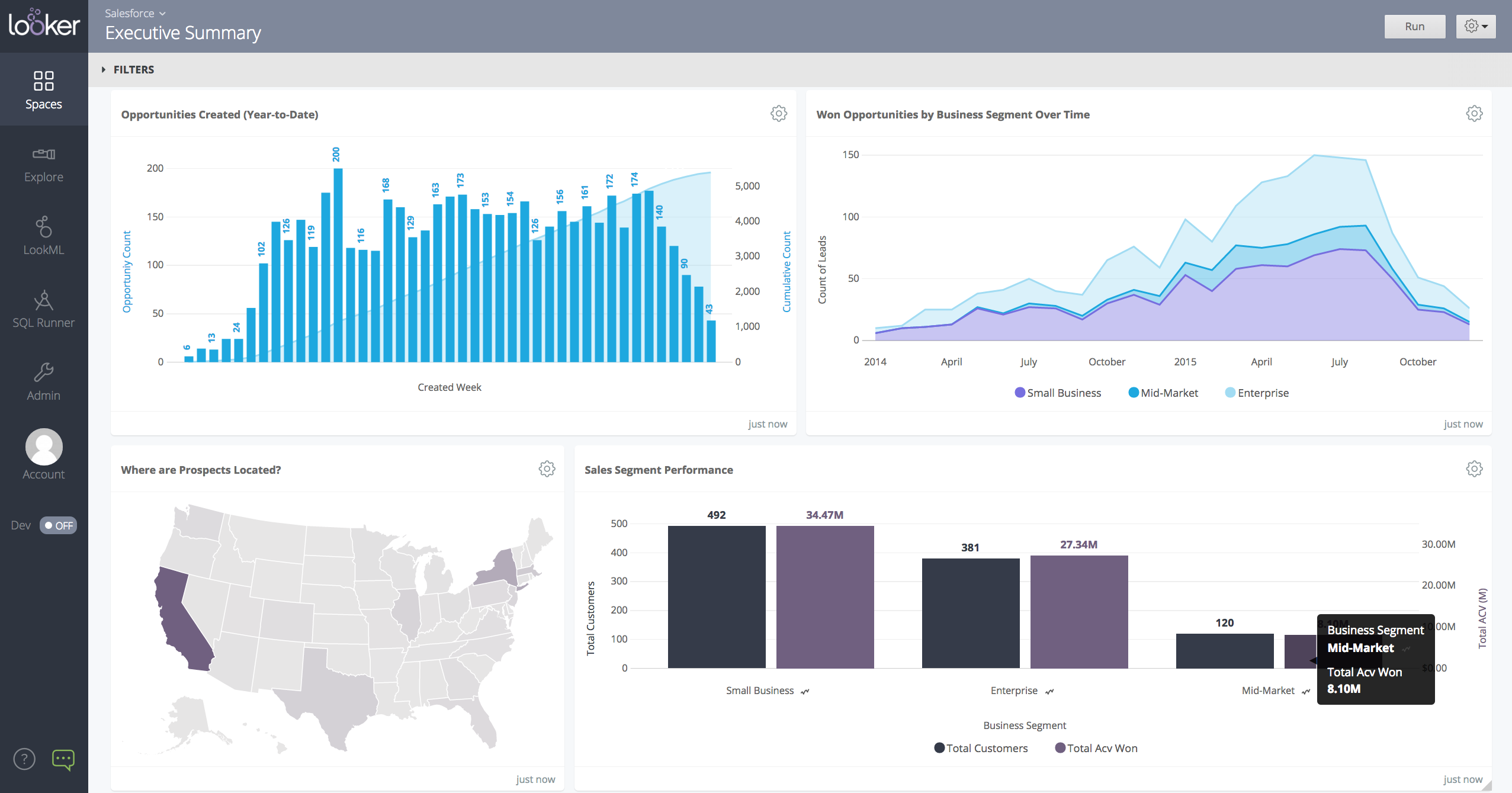
Looker is a BI application with an analytics-oriented application server that sits on top of relational data stores. It includes an end-user interface for exploring data, a reusable development paradigm for data discovery, and an API for supporting data in other systems.
N/A
Pricing
Amazon QuickSight
JMP
Looker
Editions & Modules
Reader
$3
per month per user
Author
$24
per month per user
Reader Pro
$24
per month per user
Author Pro
$50
per month per user
JMP
$1320
per year per user
No answers on this topic
Offerings
Pricing Offerings
Amazon QuickSight
JMP
Looker
Free Trial
Yes
Yes
Yes
Free/Freemium Version
No
No
No
Premium Consulting/Integration Services
No
No
Yes
Entry-level Setup Fee
No setup fee
No setup fee
Required
Additional Details
Prospective buyers can also purchase a set number of sessions or questions in lieu of a monthly subscription.
Bulk discounts available.
Must contact sales team for pricing.
More Pricing Information
Community Pulse
Amazon QuickSight
JMP
Looker
Considered Multiple Products
Amazon QuickSight
No answer on this topic
JMP
No answer on this topic
Looker
Verified User
Engineer
Chose Looker
Looker is more mailable; it allows more dynamic visualisations, filters, drilldowns etc. It's sharing capabilities are also more streamlined than AWS Quicksight. However in contrast to this AWS Quicksight can leverage AWS IAM roles and policies which can be quite scalable. …
Looker provides really excellent customer service in comparison to other similar products. The sharing aspect of Looker is also a big plus, which allows multiple users to access the data at the same time. We have also found it to stand out among competitors with its dashboard …
Amazon Quicksight is a truly cloud-based solution so it works perfectly fine and saves a lot of expense in terms of hardware and maintenance. We can maintain it by ourselves by giving commands on UI. If you have connectivity issues then it can cause headaches because it's a cloud platform and it's a bit costly as compared to other services
It is perfectly suited for statistical analyses, but I would not recommend JMP for users who do not have a statistical background. As previously stated, the learning curve is exceptionally steep, and I think that it would prove to be too steep for those without statistical background/knowledge
When data drives potential for new orders, Looker earns its place in our tech stack. If, on the other hand, we are hoping for pipeline generation, Looker is useful if you are willing to repeatedly go check customer utilizations .... it is not appropriate if you are hoping to automate data analysis for this purpose.
JMP is designed from the ground-up to be a tool for analysts who do not have PhDs in Statistics without in anyway "dumbing down" the level of statistical analysis applied. In fact, JMP operationalizes the most advanced statistical methods. JMP's design is centred on the JMP data table and dialog boxes. It is data focused not jargon-focussed. So, unlike other software where you must choose the correct statistical method (eg. contingency, ANOVA, linear regression, etc.), with JMP you simply assign the columns in a dialog into roles in the analysis and it chooses the correct statistical method. It's a small thing but it reflects the thinking of the developers: analysts know their data and should only have to think about their data. Analyses should flow from there.
JMP makes most things interactive and visual. This makes analyses dynamic and engaging and obviates the complete dependence on understanding p-values and other statistical concepts(though they are all there) that are often found to be foreign or intimidating.
One of the best examples of this is JMP's profiler. Rather than looking at static figures in a spreadsheet, or a series of formulas, JMP profiles the formulas interactively. You can monitor the effect of changing factors (Xs) and see how they interact with other factors and the responses. You can also specify desirability (maximize, maximize, match-target) and their relative importances to find factor settings that are optimal. I have spent many lengthy meetings working with the profiler to review design and process options with never a dull moment.
The design of experiments (DOE) platform is simply outstanding and, in fact, the principal developers of it have won several awards. Over the last 15 years, using methods broadly known as an "exchange algorithm," JMP can create designs that are far more flexible than conventional designs. This means, for example, that you can create a design with just the interactions that are of interest; you can selectively choose those interactions that are not of interest and drop collecting their associated combinations.
Classical designs are rigid. For example, a Box-Benhken or other response surface design can have only continuous factors. What if you want to investigate these continuous factors along with other categorical factors such as different categorical variables such as materials or different furnace designs and look at the interaction among all factors? This common scenario cannot be handled with conventional designs but are easily accommodated with JMP's Custom DOE platform.
The whole point of DOE is to be able to look at multiple effects comprehensively but determine each one's influence in near or complete isolation. The custom design platform, because it produces uniques designs, provides the means to evaluate just how isolated the effects are. This can be done before collecting data because this important property of the DOE is a function of the design, not the data. By evaluating these graphical reports of the quality of the design, the analyst can make adjustments, adding or reducing runs, to optimize cost, effort and expected learnings.
Over the last number of releases of JMP, which appear about every 18 months now, they have skipped the dialog boxes to direct, drag-and-drop analyses for building graphs and tables as well as Statistical Process Control Charts. Interactivity such as this allows analysts to "be in the moment." As with all aspects of JMP, they are thinking of their subject matter without the cumbersomeness associated with having to think about statistical methods. It's rather like a CEO thinking about growing the business without having to think about every nuance and intricacy of accounting. The statistical thinking is burned into the design of JMP.
Without data analysis is not possible. Getting data into a situation where it can be analyzed can be a major hassle. JMP can pull data from a variety of sources including Excel spreadsheets, CSV, direct data feeds and databases via ODBC. Once the data is in JMP it has all the expected data manipulation capabilities to form it for analysis.
Back in 2000 JMP added a scripting language (JMP Scripting Language or JSL for short) to JMP. With JSL you can automate routine analyses without any coding, you can add specific analyses that JMP does not do out of the box and you can create entire analytical systems and workflows. We have done all three. For example, one consumer products company we are working with now has a need for a variant of a popular non-parametric analysis that they have employed for years. This method will be found in one of the menus and appear as if it were part of JMP to begin with. As for large systems, we have written some that are tens of thousands of lines that take the form of virtual labs and process control systems among others.
JSL applications can be bundled and distributed as JMP Add-ins which make it really easy for users to add to their JMP installation. All they need to do is double-click on the add-in file and it's installed. Pharmaceutical companies and others who are regulated or simply want to control the JMP environment can lock-down JMP's installation and prevent users from adding or changing functionality. Here, add-ins can be distributed from a central location that is authorized and protected to users world-wide.
JMP's technical support is second to none. They take questions by phone and email. I usually send email knowing that I'll get an informed response within 24 hours and if they cannot resolve a problem they proactively keep you informed about what is being done to resolve the issue or answer your question.
Show visited pages - sessions, pageviews - which programs are viewed the most.
Displays session source/medium views to see where users are coming from.
It shows the video titles, URLs, and event counts so we can monitor the performance of our videos.
It gives a graphic face to the numbers, such as using bar charts, pie graphs, and other charts to show user trends or which channels are driving engagement.
Our clients like to see the top pages visited for a month.
I like the drop-and-drag approach, and building charts is a little easier than it was before.
In general JMP is much better fit for a general "data mining" type application. If you want a specific statistics based toolbox, (meaning you just want to run some predetermined test, like testing for a different proportion) then JMP works, but is not the best. JMP is much more suited to taking a data set and starting from "square 1" and exploring it through a range of analytics.
The CPK (process capability) module output is shockingly poor in JMP. This sticks out because, while as a rule everything in JMP is very visual and presentable, the CPK graph is a single-line-on-grey-background drawing. It is not intuitive, and really doesn't tell the story. (This is in contrast with a capability graph in Minitab, which is intuitive and tells a story right off.) This is also the case with the "guage study" output, used for mulivary analysis in a Six Sigma project. It is not intuitive and you need to do a lot of tweaking to make the graph tell you the story right off. I have given this feedback to JMP, and it is possible that it will be addressed in future versions.
I've never heard of JMP allowing floating licenses in a company. This will ALWAYS be a huge sticking point for small to middle size companies, that don't have teams people dedicated to analytics all day. If every person that would do problem solving needs his/her own seat, the cost can be prohibitive. (It gets cheaper by the seat as you add licenses, but for a small company that might get no more than 5 users, it is still a hard sell.)
JMP has been good at releasing updates and adding new features and their support is good. Analytics is quick and you don't need scripting/programming experience. It has been used organization wide, and works well in that respect. Open source means that there are concerns regarding timely support. Cheap licensing and easy to maintain.
I give it this rating because it deems as effective, I am able to complete majority of my tasks using this app. It is very helpful when analyzing the data provided and shown in the app and it's just overall a great app for Operational use, despite the small hiccups it has (live data).
It was helping us a lot as per our business needs. Reporting is way easy with QuickSight that helps us to understand the performance of campaigns effectively and so does the performance of sales individual. We can analyze the data and create a new strategies effectively. Setup and maintenance was way easy
The GUI interface makes it easier to generate plots and find statistics without having to write code. The JSL scripting is a bit of a steep learning curve but does give you more ability to customize your analysis. Overall, I would recommend JMP as a good product for overall usability.
Looker is relatively easy to use, even as it is set up. The customers for the front-end only have issues with the initial setup for looker ml creations. Other "looks" are relatively easy to set up, depending on the ETL and the data which is coming into Looker on a regular basis.
Somehow resources heavy, both on server and client. I recommned at least 50Mbs data rate and high performance desktop comouter to be abke to run comolex tasks and configure larger amount of data. On the other hand, the client does not need to worry when viewing, the performance is usually ok
Support is great and give ease of contact, rapid response, and willingness to 'stick to the task' until resolution or acknowledgement that the problem would have to be resolved in a future build. Basically, one gets the very real sense that another human being is sensitive to your problems - great or small.
Never had to work with support for issues. Any questions we had, they would respond promptly and clearly. The one-time setup was easy, by reading documentation. If the feature is not supported, they will add a feature request. In this case, LDAP support was requested over OKTA. They are looking into it.
All of the other reporting platforms my organization has used previously were within our CRM and not a standalone program. In that we were very limited in being able to slice and dice the data the way that we wanted to
MS Excel with AnalysisToolPak provides a home-grown solution, but requires a high degree of upkeep and is difficult to hand off. Minitab is the closes competitor, but JMP is better suited to the production environment, roughly equivalent in price, and has superior support.
Looker Studio, you can easily report on data from various sources without programming. Looker Studio is available at no charge for creators and report viewers. Enterprise customers who upgrade to Looker Studio Pro will receive support and expanded administrative features, including team content management. So it's good.
ROI: Even if the cost can be high, the insights you get out of the tool would definitely be much more valuable than the actual cost of the software. In my case, most of the results of your analysis were shown to the client, who was blown away, making the money spent well worth for us.
Potential negative: If you are not sure your team will use it, there's a chance you will just waste money. Sometimes the IT department (usually) tries to deploy a better tool for the entire organization but they keep using the old tool they are used too (most likely MS Excel).
Looker has a poignant impact on our business's ROI objectives. As an advertising exchange we have specific goals for daily requests and fill, and having premade Looks to monitor this is an integral piece of our operational capability
To facilitate an efficient monthly billing cycle in our organization, Looker is essential to track estimated revenue and impression delivery by publisher. Without the Looks we have set up, we would spend considerably more time and effort segmenting revenue by vertical.
Looker's unique value proposition is making analytical tools more digestible to people without conventional analytical experience. Other competing tools like Tableau require considerably more training and context to successfully use, and the ability to easily plot different visualizations is one of its greatest selling points.