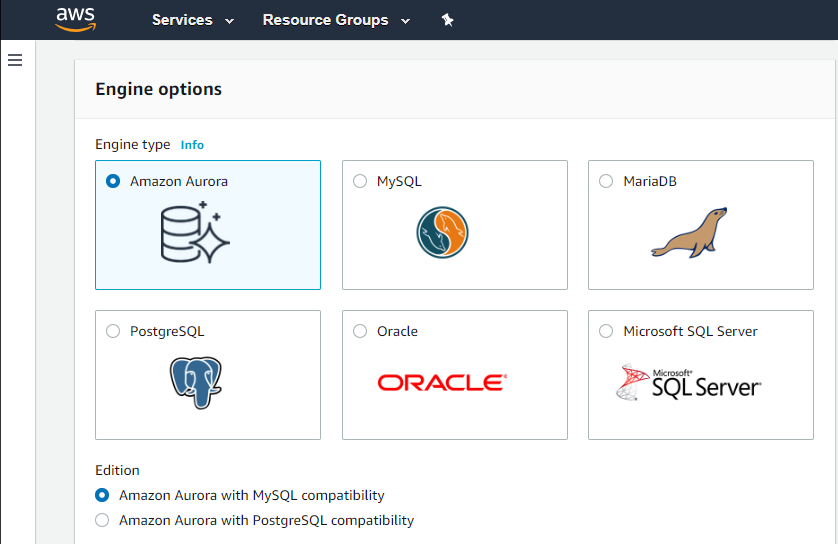
Amazon Relational Database Service (Amazon RDS) is a database-as-a-service (DBaaS) from Amazon Web Services.
N/A
MySQL
Score 8.3 out of 10
N/A
MySQL is a popular open-source relational and embedded database, now owned by Oracle.
N/A
Oracle Database
Score 8.4 out of 10
N/A
Oracle Database, currently in edition 23ai, is a converged, multimodel database management system. It is designed to simplify development for AI, microservices, graph, document, spatial, and relational applications.
$0.05
per hour
Pricing
Amazon Relational Database Service (RDS)
MySQL
Oracle Database
Editions & Modules
Amazon RDS for PostgreSQL
$0.24 ($0.48)
per hour, R5 Large (R5 Extra Large)
Amazon RDS for MariaDB
$0.25 ($0.50)
per hour, R5 Large (R5 Extra Large)
Amazon RDS for MySQL
$0.29 ($0.58)
per hour, R5 Large (R5 Extra Large)
Amazon RDS for Oracle
$0.482 ($0.964)
per hour, R5 Large (R5 Extra Large)
Amazon RDS for SQL Server
$1.02 ($1.52)
per hour, R5 Large (R5 Extra Large)
No answers on this topic
Oracle Base Database Service - Standard
$0.0538
per hour
Oracle Base Database Service - Enterprise
$0.1075
per hour
Oracle Base Database Service - High Performance
$0.2218
per hour
Standard Edition
Contact Sales
Enterprise Edition
Contact Sales
Personal Edition
Contact Sales
Offerings
Pricing Offerings
Amazon RDS
MySQL
Oracle Database
Free Trial
No
No
Yes
Free/Freemium Version
No
No
Yes
Premium Consulting/Integration Services
No
No
No
Entry-level Setup Fee
Optional
No setup fee
No setup fee
Additional Details
—
—
—
More Pricing Information
Community Pulse
Amazon Relational Database Service (RDS)
MySQL
Oracle Database
Considered Multiple Products
Amazon RDS
Verified User
Engineer
Chose Amazon Relational Database Service (RDS)
We've evaluated using [Amazon Relational Database Service (RDS)] against same-capability configurations with MySQL/MariaDB, PostgreSQL, and even Amazon Redshift (though, we haven't evaluated redshift in quite some time). Assuming RDS checks all the boxes for the requirements of …
We used to have On-Premises servers with Microsoft SQL Server and MySQL databases. We used that for years, and we had a hard time and a lot of work involved in securing and updating the server. And not no mention that growth involves a lot of calculations and extra costs. …
At first GCP was considered, but it not very intuitive to use and maintain. We then wanted to run MySQL instances on EC2, which would have been a little cost effective but having limited man power and hassle of patching, scaling and backup led us to select more managed service.
Oracle Database can be more expensive in comparison to Amazon RDS. This may be because of licensing fees. Installation can be a bit messy and take longer than necessary. The user interface could also use some work when compared to Amazon RDS. Some companies will need a DBA to …
Oracle Autonomous Database is designed for Oracle Database workloads, making it suitable for organizations with existing Oracle investments. RDS supports various database engines. Autonomy and Automation: Oracle Autonomous Database places a strong emphasis on automation for …
These tools are not necessarily competing products. They integrate seamlessly once identity access is established and used to easily manage and support our MySQL RDS instances.
Running MySQL RDS was a simpler solution than running standalone MySQL servers as the semi-managed nature of RDS saved us the need to install, maintain, secure, and backup our database servers. Using MySQL RDS was in addition to running MongoDB Atlas workloads and allowed us to …
Installing, configuring, and managing Oracle Database can be challenging, especially for people who are new to Oracle products. Longer learning curves and higher operational overhead can be caused by this complexity. Amazon Relational Database Service is easy to understand and …
In a few words, we are just to confortable working with oracle and sql server. Using RDS add another layer of distributed database in order to backup everything we have in case of a disaster and also complies with authorities locally and internacionally. All database we use, …
With the latest serverless technology Amazon Relational Database Service (RDS) has an edge over all its competitors, it works really fast with high log retention.
MongoDB is nosql database and some clients prefer it. In our presentation we try to persuade them to use RDS with its pros and cons. The type of selection depends upon the actual need.
Earlier we were using the Azure Ecosystem but we faced some issues in DevOps side so we decided to migrate towards some other reliable infra so we migrated all our engines, RDS and other services to Amazon Relational Database Service (RDS) and from that time we are using this. …
Every traditional rational Database requires server installation & accessing needs to be monitored periodically manually. But Amazon provides easy-to-access and monitor health and scale-up and scale-down option just by clicks without adding any additional hardware.
amazon provides wide range of support for multiple database engines so we dont have to look for any other providers integration with aws ecosystem so we can seemlessly use other aws services connected to database aws have data points globally so it if data needs to be in …
[Amazon Relational Database Service (RDS)] is much better to have everything in the cloud instead of having it on-premise once you can get all the benefits from Cloud. Of course, it can be a bit expensive if your company it's not growing anymore but if you check it in detail, …
Actually you can have most of these tools through AWS Relational Database Service as they are basically those technologies provided as a service. It is way better to have those products provided as a service through a huge and reliable infrastructure like AWS.
It's hard to identify how Amazon RDS stacks up against the databases they support, because to install and use a relational database in a production environment you need a Database Administrator to help install, configure and manage. Amazon RDS keeps the details simple enough …
RDS implements the databases we were interested in and allows us to focus on the application and not the management. AWS handles setting up the server and the database as well as upgrading the software when necessary. Security is simple, using security groups to allow or deny …
MySQL offers some of the features as Oracle Database 12c, however, there are many crucial ones that are missed. Features such as OLAP, really make Oracle Database 12c a clear winner here. We use both databases in our organization for separate reasons, MySQL for prototyping, and …
Of course compare to no SQL databases it's slower but there is a completely different use case for them... In my opinion it is better than PostgreSQL, it's easier to configure and has the same performance, or approximately the same. Of course Oracle Database is a way bigger …
MySQL provides the option to reduce support and maintenance cost when P0 Level 1 support is not really needed for databases used for noncritical use cases and workloads. Other versions that include Microsoft SQL, Amazon RDS, etc don't provide such options and are overkill. …
MySQL was the first option due to the existing knowledge, and after using other databases, it also appeared to be the most predictable in terms of costs
Rest all the big brand databases incure high licensing cost giving almost the same value that MySQL is giving being an open source database. Other databases like Oracle, MS SQL servers need extensive resource along with a huge team to manage those databases. However, thats not …
We chose MySQL because of its open-source nature and its compatibility with various systems, languages, and databases. It is easy to use and fast. Additionally, it has been in the market for more than 30 years now which makes it a reliable option when compared to its …
As I have been commenting in our company, we have solved our performance problems and responses obtaining speed in the queries occupies less disk space, in addition to its price and all the tools of great Scope it possesses.
Having used both PostgreSQL and Microsoft SQL Server, I can tell that MySQL performs admirably in a Linux setting. When compared to Microsoft SQL Server, the extra benefit is the minimal or nonexistent licence fee. We find that MySQL's programming interface is particularly …
Before MySQL, our team was exploring and evaluating different options for a good RDMS (relational database management system) service. We explored Oracle, MSSQL, and Google BigQuery. Most of these are costly and not easy to maintain in the long run in terms of price especially …
MySQL has most of the functionality of other, very costly, alternatives without the big price tag. It is open-source with improvements coming at a relatively good rate. It is not as robust as those other offerings and can have some challenging points at scale for large …
Microsoft SQL can be considered as an enterprise level software since it is recommended for large businesses. Microsoft SQL has some unique categories like big data processing, DBMS, etc. whereas MySQL is not capable of handling such features. I guess this is how these both …
I would choose Oracle 11g, 12c for more complex ventures which require financials and complex logic. I would choose MySQL for simpler applications which simply need to interface data to a backend. I selected MySQL in this case because it is free and much simpler to install—it …
Familiarity: With MySQL, I know what to expect, and that goes a long way. Also, since it adheres fairly close to SQL '92, It's relatively easy to construct queries, views, etc. without a steep learning curve. Also, RAM usage is important (this is true of any RDBMS …
After Oracle bought MySQL, I have pivoted some projects to use MariaDB instead, which is a fork of MySQL and maintained by the community and original developers of MySQL. This is free under the GNU GPL, and is not impacted by decisions Oracle makes for MySQL. RDS has the …
We have used Oracle as our clinical databases that stores patient records. In this project we didn't used Oracle but separately built MySQL based data infrastructure as this is an independent scientific research project. Oracle is great overall, with most of functionalities …
MySQL has it's pros / cons. The best things about MySQL are that it is open-source/free and has such a vast community of users. If you want a free database MySQL is the quickest to use, but if you're trying to build a strong foundation for your company, I prefer Postgres. If …
MySQL is a standard across many industries and is familiar to most developers as a result. When comparing to something like MongoDB, most developers are more familiar and comfortable with MySQL. When comparing to something like Oracle, MySQL clearly wins in the expense …
I've used both Oracle and MySQL. I like both database technologies. Both of them provide great solutions. Each one has their own benefits based on the requirement and right environment. The point is to find the right environment to use and compare price/performance/scalability.
There are so many SQL solutions, it's difficult to compare them all. MySQL has a huge community and suite of tools to help it. However, it doesn't have quite the upside as the paid solutions. It's comparable to something like Postgres and all depends on the tools and support …
MySQL does not provide anywhere near the user interface or features that Oracle Database 12c provides. Building REST endpoints on MySQL is a much more challenging process and integrating it with a web app is much more complicated than building an ORDS endpoint within the Oracle …
We currently use all of the above database technologies in different applications, but where the application is mission-critical we use Oracle. Microsoft SQL Server is good for canned applications such as back-office or HR. MySQL does not have the same level of logging or …
IBM DB2 is extremely heavy as compared to Oracle and is expensive for the price we pay for the product. MySQL doesn’t have most of the features that Oracle has.
Oracle is placed in a good spot against its competitors. It has advantages over its competitors in its legacy stability and high availability. A common engine to handle relational, JSON, Vector, and graph data makes it more cost-effective. Given all the good features, the …
The Oracle database was selected before I started working on the project, so I can't tell the reasons behind the choice. However, it was recognized as the best suited for holding several million records for related entities and was preferred over NoSQL options.
Oracle 12c is good for all business applications but still consider Microsoft SQLServer for internal/other applications to save on cost.
Verified User
Consultant
Chose Oracle Database
Oracle Database is best in business, consistent, and robust. Even the standard version is sufficient for the best performance. The main thing is I have never seen corruption and in my opinion, it is best when used with Linux.
Verified User
Engineer
Chose Oracle Database
Microsoft SQL is just as stable and almost as sellable with a much lower cost of ownership (staff and licensing). But as our primary application doesn't support Microsoft SQL we had to license Oracle.
Exadata is expensive and we decided to switch to 12c for the sake of consolidating and keep up with Oracles initiative to move towards cloud. Maybe in the future.
Oracle is more of an enterprise-level database than Access and SAP Adaptive Server Enterprise isn't getting developed much (some people wonder how close it is to end of life) but SQL Server is miles ahead of Oracle IMO in terms of user experience and comparable in terms of …
Oracle 12c is able to support daily operations that might be required. Of course, Exadata is a powerful machine that is definitely fit for big scale but requires high demand of both CPU, IO, and memory processing. Also the one engineered system saves lots of time to build the …
It's the Oracle Support that beats everything else, and a solid contract. Also, all the other features that support Oracle are way ahead of other products.
Oracle completed solution and support is of cause better than open source solutions, we also choose other NoSQL database and Graph database, to address some very particular business use cases
It's easy to scale an Oracle database compared to any others, it's easy to manage many Oracle databases together with lots of administrative and security features.
1. The commercial application required an Oracle database running at the back end 2. Existing Oracle expertise makes it easy to manage an Oracle database 3. Confidence in Oracle databases: No need to worry about performance, scalability.
For some implementations in my company, Oracle Database was selected because all the support, experience, features, continuing development, etc that the product and Oracle's company has been providing so far, but also, it was selected by the system's company that my …
If your application needs a relational data store and uses other AWS services, AWS RDS is a no-brainer. It offers all the traditional database features, makes it a snap to set up, creates cross-region replication, has advanced security, built-in monitoring, and much more at a very good price. You can also set up streaming to a data lake using various other AWS services on your RDS.
MySQL is best suited for applications on platform like high-traffic content-driven websites, small-scale web apps, data warehouses which regards light analytical workloads. However its less suited for areas like enterprise data warehouse, OLAP cubes, large-scale reporting, applications requiring flexible or semi-structured data like event logging systems, product configurations, dynamic forms.
We migrated from NoSQL to an Oracle database. One of the reasons was robust backup and recovery options available in the Oracle database, which provide zero data loss. A transactional database like Oracle is a better fit for our use case than NoSQL. On a large scale, deployment was evaluated as a cheaper option than the NoSQL engine. This conclusion came even after considering Oracle license is expensive.
Automated Database Management: We use it for streamlining routine tasks like software patching and database backups.
Scalability on Demand: we use it to handle traffic spikes, scaling both vertically and horizontally.
Database Engine Compatibility: It works amazingly with multiple database engines used by different departments within our organization including MySQL, PostgreSQL, SQL Server, and Oracle.
Monitoring: It covers our extensive monitoring and logging, and also has great compatibility with Amazon CloudWatch
It is a little difficult to configure and connect to an RDS instance. The integration with ECS can be made more seamless.
Exploring features within RDS is not very easy and intuitive. Either a human friendly documentation should be added or the User Interface be made intuitive so that people can explore and find features on their own.
There should be tools to analyze cost and minimize it according to the usage.
Learning curve: is big. Newbies will face problems in understanding the platform initially. However, with plenty of online resources, one can easily find solutions to problems and learn on the go.
Backup and restore: MySQL is not very seamless. Although the data is never ruptured or missed, the process involved is not very much user-friendly. Maybe, a new command-line interface for only the backup-restore functionality shall be set up again to make this very important step much easier to perform and maintain.
We do renew our use of Amazon Relational Database Service. We don't have any problems faced with RDS in place. RDS has taken away lot of overhead of hosting database, managing the database and keeping a team just to manage database. Even the backup, security and recovery another overhead that has been taken away by RDS. So, we will keep on using RDS.
For teaching Databases and SQL, I would definitely continue to use MySQL. It provides a good, solid foundation to learn about databases. Also to learn about the SQL language and how it works with the creation, insertion, deletion, updating, and manipulation of data, tables, and databases. This SQL language is a foundation and can be used to learn many other database related concepts.
There is a lot of sunk cost in a product like Oracle 12c. It is doing a great job, it would not provide us much benefit to switch to another product even if it did the same thing due to the work involved in making such a switch. It would not be cost effective.
I've been using AWS Relational Database Services in several projects in different environments and from the AWS products, maybe this one together to EC2 are my favourite. They deliver what they promise. Reliable, fast, easy and with a fair price (in comparison to commercial products which have obscure license agreements).
I give MySQL a 9/10 overall because I really like it but I feel like there are a lot of tech people who would hate it if I gave it a 10/10. I've never had any problems with it or reached any of its limitations but I know a few people who have so I can't give it a 10/10 based on those complaints.
Many of the powerful options can be auto-configured but there are still many things to take into account at the moment of installing and configuring an Oracle Database, compared with SQL Server or other databases. At the same time, that extra complexity allows for detailed configuration and guarantees performance, scalability, availability and security.
I have only had good experiences in working with AWS support. I will admit that my experience comes from the benefit of having a premium tier of support but even working with free-tier accounts I have not had problems getting help with AWS products when needed. And most often, the docs do a pretty good job of explaining how to operate a service so a quick spin through the docs has been useful in solving problems.
We have never contacted MySQL enterprise support team for any issues related to MySQL. This is because we have been using primarily the MySQL Server community edition and have been using the MySQL support forums for any questions and practical guidance that we needed before and during the technical implementations. Overall, the support community has been very helpful and allowed us to make the most out of the community edition.
1. I have very good experience with Oracle Database support team. Oracle support team has pool of talented Oracle Analyst resources in different regions. To name a few regions - EMEA, Asia, USA(EST, MST, PST), Australia. Their support staffs are very supportive, well trained, and customer focused. Whenever I open Oracle Sev1 SR(service request), I always get prompt update on my case timely. 2. Oracle has zoom call and chat session option linked to Oracle SR. Whenever you are in Oracle portal - you can chat with the Oracle Analyst who is working on your case. You can request for Oracle zoom call thru which you can share the your problem server screen in no time. This is very nice as it saves lot of time and energy in case you have to follow up with oracle support for your case. 3.Oracle has excellent knowledge base in which all the customer databases critical problems and their solutions are well documented. It is very easy to follow without consulting to support team at first.
Overall the implementation went very well and after that everything came out as expected - in terms of performance and scalability. People should always install and upgrade a stable version for production with the latest patch set updates, test properly as much as possible, and should have a backup plan if anything unexpected happens
Amazon Relational Database Service (RDS) stands out among similar products due to its seamless integration with other AWS services, automated backups, and multi-AZ deployments for high availability. Its support for various database engines, such as MySQL, PostgreSQL, and Oracle, provides flexibility. Additionally, RDS offers managed security features, including encryption and IAM integration, enhancing data protection. The pay-as-you-go pricing model makes it cost-effective. Overall, Amazon RDS excels in ease of use, scalability, and a comprehensive feature set, making it a top choice for organizations seeking a reliable and scalable managed relational database service in the cloud.
MongoDB has a dynamic schema for how data is stored in 'documents' whereas MySQL is more structured with tables, columns, and rows. MongoDB was built for high availability whereas MySQL can be a challenge when it comes to replication of the data and making everything redundant in the event of a DR or outage.
Because of a rich user base and support for any critical issue, this is one of the best options to choose. In case the project has a TCO issue, it can compromise and choose Postgres as the best alternative. SQL server is also good and easy to code and maintain but performance is not as good as the Oracle