Amplitude Analytics is an analytics platform for mobile and web. It is designed to help organizations segment users and analyze funnels, retention and revenue. Amplitude Analytics helps product marketers to achieve actionable insights from customer digital journeys and uses behavioral graphs to build customer-focused products. Amplitude also optimizes digital products for increased quality engagements, increased conversion rates, and long-term customer loyalty.
$61
per month
Looker
Score 8.2 out of 10
N/A
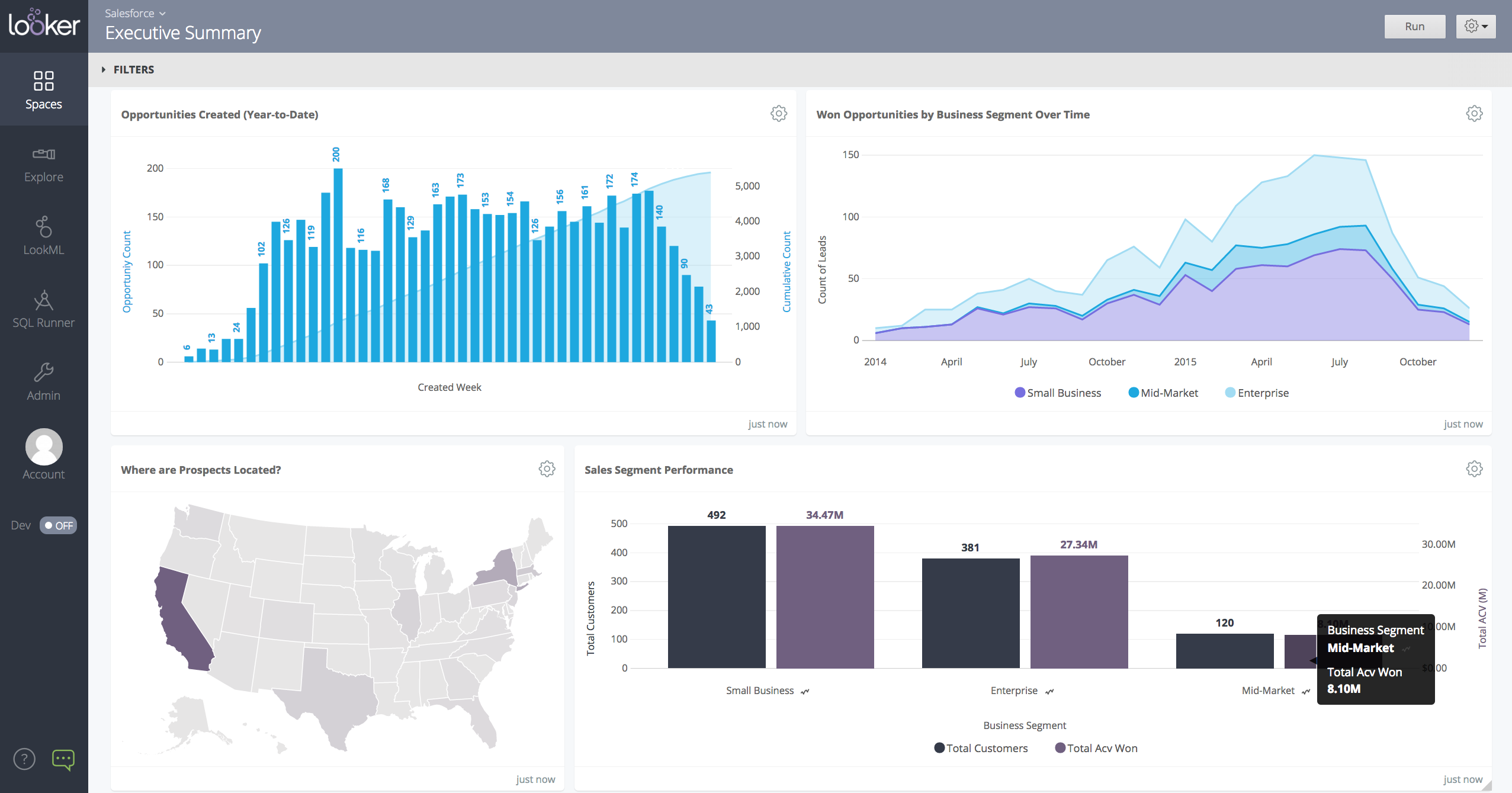
Looker is a BI application with an analytics-oriented application server that sits on top of relational data stores. It includes an end-user interface for exploring data, a reusable development paradigm for data discovery, and an API for supporting data in other systems.
N/A
Pricing
Amplitude Analytics
Looker
Editions & Modules
Plus
$49
per month (paid annually)
Growth
Contact Sales
Enterprise
Contact Sales
Starter
Free
No answers on this topic
Offerings
Pricing Offerings
Amplitude Analytics
Looker
Free Trial
No
Yes
Free/Freemium Version
Yes
No
Premium Consulting/Integration Services
Yes
Yes
Entry-level Setup Fee
No setup fee
Required
Additional Details
—
Must contact sales team for pricing.
More Pricing Information
Community Pulse
Amplitude Analytics
Looker
Considered Both Products
Amplitude Analytics
Verified User
Program Manager
Chose Amplitude Analytics
I find Amplitude much easier to use than Mixpanel or GA are. The UX is easy to grasp and as long as you have an intuitive set-up or good documentation on how your events are set up it makes for quick onboarding. Looker does a better job of easily allowing customization with SQL …
I would say it's largely different; Looker was able to be embedded directly into the platform and was valuable for people creating their own dashboards whereas Amplitude is more valuable for understanding usage, performance, and health of the platform itself -- more for …
Amplitude Analytics is an excellent solution for anyone with a mobile app and you want to track what users are doing, are they completing conversion steps, and are they coming back more often. This all helps you visual your customer bases engagement and help project future engagement and create goals. This also helps with prioritizing products to address drop-off points in the product to increase conversions.
When data drives potential for new orders, Looker earns its place in our tech stack. If, on the other hand, we are hoping for pipeline generation, Looker is useful if you are willing to repeatedly go check customer utilizations .... it is not appropriate if you are hoping to automate data analysis for this purpose.
Show visited pages - sessions, pageviews - which programs are viewed the most.
Displays session source/medium views to see where users are coming from.
It shows the video titles, URLs, and event counts so we can monitor the performance of our videos.
It gives a graphic face to the numbers, such as using bar charts, pie graphs, and other charts to show user trends or which channels are driving engagement.
Our clients like to see the top pages visited for a month.
I like the drop-and-drag approach, and building charts is a little easier than it was before.
Some offerings seem duplicative, like dashboards and notebooks, which only seem to differ in that one can subscribe to dashboards
The messaging on valid vs invalid property types could be better explained to clarify which types (string, Boolean, integer, etc) are expected in particular scenarios. Though the type is usually set during event creation, we've often seen examples where the data received in production is different, leading to 'invalid type' errors
Great product Good value for the cost/initiate Support docs and FAQs are great - they limit the necessity of reaching out to in-person support. So when you do call them ... it is for a legit question/issue, no just a "where is it" or a "how to I do xyz123?"
I give it this rating because it deems as effective, I am able to complete majority of my tasks using this app. It is very helpful when analyzing the data provided and shown in the app and it's just overall a great app for Operational use, despite the small hiccups it has (live data).
It's a fairly straightforward platform that's beginner friendly. The biggest usability hurdle is most often created by your own team, as it's imperative to know what event sources are being sent to Amplitude and what those event names are. Within being properly onboarded by a team member it can be hard to get started using Amplitude. It takes time to understand what data your company may be sending to the product, the naming conventions of events (especially if there are old or deprecated events names
Looker is relatively easy to use, even as it is set up. The customers for the front-end only have issues with the initial setup for looker ml creations. Other "looks" are relatively easy to set up, depending on the ETL and the data which is coming into Looker on a regular basis.
Alway up and running, or if there is a problem we can get back in the game right away. The reliability was a big selling point for me, and it was true when this company got it. Rollouts can be tough, but this was pretty seamless. Good support throughout the process, good documentation to handle questions/tips
No issues, problems, or negative remarks from us!! We had a plan, vendor support was rock solid, our data folks have experience, OCM supported as needed, and we got the rollout done on time, on budget, and with only minor hiccups. SInce the rollout, most of us have already forgotten the hiccups and generally speak highly of the product
Somehow resources heavy, both on server and client. I recommned at least 50Mbs data rate and high performance desktop comouter to be abke to run comolex tasks and configure larger amount of data. On the other hand, the client does not need to worry when viewing, the performance is usually ok
I haven't used the Amplitude support other than their training docs so I can't speak too much to the in-person support but the docs are serviceable. Nothing too crazy but between the user tips, email notifications, and the decent number of docs I was able to get the support I needed to ramp up on the tool.
Never had to work with support for issues. Any questions we had, they would respond promptly and clearly. The one-time setup was easy, by reading documentation. If the feature is not supported, they will add a feature request. In this case, LDAP support was requested over OKTA. They are looking into it.
Virtual Not bad considering the timeframe and turnaround. The biggest benefit was for my end-users to hear a voice (other than mine/ours! LOL) telling them about the new features and capabilities. The in-person training was really good for having an expert that knows the answers and could refer to past experiences, problems, solutions. THey were a great resource to ease the transition ... basically a "you are gonna be okay with this change ... you got this etc.!" kinda vibe
Good enough to get strong baseline. I always make sure our our users go to and/or focus on the vebndor-provided support docs rather than any formal training. Our instructors come and go, but written policy and how-to docs live much longer in a corporate setting. That said, the online training is sufficient. I like that the training curric is stacked and progressive.
My team members all have background as data analysts, so Amp was pretty easy to for them. There was sufficient online training available. We also used the available support documents. The actual rollout went well. We did significant testing beforehand. We did a phased rollout, with partial silent rollout (part of OCM's plan) for the smallest line of business. THe silent one was "silent" b/c it was done without fanfare or public notices ... it was just a "we're doing some things, it wont impact your work or workday
Amplitude Analytics provides much more granular data than Google Analytics and gives you much more flexibility in how you can segment and splice the data. It also provides the ability to create closed funnels, which I have yet to find out how to do in Google Analytics. Amplitude has a very similar interface to Mixpanel, with a few handy additions, like the ability to name and categorize your events.
Looker Studio, you can easily report on data from various sources without programming. Looker Studio is available at no charge for creators and report viewers. Enterprise customers who upgrade to Looker Studio Pro will receive support and expanded administrative features, including team content management. So it's good.
Like all the other grades, it was mostly an easy implementation ... we have experience people, the rollout in general is well planned, and the vendor was very supportive
Looker has a poignant impact on our business's ROI objectives. As an advertising exchange we have specific goals for daily requests and fill, and having premade Looks to monitor this is an integral piece of our operational capability
To facilitate an efficient monthly billing cycle in our organization, Looker is essential to track estimated revenue and impression delivery by publisher. Without the Looks we have set up, we would spend considerably more time and effort segmenting revenue by vertical.
Looker's unique value proposition is making analytical tools more digestible to people without conventional analytical experience. Other competing tools like Tableau require considerably more training and context to successfully use, and the ability to easily plot different visualizations is one of its greatest selling points.