Anaplan is a scenario planning and analysis platform designed to optimize decision-making in complex business environments so that enterprises can outpace their competition and the market. By building connections and collaboration across organizational silos, the Anaplan platform surfaces key insights.
N/A
Workday Adaptive Planning
Score7.8 out of 10
Mid-Size Companies (51-1,000 employees)
Workday Adaptive Planning streamlines planning workflows, using AI and real-time data integration to improve collaboration and provide predictive forecasts for better strategic analysis.
Senior Consultant in Information Technology at Deloitte India (Offices of the US) (Information Technology & Services, 5001-10,000 employees)
Chose Anaplan
Anaplan is more flexible and agile to implement and can be customized to the requirements as it comes as a completely blank slate with no predefined templates. The data processing capabilities and functional logic available to set up the system are much superior. However, it …
A de minimis incentive was given to thank the reviewer for their time. The incentive was not used to bias or drive a particular response, nor was the incentive contingent on a positive endorsement. More Info
A de minimis incentive was given to thank the reviewer for their time. The incentive was not used to bias or drive a particular response, nor was the incentive contingent on a positive endorsement. More Info
Verified User
Chose Anaplan
Anaplan is easier to implement, easier to use, easier to maintain than these tools. It scales easily with the business. Workflows are easy to implement. It is easy to drill down and understand how the tool obtained a specific result, giving confidence in its calculations. …
A de minimis incentive was given to thank the reviewer for their time. The incentive was not used to bias or drive a particular response, nor was the incentive contingent on a positive endorsement. More Info
Verified User
Chose Anaplan
Easy of use is Anaplan's main advantage. As Anaplan is code-less configuration, and the logic for model building is by far the simplest, it would make the learning curve less steep. This is very important when we are showing our clients that, their complicated planning scenario …
A de minimis incentive was given to thank the reviewer for their time. The incentive was not used to bias or drive a particular response, nor was the incentive contingent on a positive endorsement. More Info
Verified User
Chose Anaplan
Both platforms are excellent but come with some challenges. They are often complex to configure and offer limited customization options. Their user interfaces are not very intuitive, and their reporting capabilities are somewhat restricted. The total cost of ownership is …
A de minimis incentive was given to thank the reviewer for their time. The incentive was not used to bias or drive a particular response, nor was the incentive contingent on a positive endorsement. More Info
A de minimis incentive was given to thank the reviewer for their time. The incentive was not used to bias or drive a particular response, nor was the incentive contingent on a positive endorsement. More Info
A de minimis incentive was given to thank the reviewer for their time. The incentive was not used to bias or drive a particular response, nor was the incentive contingent on a positive endorsement. More Info
Verified User
Chose Anaplan
Anaplan is easy to implement and use and provides a lot of flexibility over other tools. Solution in anaplan can be developed by a limited set of model builders and can easily implemented if build properly and understanding the business problem. Anaplan is a good tool for …
A de minimis incentive was given to thank the reviewer for their time. The incentive was not used to bias or drive a particular response, nor was the incentive contingent on a positive endorsement. More Info
Verified User
Chose Anaplan
The only platform with the flexibility that matches Anaplan is Excel. However, excel is not scalable. There are also many great point solutions out there that can do one thing well, but I have not seen anything else that can do as much as Anaplan can, and do it well.
A de minimis incentive was given to thank the reviewer for their time. The incentive was not used to bias or drive a particular response, nor was the incentive contingent on a positive endorsement. More Info
Senior model builder in Information Technology at Splunk Inc (Computer Software, 10,001+ employees)
Chose Anaplan
Anaplan has greater flexibility and ease of use for any use cases, It connect different planning models with ease and making it is easy to adjust to changing business structures. It is able to handle large data, it is also helps complex planning and Analytics. It is well suited …
A de minimis incentive was given to thank the reviewer for their time. The incentive was not used to bias or drive a particular response, nor was the incentive contingent on a positive endorsement. More Info
Senior Manager in Finance and Accounting at Lionpoint (Financial Services, 51-200 employees)
Chose Anaplan
Anaplan provides all the functions required for reporting (IRR, previous, etc.). I also find the user experience is more intuitive for both end users and modelers. Anaplan has recently came out with a myriad of new features, and have announced even more. This is an evolving …
A de minimis incentive was given to thank the reviewer for their time. The incentive was not used to bias or drive a particular response, nor was the incentive contingent on a positive endorsement. More Info
Director, Sales Operations Business Systems and COE in Information Technology at DocuSign (Computer Software, 1001-5000 employees)
Chose Anaplan
DocuSign is one of the early Anaplan adopters, the tool was purchased way before I joined the company. So, I have little to say about the selection process. Based on my personal knowledge, Anaplan has: - better performance on large data volumes without the need to write …
A de minimis incentive was given to thank the reviewer for their time. The incentive was not used to bias or drive a particular response, nor was the incentive contingent on a positive endorsement. More Info
Product Manager, Enterprise Apps in Information Technology at Snap Inc. (Online Media, 5001-10,000 employees)
Chose Anaplan
Anaplan is more scalable and better suited for planning outside of Financial Planning. Adaptive is limited to mostly Financial Planning and cannot do Sales Performance Management. Anaplan allows us to build models for all the different types of planning we do at our company. …
A de minimis incentive was given to thank the reviewer for their time. The incentive was not used to bias or drive a particular response, nor was the incentive contingent on a positive endorsement. More Info
Verified User
Chose Anaplan
Anaplan works well where you have a requirement for complete flexibility, such as in business structure, or in calculation methodology that is bespoke. You can tailor the system to your exact requirements, whereas some products come with pre-built modules that you might …
A de minimis incentive was given to thank the reviewer for their time. The incentive was not used to bias or drive a particular response, nor was the incentive contingent on a positive endorsement. More Info
Verified User
Chose Anaplan
Ease of use, intuitive design, business user friendly, quick implementation time
A de minimis incentive was given to thank the reviewer for their time. The incentive was not used to bias or drive a particular response, nor was the incentive contingent on a positive endorsement. More Info
Verified User
Chose Anaplan
Anaplan's UX and calculation engine tend to perform better. Regarding the UX, Anaplan's is very customizable and end-user-friendly. Some of the other solutions' UX looks very dated. Regarding the calculation engine, when an input is made in Anaplan it will calculate real-time …
A de minimis incentive was given to thank the reviewer for their time. The incentive was not used to bias or drive a particular response, nor was the incentive contingent on a positive endorsement. More Info
Verified User
Chose Anaplan
Anaplan is such
a wonderful and powerful product. The
NUX dashboards with time filters and user filters are much
A de minimis incentive was given to thank the reviewer for their time. The incentive was not used to bias or drive a particular response, nor was the incentive contingent on a positive endorsement. More Info
Verified User
Chose Anaplan
Anaplan is the most flexible solution that provides extended value across business value chains.
A de minimis incentive was given to thank the reviewer for their time. The incentive was not used to bias or drive a particular response, nor was the incentive contingent on a positive endorsement. More Info
A de minimis incentive was given to thank the reviewer for their time. The incentive was not used to bias or drive a particular response, nor was the incentive contingent on a positive endorsement. More Info
A de minimis incentive was given to thank the reviewer for their time. The incentive was not used to bias or drive a particular response, nor was the incentive contingent on a positive endorsement. More Info
Vice President of IT in Information Technology at PJT Partners (Banking, 501-1000 employees)
Chose Anaplan
Other platforms offer some scale vs Anaplan by adding great user interfaces and many out of the box functionality (Time filtering, versions, predefined tables (modeled sheet), chart of accounts (debit, credit)). However, very structured architecture makes edge use cases harder …
A de minimis incentive was given to thank the reviewer for their time. The incentive was not used to bias or drive a particular response, nor was the incentive contingent on a positive endorsement. More Info
Senior Consulatant in Professional Services at Tridant Pty Ltd (Information Technology & Services, 51-200 employees)
Chose Anaplan
Anaplan logic and formula is easier to understand by end users so they can be more independent when they started to use the tool. Also the self training courses are detailed and practical enough to give end users a better understanding of the functions and what they can achieve …
A de minimis incentive was given to thank the reviewer for their time. The incentive was not used to bias or drive a particular response, nor was the incentive contingent on a positive endorsement. More Info
Reporting in Finance and Accounting at WorldStrides (Leisure, Travel & Tourism, 501-1000 employees)
Chose Anaplan
I believe that Adaptive is more user-friendly. The reason being, every functionality is intuitive. Also, it has an out-of-box reporting solution that allows the use of Excel for reporting purposes. Also, Adaptive offers a planning tool that allows users access to Adaptive …
A de minimis incentive was given to thank the reviewer for their time. The incentive was not used to bias or drive a particular response, nor was the incentive contingent on a positive endorsement. More Info
Verified User
Chose Anaplan
Anaplan is one of the better cloud-based EPM solutions out there. While it doesn't come with a lot of features/modules out of the box, once you get it up and running it's really powerful. There is a steeper learning curve than some other EPM tools out there which are …
A de minimis incentive was given to thank the reviewer for their time. The incentive was not used to bias or drive a particular response, nor was the incentive contingent on a positive endorsement. More Info
A de minimis incentive was given to thank the reviewer for their time. The incentive was not used to bias or drive a particular response, nor was the incentive contingent on a positive endorsement. More Info
Director of Finance in Finance and Accounting at Conexiom (Information Technology & Services, 201-500 employees)
Chose Workday Adaptive Planning
We did some analysis of Anaplan, but it seemed they were built for much bigger companies. It did not seem like we could implement and maintain Anaplan without significant IT support, which was one of the main goals of the project. Anaplan did seem like it could have more …
A de minimis incentive was given to thank the reviewer for their time. The incentive was not used to bias or drive a particular response, nor was the incentive contingent on a positive endorsement. More Info
Senior Financial Analyst in Finance and Accounting at Comcast Technology Solutions (Broadcast Media, 501-1000 employees)
Chose Workday Adaptive Planning
We looked at essentially three different products. Essbase (Current), Adaptive Insights, and Anaplan. We knew that Essbase wasn't the right solution for our business with historical experience, it was too difficult to forecast at the detailed business unit, department, and …
A de minimis incentive was given to thank the reviewer for their time. The incentive was not used to bias or drive a particular response, nor was the incentive contingent on a positive endorsement. More Info
Verified User
Chose Workday Adaptive Planning
Adaptive Insights is well-positioned against the new tier of SaaS players as well as the larger, legacy, on-premise financial planning solutions such as Hyperion and IBM Cognos TM1. Its got an approachable user interface and relatively easy to use models and forecast …
A de minimis incentive was given to thank the reviewer for their time. The incentive was not used to bias or drive a particular response, nor was the incentive contingent on a positive endorsement. More Info
Verified User
Chose Workday Adaptive Planning
We had looked at Anaplan, but people on our team had a stronger comfort level with Adaptive and the sales process with Adaptive felt less agressive.
A de minimis incentive was given to thank the reviewer for their time. The incentive was not used to bias or drive a particular response, nor was the incentive contingent on a positive endorsement. More Info
Verified User
Chose Workday Adaptive Planning
From our initial findings, Workday Adaptive seemed like it was going to be easier to get up and running out of the box and fit the needs of our company more.
A de minimis incentive was given to thank the reviewer for their time. The incentive was not used to bias or drive a particular response, nor was the incentive contingent on a positive endorsement. More Info
Verified User
Chose Workday Adaptive Planning
We ultimately chose Adaptive Insights as we wanted budget owners to use our budgeting/forecasting tool on a regular basis, and we felt that Adaptive was the most user-friendly for non-finance folks.
A de minimis incentive was given to thank the reviewer for their time. The incentive was not used to bias or drive a particular response, nor was the incentive contingent on a positive endorsement. More Info
A de minimis incentive was given to thank the reviewer for their time. The incentive was not used to bias or drive a particular response, nor was the incentive contingent on a positive endorsement. More Info
Sr. Financial Analyst in Finance and Accounting at Instructure (E-Learning, 1001-5000 employees)
Chose Workday Adaptive Planning
Adaptive Insights is better than their competitors because they have better "best practices" implemented, the product has a great interface, it has structure so your model doesn't get too messy, and it works well. It also has great scenario planning, Excel reporting functions, …
A de minimis incentive was given to thank the reviewer for their time. The incentive was not used to bias or drive a particular response, nor was the incentive contingent on a positive endorsement. More Info
Verified User
Chose Workday Adaptive Planning
Adaptive was easier for me to learn than the competitor product. The other product requires custom development, which takes time. However, once up and running it is easier to do analytics with less steps by using more formulas. The caveat is that it requires considerable …
A de minimis incentive was given to thank the reviewer for their time. The incentive was not used to bias or drive a particular response, nor was the incentive contingent on a positive endorsement. More Info
Verified User
Chose Workday Adaptive Planning
Adaptive was already being implemented when I joined the company, but we have heard that Anaplan has better capabilities but the cost is significantly higher.
A de minimis incentive was given to thank the reviewer for their time. The incentive was not used to bias or drive a particular response, nor was the incentive contingent on a positive endorsement. More Info
Anaplan and Workday Adaptive Planning are both Corporate Performance Management products focused on budgeting and financial planning. However, they are most commonly used in different market segments, and are ideal at different points in businesses’ growth and development.
Adaptive Planning, recently acquired by Workday, is most commonly used by midsize companies. The CPM tool integrates natively with the Workday HCM platform and is designed to help data flow smoothly from HR to finance and accounting processes in a unified system. Anaplan is more enterprise-focused, with a heavier focus on traditional CPM capabilities like financial process management and reporting.
Features
Anaplan and Workday Adaptive Planning both provide advantages for their users.
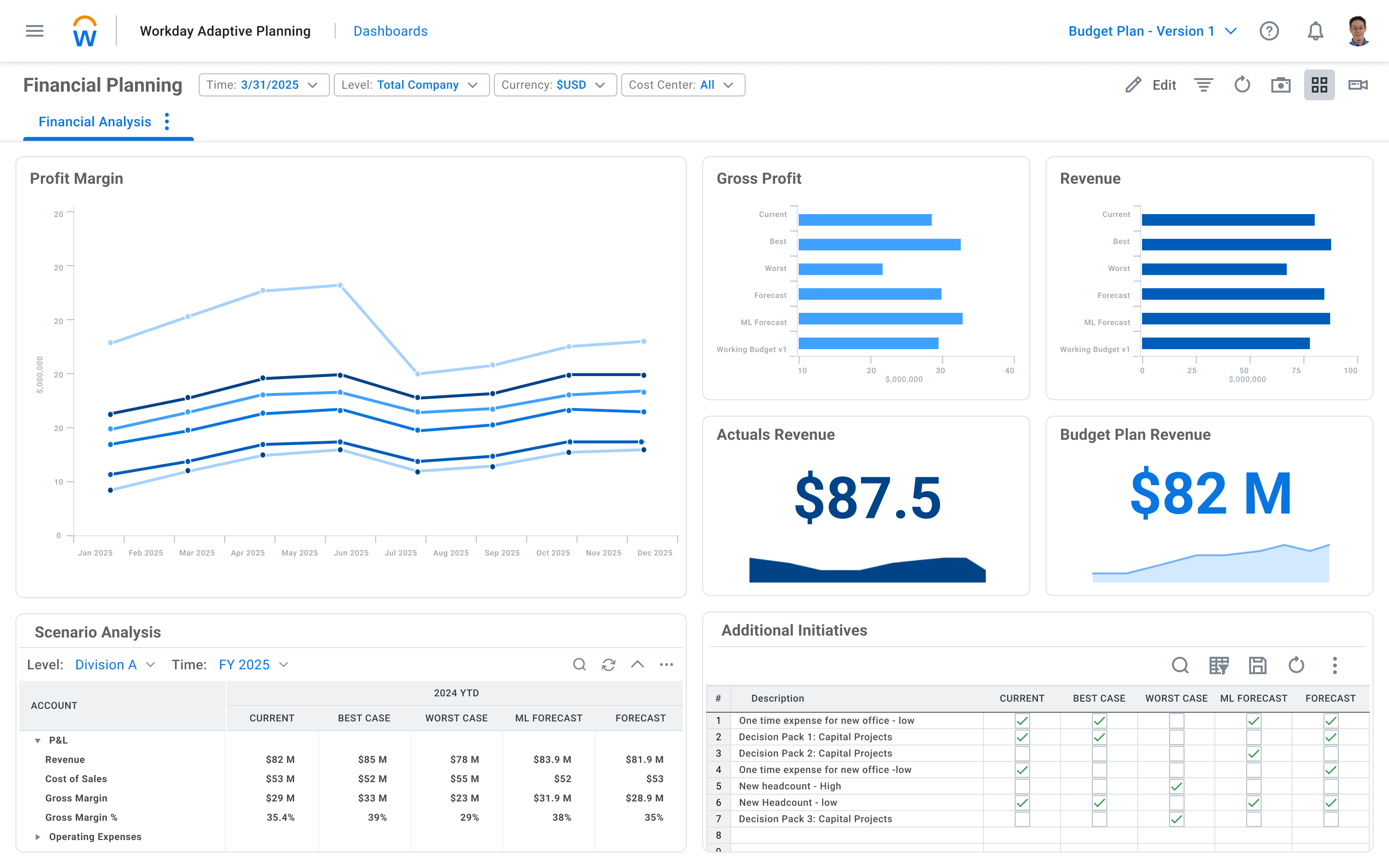
Anaplan’s capabilities are scaled to enhance enterprises’ financial performance management. Reviewers highlight the platform’s flexibility and adaptability to business process and data structure changes. This customization is designed to help enterprises be more flexible and better absorb business changes. Anaplan also allows for a large number of different users on the platform for excellent collaboration support.
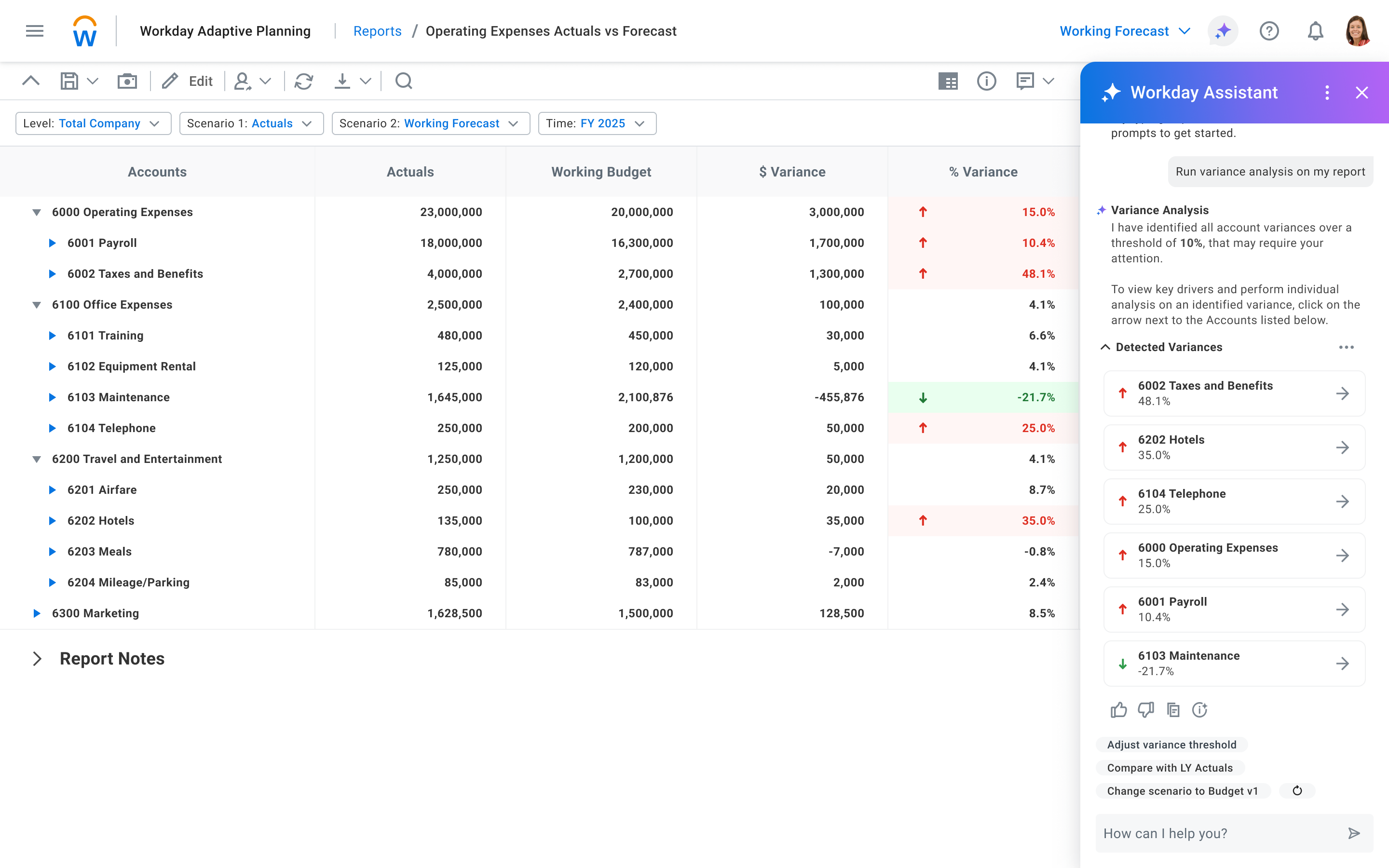
Workday stands out for its support for midsize and growing companies, particularly those who have outgrown their Excel-based financial processes. Its Office Connect feature creates a familiar and accessible experience for professionals used to Excel-based financial processes and reporting without adding on a substantial training curve. For those who do require additional training, the Adaptive Learning Center provides a host of self-service resources for training and development.
Limitations
Anaplan and Workday Adaptive Planning also have certain limitations worth considering.
Anaplan lacks some of the support that users look for from CPM vendors. In particular, some reviewers have found a lack of training materials when adopting and training on the platform. It also is limited as a standalone data warehouse for financial data.
In contrast, Adaptive Planning reviewers have had issues with post-implementation flexibility in some areas. One area of note is the platform’s web-based reporting capabilities, which are more limited than on-premise features. Additionally, Office Connect is not a one-to-one match with Excel in terms of processes and functions, so there is still a learning curve and change management necessary when transitioning away from Excel.
Pricing
Anaplan provides 3 different packages, all priced by custom quote from the vendor. The Basic plan includes core CPM capabilities around model building, dashboarding, and Microsoft Office integrations. The Professional plan adds on Application Lifecycle Managament and Auditing support, as well as DocuSign and additional support features as add-ons. The Enterprise plan provides all of the features beyond Bring Your Own Key, including an Informatica iPaaS license and additional computational power.
Workday Adaptive Planning offers two packages, each priced by quote from the vendor. The Standard package includes all the core features and capabilities, while the Enterprise package adds on unlimited storage, additional automation, and sandboxing. Workday also offers 3 license types, a Full Seat, or admins, which cost the most, Contributors, which are standard users, and Viewers, which can access data but not make changes.
Features
Anaplan
Workday Adaptive Planning
BI Standard Reporting
Comparison of BI Standard Reporting features of Anaplan and Workday Adaptive Planning
Feature
Anaplan
7.2
243 Ratings
5% below category average
Workday Adaptive Planning
8.1
4 Ratings
7% above category average
Pixel Perfect reports
6.47 Ratings
9.01 Ratings
Customizable dashboards
7.5243 Ratings
7.34 Ratings
Report Formatting Templates
7.96 Ratings
8.04 Ratings
Ad-hoc Reporting
Comparison of Ad-hoc Reporting features of Anaplan and Workday Adaptive Planning
Feature
Anaplan
9.1
8 Ratings
16% above category average
Workday Adaptive Planning
8.1
4 Ratings
5% above category average
Drill-down analysis
9.18 Ratings
8.34 Ratings
Formatting capabilities
9.18 Ratings
7.74 Ratings
Report sharing and collaboration
9.18 Ratings
8.34 Ratings
Integration with R or other statistical packages
00 Ratings
8.01 Ratings
Report Output and Scheduling
Comparison of Report Output and Scheduling features of Anaplan and Workday Adaptive Planning
Feature
Anaplan
8.2
250 Ratings
3% above category average
Workday Adaptive Planning
8.0
1 Ratings
1% above category average
Publish to Web
8.67 Ratings
00 Ratings
Publish to PDF
8.3247 Ratings
8.01 Ratings
Report Versioning
8.0218 Ratings
8.01 Ratings
Report Delivery Scheduling
7.98 Ratings
8.01 Ratings
Data Discovery and Visualization
Comparison of Data Discovery and Visualization features of Anaplan and Workday Adaptive Planning
With its versions and native time features Anaplan is well suited for all activities around planning in time and scenarios. Tasks involving calculating across multiple dimensions make Anaplan shine - the easiness to build complex calculation and present results on customizable pages. With its access restrictions it's well suited also for working with sensitive data (employee and customers personal data).
It's well suited to any business where you have defined inputs, a layer of structured calculations and a defined output. In other words, any business situation! We use it in a law firm setting where it enables us to import staff plans, assign targets to each individual, thereby generating a revenue forecast linked to business capacity. From there, global assumptions determine staff and direct costs, with the user overlaying discretionary costs to arrive at a final P&L forecast. This is then summarised using the reporting and dashboarding layer to provide outputs to senior leaders for sign off.
A de minimis incentive was given to thank the reviewer for their time. The incentive was not used to bias or drive a particular response, nor was the incentive contingent on a positive endorsement. More Info
Anaplan removes the time consuming process of integrating the results of individual spreadsheets.
Anaplan facilitates the standardization of assumptions across all sub-processes
Anaplan provides full transparency of the calculations and source inputs
Anaplan allows us to automate certain planning processes that would have been impossible when relying on the computational capabilities of an individual computer.
It helps create dynamic plans for finances, operations and various functional units in an organization all under one platform
It helps in scenario modeling to help analyze various business events and report by any number of business dimensions including channel, customer or product
It can be integrated with any system including ERP, BI or CRM
A de minimis incentive was given to thank the reviewer for their time. The incentive was not used to bias or drive a particular response, nor was the incentive contingent on a positive endorsement. TR verified that a representative sample of customers was invited. More Info
Expense reporting aspects are repetitive and hard to fully optimize.
Finance tracking is limited to basic reports with multiple levels or drill-down...hard to fully grasp without exporting data and massaging in something else (like Excel).
A de minimis incentive was given to thank the reviewer for their time. The incentive was not used to bias or drive a particular response, nor was the incentive contingent on a positive endorsement. More Info
Anaplan is a very strong multi-dimensional modeling tool that provides a calculation engine to empower a complex planning process. It is fairly easy to learn for those with experience in similar tools, or excel. It forces structure and auditability that spread sheets do not have, along with extensive security capabilities
For one we're in way too deep to not move forward with Adaptive. We're integrated with Workday, we do a ton of reporting with Adaptive, and it's working very well for planning and forecasting. No reason to look back or change course.
Anaplan's usability is dependent on who is implementing the project and how clear business processes are at the beginning of the implementation. Complex business processes with many inputs and reviews will still be complicated in Anaplan; however, the UX is very flexible in how to help people through the process and there are also other items such as Workflow that can help people move through the system.
It is an easy transition for Excel users, with more built-in analytical tools and no need to build formulas. It also has built-in reporting and integration with Microsoft Office products such as Excel and PowerPoint. For non-Finance users, there's an initial learning curve to get used to the tool.
A de minimis incentive was given to thank the reviewer for their time. The incentive was not used to bias or drive a particular response, nor was the incentive contingent on a positive endorsement. More Info
There are very few outages. Maintenance is scheduled on two or three Saturdays per month, so as not to affect businesses. When there is an outage, users are kept informed of progress to restore the platform and typically this takes no more than an hour. Anaplan customer support is very responsive if we ever have questions about platform issues
There haven't been any lately. The only one issue I can think of is when there was an update in Adaptive that altered our reports. Before I realized there was an issue, Adaptive reached out to let me know, so that it could be fixed.
Everything is calculated in memory in the cloud. It's nearly instantaneous updates when you make changes. The only time things get a little slow is when you have a massive model with very intricate calculations...but "slow" for Anaplan is not what I would call "slow" for something like Hyperion. We used to have Hyperion calcs that ran for 60 mins before you could use data. The equivalent would be 60 seconds in Anaplan.
A de minimis incentive was given to thank the reviewer for their time. The incentive was not used to bias or drive a particular response, nor was the incentive contingent on a positive endorsement. More Info
All aspects of Adaptive Insights perform well. One area that I wish was quicker was integration. When importing data from Intacct our accounting ERP platform, it can sometimes take 4 hours for the import to process. The earlier imports are done, the quicker they complete. My estimate for a quick upload is about two hours.
Support quality has dropped since Thoma Bravo has taken over. I think some serious re-focus needs to happen here -- part of the beauty of being in the Anaplan community was how involved you felt in it before. Before I didn't dread sending a support ticket, now I am starting to.
Whenever we have had any questions, issues, or concerns, the support has been quick and thorough. [This] allow[s] us to be able to fully resolve any issues, or be connected with the right group quickly to attain the result we were after; be it from simple formatting to adding new detailed reporting.
A de minimis incentive was given to thank the reviewer for their time. The incentive was not used to bias or drive a particular response, nor was the incentive contingent on a positive endorsement. More Info
In my opinion, in-person training is always the best if you have the option to do so. This allows real-time interactions with the instructions, whereas the online training I took required me to write-down questions, email them, and wait for responses. This slows down the process, as you can imagine. That said, in-person training is an extra cost and it likely isn't needed for everyone. I would suggest selecting a small number of people to take in-person training and then having them act as mentors to the rest of your team. That way, as the rest of the team takes the online training, they have a resource to help them in real time.
This was extremely helpful so that they could walk you through the model and teach you more about the complexity of various areas. It is most helpful when it is specific to your organization's model. The larger in-person trainings were helpful but they tended to be more generic and entry level. The trainings that are more tailored to your specific needs are the most helpful.
A de minimis incentive was given to thank the reviewer for their time. The incentive was not used to bias or drive a particular response, nor was the incentive contingent on a positive endorsement. More Info
Anaplan training materials are clear, simple, easy to understand and to follow. Visuals are excellent. The vendor is good at updating training materials in a timely manner and encouraging users and administrators to keep coming back to Academy site for refresher courses or new feature courses. I really like their interactive diagrams
They often times tended to be way too generic or entry level. They would also become sales pitches to upgrade or get new Adaptive Planning products. The questions in the training would be very niche and specific to other organizations. They were rarely helpful to the group at large.
A de minimis incentive was given to thank the reviewer for their time. The incentive was not used to bias or drive a particular response, nor was the incentive contingent on a positive endorsement. More Info
One key insight from implementing Anaplan is that success comes from focusing on designing the process, not just building the model. Anaplan is extremely flexible—there are very few planning scenarios it cannot support—but that flexibility means the project needs strong governance, clear ownership of requirements, and a well-defined data model. When those foundations are in place, implementations are fast, iterations are easy, and users can quickly see value. In our projects, both Financial Planning and Integrated Business Planning models were adopted smoothly because we involved business users early, kept the model design intuitive, and leveraged Anaplan’s Excel-like syntax and user-friendly dashboards. The result was more efficient day-to-day work, reduced manual tasks, and increased collaboration across teams. In short: when you combine Anaplan’s flexibility with a structured implementation approach, adoption and value realization happen quickly.
Trust the expertise of very strong 3rd party implementers. Having deployed Adaptive at a separate company before, I thought I knew it all (hubris, I know). Fortunately, I began to (very quickly) trust the judgment of our Carlson implementation team, and they provided invaluable insights and best-in-class processes that have benefitted me and my team greatly.
A de minimis incentive was given to thank the reviewer for their time. The incentive was not used to bias or drive a particular response, nor was the incentive contingent on a positive endorsement. More Info
Anaplan is more powerful than Pigment considering that it is an Enterprise class system and is able to manage bigger data sets. Anaplan allows for advanced scenario modeling and formula capabilities along with custom reporting functionalities. Anaplan has proven its capabilities and stability across various use cases and across bigger enterprises when compared to Pigment which is still in earlier phases of its development
Workday became our choice because it is fully web-based and easily integrates with other systems. The learning curve for Workday was shorter than that of Dynamics. The reporting tools in Workday are more user-friendly than that of Dynamics. However Workday did not have Check Printing tools which are available in Dynamics. The organization started a project to digitize all financial transactions so it was not a priority feature. When it comes to scaling up the functionalities of Workday it was much easier than Dynamics.
A de minimis incentive was given to thank the reviewer for their time. The incentive was not used to bias or drive a particular response, nor was the incentive contingent on a positive endorsement. TR verified that a representative sample of customers was invited. More Info
A de minimis incentive was given to thank the reviewer for their time. The incentive was not used to bias or drive a particular response, nor was the incentive contingent on a positive endorsement. More Info
We have managed to leverage Anaplan for financial planning and forecasting across the business. It is now used by almost every department, with more than 50 users (but I know of companies that have hundreds of users) and still the platform is quick and reliable. It is easy to make changes to divisions and departments or add users and apply different user settings - the core part of the model is not affected and end users can continue their work without any disruption
We went from 2 users to 70+ users over a 2 year period of time. The application scaled wonderfully. 65 of those users were non-finance users so they were able to quickly learn the software and prepare budgets quickly and efficiently. That is the power of Adaptive and its ability to scale
A de minimis incentive was given to thank the reviewer for their time. The incentive was not used to bias or drive a particular response, nor was the incentive contingent on a positive endorsement. More Info
Anaplan's implementation led to a significant reduction in planning cycle errors and bugs, streamlining processes and improving overall accuracy in data inputs
Standardizing the planning process and enabling cross-functional collaboration through Anaplan enhanced our ability to adapt swiftly to changing business needs, resulting in improved agility in decision-making
The platform's capabilities, especially in Demand Planning and Supply Chain, positively impacted our ROI by optimizing resource allocation and solving complex business problems efficiently across multiple functions
It's facilitated a better financial literacy and management by the non-financial managers in the company, giving them a much better ability to see what they're spending, control it, and plan better in the future.
It's hard to quantify the ease of model and version management, but we could never do what we're doing now with our current staff. It would take a small army to replicate anything close to what Adaptive pulls off using Excel, if it's even possible.
A de minimis incentive was given to thank the reviewer for their time. The incentive was not used to bias or drive a particular response, nor was the incentive contingent on a positive endorsement. More Info