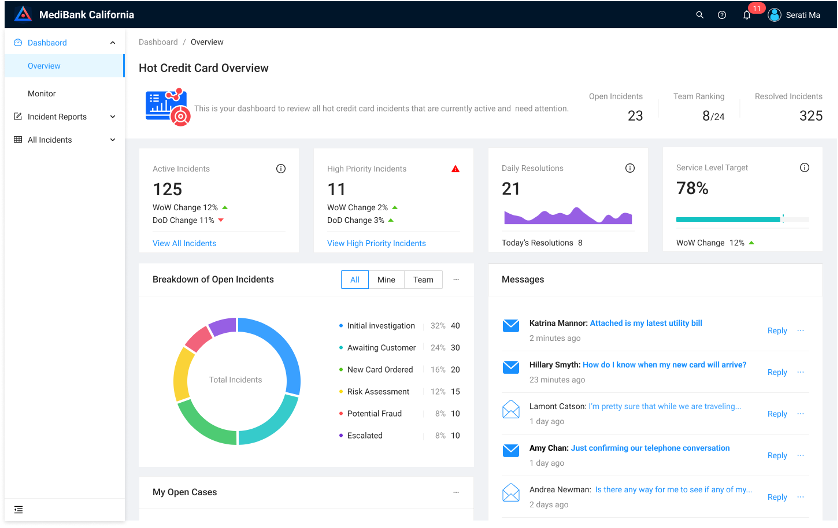
Appian is a low-code development and business process management platform. It features drag-and-drop design for app building, automated work processes, unified data management, and cloud-based deployment.
$0
Nintex
Score 8.1 out of 10
N/A
Nintex offers a platform that helps companies discover, automate, and optimize business processes.
$480
Minimum 1,000 users per user
Unqork
Score 8.0 out of 10
N/A
Unqork is a no-code application platform from the company of the same name in New York, designed to help large enterprises build complex custom software faster, with higher quality, and lower costs than conventional approaches. Unqork boasts a visual, drag-and-drop designer with a wide array of components, as well as a library of industry specific templates. With these, users can orchestrate business logic across internal and external users, visually build complex routes throughout an…
N/A
Pricing
Appian
Nintex
Unqork
Editions & Modules
Appian Community Edition
$0
Application - Input-Only
$2
per month per user
Application - Infrequent
$9
per month per user
Application - Standard
$75
per month per user
Platform
Custom Quote Priced per user with unlimited apps.
minimum 100 users, no maximum
Unlimited
Custom Quote Priced per development with unlimited apps.
I am a user of Appian, where we have a data connector application built in Appian that is integrated with various systems, and provide a summary in Appian UI. We as a user can initiate new requests to extract, Transform and Load data on a specific or selected system with just …
There are a lot of reasons to select Appian the first is low code. We can create various interactive data connectors applications also it is best in terms of security with an interactive user interface which makes it unique from the other platforms.
Appian's pricing model and co-selling is more interesting than that of Power platform. We used Appian because of its better case management and the learning curve is also not that huge. Power platform says it is Low code no code but it still requires certain some coding …
Appian compares favorably with other vendors in the space. It is strongest with business workflow automation and to create custom business applications. The tool base for coding is extremely straightforward and allows for faster coding and deployment. Handles very complex …
Have not used many BPM tools but we are using RPA to automate many technologies and business processes. We are also using Servicenow for incidents and change management.
Java is much more customizable but it is also a lot more work developing apps and setting up infrastructure. Appian is much easier to learn and code in. Also, apps are able to be built much quicker. This helps when time and money are an issue.
In the BPM space, there are a few areas that IBM BPM gives the flexibility to integrate different systems. Whereas in Cloud space [through] Appian has picked up, there are lot of features that Salesforce provide can be put in Appian
It has reduced our time to market because of the feedback we got early on. The smooth movements and easy flow create a vast difference. The team gets ample time to innovate and increase performance. Tasks are well performed in sprints and ready to release with fewer errors and …
I personally think Appian will win the discussion of pricing between itself and Microsoft Power Automate currently, but since I don't feel as though the average person would be able to learn how to automate processes on Appian, I have to give the nod to Microsoft Power Automate …
To be honest, I have not used any other software that is similar to Appian. I am used to just using raw code when it comes to creating an application. I find Appian very useful to use in this fast-paced industry, and when the client wishes to see the iteration of the project. …
I am not involved in evaluating different products. We have a specific team that is tasked with the responsibility of evaluating various products and choosing the one that is most appropriate for the organization. My team and I are the users of the products. Appian was the best …
We used custom BPM solutions in the past and find greater value in using Appian. I was not a part of the architecture team that reviewed other BPM solutions when Appian was selected.
Appian has a lesser learning curve than Pega. Pega uses a combination of directed and pattern inheritance and architects need to design bearing these in mind. While the intent behind this approach is to allow for reuse of rules to allow for efficient enterprise-wide design, …
I did not get chance to work on the other BPM tools but I am pretty sure that Appian will outstrip others in terms of Process Designing and Management, Scalability, Security, Performance and ease of use.
The main product that my company uses is Microsoft Teams. I think that Appian is far superior to Microsoft Teams in many aspects but the most significant is the ability to use easily and move from reports to reports. I far prefer Appian to Teams. The design is much better and …
Appian surpasses Microsoft PowerApps because of how much easier it is to code. I found Appian easier to code than the competitor because of how you could access the code behind the scene (SAIL). This allowed for even greater customization and helps with debugging when you have …
I was not part of selecting Nintex, but I think Nintex does a better job of generating linear flowcharts vs. Microsoft Visio because it automates the majority of the process of creating process maps. (Microsoft Visio is better for creating flowcharts that are not linear. …
Nintex is easier than Visual Studio and richer than SharePoint Designer, chosen for accessibility, scalability, and faster business process automation.
Nintex is great! It works well with these applications. We can build profiles to give the bot the ability to use the applications like an employee. This gives us the ability to automate tasks inside our applications. As stated earlier, some of the applications are web-based. …
Nintex licensing is very suitable for our needs and solutions built are embedded and is adding a lot of value with the added benefit of being easy to maintain. The time to production for building some complex solutions versus other low code platforms is significantly less …
We selected Nintex because Process Manager is a purpose designed platform for knowledge management. However, what we discovered is that there are significant limitations, which has lead us to now explore developing a knowledge management platoform in sharepoint. this is a much …
Microsoft environment does not have the scalability of Nintex; it is perfect for small and medium-sized companies, especially in environments where Microsoft environment is almost entirely used. Although Microsoft offers options to connect to other applications, its platform …
Nintex Process Platform is a great tool for automatic tasks and creating forms in SharePoint Online. For automating using other applications, including third party, Power Automate has more usage.
Xmind was great for mind mapping, but when I tried to use it as a process mapper, I found it was rather lacking. It has its uses, but process mapping (at least for us in our stage and phase of mapping) was not up to the task, unfortunately. We didn't have any other software we …
We use Outsystems for other processes in our operation but we see that this platform is not able to indentify processes when drawed. Besides that OutSystems requires some basic development knowledge to use it. This makes it not really useable for business units.
Appian is well suited for the areas which involve a workflow. For Example: Consider there is a task and 3 teams are required to work on the task, with Appian we can create tasks for each team and monitor the comments and completion. Together with the integration capabilities, this tool can function in many areas. In our firm, we are using it to automate the workflows for our business teams and help them in capturing the OLA's and SLA's.
We use Nintex to automate fundraising outreach at scale. It helps us send personalized emails to a large contact list, and we’d also like to automate follow-ups when there’s no reply. If you need highly customized solutions or clean, fully controllable code, I wouldn’t recommend Nintex. It has many features, but it’s not the same as building your own system from scratch. That said, it can save a lot of time for standard automation workflows.
Allows at a glance workflow documentation which assists in the need we have for information readiation.
Drag and drop interface for workflow development greatly speeds our apps time to market.
Using the advanced features of Appian, we are able to create working sites in a fraction of the time it would take to do so using "traditional" development.
Integrations with other services using various secure authentication methods, along with the seamless integration with SharePoint, are the icing on the cake. This makes it superior to other BPM tools available in the market.
Flexibility in application development - The diverse configurable properties offer multiple ways to utilise the controls and events, affording the flexibility to expand your scope and enabling the creation and use of processes in a myriad of ways.
The streamlined and efficient deployment process significantly accelerates release management, allowing for faster and smoother implementation of updates and new features.
The user interface of the pages offers a more refined and appealing look and feel compared to most other BPM tools.
Search issues when type ahead and database search are used in the same field.
Buttons implementation where user is require[d] to click on the button description - if clicks on the button outside that text - button will not work.
Problems with using certain off-the-shelf performance tools like WebLoad or Neoload. That is because of different dynamic variables being used internally in Appian - which these tools are unable to correlate. We are still investigating using other tools like Jmeter to overcome dynamic correlation problem for performance testing.
New Responsive Form does not allow to create a custom button anywhere we want. It will be useful to allow to add the button control anywhere within the form that can trigger the click event rule.
It will be useful to allow CSS in New Responsive Form.
Found HTML Table tag does not work properly in New Responsive Form.
More functionalities related to HTML, CSS and JavaScript in New Responsive Form will be very helpful.
We recently renewed our license with Appian. We are convinced that its flexibility, relative ease of use, the support they provide, there mobile advancements and their general willingness and desire to see us succeed all contributed to our reason to renew our agreement with Appian
Renewal is mainly on the fact that Nintex is so widely used and it would be impossible to migrate all of these existing workflows to another engine. Third-party lock-in within SharePoint is pretty strong, which makes it difficult to move to something else. Our Nintex database is well-over 100 GBs. Nintex email support is very good, and I've been impressed. The Community however is non-existent and filled with unanswered questions.
There are many differences between using Appian and using other programming languages. Additionally, there are many trade offs that have to be made and that have to be accepted for using Appian. In some cases, you give up control of one small area, but in others, it may open settings that are unavailable to a developer when using other program languages.
Nintex Workflow does exactly what it is advertised to do: make workflow development fast and easy. It doesn't provide very much new functionality, but it isn't really supposed to. When I am working with a client on a SharePoint project, I am always happy if I hear that they use Nintex Workflow, as it makes workflows much easier.
The Nintex Process Platform has never crashed or had any availability issues during my usage. However there was an issue that was of my own making that caused a slowdown of the system. I had set up a process to run once a day and check for employees on a list that had certain parameters selected, and for some reason that I had to troubleshoot, the process instead ran constantly, which filled the cache quickly. I ended up having to dismantle that process so the system didn't crash.
Unlike any other process automation product out there. Not only is it a low-code, easy to use tool for building processes in environments like SharePoint or Salesforce, they have really started to expand their tool-set by offering tools to manage other things like process mapping, RPA, mobile,etc.
Appian is one of the leading low code business automation platforms that support RPA, decision rules, case management, workflow automation, and machine learning all in a single bundle. But it is also harder to implement and replace the traditional business process.
The support team works as fast as they can and they are usually fast to solver the issues. Sometimes they need more time to solve one of them because our workflows and so on are more complex than usual clients.
As analyst I participated in a developer boot camp. At times it was hard to keep up but most of the time it made sense. Trainer took the time to explain and slowed pace down to answer questions etc.
I used the Nintex training software, it was easy to watch and follow along. It didn't go too fast and was descriptive enough to understand what the steps needed were in order to produce efficient workflows and user friendly forms.
1.Start with Simple Workflows: Begin with basic workflows to gain user confidence before tackling complex processes. 2.Involve Stakeholders Early: Engage business users and IT early to align workflows with real business needs. 3.Comprehensive Training: Invest in user training to ensure smooth adoption and reduce resistance. 4.Leverage Prebuilt Templates: Use Nintex’s templates to speed up implementation and maintain consistency. 5.Iterate and Optimize: Continuously improve workflows based on user feedback and performance metrics.
Appian compares favorably with other vendors in the space. It is strongest with business workflow automation and to create custom business applications. The tool base for coding is extremely straightforward and allows for faster coding and deployment. Handles very complex process flows and has the ability to discover new opportunities for automation.
I was not part of selecting Nintex, but I think Nintex does a better job of generating linear flowcharts vs. Microsoft Visio because it automates the majority of the process of creating process maps. (Microsoft Visio is better for creating flowcharts that are not linear. because it is less automated and more flexible.)
The scalability is really bottlenecked by the imagination of the user. I was able to make processes for my own personal usage, making my daily tasks easier. I was also able to make processes that affected hundreds of employees, making large standardization and efficiency gains. So either way, the system is used the same way, and I was the limiting factor.
Our IT automated procurement process has sped up time to get paid by a few days on every transaction
Our approvals are more organized as a result of being put in digitally
Managing our own tenant requires more than we have available, given the quarterly updates
Since we have business-critical functions running in the platform, we have to thoroughly review every note of every update. Because of this we skip half of the updates since we don't have enough time to review these changes four times a year.
People have woken up to the amount of overlap after mapping their processes.
People can be resistant to process changes. You need to have the support from above or support from the 'business' that you are process changing to be able to see the positive impacts.
Numbers talk. if you can get a general salary figure from your HR dept to show savings for 'employee bands', then when you present reports, they will be all the richer in data.