
Arctera Enterprise Vault vs. Smarsh vs. Veeam Data Cloud for Microsoft 365
Arctera Enterprise Vault vs. Smarsh vs. Veeam Data Cloud for Microsoft 365
| Product | Rating | Most Used By | Product Summary | Starting Price |
|---|---|---|---|---|
 Arctera Enterprise Vault | N/A | Arctera Enterprise Vault is a file archiving option. | N/A | |
 Smarsh | N/A | The Smarsh Enterprise Platform is a unified, cloud-native solution designed to future-proof enterprise communications data strategies. Its technologies include elastic compute, natural language processing, machine learning and artificial intelligence. | N/A | |
 Veeam Data Cloud for Microsoft 365 | Mid-Size Companies (51-1,000 employees) | Veeam Data Cloud for Microsoft 365 is a BaaS (Backup as a Service) solution used to back up and restore Microsoft 365 data, including Microsoft Exchange, Microsoft SharePoint, Microsoft OneDrive for Business and Microsoft Teams data. | N/A |
| Arctera Enterprise Vault | Smarsh | Veeam Data Cloud for Microsoft 365 | ||||||||||||||||||||||
|---|---|---|---|---|---|---|---|---|---|---|---|---|---|---|---|---|---|---|---|---|---|---|---|---|
| Editions & Modules | No answers on this topic | No answers on this topic |
| |||||||||||||||||||||
| Offerings |
| |||||||||||||||||||||||
| Entry-level Setup Fee | No setup fee | No setup fee | No setup fee | |||||||||||||||||||||
| Additional Details | — | — | — | |||||||||||||||||||||
| More Pricing Information | ||||||||||||||||||||||||
| Arctera Enterprise Vault | Smarsh | Veeam Data Cloud for Microsoft 365 |
|---|
| Arctera Enterprise Vault | Smarsh | Veeam Data Cloud for Microsoft 365 | |||||||||||||||||||
|---|---|---|---|---|---|---|---|---|---|---|---|---|---|---|---|---|---|---|---|---|---|
| Data Center Backup |
| ||||||||||||||||||||
| Enterprise Backup |
| ||||||||||||||||||||
| SaaS Backup |
|
| Arctera Enterprise Vault | Smarsh | Veeam Data Cloud for Microsoft 365 | |
|---|---|---|---|
| Small Businesses |  Cove Data Protection Score 9.7 out of 10 | Cove Data Protection Score 9.7 out of 10 | Cove Data Protection Score 9.7 out of 10 |
| Medium-sized Companies | Cove Data Protection Score 9.7 out of 10 | Cove Data Protection Score 9.7 out of 10 |  Druva Security Cloud Score 9.4 out of 10 |
| Enterprises |  Microsoft Exchange Score 8.8 out of 10 | Microsoft Exchange Score 8.8 out of 10 | Druva Security Cloud Score 9.4 out of 10 |
| All Alternatives | View all alternatives | View all alternatives | View all alternatives |
| Arctera Enterprise Vault | Smarsh | Veeam Data Cloud for Microsoft 365 | |
|---|---|---|---|
| Likelihood to Recommend | 7.5 (9 ratings) | 7.5 (2 ratings) | 8.6 (247 ratings) |
| Likelihood to Renew | 8.6 (2 ratings) | 8.1 (2 ratings) | 9.0 (10 ratings) |
| Usability | - (0 ratings) | - (0 ratings) | 8.4 (248 ratings) |
| Availability | - (0 ratings) | - (0 ratings) | 9.1 (2 ratings) |
| Performance | - (0 ratings) | - (0 ratings) | 8.0 (2 ratings) |
| Support Rating | - (0 ratings) | - (0 ratings) | 8.6 (243 ratings) |
| Implementation Rating | - (0 ratings) | - (0 ratings) | 8.7 (7 ratings) |
| Configurability | - (0 ratings) | - (0 ratings) | 8.2 (1 ratings) |
| Ease of integration | - (0 ratings) | - (0 ratings) | 9.1 (1 ratings) |
| Product Scalability | - (0 ratings) | - (0 ratings) | 9.1 (2 ratings) |
| Vendor post-sale | - (0 ratings) | - (0 ratings) | 9.1 (2 ratings) |
| Vendor pre-sale | - (0 ratings) | - (0 ratings) | 9.1 (2 ratings) |
| Arctera Enterprise Vault | Smarsh | Veeam Data Cloud for Microsoft 365 | |
|---|---|---|---|
| Likelihood to Recommend |  Arctera US LLC
 Joshua Kirk IT Manager & Senior Systems Engineer |  Smarsh
| Veeam Software
 Zachariah Murray Systems Administrator |
| Pros | Arctera US LLC
 Sheldon Eng Systems Specialist | Smarsh
 Will Jordan Infrastructure Analyst | Veeam Software
 Antonio Mendoza IT Infrastructure and Security Manager |
| Cons | Arctera US LLC
| Smarsh
| Veeam Software
 Clay Fulton Application Support Manager |
| Likelihood to Renew | Arctera US LLC
 Ryan Hanzalik Windows Enterprise Support - Systems Specialist | Smarsh
Will Jordan Infrastructure Analyst | Veeam Software
|
| Usability | Arctera US LLC No answers on this topic | Smarsh No answers on this topic | Veeam Software
|
| Reliability and Availability | Arctera US LLC No answers on this topic | Smarsh No answers on this topic | Veeam Software
 Tony Haynes IT Administrator and Project Coordinator |
| Performance | Arctera US LLC No answers on this topic | Smarsh No answers on this topic | Veeam Software
|
| Support Rating | Arctera US LLC No answers on this topic | Smarsh No answers on this topic | Veeam Software
|
| Implementation Rating | Arctera US LLC No answers on this topic | Smarsh No answers on this topic | Veeam Software
|
| Alternatives Considered | Arctera US LLC
 Dan Lepinski Systems Engineer | Smarsh
| Veeam Software
|
| Scalability | Arctera US LLC No answers on this topic | Smarsh No answers on this topic | Veeam Software
|
| Return on Investment | Arctera US LLC
| Smarsh
| Veeam Software
|
| ScreenShots | Veeam Data Cloud for Microsoft 365 Screenshots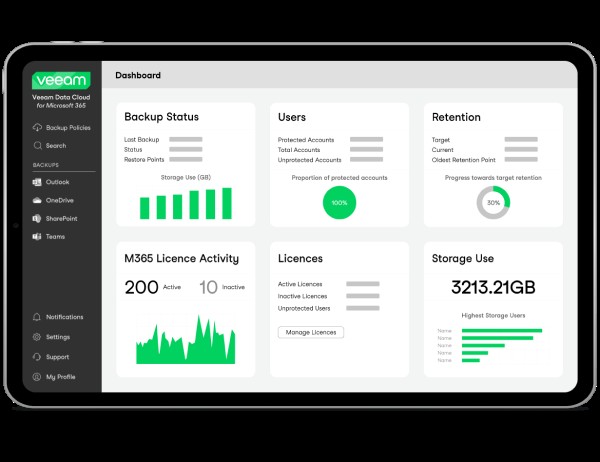 |