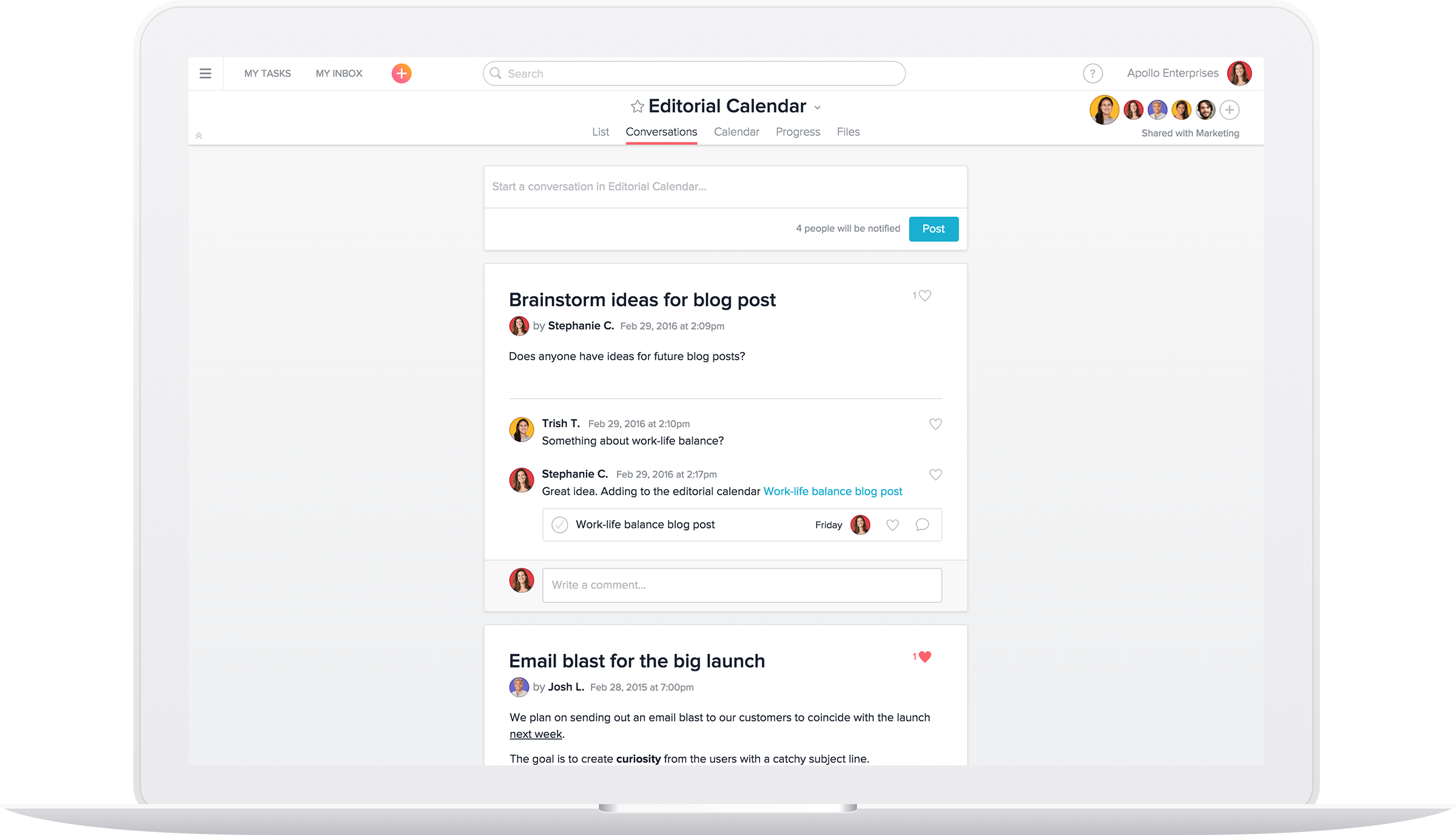
Asana is a web and mobile project management app. With tasks, projects, conversations, and dashboards, Asana lets an entire team know who's doing what by when, enabling workload balancing. Users can also add integrations for GANTT charts, time tracking and more.
$13.49
per month per user
Hive
Score 9.0 out of 10
N/A
Hive Technology offers their eponymous project management and process management application, providing integrations with many popularly used applications for productivity, cloud storage, and collaboration.
$24
per month per user
ProofHub
Score 9.2 out of 10
N/A
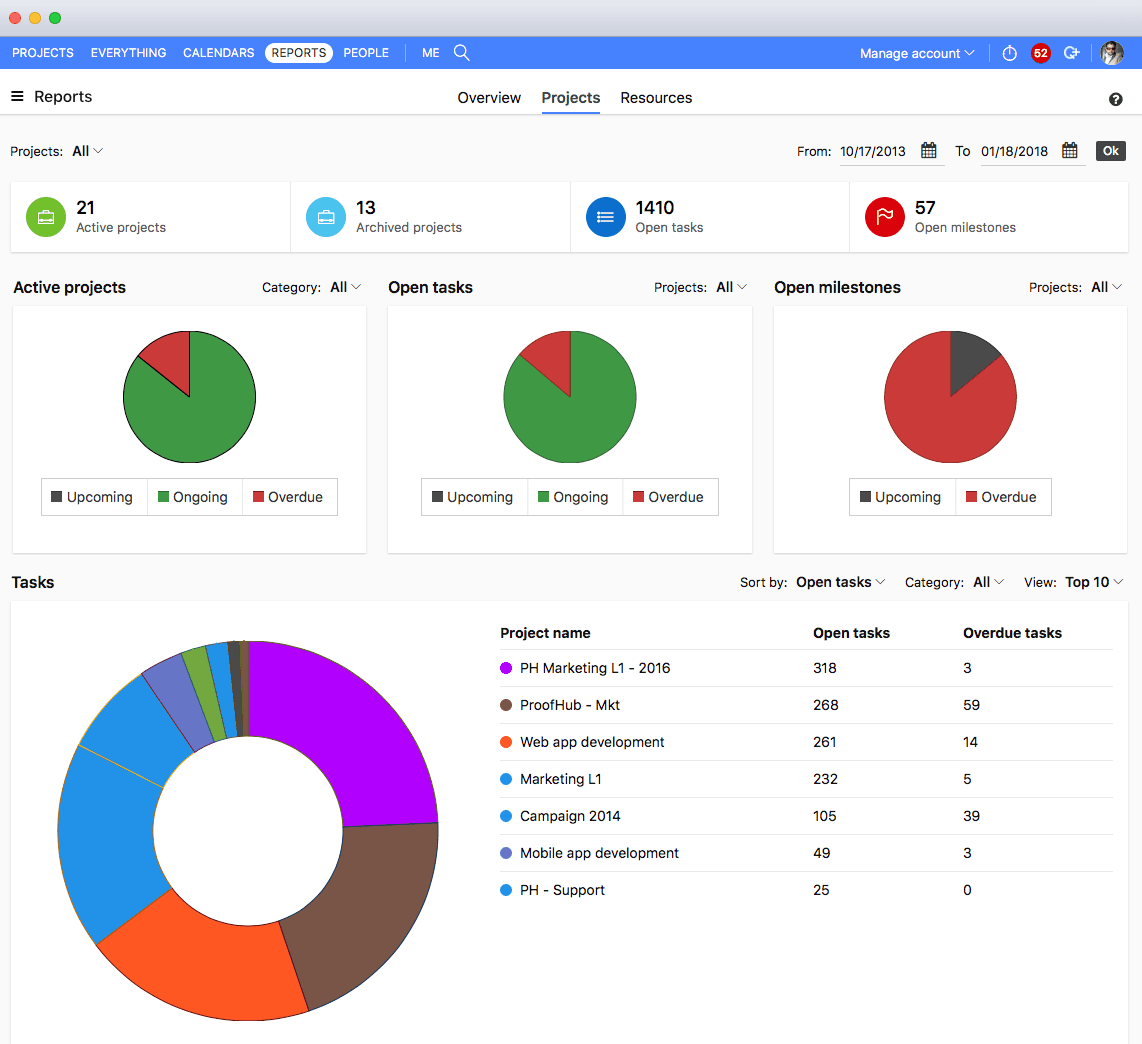
ProofHub is a SaaS based project management software from ProofHub LLC in Walnut, CA. It is an online project management and collaboration tool that comes with integrated Group chat, quick Discussions on projects, Workflows and boards, Project reports, among other features. Document (e.g. Excel, Powerpoint) uploading and sharing is supported, along with an integrated an Online proofing tool to aid in image and document review. ProofHub aims to enable teams to…
I would say that in comparison to Asana, Hive is a better interface an UI. I think Asana is more robust in terms of what it can do in conjunction with Confluence but I think Hive is a better entry-level model for new employees. Hive is much simpler and more straight forward and …
Hive is a bit different than Jira and Monday, which I used mostly. Overall does a great job managing project and helps with team communication. Removes dependency of asking team members for updates by going to conference rooms. With Hive, the team updates the status, and we …
So far Hive is the total package for our needs. Offering request forms and proofing/approval out of the box without third party integrations has been a huge upgrade for us along with incredibly reasonable pricing. The support for onboarding has been fantastic and we haven't …
Unfortunately ProofHub did not compare very well. The pricing model is fantastic and I think the approach the software takes to creative project management isn't necessarily bad, it's just others do it better. For example, Wrike has very powerful and easy-to-manage form …
The usability of Asana is broad since it's available in a variety of platforms that are widely used nowadays. I think that it would be great for people who are constantly on the move and switching devices, since it has allowed me to work from my phone, too. I also think that Asana has proven itself to handle a large quantity of work
Hive is a powerful tool for data analysis and management that is well-suited for a wide range of scenarios. Here are some specific examples of scenarios where Hive might be particularly well-suited: Data warehousing: Hive is often used as a data warehousing platform, allowing users to store and analyze large amounts of structured and semi-structured data. It is especially good at handling data that is too large to be stored and analyzed on a single machine, and supports a wide variety of data formats. Batch processing: Hive is designed for batch processing of large datasets, making it well-suited for tasks such as data ETL (extract, transform, load), data cleansing, and data aggregation.Simple queries on large datasets: Hive is optimized for simple queries on large datasets, making it a good choice for tasks such as data exploration and summary statistics. Data transformation: Hive allows users to perform data transformations and manipulations using custom scripts written in Java, Python, or other programming languages. This can be useful for tasks such as data cleansing, data aggregation, and data transformation. On the other hand, here are some specific examples of scenarios where Hive might be less appropriate: Real-time queries: Hive is a batch-oriented system, which means that it is designed to process large amounts of data in a batch mode rather than in real-time. While it is possible to use Hive for real-time queries, it may not be the most efficient choice for this type of workload. Complex queries: Hive is optimized for simple queries on large datasets, but may struggle with more complex queries or queries that require multiple joins or subqueries.Very large datasets: While Hive is designed to scale horizontally and can handle large amounts of data, it may not scale as well as some other tools for very large datasets or complex workloads.
It suits well for those businesses who want to operate on a global level without investing too much over creating infrastructure. A business can easily reach out to various clients, customers, partners and other stakeholders and communicate and collaborate with them in a fast and transparent manner and can effectively tap any opportunities coming its way. Such opportunities if properly implemented can lead to gains for the parties involved.
Through it, we were able to communicate and cooperate with the rest of the team to complete the work in the required manner and at the appropriate time.
Simplicity, it offers a clean environment without risking the outcome. An example of this are the timesheets that allow a fast way to keep track of progress
Interaction, the different options make it faster and easier to interact and collaborate in the development of a product. An example of this would be Hive Notes for meetings
The different visualisations it offers allow to explore the best ways to affront your projects. I really like the Gantt mappings view to understand who can be contacted at each point
The obvious, proofing! We need something in-house that can do this instead of hiring one person for this job. Each person on our marketing team knows how to use it.
Proofhub can improve a bit in areas of helping people customize their accounts a bit more. That makes managing work even more easier, when you have things just the way you want them to be.
With an array of useful features available that solve all our work issues, each department has an access to it. Each one knows what’s going on with different teams. This makes collaboration easier, as different teams just need one tool to come together and get things done. I think this is a great product! it has really helped my company get MUCH better organized.
It is very user-friendly. Takes a new employee an hour to start figuring out how the system works. That's an important factor. You don't want to encounter the issue where employees need a week to understand how the system works. For example, JIRA, I tried using it for a week and I still don't understand the complicated layout. Asana has a simple interface. Once you see it, you get it type of program.
I haven't had to use their support so I can't rate it. The fact that I haven't needed them reflects the ease of use of the product. I would recommend that any new users schedule a complete demo of the product to ensure that they are using it to it's fullest (there's a lot of useful features).
Our CSR is easily accessible and they have support built into the app itself. They also have a pretty robust support site. We also took advantage of the free trial and learned so much by putting Hive through the paces and figuring out the best way to mold it to our needs.
Great support website and had reps follow up multiple times in our trial process. Getting started was very straightforward and adding people is easy too.
Asana is a top-tier project management software that helps us organize and track projects from start to finish. It allows us to apply tasks/to-dos to multiple projects without duplication, divide complex projects into smaller tasks, and track project progress. It also helps us organize work on Kanban boards or linear lists. It stands out from the crowd in a big way compared to the competition.
Hive is a bit different than Jira and Monday, which I used mostly. Overall does a great job managing project and helps with team communication. Removes dependency of asking team members for updates by going to conference rooms. With Hive, the team updates the status, and we can easily track it.
We used Basecamp in the past, but we did encounter some problems while working with it. But these concerns have been better addressed in ProofHub. It has a simple interface which is so easy to operate and this was not the case in Basecamp. ProofHub lets us quickly chat with our team members over various work matters through its inbuilt chat feature and resolve them fast while Basecamp provides this feature through a third-party tool which added to our expenses and it was not a very convenient affair. ProofHub has got an inbuilt proofing tool which allows us to get quality feedback over designs instantly saving our time and costs, whereas Basecamp enables proofing through a third party tool which again was not convenient for us. ProofHub’s casper mode feature helps us to protect privacy and secrecy over confidential issues but Basecamp lacks such an important feature. So ProofHub has more to offer and better too in comparison to Basecamp. (answer to Describe how ProofHub stacks up against them and why you selected ProofHub.
Proofhub has a great impact on our ROI. Due to a systematic approach of handling each clients’ project, we have been able to double the number of clients we had prior to signing up for Proofhub.