AWS Elastic Beanstalk is the platform-as-a-service offering provided by Amazon and designed to leverage AWS services such as Amazon Elastic Cloud Compute (Amazon EC2), Amazon Simple Storage Service (Amazon S3).
$35
per month
Veeam Data Cloud for Microsoft 365
Score 8.8 out of 10
Mid-Size Companies (51-1,000 employees)
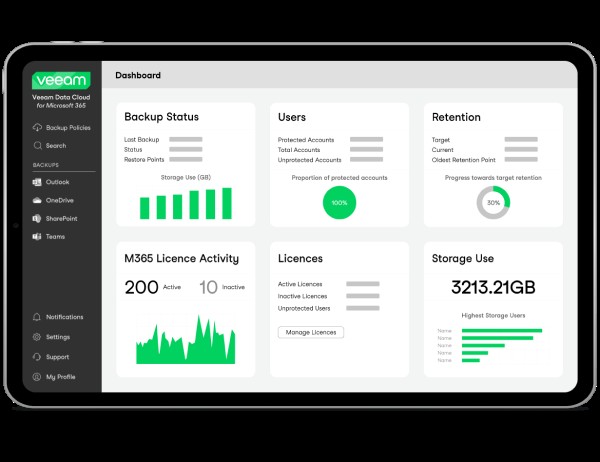
Veeam Data Cloud for Microsoft 365 is a BaaS (Backup as a Service) solution used to back up and restore Microsoft 365 data, including Microsoft Exchange, Microsoft SharePoint, Microsoft OneDrive for Business and Microsoft Teams data.
N/A
Pricing
AWS Elastic Beanstalk
Veeam Data Cloud for Microsoft 365
Editions & Modules
No Charge
$0
Users pay for AWS resources (e.g. EC2, S3 buckets, etc.) used to store and run the application.
I have been using AWS Elastic Beanstalk for more than 5 years, and it has made our life so easy and hassle-free. Here are some scenarios where it excels -
I have been using different AWS services like EC2, S3, Cloudfront, Serverless, etc. And Elastic Beanstalk makes our lives easier by tieing each service together and making the deployment a smooth process.
N number of integrations with different CI/CD pipelines make this most engineer's favourite service.
Scalability & Security comes with the service, which makes it the absolute perfect product for your business.
Personally, I haven't found any situations where it's not appropriate for the use cases it can be used. The pricing is also very cost-effective.
Analyzing campaign performance is a great area where the Veeam Data Cloud for Microsoft 365 is well-suited, and it’s working well. In the past, when we analyzed campaign performance, we had to use outside vendors, which was a time-consuming, laborious, and costly process.
Getting a project set up using the console or CLI is easy compared to other [computing] platforms.
AWS Elastic Beanstalk supports a variety of programming languages so teams can experiment with different frameworks but still use the same compute platform for rapid prototyping.
Common application architectures can be referenced as patterns during project [setup].
Multiple environments can be deployed for an application giving more flexibility for experimentation.
Limited to the frameworks and configurations that AWS supports. There is no native way to use Elastic Beanstalk to deploy a Go application behind Nginx, for example.
It's not always clear what's changed on an underlying system when AWS updates an EB stack; the new version is announced, but AWS does not say what specifically changed in the underlying configuration. This can have unintended consequences and result in additional work in order to figure out what changes were made.
I would like the option to remove users from the backup and set them to an alternate storage location/ archive location. Currently, my backups are at 7 TB, and I would like to segment out data with lower data retention requirements.
As our technology grows, it makes more sense to individually provision each server rather than have it done via beanstalk. There are several reasons to do so, which I cannot explain without further diving into the architecture itself, but I can tell you this. With automation, you also loose the flexibility to morph the system for your specific needs. So if you expect that in future you need more customization to your deployment process, then there is a good chance that you might try to do things individually rather than use an automation like beanstalk.
Veeam Backup for Microsoft 365 just works so well and is so easy to use. I researched multiple options for Office 365 backup and none seemed to be as easy to setup and use as Veeam Backup for Microsoft 365 and the pricing was very comfortable to us. I can't imagine any reason why we would change away from Veeam Backup for Microsoft 365.
The overall usability is good enough, as far as the scaling, interactive UI and logging system is concerned, could do a lot better when it comes to the efficiency, in case of complicated node logics and complicated node architectures. It can have better software compatibility and can try to support collaboration with more softwares
The interface is simple, but powerful. It's easy to setup, easy to use. It's able to restore individual files and emails with ease. Would like to see the wording on some features cleared up, as it's caused us some confusing learning the tool.
We have a lot of data, and pulling backups out of the store sometimes takes a bit of time - but this is within acceptable tolerances. I don't expect restores to be instantaneous, and I can't quantify if the speed is software or data repository.
As I described earlier it has been really cost effective and really easy for fellow developers who don't want to waste weeks and weeks into learning and manually deploying stuff which basically takes month to create and go live with the Minimal viable product (MVP). With AWS Beanstalk within a week a developer can go live with the Minimal viable product easily.
The setup support we received was extremely helpful. They allowed us to learn as they created the policies and managed the handoff between setup and guided setup very well. This resulted in active, usable policies and us having the knowledge to adapt these as our needs change in the future.
- Do as many experiments as you can before you commit on using beanstalk or other AWS features. - Keep future state in mind. Think through what comes next, and if that is technically possible to do so. - Always factor in cost in terms of scaling. - We learned a valuable lesson when we wanted to go multi-region, because then we realized many things needs to change in code. So if you plan on using this a lot, factor multiple regions.
We also use Heroku and it is a great platform for smaller projects and light Node.js services, but we have found that in terms of cost, the Elastic Beanstalk option is more affordable for the projects that we undertake. The fact that it sits inside of the greater AWS Cloud offering also compels us to use it, since integration is simpler. We have also evaluated Microsoft Azure and gave up trying to get an extremely basic implementation up and running after a few days of struggling with its mediocre user interface and constant issues with documentation being outdated. The authentication model is also badly broken and trying to manage resources is a pain. One cannot compare Azure with anything that Amazon has created in the cloud space since Azure really isn't a mature platform and we are always left wanting when we have to interface with it.
First and foremost, Veeam's reputation stood out. They have been a leader in the backup vendors for a few years. That reputation along with recommendations from colleagues sold us on Veeam Data Cloud for Microsoft 365. The other vendors that we did demo's with were lacluster in setup and performance. Veeam Data Cloud for Microsoft 365 immediately won us over.
The only real impact is from a compliance standpoint. Our company is expected at a regulatory level to be protecting our data and even though the tenant has little traffic there could still be some regulated data in there. We have to be able to tell an auditor that it's being backed up by an enterprise grade solution, and that's what VDC was intended for.