CircleCI is a software delivery engine from the company of the same name in San Francisco, that helps teams ship software faster, offering their platform for Continuous Integration and Continuous Delivery (CI/CD). Ultimately, the solution helps to map every source of change for software teams, so they can accelerate innovation and growth.
$0
for up to 6,000 build minutes and up to 5 active users per month
Splunk Observability Cloud
Score 8.4 out of 10
N/A
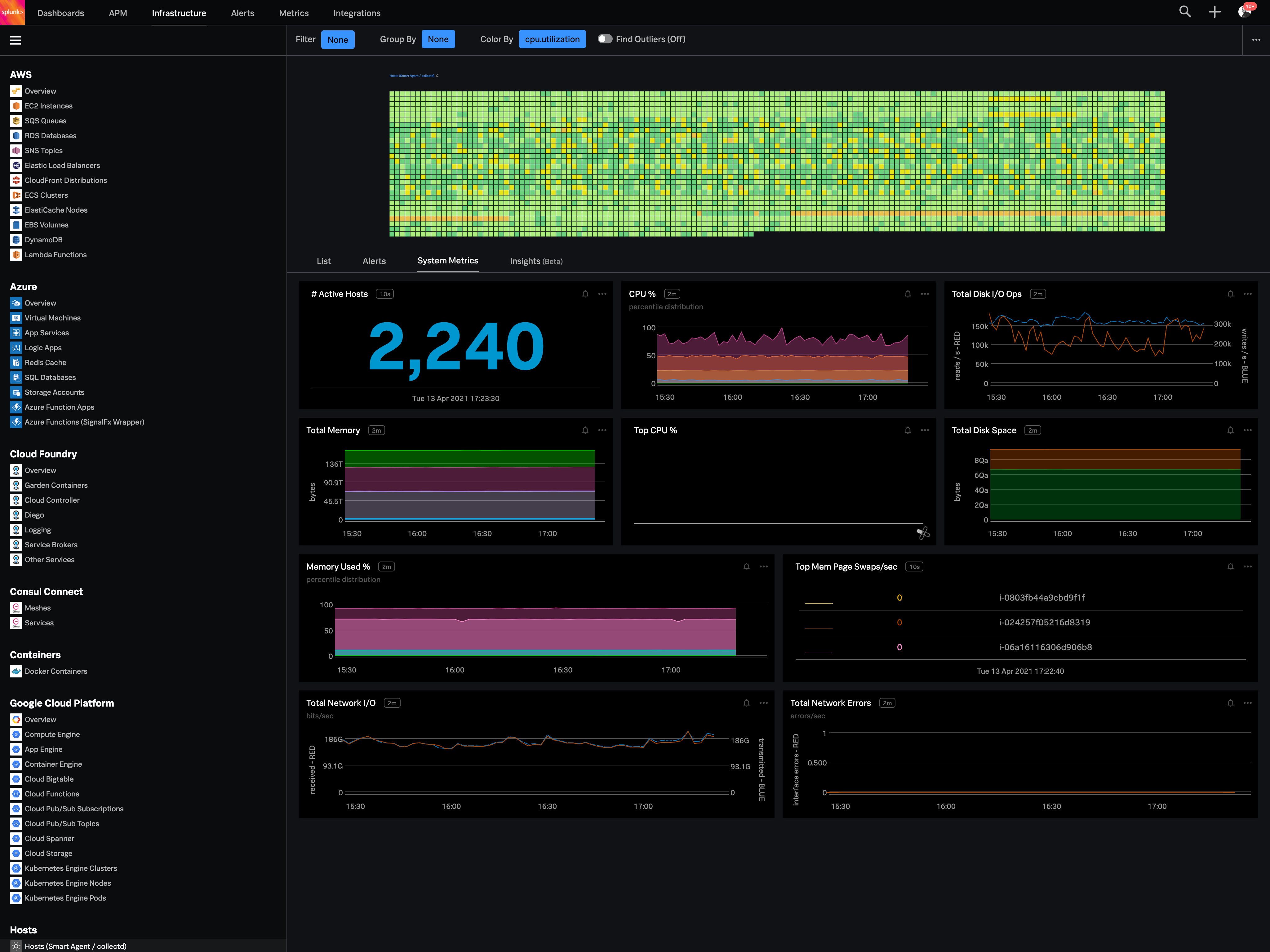
Splunk Observability Cloud aims to enable operational agility and better customer experience through real-time AI-driven streaming analytics allowing accurate alerts in seconds. It is designed to shorten MTTD and MTTR by providing real-time visibility into cloud infrastructure and services.
$180
per year per host
TeamCity
Score 7.1 out of 10
N/A
TeamCity is a continuous integration server from Czeck company JetBrains.
Circle was the first CI with simple setup, great documentation, and tight integration with GitHub. Using Jenkins was too much maintenance and overhead, TeamCity was limited in how we could customize it and run concurrent builds, TravisCI was not available for private repos when …
This application is easy to install and deploy at site than most of the similar solutions in market. Easy user interface is one of the reason it can be installed. However each software have its good points and bad points. Study your organizations case and then only choose …
Based on our experience, CircleCI is well-suited for automating mobile app release cycles. For example, to release an iOS app, you would need to build, sign, and upload it to TestFlight, which requires a dedicated Mac in the office. But with CircleCI, you can have macOS executors, so you don't have to manage a physical build machine. Another benefit is that CircleCI's certified AWS Orbs abstract away complex authentication and deployment logic, allowing us to build, push, and deploy Docker containers to Amazon ECS with minimal configuration and high reliability. CircleCI is less suited for smaller projects where the development and deployment are not that extensive, for example, a static site. Once you have built a static site, you probably won't make any further changes, so there's no point in paying for it.
Its great if you need real-time visibility across complex or regulated environments. Also strong for hybrid or multi-cloud setups where uptime, observability and fast IR are required. It’s probably overkill for smaller teams or environments that don’t have constant changes or compliance reporting needs. It's expensive and has a steep learning curve. Also, in my opinion, do not get yourself into a consumption based model. Costs can certainly get out of control quickly.
TeamCity is very quick and straightforward to get up and running. A new server and a handful of agents could be brought online in easily under an hour. The professional tier is completely free, full-featured, and offers a huge amount of growth potential. TeamCity does exceptionally well in a small-scale business or enterprise setting.
Automated builds! This is really why you get CircleCI, to automate the build process. This makes building your application far more reliable and repeatable. It can also run tests and verify your application is working as expected.
Simple. Unlike Jenkins, Teamcity, or other platforms, CircleCI doesn't need a lot of setup. It's completely hosted, so there's no infrastructure to set up. The config file does take a bit to understand, but if you follow their example and start with something small and add to it, you can get it up and going quicker than it first looks.
Scales easily. Again, since it's all cloud-based, you don't have to manage or scale infrastructure. Simply subscribe to the number of containers you want, and scaling up just means buying more containers.
The first one is its Kubernetes container monitoring.
I really like this features because as we know how much K8s is vast and to manually monitor each part of the Kubernetes it takes so much time but Splunk Observability Cloud makes it easier. And even once we integrate K8s with Splunk Observability Cloud it gives us some prebuilt dashboards which gives holistic view of our Cluster and its nodes, pods, etc.
The dashbaord feature of Splunk Observability Cloud, it gives us full flexibility to customize our dashboard with a wide range of predefined chart types.
Now it also supports OTEL, which is a plus point for observability. As now everyone is moving towards Otel and in current market there are only few tools who supports OTEL based integrations, Splunk Observability Cloud is one out of them.
You can use table-like functionality to generate dashboards, but these queries are heavy on the system.
It could be easier to give insight into what type of line parsing is used for specific documents in a company-managed environment and/or show ways to gain the insights needed.
I would like to see ways to anonymize specific data for shared reports without pre-formatting this in a dashboard on which reports could be based.
The customization is still fairly complex and is best managed by a dev support team. There is great flexibility, but with flexibility comes responsibility. It isn't always obvious to a developer how to make simple customizations.
Sometimes the process for dealing with errors in the process isn't obvious. Some paths to rerunning steps redo dependencies unnecessarily while other paths that don't are less obvious.
Good: Stable system with low error rate Easy to use for simple use cases Bad: UI is not very clear for complex usage Mobile view (when logged in from phone) is bad No library for .net
The reliability & speed, it just works. The ability to spin up macOS runners and Docker containers on demand without managing hardware is a huge win. The Orbs system makes integrating with AWS and Slack incredibly easy, saving us weeks of custom scripting and providing real-time updates in our Slack channel. This makes it easy for us to track and ensures that everyone involved knows the status. Of course, it has drawbacks related to configuration complexity and, in some cases, cost transparency, but overall, it is an industry-standard, robust tool that solves our core infrastructure problems well.
When there is an issue, it’s a win if one can easily identify the root cause. To do the same, it should allow the user to dig deep with multiple data points and compare the data and identify the anomaly. In this use case, it’s good to drive from Splunk 011y.
It's pretty snappy, even with using workflows with multiple steps and different docker images. I've seen builds take a long time if it's really involved, but from what I can tell, it's still at least on par if not faster than other build tools.
TeamCity runs really well, even when sharing a small instance with other applications. The user interface adequately conveys important information without being overly bloated, and it is snappy. There isn't any significant overhead to build agents or unit test runners that we have measured.
Unless you have a reasonably large account, you're going to be mainly stuck reading their documentation. Which has improved somewhat over the years but is still extremely limited compared to a platform like Digital Ocean who invested in the documentation and a community to ensure it's kept up to date. If you can't find your answer there, you can be stuck.
Jenkins is usually self-hosted, Travis CI's infrastructure is largely unreliable (lots of tests time out for no discernable reason), and Semaphore encourages you to configure your CI/CD from a web UI. We like CircleCI because its hosted, our tests run largely as expected on their infrastructure, and we can configure it from a config file that we track in GitHub.
Splunk Infrastructure Monitoring provides far superior options for anybody using a complex hybrid multi-cloud environment and allows both your SOC and NOC to work together on the same data while driving their own insights. We found other products are still in the old world view of servers and agents residing together within a single data centre, but modern apps are no longer like this.
TeamCity is a great on-premise Continuous Integration tool. Visual Studio Team Services (VSTS) is a hosted SAAS application in Microsoft's Cloud. VSTS is a Source Code Repository, Build and Release System, and Agile Project Management Platform - whereas TeamCity is a Build and Release System only. TeamCity's interface is easier to use than VSTS, and neither have a great deployment pipeline solution. But VSTS's natural integration with Microsoft products, Microsoft's Cloud, Integration with Azure Active Directory, and free, private, Source Code repository - offer additional features and capabilities not available with Team City alone.
We pay over $5K/ month and we have high expectations for service. Sometimes I feel that we don't get the value, but only sometimes.
We have had to build our own application to keep state and broker releases and deployments. We call our app deployer. I feel that CircleCI could do more to understand our needs and possibly build additional features that would enable us to invest less in build and deployment infrastructure and justify paying more for Circle.
TeamCity has greatly improved team efficiency by streamlining our production and pre-production pipelines. We moved to TeamCity after seeing other teams have more success with it than we had with other tools.
TeamCity has helped the reliability of our product by easily allowing us to integrate unit testing, as well as full integration testing. This was not possible with other tools given our corporate firewall.
TeamCity's ability to include Docker containers in the pipeline steps has been crucial in improving our efficiency and reliability.