Citrix Endpoint Management (formerly XenMobile), is a UEM and enterprise mobility management application for securing mobile applications and devices.
N/A
Hexnode UEM
Score 8.5 out of 10
N/A
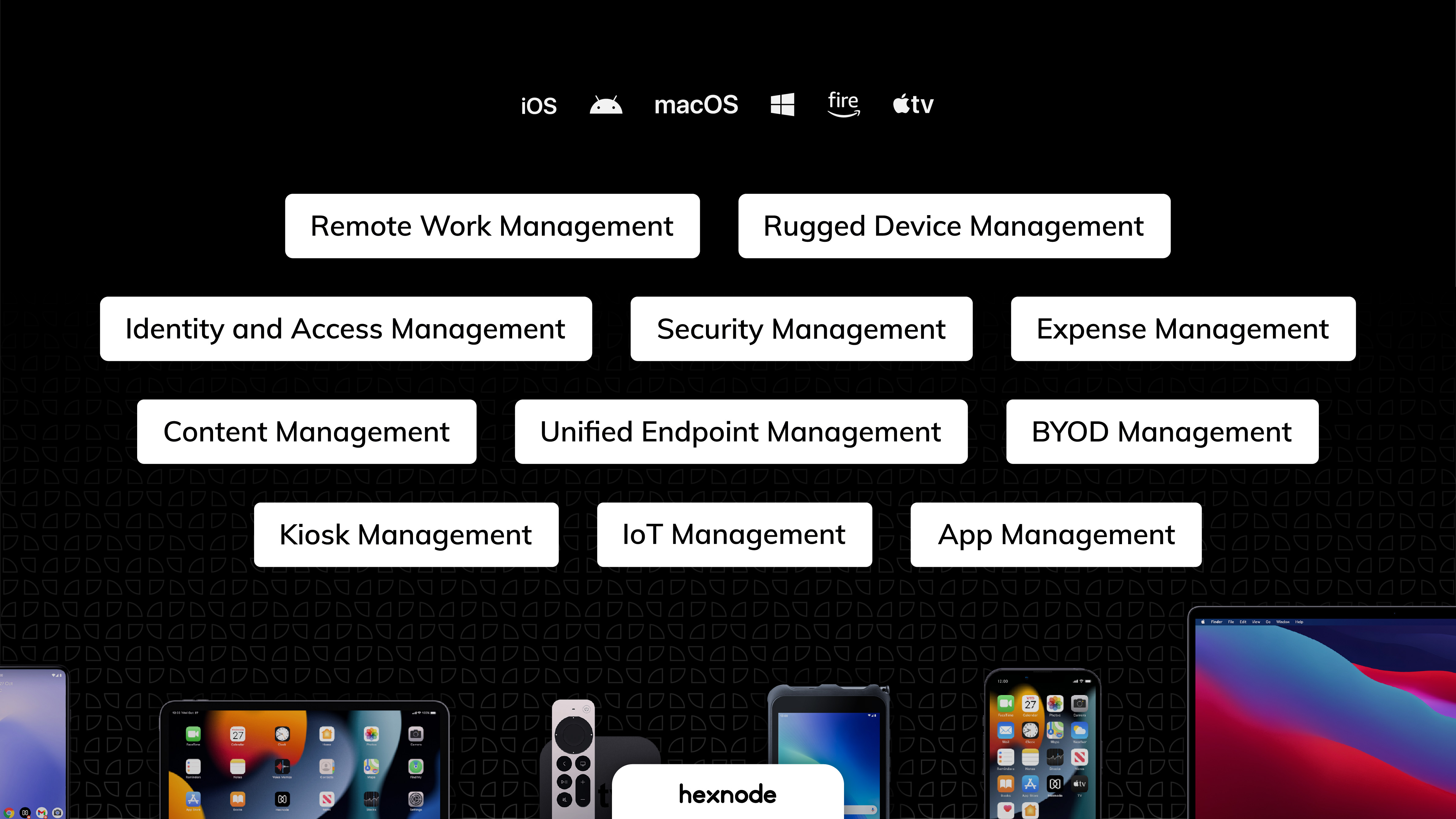
Hexnode is a Unified Endpoint Management solution that aims to simplify the way people work with the help of intelligent tools. The management platform streamlines the device lifecycle model to offer its support at every stage, from device onboarding to the end of its life. It also gives a hands-free experience with automatic enrollment using Zero-touch enrollment, Knox Mobile Enrollment, and ABM and endpoint management with the help of dynamic group allocation in the case of…
$36
per month 15 devices (minimum)
ManageEngine Mobile Device Manager Plus
Score 9.3 out of 10
N/A
The ManageEngine Mobile Device Manager Plus application is an enterprise mobile device management (MDM) solution.
N/A
Pricing
Citrix Endpoint Management
Hexnode UEM
ManageEngine Mobile Device Manager Plus
Editions & Modules
No answers on this topic
Pro
$2.40
per month per device
Enterprise
$3.60
per month per device
Ultimate
$5.20
per month per device
Ultra
Contact Hexnode for a Quote
No answers on this topic
Offerings
Pricing Offerings
Citrix Endpoint Management
Hexnode UEM
ManageEngine Mobile Device Manager Plus
Free Trial
No
Yes
No
Free/Freemium Version
No
Yes
No
Premium Consulting/Integration Services
No
Yes
No
Entry-level Setup Fee
No setup fee
No setup fee
No setup fee
Additional Details
—
No support costs, No maintenance charges. Per device pricing. Discount available for annual pricing.
ManageEngine was confusing and hard to get support from, in my experience. We use other products from ManageEngine and it is always a headache to get a hold of them. Hexnode UEM is two clicks and you are talking to someone on their live chat pretty much all day. ManageEngine …
This product is well suited for any healthcare organization, especially one privately owned by the providers. Many of our providers were displeased with our efforts to use a product that forced sandboxing of Exchange information. Therefore, we needed something that was flexible enough that sandboxing could be used where desired but still allowed native OS integration where necessary.
We enjoy the ability to remotely support our end users with their tablets while they are traveling. I've had the ability to provide support to some of our remote sales users as they are working at a customers location. However, sometimes the remote view can be a bit of a lagging issue that makes things a bit difficult. Though overall this has been a great experience that helps us support our various users throughout the company.
An amazing solution for an organisation of up to 25 devices as they offer a free subscription. You could use this to trial the product at your organisation. The perfect fit for any size of organisation with the software being simple enough for non-technical staff to be able to deploy and manage devices.
Android zero-touch enrollment allows bulk enrollment of corporate-owned android devices with a single click.
With the help of the dynamic device grouping function, devices may be grouped in accordance with specific pre-configured criteria.
The kiosk mode supports both single-app kiosk mode, in which the device is restricted to using a single app, and multi-app kiosk mode, in which the device is in kiosk mode but has access to a number of other programs and files.
Geo tracking: once the mobile app is installed, the phone checks in to our cloud management console and we can ping the location of the device easily.
Lost/stolen device: when a device is lost or stolen, we can make the phone make a sounds to help in finding it or perform a complete wipe to remove any sensitive data.
App management: they make it easy to add mobile apps that can automatically be pushed out to all of the managed devices. It is easy to control what apps you want to have immediately installed, apps you want to make available, or apps you want to block.
issues with non apple, non samsung devices: if it is not setup with an apple or samsung phone, then the Certificate onboarding is a struggle/unable to be done.
user-pin setup: for a user to be onboarded, requiring a PIN; there is a self service way but it is clunky and users prefer to call in instead of trying to follow the 15 step process via PDF
if the certificate is ever lost, due to an upgrade via IOS or android, then the entire process [uninstall, reinstall] has to be done, which means downtime for the end user, and higher call volume when a service provider pushes an iOS update.
Devices running watchOS cannot be handled or enrolled.
The policies under WIFI, which allowed certain websites to be blocked using website certificates, were complicated .
The app management features provide the ability to push the installation of corporate apps on the devices. Even though it was successful on the Hexnode Portal, this feature periodically malfunctioned, and the apps were not loaded.
Documents are sorted by some random order by default, users need to manually select "sort by A-Z", and even by doing so, coming out of documents and back in will reset the order to the random one. Would be amazing if A-Z was default, or if I could find out what this default order was to edit the files accordingly.
Playing audio files from the app is approached as if it was a video: if you come out of the app or lock the screen, the audio will stop. Would be great if it could act like music apps and keep playing with locked screen.
The software's usability is what we expected. We knew what our organization needed and Citrix was able to meet our needs. The ability to have the apps on a mobile device has been a great plus and Citrix seems to have really developed a software based on the every day needs of the user.
UX is pretty good, but various screens are a bit redundant. Managing user and managing devices is often one in the same operation, but is broken across multiple screens. Device management policies are strange because if you make a "macOS" policy, why does it have all the Windows, iOS, Android etc options? It's unlikely you'll want all of these options for all possible OSes in one policy, but that's the only way to build a policy. Manage policy changes require remote system restart which is highly disruptive to employees.
Overall, I like using MDM as the GUI is greatly easier to use. The navigation is very simple, as you can find your way using multiple routes. I like how the opening dashboard shows devices and users, so you can see your numbers grow or shrink.
Overall the support from the customer service team has been good. They are very timely and expert in resolving the tickets. They have appropriate knowledge to resolve issues in all stages to development. They were up to the point during the implementation stage of the XenMobile, all queries were answered in time to help finish the deployment. The support for last three years has been extraordinary in helping us use XenMobile effectively and efficiently.
With a zero trust solution for the entire digital workspace, you can continually monitor and assess session activities before, during, and after login. Reduce risk, gain more control over every session, and get deeper insights across your entire application landscape. To achieve this strong security posture across all environments, you need an application delivery solution that shares a common code base. This lets you implement consistent security policies across all your applications for comprehensive protection.
I am currently using both the platforms, Hexnode UEM and Esper. Esper is used for managing mobile devices and Lenovo Tablets while Hexnode UEM is being used for Microsoft tablets. The basic framework behind both of them is almost the same. Both of them have a clean and interactive UI with good functionality.
After exploring some MDM system, we choose ManageEngine Mobile Device Manager Plus as the out-of-the-box features and functionalities meet our business needs, reasonable license cost, reputable company, and provide good supports.
Specific ROI was on us avoiding purchasing company managed cell phones - one of the most important drivers
Makes on boarding, and especially offboarding remote users a heck of a lot easier w/the ability to wipe the container, even if not connected (via time setting)
Easy access to internal resources - no need for separate vpn, etc...
We already had someone try to walk away with an ipad after deploying Hexnode, and we were immediately able to force an activation lock telling them to bring it back and they did.
It has saved us a lot of time setting up ios devices as we have a limited amount of IT staff and Hexnode makes it take probably around ten minutes an ipad.
Employee experience has improved since we can reset code remotely and they no longer have to send the ipads back to the corporate office to get reset.