Overview
ProductRatingMost Used ByProduct SummaryStarting Price
Couchbase Server
Score 8.6 out of 10
N/A
Couchbase Server is a cloud-native, distributed database that fuses the strengths of relational databases such as SQL and ACID transactions with JSON flexibility and scale that defines NoSQL. It is available as a service in commercial clouds and supports hybrid and private cloud deployments.N/A
MongoDB
Score 8.9 out of 10
N/A
MongoDB is an open source document-oriented database system. It is part of the NoSQL family of database systems. Instead of storing data in tables as is done in a "classical" relational database, MongoDB stores structured data as JSON-like documents with dynamic schemas (MongoDB calls the format BSON), making the integration of data in certain types of applications easier and faster.
$0.10
million reads
Redis Software
Score 9.1 out of 10
N/A
Redis is an open source in-memory data structure server and NoSQL database.N/A
Pricing
Couchbase ServerMongoDBRedis Software
Editions & Modules
No answers on this topic
Shared
$0
per month
Serverless
$0.10million reads
million reads
Dedicated
$57
per month
No answers on this topic
Offerings
Pricing Offerings
Couchbase ServerMongoDBRedis Software
Free Trial
YesYesYes
Free/Freemium Version
YesYesYes
Premium Consulting/Integration Services
YesNoYes
Entry-level Setup FeeOptionalNo setup feeOptional
Additional DetailsFully managed, global cloud database on AWS, Azure, and GCP
More Pricing Information
Community Pulse
Couchbase ServerMongoDBRedis Software
Considered Multiple Products
Couchbase Server
Chose Couchbase Server
Couchbase is easier to use and higher performing than Mongo DB. We also evaluated MongoDB but decided to use Couchbase.
Chose Couchbase Server
Couchbase has a database monitoring tool kit and performance-wise Couchbase is a step beyond MongoDB so we chose the Couchbase Database solution.
Chose Couchbase Server
Couchbase's server is more scalable than MongoDB, as MongoDB degrades its performance if the number of users grows. Also, Couchbase allows us to integrate more third-party applications, Couchbase’s query language extends ANSI SQL.
Chose Couchbase Server
While considering NoSQL database options, we evaluated MongoDB and Couchbase. We decided to go with Couchbase as our dabatase of choice primarily because we had previous Couchbase experience within the team and we knew that this existing expertise could reduce the time needed …
Chose Couchbase Server
We have good experiences with MongoDB, Elasticsearch, and today we expect to be able to improve our products with Couchbase and in the near future replace 2 products with 1, which will simplify our product architecture.
Chose Couchbase Server
It is optimized for interactive applications
Chose Couchbase Server
The project we are developing with Couchbase, was very inconsistent for few years of the beginning. We had to change data model multiple times. We knew this before starting the project. So we had to choose a NoSQL solution. We also wanted a syncing solution. After some research …
Chose Couchbase Server
Couchbase was mainly selected because it provided professional support, which was mandatory. I did not participate in the technical decisions.
Chose Couchbase Server
Couchbase offers p2p sync and offline sync capabilities which gave an advantage over mongo. The sync has filter functions.
Chose Couchbase Server
Couchbase is scalable and very secure. It also offers better features and is very capable.
Chose Couchbase Server
Easy to deploy and manage. Clustering and replication is fairly simple and straightforward. According to developers, Couchbase scored higher points compared to the other products that we evaluated.
Chose Couchbase Server
Experience with DataStax Cassandra was seamless, but the cost and effort to support it was not justified. Also commercial process experience with Couchbase was much better. ActiveSpaces is a good technology for big TIBCO shop, but keeping with the lifecycle of it is not easy. I …
Chose Couchbase Server
None of the products mentioned above provided a seamless synchronization strategy that could be available on-premises at the time.
Chose Couchbase Server
I'm not qualified enough to make a meaningful comparison, but 2 years after, I hear regularly about issues on Mongo from the other teams, especially on the SRE side. On our side, not much to say, except that it works. Ram, CPU, disk behave like expected. Same for bandwidth. …
Chose Couchbase Server
  • All the selected products above are free but don't have peer to peer syncing cloud to mobile.
  • The GUI for maintaining and clustering the DB is wonderful.
  • We can use community release for the mobile app.
Chose Couchbase Server
Couchbase had more features than the other products we evaluated and a more flexible data model. It also has global replication and better performance. Compared to some, it was also easier to deploy, manage, and scale. The global replication, plus the ease of deploying and …
Chose Couchbase Server
Couchbase takes most of the best features of products such as Amazon Aurora, DynamoDB, Mongo DB, or Realm IO. It by the way might be lacking a good AWS strategy compared to other solutions. Couchbase has a great field for improvements in establishing specific deployment …
Chose Couchbase Server
We looked at several different SQL and NoSQL systems. Most were either too expensive, didn't provide the needed functionality, or were too hard to use with the size of our team. We ultimately went with Couchbase because of its performance, horizontal scalability, and price.
Chose Couchbase Server
Comparable but more costly. More features but not necessarily correlated to the price point.
MongoDB
Chose MongoDB
Both Couchbase and MongoDB are document-oriented NoSQL databases, so they have very similar features. While they do have some fundamental differences in terms of how they scale, shard, etc. the one key reason why we went with MongoDB is its availability and support from the …
Chose MongoDB
In our early development days we weighed NoSQL databases like MongoDB with RDBMS solutions like MySQL. We were more familiar with MySQL from past experience but also were wary of painful data migrations that slowed down development iterations and increased the risk of outages …
Chose MongoDB
I just felt MongoDB was easier to use and more cost-effective. Aggregation pipelines are great.
Chose MongoDB
MongoDB is our go-to database solution for any project, and the more we work with it the more we love it. Some say that NoSQL is pointless... Our developers wholeheartedly disagree, because they love working with it. Though both NoSQL and SQL have their purposes, in most …
Chose MongoDB
SQL server is ancient, and Couchbase doesn't let you accomplish anything special--it's too basic, especially from a security standpoint.
Chose MongoDB
The way MongoDB handles the data is unique and the indexing of data is powerful.
Chose MongoDB
MySQL is a great for querying related data, but it's unable to store structured data and has a fixed schema. Also SQL can be non-intuitive. DynamoDB, CouchDB and Redis all make querying the data quite difficult and lack important features. The problem CouchDB tries to solve is …
Chose MongoDB
Cassandra: may be better for bigger use cases, in PB range, due to our use cases being slightly smaller, we did not need this, but we highly rely on efficient indexing, and low latency, which seemed to be better based on our testing in Mongodb.
Couchbase Server: Document …
Chose MongoDB
We chose MongoDB because it fit our specific use cases better than the other two NoSQL products that I've identified. There are some use cases where those products would be better. Be sure to use the right tool for the job, for us, it was MongoDB, for you it might not be.
Chose MongoDB
MongoDB is document oriented, and fits our goals best.
Redis Software
Chose Redis Software
Initially, we were unsure whether to use Redis or MongoDB., in reality, they are both no-SQL databases but can be used both as needed. certainly, in my opinion, it is more reasonable a DB no SQL MongoDB than Redis, the key logic value of Redis is certainly performing for the …
Chose Redis Software
Redis is great at set operations and is very fast. Riak is a fast long-term data store, but it is expensive to run. MongoDB is good for small, quick projects. Elasticsearch is great at indexing and searching. Choose the right tool for the job, and don't be afraid to …
Chose Redis Software
Redis was initially in the list of competitors like Aerospike, Cassandra, MongoDB.The major point that outset all others is that it provides a number of read and writes to the database that no one can match. Another major factor is Redis really knows the basic components that …
Chose Redis Software
Couchbase doesn't keep up with what they offer and what really does.
MongoDB just doesn't scale out, reads are performed across multiple nodes but writes still go to the single master.
DynamoDB is good overall but just way too expensive.
Chose Redis Software
We have also done lot of research over NoSQL databases to find what is a good fit for our application. We finally decided to use Redis because:
  1. It requires very minimal hardware to set up.
  2. Supports key-value structure.
Chose Redis Software
Every time you don't need a document DB, you can't go wrong with Redis over MongoDB.
Google Cloud Pub/Sub may have solved one use case, but we'd still have to deploy Redis instances for other use cases, and adding another tech stack would only add complexity to our …
Chose Redis Software
Redis is faster, provides documents JSON-wise with the proper odule and it is far more stable than MongoDB (we had really bad experiences with Mongo, especially when ops tends to increase).
Chose Redis Software
All are good products. MongoDB is a great NoSQL DB but didn't seem to have the high performance caching of Redis. Coherence and Xtreme Scale are expensive. In my opinion for our particular use case, Redis was the clear winner.
Chose Redis Software
UI isn't that great compared to the other competitors.
The management of our memcached cluster was becoming pretty complicated as the application grew in size. Redis is a much better option compared to memcached.
Redis is bit unreliable compared to the alternative RabbitMQ
Chose Redis Software
We divide projects between Redis and Elasticsearch Service. In some parts or modules one of these two databases fit better than the other.
Chose Redis Software
  • Redis vs. Aerospike ... Aerospike is way BETTER. But very expensive.
  • Between Redis and MemCacheD, Redis outright is better than it.
  • Couchbase is better than Redis, but CouchB is expensive
Chose Redis Software
We initially used Memcached for some of the caching and locking solutions we now use Redis for; we found that for the purposes of our system Memcache could not match up to Redis for performance. We also found Redis to be a bit more reliable, but that could have just been down …
Chose Redis Software
We are big users of MySQL and PostgreSQL. We were looking at replacing our aging web page caching technology and found that we could do it in SQL, but there was a NoSQL movement happening at the time. We dabbled a bit in the NoSQL scene just to get an idea of what it was about …
Chose Redis Software
We initially tried ElastiCache with Redis hosting. While it did the job of running Redis, we still had to deal with server sizing. We switched to Redis Cloud since that had auto-scaling and easy to use tools.
Chose Redis Software
Actually, our CouchDB usage has been testimonial, so I can't do a good comparison.
Chose Redis Software
One key feature: easy to use. you can install and use it under minutes. For the rest of the options, you have to do more configuration and settings. Besides all these, Redis is in-memory so the performance is a blast. Considering that simple is better, the proof of the concept …
Chose Redis Software
We chose Redis over Memcached and Couchbase for its performance, cost, support, and ease of use. Couchbase probably would have worked as well, but it seemed a bit overkill for our use cases.
Chose Redis Software
Redis is easy to get setup, has great documentaiton, and quality online support. Antirez is constantly making feature updates the product, and is engaged with the community. Redis doesn't have a lot of bells and whistles, but what features it does has are well implemented and …
Features
Couchbase ServerMongoDBRedis Software
NoSQL Databases
Comparison of NoSQL Databases features of Product A and Product B
Couchbase Server
8.9
96 Ratings
0% above category average
MongoDB
10.0
39 Ratings
12% above category average
Redis Software
8.6
70 Ratings
3% below category average
Performance8.996 Ratings10.039 Ratings9.070 Ratings
Availability9.495 Ratings10.039 Ratings7.070 Ratings
Concurrency8.993 Ratings10.039 Ratings9.069 Ratings
Security9.093 Ratings10.039 Ratings8.064 Ratings
Scalability9.494 Ratings10.039 Ratings9.070 Ratings
Data model flexibility9.094 Ratings10.039 Ratings9.063 Ratings
Deployment model flexibility8.093 Ratings10.038 Ratings9.063 Ratings
Best Alternatives
Couchbase ServerMongoDBRedis Software
Small Businesses
IBM Cloudant
IBM Cloudant
Score 7.4 out of 10
IBM Cloudant
IBM Cloudant
Score 7.4 out of 10
IBM Cloudant
IBM Cloudant
Score 7.4 out of 10
Medium-sized Companies
IBM Cloudant
IBM Cloudant
Score 7.4 out of 10
IBM Cloudant
IBM Cloudant
Score 7.4 out of 10
IBM Cloudant
IBM Cloudant
Score 7.4 out of 10
Enterprises
IBM Cloudant
IBM Cloudant
Score 7.4 out of 10
IBM Cloudant
IBM Cloudant
Score 7.4 out of 10
IBM Cloudant
IBM Cloudant
Score 7.4 out of 10
All AlternativesView all alternativesView all alternativesView all alternatives
User Ratings
Couchbase ServerMongoDBRedis Software
Likelihood to Recommend
9.0
(98 ratings)
10.0
(79 ratings)
8.0
(76 ratings)
Likelihood to Renew
2.1
(3 ratings)
10.0
(67 ratings)
8.7
(12 ratings)
Usability
8.0
(1 ratings)
10.0
(15 ratings)
9.0
(6 ratings)
Availability
8.0
(1 ratings)
9.0
(1 ratings)
-
(0 ratings)
Performance
9.3
(94 ratings)
-
(0 ratings)
-
(0 ratings)
Support Rating
8.5
(5 ratings)
9.6
(13 ratings)
8.7
(5 ratings)
Implementation Rating
-
(0 ratings)
8.4
(2 ratings)
7.3
(1 ratings)
Product Scalability
7.0
(52 ratings)
-
(0 ratings)
-
(0 ratings)
User Testimonials
Couchbase ServerMongoDBRedis Software
Likelihood to Recommend
Couchbase
Best suited when edge devices have interrupted internet connection. And Couchbase provides reliable data transfer. If used for attachment Couchbase has a very poor offering. A hard limit of 20 MB is not okay. They have the best conflict resolution but not so great query language on Couchbase lite.
Read full review
MongoDB
If asked by a colleague I would highly recommend MongoDB. MongoDB provides incredible flexibility and is quick and easy to set up. It also provides extensive documentation which is very useful for someone new to the tool. Though I've used it for years and still referenced the docs often. From my experience and the use cases I've worked on, I'd suggest using it anywhere that needs a fast, efficient storage space for non-relational data. If a relational database is needed then another tool would be more apt.
Read full review
Redis
Redis has been a great investment for our organization as we needed a solution for high speed data caching. The ramp up and integration was quite easy. Redis handles automatic failover internally, so no crashes provides high availability. On the fly scaling scale to more/less cores and memory as and when needed.
Read full review
Pros
Couchbase
  • Couchbase performance is exceptional both for in-memory and persisted transactions.
  • Handling of node failures and cluster rebalancing (high availability).
  • Enterprise support from Couchbase themselves
  • Good documentation
  • Streaming of bucket (database) level mutations via their Database Change Protocol (DCP).
  • Replication of datasets between native clients and Couchbase buckets
  • Handling of simultaneous writes to the same record with performance penalties
Read full review
MongoDB
  • Being a JSON language optimizes the response time of a query, you can directly build a query logic from the same service
  • You can install a local, database-based environment rather than the non-relational real-time bases such a firebase does not allow, the local environment is paramount since you can work without relying on the internet.
  • Forming collections in Mango is relatively simple, you do not need to know of query to work with it, since it has a simple graphic environment that allows you to manage databases for those who are not experts in console management.
Read full review
Redis
  • Easy for developers to understand. Unlike Riak, which I've used in the past, it's fast without having to worry about eventual consistency.
  • Reliable. With a proper multi-node configuration, it can handle failover instantly.
  • Configurable. We primarily still use Memcache for caching but one of the teams uses Redis for both long-term storage and temporary expiry keys without taking on another external dependency.
  • Fast. We process tens of thousands of RPS and it doesn't skip a beat.
Read full review
Cons
Couchbase
  • The N1QL engine performs poorly compared to SQL engines due to the number of interactions needed, so if your use case involves the need for a lot of SQL-like query activity as opposed to the direct fetch of data in the form of a key/value map you may want to consider a RDBMS that has support for json data types so that you can more easily mix the use of relational and non-relational approaches to data access.
  • You have to be careful when using multiple capabilities (e.g. transactions with Sync Gateway) as you will typically run into problems where one technology may not operate correctly in combination with another.
  • There are quality problems with some newly released features, so be careful with being an early adopter unless you really need the capability. We somewhat desperately adopted the use of transactions, but went through multiple bughunt cycles with Couchbase working the kinks out.
Read full review
MongoDB
  • An aggregate pipeline can be a bit overwhelming as a newcomer.
  • There's still no real concept of joins with references/foreign keys, although the aggregate framework has a feature that is close.
  • Database management/dev ops can still be time-consuming if rolling your own deployments. (Thankfully there are plenty of providers like Compose or even MongoDB's own Atlas that helps take care of the nitty-gritty.
Read full review
Redis
  • We had some difficulty scaling Redis without it becoming prohibitively expensive.
  • Redis has very simple search capabilities, which means its not suitable for all use cases.
  • Redis doesn't have good native support for storing data in object form and many libraries built over it return data as a string, meaning you need build your own serialization layer over it.
Read full review
Likelihood to Renew
Couchbase
I rarely actually use Couchbase Server, I just stay up-to-date with the features that it provides. However, when the need arises for a NoSQL datastore, then I will strongly consider it as an option
Read full review
MongoDB
I am looking forward to increasing our SaaS subscriptions such that I get to experience global replica sets, working in reads from secondaries, and what not. Can't wait to be able to exploit some of the power that the "Big Boys" use MongoDB for.
Read full review
Redis
We will definitely continue using Redis because: 1. It is free and open source. 2. We already use it in so many applications, it will be hard for us to let go. 3. There isn't another competitive product that we know of that gives a better performance. 4. We never had any major issues with Redis, so no point turning our backs.
Read full review
Usability
Couchbase
Couchbase has been quite a usable for our implementation. We had similar experience with our previous "trial" implementation, however it was short lived.
Couchbase has so far exceeded expectation. Our implementation team is more confident than ever before.
When we are Live for more than 6 months, I'm hoping to enhance this rating.
Read full review
MongoDB
NoSQL database systems such as MongoDB lack graphical interfaces by default and therefore to improve usability it is necessary to install third-party applications to see more visually the schemas and stored documents. In addition, these tools also allow us to visualize the commands to be executed for each operation.
Read full review
Redis
It is quite simple to set up for the purpose of managing user sessions in the backend. It can be easily integrated with other products or technologies, such as Spring in Java. If you need to actually display the data stored in Redis in your application this is a bit difficult to understand initially but is possible.
Read full review
Performance
Couchbase
One of Couchbase’s greatest assets is its performance with large datasets. Properly set up with well-sized clusters, it is also highly reliable and scalable. User management could be better though, and security often feels like an afterthought. Couchbase has improved tremendously since we started using it, so I am sure that these issues will be ironed out.
Read full review
MongoDB
No answers on this topic
Redis
No answers on this topic
Support Rating
Couchbase
I haven't had many opportunities to request support, I will look forward to better the rating. We have technical development and integration team who reach out directly to TAM at Couchbase.
Read full review
MongoDB
Finding support from local companies can be difficult. There were times when the local company could not find a solution and we reached a solution by getting support globally. If a good local company is found, it will overcome all your problems with its global support.
Read full review
Redis
The support team has always been excellent in handling our mostly questions, rarely problems. They are responsive, find the solution and get us moving forward again. I have never had to escalate a case with them. They have always solved our problems in a very timely manner. I highly commend the support team.
Read full review
Implementation Rating
Couchbase
No answers on this topic
MongoDB
While the setup and configuration of MongoDB is pretty straight forward, having a vendor that performs automatic backups and scales the cluster automatically is very convenient. If you do not have a system administrator or DBA familiar with MongoDB on hand, it's a very good idea to use a 3rd party vendor that specializes in MongoDB hosting. The value is very well worth it over hosting it yourself since the cost is often reasonable among providers.
Read full review
Redis
Whitelisting of the AWS lambda functions.
Read full review
Alternatives Considered
Couchbase
The Apache Cassandra was one type of product used in our company for a couple of use-cases. The Aerospike is something we [analyzed] not so long time ago as an interesting alternative, due to its performance characteristics. The Oracle Coherence was and is still being used for [the] distributed caching use-case, but it will be replaced eventually by Couchbase. Though each of these products [has] its own strengths and weaknesses, we prefer sticking to Couchbase because of [the] experience we have with this product and because it is cost-effective for our organization.
Read full review
MongoDB
We have [measured] the speed in reading/write operations in high load and finally select the winner = MongoDBWe have [not] too much data but in case there will be 10 [times] more we need Cassandra. Cassandra's storage engine provides constant-time writes no matter how big your data set grows. For analytics, MongoDB provides a custom map/reduce implementation; Cassandra provides native Hadoop support.
Read full review
Redis
We are big users of MySQL and PostgreSQL. We were looking at replacing our aging web page caching technology and found that we could do it in SQL, but there was a NoSQL movement happening at the time. We dabbled a bit in the NoSQL scene just to get an idea of what it was about and whether it was for us. We tried a bunch, but I can only seem to remember Mongo and Couch. Mongo had big issues early on that drove us to Redis and we couldn't quite figure out how to deploy couch.
Read full review
Scalability
Couchbase
So far, the way that we mange and upgrade our clusters has be very smooth. It works like a dream when we use it in concert with AWS and their EC2 machines. Having access to powerful instances along side the Couchbase interface is amazing and allows us to do rebalances or maintenance without a worry
Read full review
MongoDB
No answers on this topic
Redis
No answers on this topic
Return on Investment
Couchbase
  • Great performance.
  • Leading Couchbase Lite capabilities for mobile use.
  • Developers' learning curve with replica reads and multi cluster can be long. Needs guidance and nurturing.
  • Cluster maintenance during OS patching, etc. has multiple ways to approach. Operational teams may need some guidance.
Read full review
MongoDB
  • Open Source w/ reasonable support costs have a direct, positive impact on the ROI (we moved away from large, monolithic, locked in licensing models)
  • You do have to balance the necessary level of HA & DR with the number of servers required to scale up and scale out. Servers cost money - so DR & HR doesn't come for free (even though it's built into the architecture of MongoDB
Read full review
Redis
  • Redis has helped us increase our throughput and server data to a growing amount of traffic while keeping our app fast. We couldn't have grown without the ability to easily cache data that Redis provides.
  • Redis has helped us decrease the load on our database. By being able to scale up and cache important data, we reduce the load on our database reducing costs and infra issues.
  • Running a Redis node on something like AWS can be costly, but it is often a requirement for scaling a company. If you need data quickly and your business is already a positive ROI, Redis is worth the investment.
Read full review
ScreenShots

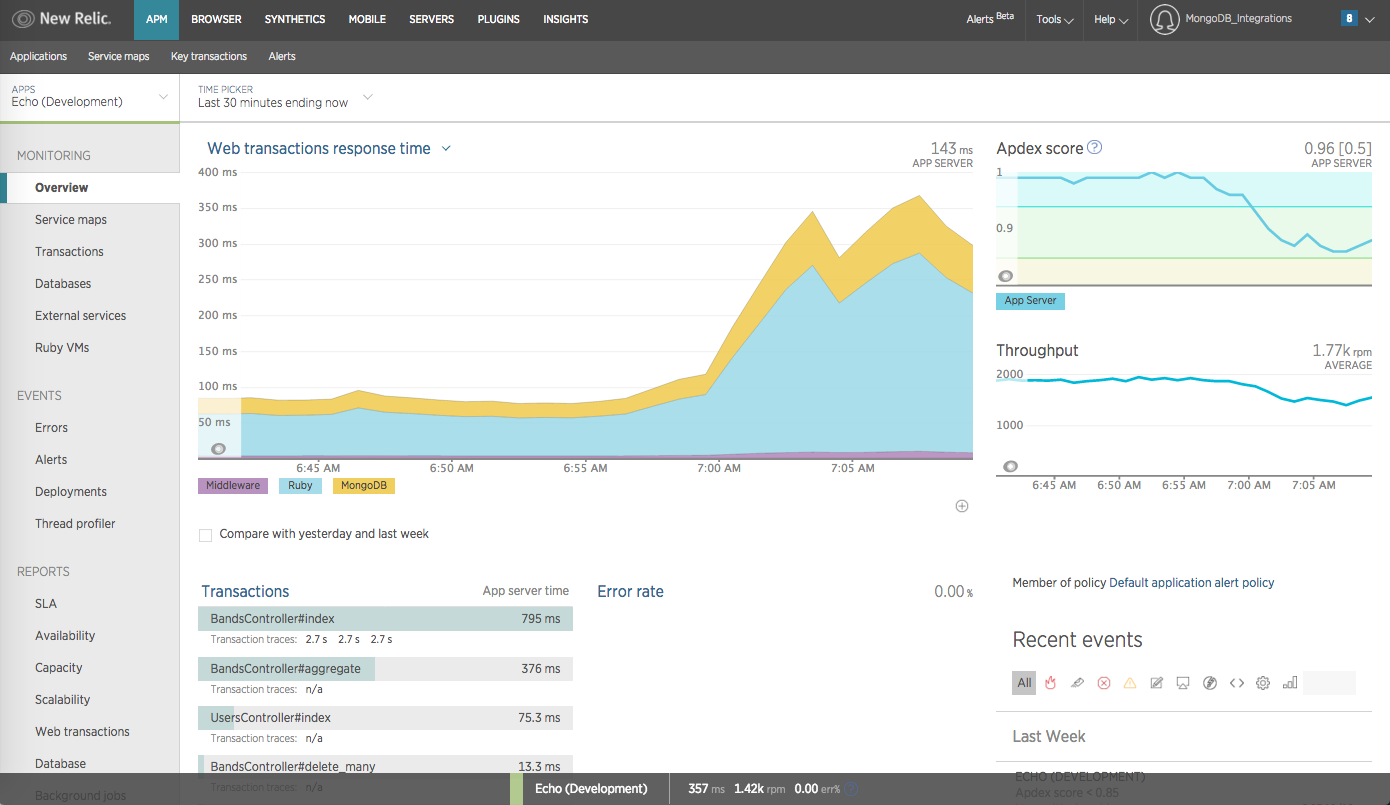
MongoDB Screenshots

Screenshot of Screenshot of Screenshot of Screenshot of Screenshot of Screenshot of

Redis Software Screenshots

Screenshot of Database configurationScreenshot of Database metricsScreenshot of DatabasesScreenshot of NodesScreenshot of Alerts