Dell Avamar is a hardware and software data backup and deduplication product. It provides protection and recovery through a complete software and hardware solution when paired with Dell Data Domain for virtual environments, remote offices, enterprise apps, NAS servers, and desktops/laptops.
N/A
Veeam Data Cloud for Microsoft 365
Score8.7 out of 10
Mid-Size Companies (51-1,000 employees)
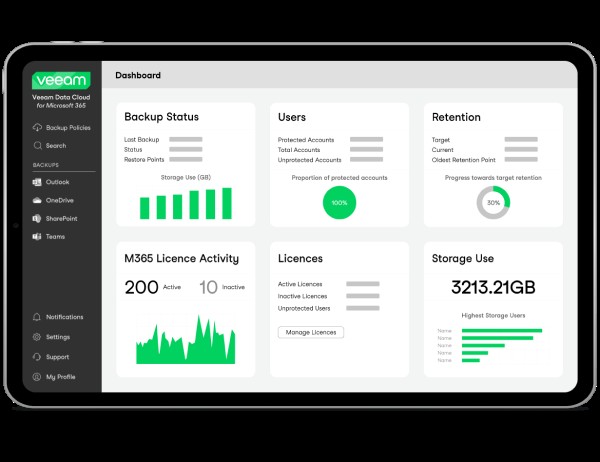
Veeam Data Cloud for Microsoft 365 is a BaaS (Backup as a Service) solution used to back up and restore Microsoft 365 data, including Microsoft Exchange, Microsoft SharePoint, Microsoft OneDrive for Business and Microsoft Teams data.
Veeam Backup for Microsoft 365 is specifically focused at Microsoft 365 data. The other products are good backup products. They all have similar interfaces and functionality. It is my oppinion that the Veeam series of software is more user friendly and works very well. I have …
A de minimis incentive was given to thank the reviewer for their time. The incentive was not used to bias or drive a particular response, nor was the incentive contingent on a positive endorsement. More Info
Verified User
Chose Veeam Data Cloud for Microsoft 365
I actually moved to Barracuda but only for O365 app. I was able to pay per user and backup and save all data, forever.
A de minimis incentive was given to thank the reviewer for their time. The incentive was not used to bias or drive a particular response, nor was the incentive contingent on a positive endorsement. More Info
This software is well suited for companies that want to be very in control of their backups but need a simple tool. It could be convenient for them to just buy their own node, locate it in a different location, and set up the jobs for their machines to backup to the cloud with the specific plugins. However, it would not be convenient for companies looking to have a tool that needs to be secure and compliant, and that need to have different other options for business continuity.
A de minimis incentive was given to thank the reviewer for their time. The incentive was not used to bias or drive a particular response, nor was the incentive contingent on a positive endorsement. More Info
Analyzing campaign performance is a great area where the Veeam Data Cloud for Microsoft 365 is well-suited, and it’s working well. In the past, when we analyzed campaign performance, we had to use outside vendors, which was a time-consuming, laborious, and costly process.
A de minimis incentive was given to thank the reviewer for their time. The incentive was not used to bias or drive a particular response, nor was the incentive contingent on a positive endorsement. More Info
Avamar performs data deduplication on the remote host. This greatly reduces the amount of traffic that each backup requires. This even applies to the virtual environment through change block tracking. Backup times are reduced from hours to minutes.
The management interface makes it easy to configure and maintain data retention periods. Many times certain data must be kept for an extended period of time. There is a specific menu for managing retention periods.
The system is able to recover itself from a hard failure with virtually no loss of backups. There is a checkpoint taken each day that provides a recovery point in the event of a catastrophic failure. Since this is a node based system, the loss of more than one node could require a recovery be performed.
While another grid must be purchased, the replication utility allows all backups to be replicated to another grid at a remote location. This ensures the resilience of the backups in the event there is the loss of the primary data center.
Also works on HCI devices performing image-level backups as in our primary data center environment
There is also now an All-in-One appliance for smaller locations
A de minimis incentive was given to thank the reviewer for their time. The incentive was not used to bias or drive a particular response, nor was the incentive contingent on a positive endorsement. More Info
A de minimis incentive was given to thank the reviewer for their time. The incentive was not used to bias or drive a particular response, nor was the incentive contingent on a positive endorsement. More Info
The client interface has constant JAVA issues and can be slow and chunky. We have often had issues with current versions of JAVA breaking it so it will not even run.
The backup clients are split out for function. Although this makes them light, it also makes it cumbersome to upgrade clients. The naming scheme can also be confusing for the clients.
A de minimis incentive was given to thank the reviewer for their time. The incentive was not used to bias or drive a particular response, nor was the incentive contingent on a positive endorsement. More Info
I would like the option to remove users from the backup and set them to an alternate storage location/ archive location. Currently, my backups are at 7 TB, and I would like to segment out data with lower data retention requirements.
A de minimis incentive was given to thank the reviewer for their time. The incentive was not used to bias or drive a particular response, nor was the incentive contingent on a positive endorsement. More Info
I have been using the product for over five years. This has performed so well that with the current system reaching its End-of-Life with EMC next year, I have proposed replacing it with the latest version of the product. Now that it integrates with Data Domain, the cost has been greatly reduced. Instead of the need to purchase many nodes, one Data Domain can replace them creating a significant cost savings.
A de minimis incentive was given to thank the reviewer for their time. The incentive was not used to bias or drive a particular response, nor was the incentive contingent on a positive endorsement. More Info
Veeam Backup for Microsoft 365 just works so well and is so easy to use. I researched multiple options for Office 365 backup and none seemed to be as easy to setup and use as Veeam Backup for Microsoft 365 and the pricing was very comfortable to us. I can't imagine any reason why we would change away from Veeam Backup for Microsoft 365.
A de minimis incentive was given to thank the reviewer for their time. The incentive was not used to bias or drive a particular response, nor was the incentive contingent on a positive endorsement. More Info
The system overall is easy to monitor and see your backup/restore status. The user interface could use updating as it relies on Java and any updates to Java cause the interface to stop working need to be reinstalled
A de minimis incentive was given to thank the reviewer for their time. The incentive was not used to bias or drive a particular response, nor was the incentive contingent on a positive endorsement. More Info
The interface is simple, but powerful. It's easy to setup, easy to use. It's able to restore individual files and emails with ease. Would like to see the wording on some features cleared up, as it's caused us some confusing learning the tool.
A de minimis incentive was given to thank the reviewer for their time. The incentive was not used to bias or drive a particular response, nor was the incentive contingent on a positive endorsement. More Info
A de minimis incentive was given to thank the reviewer for their time. The incentive was not used to bias or drive a particular response, nor was the incentive contingent on a positive endorsement. More Info
We have a lot of data, and pulling backups out of the store sometimes takes a bit of time - but this is within acceptable tolerances. I don't expect restores to be instantaneous, and I can't quantify if the speed is software or data repository.
A de minimis incentive was given to thank the reviewer for their time. The incentive was not used to bias or drive a particular response, nor was the incentive contingent on a positive endorsement. More Info
Support is very convincing, always eager to solve issues from the root rather than workaround, don't hesitate to take webex, describe the issues to the core and recommend configuration to avoid further issues. We can ask few questions other than the main issue. They don't hesitate to answer.
A de minimis incentive was given to thank the reviewer for their time. The incentive was not used to bias or drive a particular response, nor was the incentive contingent on a positive endorsement. More Info
The setup support we received was extremely helpful. They allowed us to learn as they created the policies and managed the handoff between setup and guided setup very well. This resulted in active, usable policies and us having the knowledge to adapt these as our needs change in the future.
A de minimis incentive was given to thank the reviewer for their time. The incentive was not used to bias or drive a particular response, nor was the incentive contingent on a positive endorsement. More Info
A de minimis incentive was given to thank the reviewer for their time. The incentive was not used to bias or drive a particular response, nor was the incentive contingent on a positive endorsement. More Info
Avamar has simplied the back up approach in their VE edition and is much easier to use than Data Protector. Backing up multiple VMs takes minutes instead of hours now. Creating policies, retentions, and schedules, is vastly improved and much easier.
A de minimis incentive was given to thank the reviewer for their time. The incentive was not used to bias or drive a particular response, nor was the incentive contingent on a positive endorsement. More Info
First and foremost, Veeam's reputation stood out. They have been a leader in the backup vendors for a few years. That reputation along with recommendations from colleagues sold us on Veeam Data Cloud for Microsoft 365. The other vendors that we did demo's with were lacluster in setup and performance. Veeam Data Cloud for Microsoft 365 immediately won us over.
A de minimis incentive was given to thank the reviewer for their time. The incentive was not used to bias or drive a particular response, nor was the incentive contingent on a positive endorsement. More Info
A de minimis incentive was given to thank the reviewer for their time. The incentive was not used to bias or drive a particular response, nor was the incentive contingent on a positive endorsement. More Info
A de minimis incentive was given to thank the reviewer for their time. The incentive was not used to bias or drive a particular response, nor was the incentive contingent on a positive endorsement. More Info
The only real impact is from a compliance standpoint. Our company is expected at a regulatory level to be protecting our data and even though the tenant has little traffic there could still be some regulated data in there. We have to be able to tell an auditor that it's being backed up by an enterprise grade solution, and that's what VDC was intended for.
A de minimis incentive was given to thank the reviewer for their time. The incentive was not used to bias or drive a particular response, nor was the incentive contingent on a positive endorsement. More Info