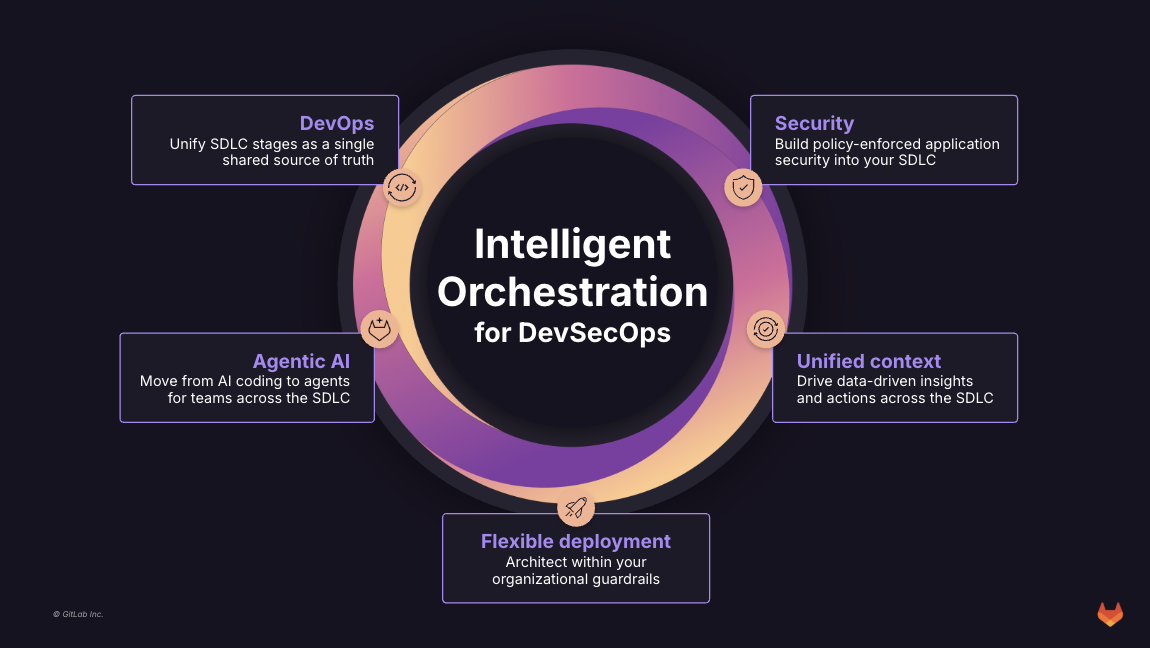
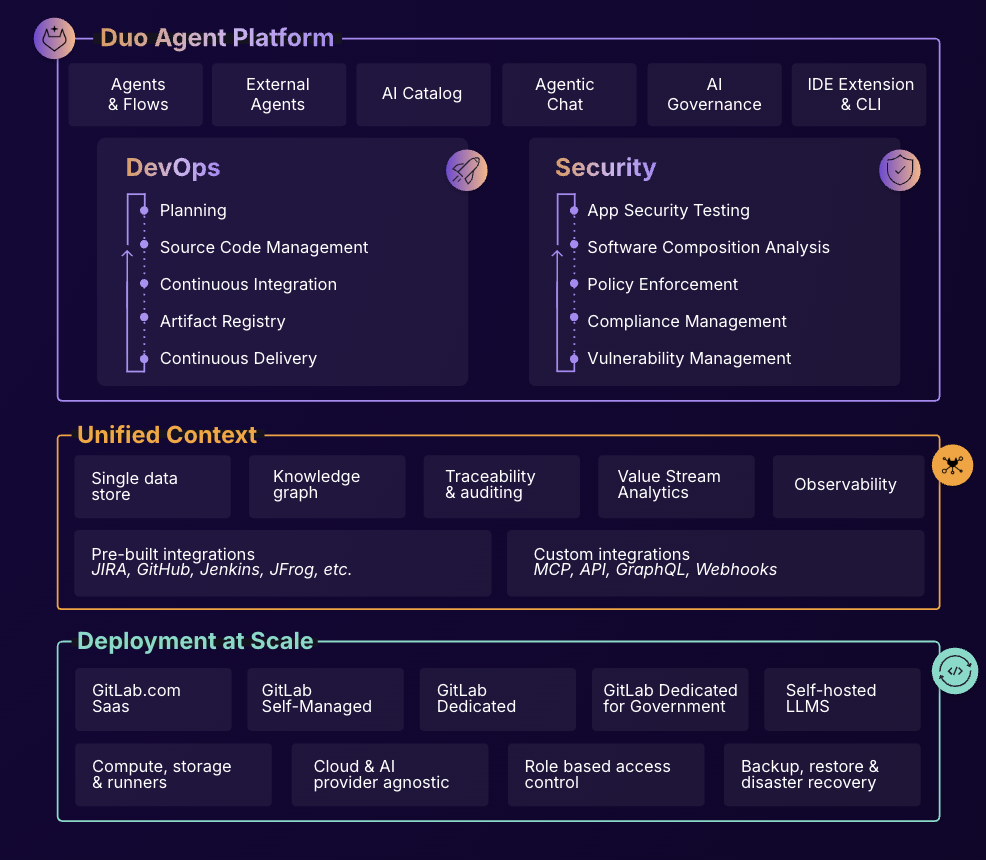
GitLab is an intelligent orchestration platform for DevSecOps, where software teams enable AI at every stage of the software lifecycle to ship faster. The platform enables teams to automate repetitive tasks across planning, building, securing, testing, deploying, and maintaining software.
$0
per month per user
IBM Cloud Object Storage
Score 9.3 out of 10
N/A
IBM Cloud Object Storage is an IBM Cloud product in the endpoint backup and IaaS categories. It is commonly used for data archiving and backup, for web and mobile applications, and as scalable, persistent storage for analytics.
$0
per month
Kubernetes
Score 9.0 out of 10
N/A
Kubernetes is an open-source container cluster manager.
N/A
Pricing
GitLab
IBM Cloud Object Storage
Kubernetes
Editions & Modules
GitLab Free (self-managed)
$0
GitLab Free
$0
GitLab Premium
$29
per month per user
GitLab Premium (self-managed)
$29
per month per user
GitLab Ultimate
Contact Sales
GitLab Ultimate (self-managed)
Contact Sales
One-Rate Plan
As low as USD $12/TB a month
per month
Standard Plan
Free up to 5GB—no minimum fee, pay only for what you use
per month
No answers on this topic
Offerings
Pricing Offerings
GitLab
IBM Cloud Object Storage
Kubernetes
Free Trial
Yes
No
No
Free/Freemium Version
Yes
Yes
No
Premium Consulting/Integration Services
Yes
Yes
No
Entry-level Setup Fee
Optional
Optional
No setup fee
Additional Details
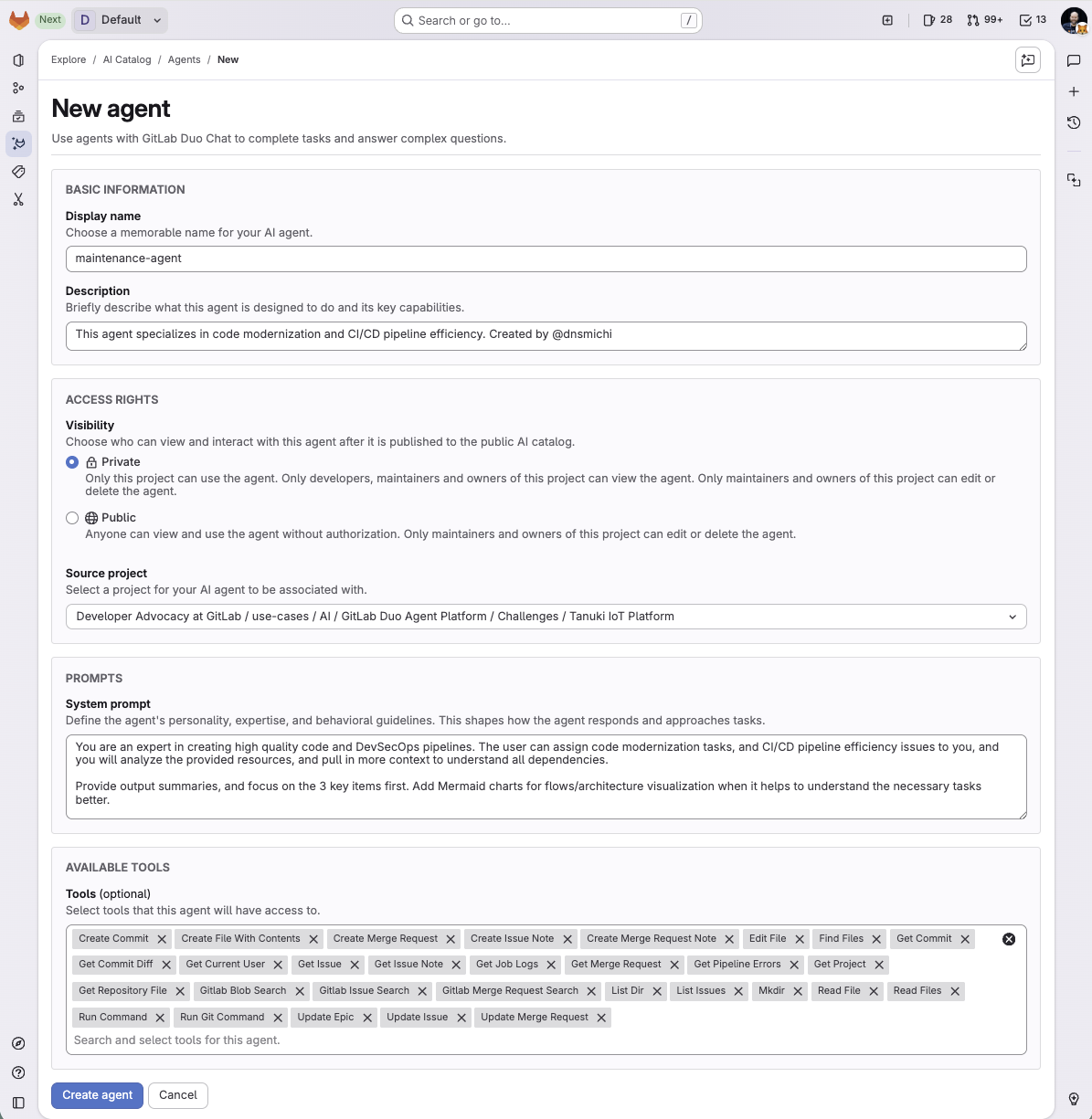
GitLab Credits enable flexible, consumption-based access to agentic AI capabilities in the GitLab platform, allowing you to scale AI adoption at your own pace while maintaining cost predictability. Powered by Duo Agent Platform, GitLab’s agentic AI capabilities help software teams to collaborate at AI speed, without compromising quality and enterprise security.
If usage exceeds monthly allocations and overage terms are accepted, automated on-demand billing activates without service interruption, so your developers never lose access to AI capabilities they need.
Real-time dashboards provide transparency into AI consumption patterns. Software teams can see usage across users, projects, and groups with granular attribution for cost allocation. Automated threshold alerts facilitate proactive planning. Advanced analytics deliver trending, forecasting, and FinOps integration.
The One-Rate and Standard service plans for Cloud Object Storage include resiliency options, flexible data classes and built-in security. Pricing is based on the choice of location, storage class and resiliency choice.
GitHub wins the social coding battle by a longshot. Their community engagement is huge and the number of popular projects hosted there is higher than any other service. I've only ever heard of 1 serious project hosted on Bitbucket, but I would imagine it integrates very well …
GitLab stands up great to other Git hosting services. GitLab CI blows GitLab past it's competitors to take a Git server and make it a complete application management platform. Versus GitHub, GitLab does not stand up for hosting open source projects as GitHub has a much larger …
Mostly cost because most of them deliver a similar product and the decision for a hyperscaler (when you do not plan to use Multi Cloud) was not solely based on the object storage offering. Moreover, other components as K8s/postgres and the overall picture inclunding consulting …
Amazon S3 has a more complex pricing model. It charges as per the requests, which will be more costly for us compared to IBM cloud object storage. The safety of our data is the main focus, and this is guaranteed with IBM.
I feel that both of these products have almost the same kind of work. Both are used for cloud based storage of unstructured data. IBM Cloud Storage Object Storage provides an upper hand as it is more effective.
We evaluated Docker Swarm as usage of docker is very distributed in our company. But docker swarm has not as many features as kubernetes and we have large, complex architectures which require good scalability and robustness - this is a huge strength of kubernetes compared to …
GitLab is good if you work a lot with code and do complex repository actions. It gives you a very good overview of what were the states of your branches and the files in them at different stages in time. It's also way easier and more efficient to write pipelines for CI\CD. It's easier to read and it's easier to write them. It takes fewer clicks to achieve the same things with GitLab than it does for competitor products.
In my experience, IBM Cloud Object Storage is well suited for projects like the one I am working on. This includes the use of natural language classification and the uploading of data to train a machine learning model for tag suggestions based on a body of text. Using IBM Cloud Object Storage has helped with this greatly. IBM Cloud Object Storage has also been great for Big Data Analytics thanks to its scalablilty and ease of use for large datasets. Alongside IBM Watson and our team's internal big data tools we've managed to process and analyze data more efficiently, leading to key insights that have driven business value for our clients.
K8s should be avoided - If your application works well without being converted into microservices-based architecture & fits correctly in a VM, needs less scaling, have a fixed traffic pattern then it is better to keep away from Kubernetes. Otherwise, the operational challenges & technical expertise will add a lot to the OPEX. Also, if you're the one who thinks that containers consume fewer resources as compared to VMs then this is not true. As soon as you convert your application to a microservice-based architecture, a lot of components will add up, shooting your resource consumption even higher than VMs so, please beware. Kubernetes is a good choice - When the application needs quick scaling, is already in microservice-based architecture, has no fixed traffic pattern, most of the employees already have desired skills.
IBM Cloud Object Storage is an excellent choice for disaster recovery and backup solutions. Its high durability and geographic redundancy ensure that our backup data is safe and can be quickly restored in case of a disaster. This capability is crucial for maintaining our business continuity and minimizing downtime. We have deployed our loads in an IKS cluster distributed in 3 different AZs with stateful data allocated in COS.
We have a video streaming application and need to store and deliver a vast library of video content to millions of users worldwide, so we store our data in COS, which is cheap and reliable.
We have a bunch of data that must be analyzed and stored in datasets for fraud detection, risk management, and customer insights. In these cases, this data is moved from Onprem to IBM Cloud so we can use cheap storage like COS.
Searching and retrieving—full-text search or metadata search—is one of the significant areas of improvement. It isn't easy to search for data with this.
Integration with other IBM cloud services is trickier. For example, integrating this with API Connect to access the data from API will be difficult for users.
Support - I think you should have more support community.
Local development, Kubernetes does tend to be a bit complicated and unnecessary in environments where all development is done locally.
The need for add-ons, Helm is almost required when running Kubernetes. This brings a whole new tool to manage and learn before a developer can really start to use Kubernetes effectively.
Finicy configmap schemes. Kubernetes configmaps often have environment breaking hangups. The fail safes surrounding configmaps are sadly lacking.
I really feel the platform has matured quite faster than others, and it is always at the top of its game compared to the different vendors like GitHub, Azure pipelines, CircleCI, Travis, Jenkins. Since it provides, agents, CI/CD, repository hosting, Secrets management, user management, and Single Sign on; among other features
The Kubernetes is going to be highly likely renewed as the technologies that will be placed on top of it are long term as of planning. There shouldn't be any last minute changes in the adoption and I do not anticipate sudden change of the core underlying technology. It is just that the slow process of technology adoption that makes it hard to switch to something else.
I find it easy to use, I haven't had to do the integration work, so that's why it is a 9/10, cause I can't speak to how easy that part was or the initial set up, but day to day use is great!
For my use cases, it has been a very smooth experience. Even my new colleagues have been able to get on top of things very quickly. This shows how easy it is to work with
It is an eminently usable platform. However, its popularity is overshadowed by its complexity. To properly leverage the capabilities and possibilities of Kubernetes as a platform, you need to have excellent understanding of your use case, even better understanding of whether you even need Kubernetes, and if yes - be ready to invest in good engineering support for the platform itself
I've never had experienced outages from GItlab itself, but regarding the code I have deployed to Gitlab, the history helps a lot to trace the cause of the issue or performing a rollback to go back to a working version
We rarely face downtime or access issues with IBM Cloud Object Storage. It’s mostly available when we need it, even during peak hours or heavy data loads.
GItlab reponsiveness is amazing, has never left me IDLE. I've never had issues even with complex projects. I have not experienced any issues when integrating it with agents for example or SSO
I would give it a 9 because it works smooth with our AI and analytics tools, no major slowdown. Pages and dashboards load fine most of the time, and reports finish in decent time even when data is heavy.
At this point, I do not have much experience with Gitlab support as I have never had to engage them. They have documentation that is helpful, not quite as extensive as other documentation, but helpful nonetheless. They also seem to be relatively responsive on social media platforms (twitter) and really thrived when GitHub was acquired by Microsoft
I have been working in IT sector for more than 15 years. I have worked with various vendors. IBM's sales team, support team have been really helpful. After we start to use their product, their UX design team also contacted us to get feedback from us. They are really interested about our experience.
I just researching and applying the tools on their platforms to ensure a good learning path, based on my needs. Reading the documentation related with resources, tools. Is too big, but I am trying to know more about it every day. It is a good way to know more about their resources. A new way to attract new customers. At the end of the day, we are all involved in improvement and automation of our tasks and resources for customers and end-users.
Yes Our organization used IBM professional services to implement IBM object storage because of its data consistency and multiple way to upload and download data and its encryption security features. Also that its brand matter for the any organization to secure the layer and storage. It sis also verify that application and system are compatibale for this product
Gitlab seems more cutting-edge than GitHub; however, its AI tools are not yet as mature as those of CoPilot. It feels like the next-generation product, so as we selected a tool for our startup, we decided to invest in the disruptor in the space. While there are fewer out-of-the-box templates for Gitlab, we have never discovered a lack of feature parity.
Amazon S3 is a great service to safely back up your data where redundancy is guaranteed, and the cost is fair. In the past I have used Amazon S3 for data that we backup and hope we never need to access, but in the case of a catastrophic or even small slip of the finger with the delete command, we know our data and our client's data is safely backed up by Amazon S3. Amazon S3 service is a good option, but based on the features it provides compared with IBM Cloud Object Storage, it is less suitable. IBM Cloud Object Storage is also integrated with more services, like IBM Cloud SQL and IBM Aspera, which AWS does not provide to transfer files at maximum speed in the world.
Most of the required features for any orchestration tool or framework, which is provided by Kubernetes. After understanding all modules and features of the K8S, it is the best fit for us as compared with others out there.
Scaling up the number of users can lead to significant increases in licensing costs, which, while not a technical limitation, can be a practical constraint for some organizations
This allows us to recommend a platform to our clients that will quickly help them create new, efficient business processes with very little development.
This saves clients hours and days of manual analysis of images, allowing the system to do the work when attaching Object Storage to models.
There is a learning curve in utilizing the storage and the modeling, but once up and running, it works well during deployment.