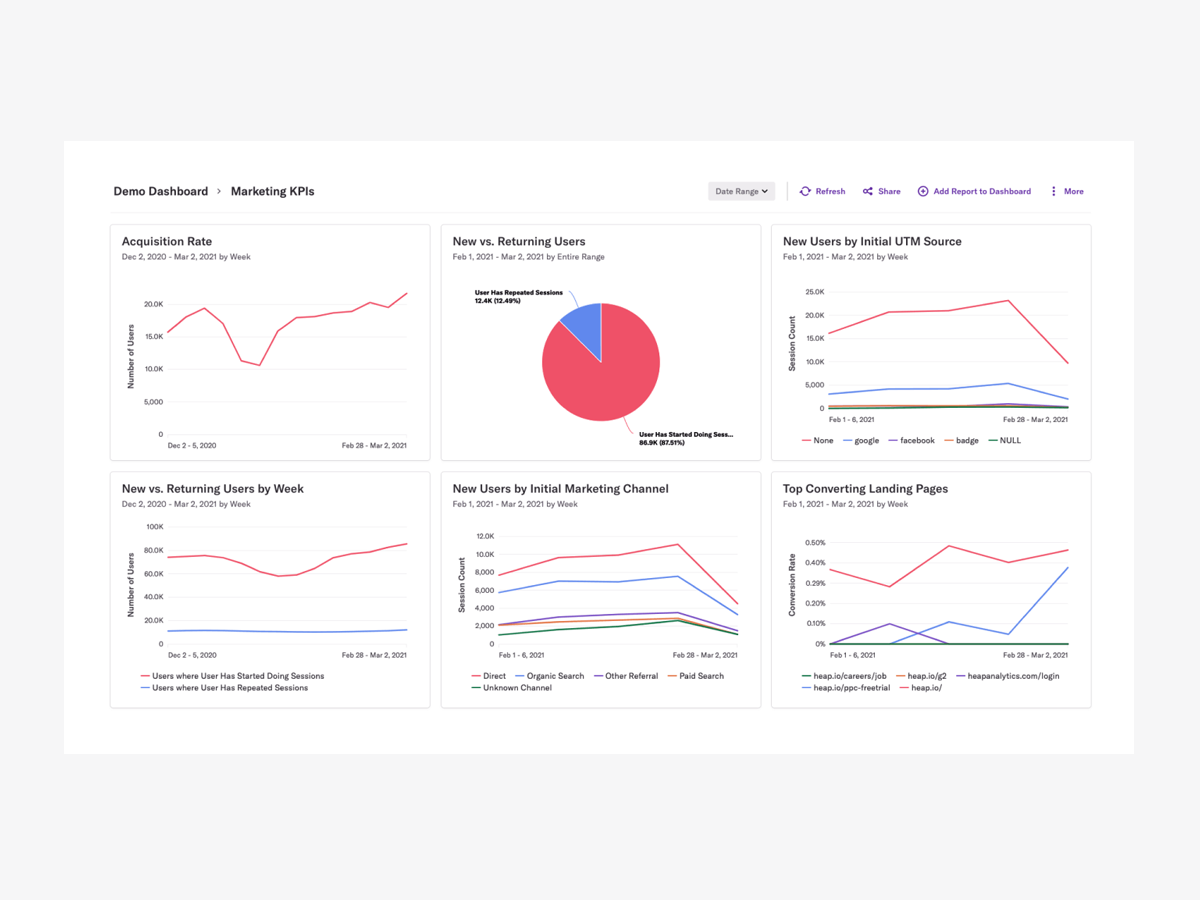
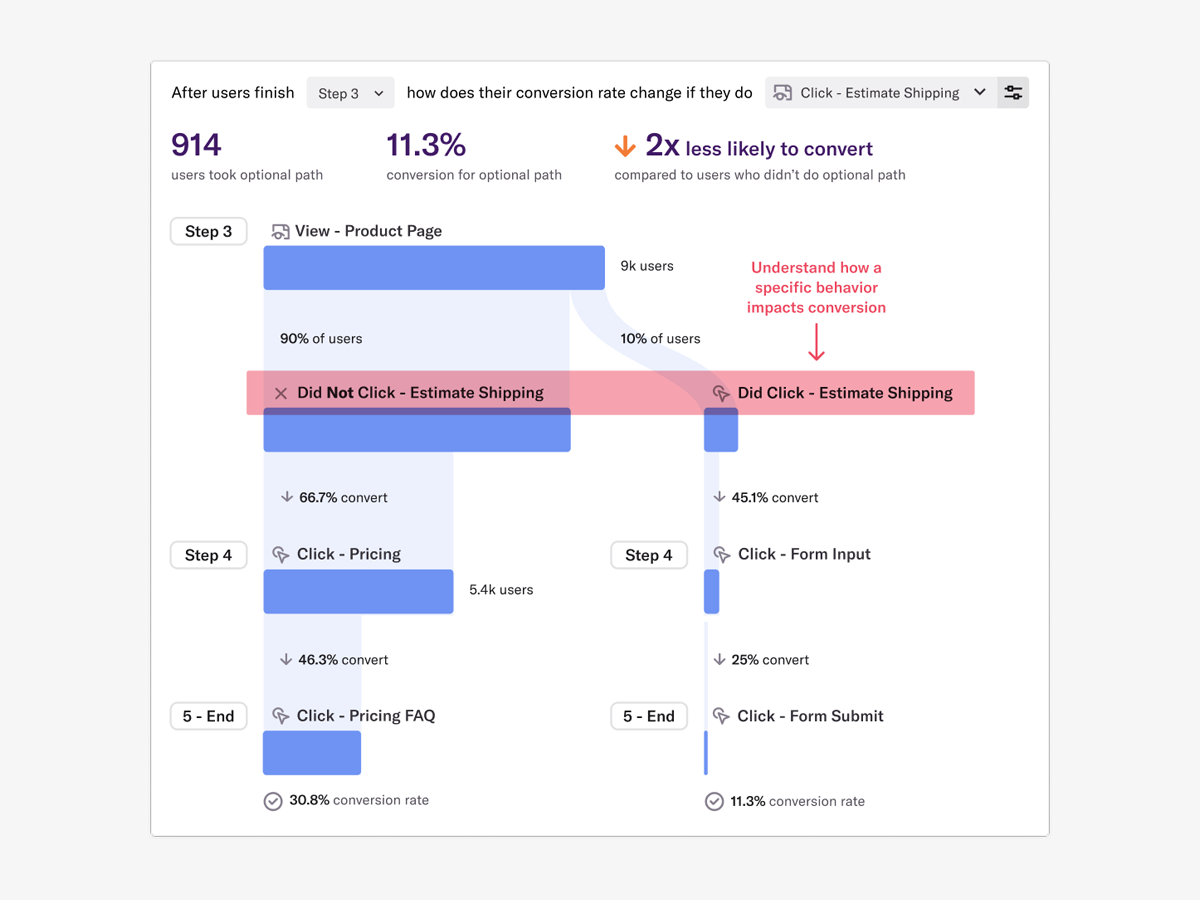
Heap is a web analytics platform captures every user interaction on web iOS with no extra code. The tool allows you to track events and set up funnels to understand user flow and dropoff. It also provides visualization tools to track trends over time.
$0
per month
Whatfix
Score 9.9 out of 10
N/A
Whatfix is the AI-native Digital Adoption Platform built for the modern enterprise. The platform unifies pre-production simulation training, in-workflow guidance and support, and adoption analytics for continuous optimization.
N/A
Pricing
Heap
Whatfix
Editions & Modules
Free
$0
Up to 10k sessions/month
Growth
Starting at $3,600 annually
Up to 300k sessions/year
Pro
Contact Heap Sales
Custom sessions per month and unlimited projects
Premier
Contact Heap Sales
Custom sessions per month
No answers on this topic
Offerings
Pricing Offerings
Heap
Whatfix
Free Trial
Yes
Yes
Free/Freemium Version
Yes
Yes
Premium Consulting/Integration Services
Yes
Yes
Entry-level Setup Fee
Optional
Optional
Additional Details
Heap pricing is based on session volume. A session is a period of activity from a single user on your app or website. It can include many pageviews or events.
All Pricing models are customized and tailor-made according to the customer's requirement.
Scenarios when Heap was well suited: It is when a user claims that he encountered a bug without giving us the details of the error message. Scenarios where it is less appropriate: Its when we try to capture user interaction in our mobile app
Currently, we are only using Whatfix with Salesforce but are in the process of implementing on other systems. It is an excellent tool to organize and provide in-app access to training materials already created. It excels at providing guidance about tasks users don't complete often and, therefore, forget what they were trained about the process. The only sort of system it might not work well is one that provides its own robust in-app assistance. More than one type of tip icon being displayed, for instance, could be confusing.
The possibility to select content/widgets at the time for "push to production" (some we would like to p2p for one single content, that is not possible at the moment).
I wish the filters in the dashboard would stay when you choose a content, currently you have to filter again and again.
In the analytics area, I would like the system to remember this for a certain time window after selecting the start date.
It's a great platform. I'm glad that one of our product managers introduced it because it has allowed us to create all kinds of new functionality. We're not only able to create a better product experience from our communications because of Heap, but we're also able to generate all kinds of helpful analysis.
[We feel like] even though Whatfix has its flaws, we are impressed by the speed of development [and] their openness about their future improvements, [but] most important their proactive customer service and customer success team. Whatfix acts more like a partner than a supplier of a 3rd party tool, and we welcome that experience.
On a scale from 1-10, I find Heap to be incredibly user-friendly and easy to use. I enjoyed the training videos available and was quickly able to pick up how to create events and reports to track user interactions on our product. I would recommend Heap for its usability first and foremost.
While they've made a lot of improvements in the last year, there are still challenges with walkthroughs and how beacons can be created. They are aware of these limitations and are actively soliciting customer feedback to help them remedy these shortcomings.
I've never run into any issues with Heap's availability, Heap is always there when I need it. I haven't run into any issues like application errors or unplanned outages during my 2+ years of using Heap. Each and every time I log in to Heap I have a completely functional experience
Heap doesn't affect page load times considerably nor has a large impact [on] our overall score, as far as page loading times inside of the tool its pretty reliable to retrieve data as much as "instant" that it can be the delay seems to be on data getting tracked into the servers to be read but it's not significant.
Heap support has allowed us to troubleshoot and test a lot of different items. Their support team is always helpful and friendly, even when we come to them with the most complicated questions. I think this greatly improves the value proposition of the product because their support team is knowledgable and friendly.
Whatfix is THE best vendor I've ever worked with when it comes to supporting their customers. The support team is friendly, helpful and always willing to listen to your suggestions and ideas. This also applies to the Engineering team who I've spent several hours on calls with debugging a few of the more challenging scenarios we have in place. Nothing is ever too much trouble for Whatfix and they are truly best-in-class when it comes to their support model.
While helpful, the feedback from our employee was, that [they felt] the training was very high-level - sometimes confusing. It would be great to have some kind of sandbox environment for new users to train certain scenarios.
The implementation was smooth and easy. The Heap team helped us with implementation and it went great! Within a few weeks, we were fully up and running and utilizing the platform to its full capability. This is an additional thing that has made this platform so great and we couldn't recommend it enough.
Although Whatfix make the process relatively straightforward (they will provide Group Policy Scripts to install a Google Chrome extension specific to your organisation) its important to ensure your network deployment teams (if you have more than one) understand their role and what they need to do to test deployment once they undertaken the work.
Heap offers a ton of functionality on a single platform.It also has an smart data science layer to offers suggestions for next steps in the analysis, allowing us to explore alternative paths we may not think to take. The low-code option for updating data is appealing, and there is a lot of automation with minimal engineering effort.
There is no comparison - Whatfix is the clear winner with us from the very beginning. As Whatfix continues to grow and innovate their product, engage with it's customers on a level beyond any I have every seen. They work as Partners with us, their teams from bottom to top are incredible - Customer Service, Collaboration Teams, Innovation, Sales, Success Mangers and everyone I missed are incredible. One team in particular I want to call out for there outstanding service, care and innovation to help us launch one of our systems is the Professional Services Team. Ganish, Joel, and everyone else who has been on our calls and worked behind the scenes to hit our incredible tight deadline in August - KUDOs for a job well done, You ROCK, THANK YOU words cannot describe how great you guys have been with us on this project, but on all of them. Whatfix's team definitely understands, the customer is first, they align with our values and we will continue to grow with them
The most challenging part of using Heap in a growing organization is the naming and structure in which reports and dashboards are organized. I work within the marketing department and our Heap leader internally works within the IT/Product department, which makes it challenging because we often don't speak the same language, so the learning curve has been steep without any specific use-case examples to leverage online.
Reduced Training Costs: By cutting traditional training time by 40%, Whatfix has saved significant resources while increasing learning efficiency.
Improved User Productivity: Faster onboarding and fewer errors have led to a 25% improvement in user performance metrics, directly contributing to operational efficiency.
Decreased Support Requests: Self-service guidance has reduced support tickets by 30%, freeing up teams to focus on strategic initiatives and cutting support costs.