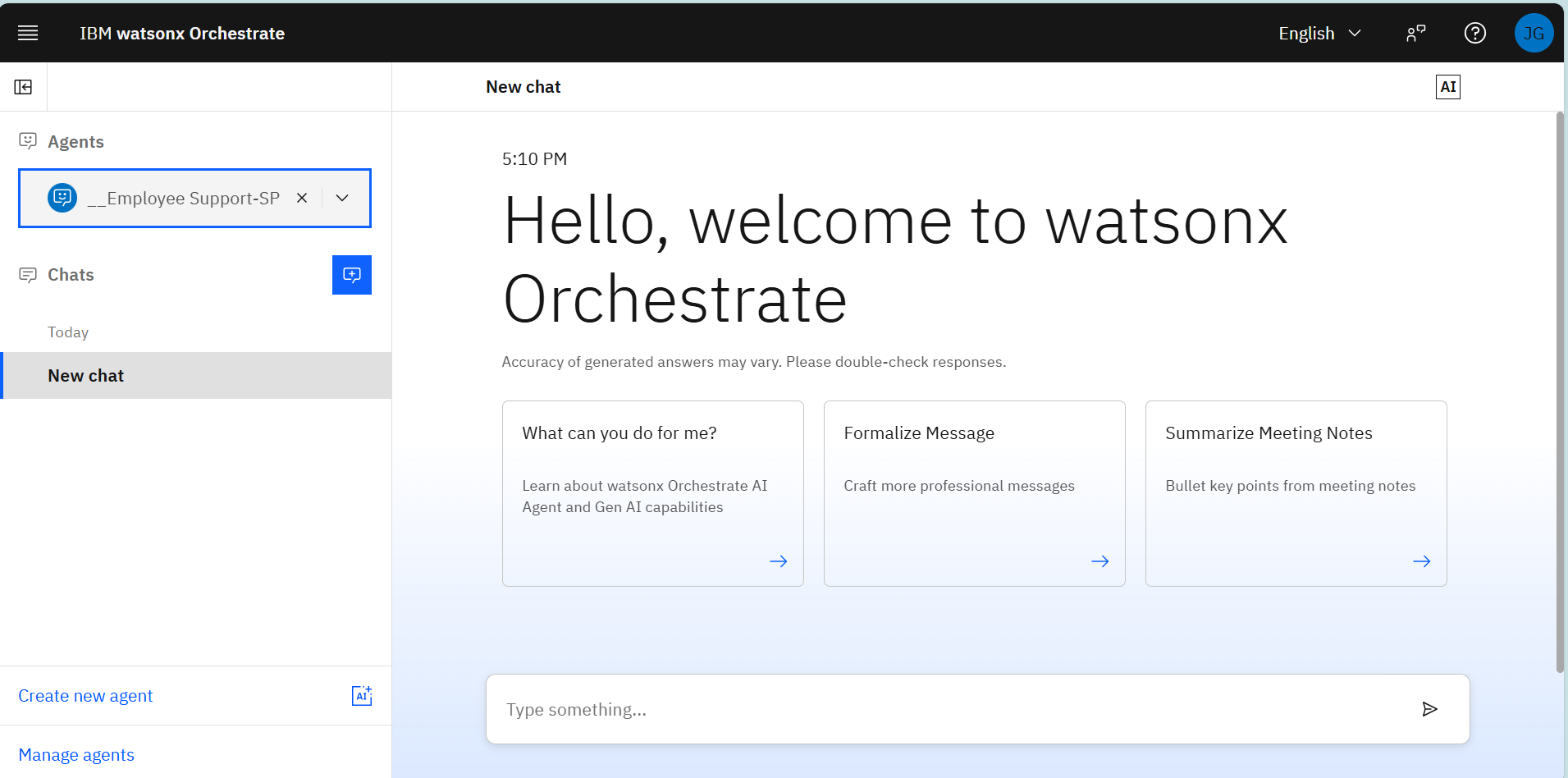
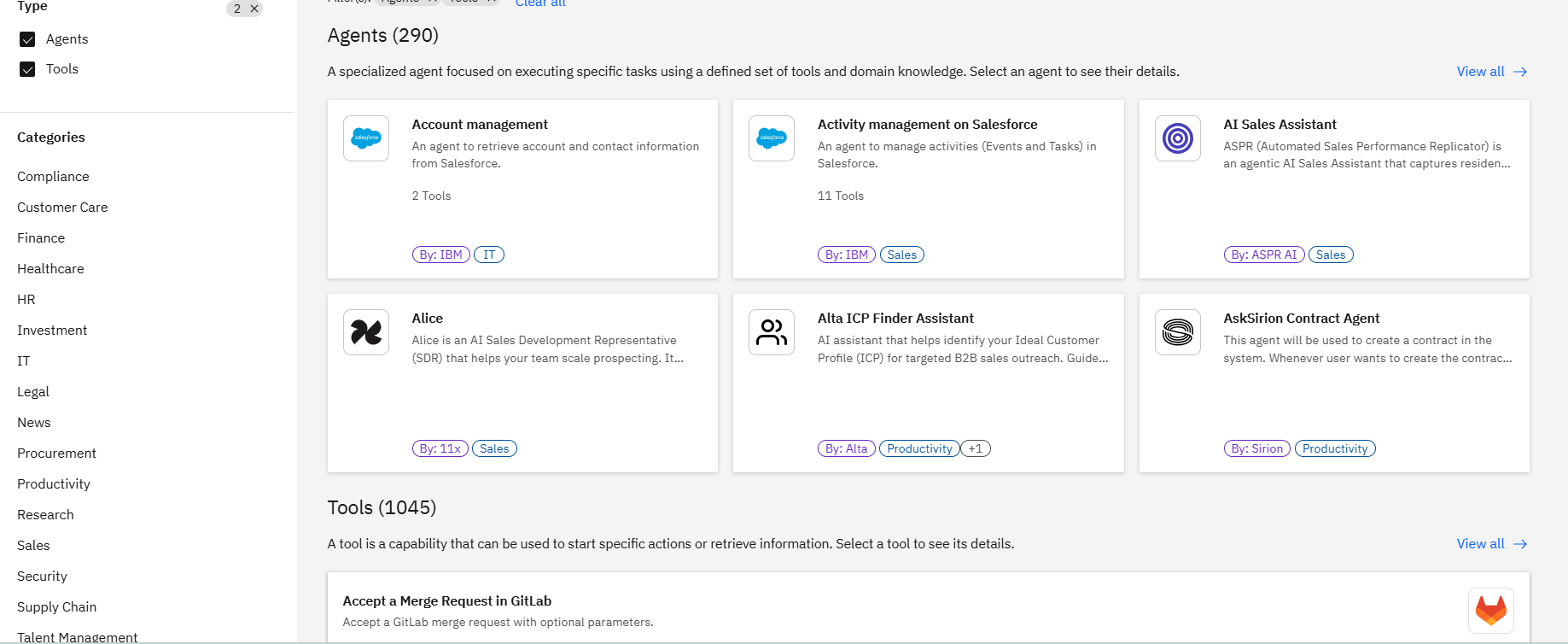
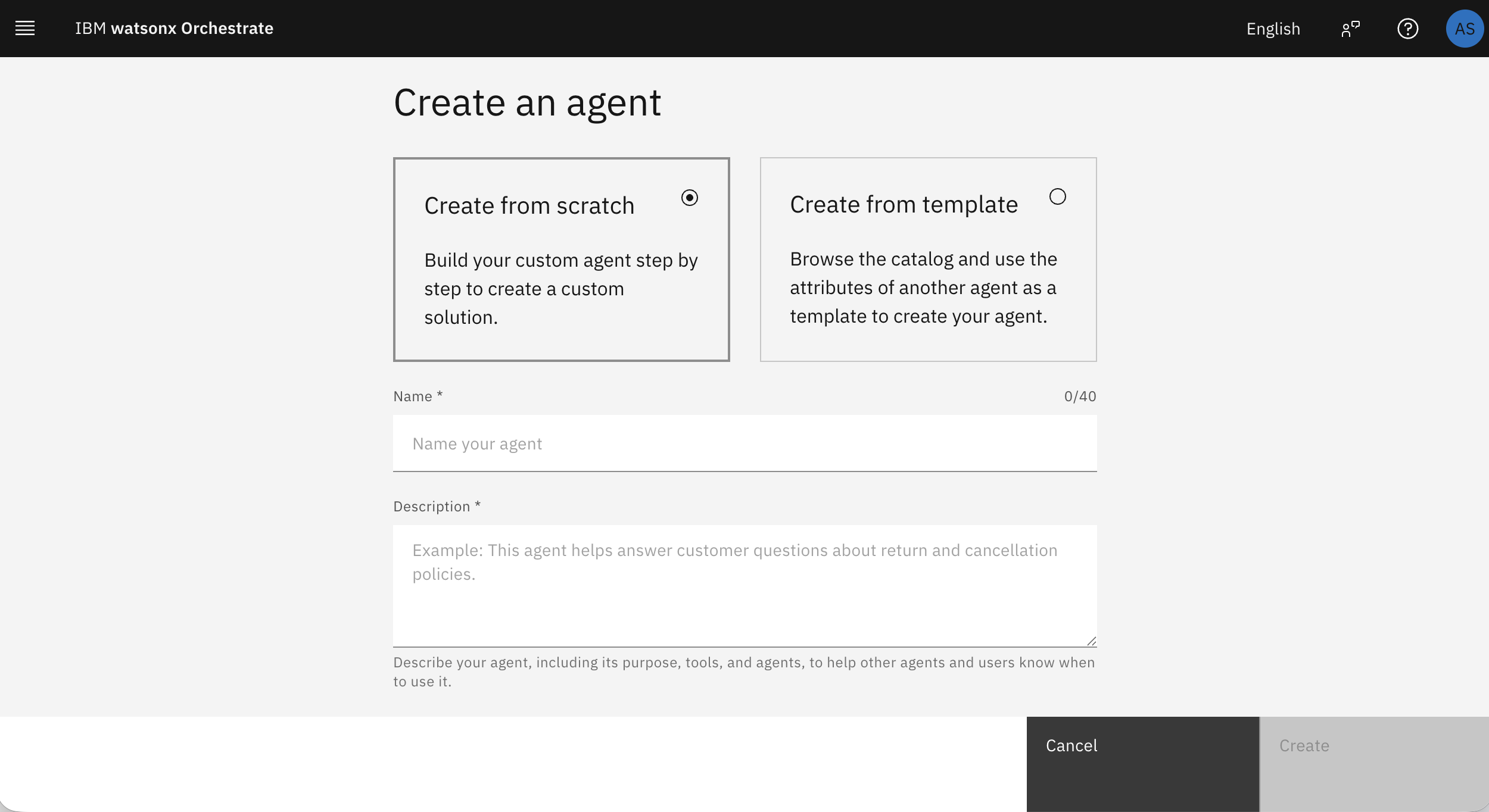
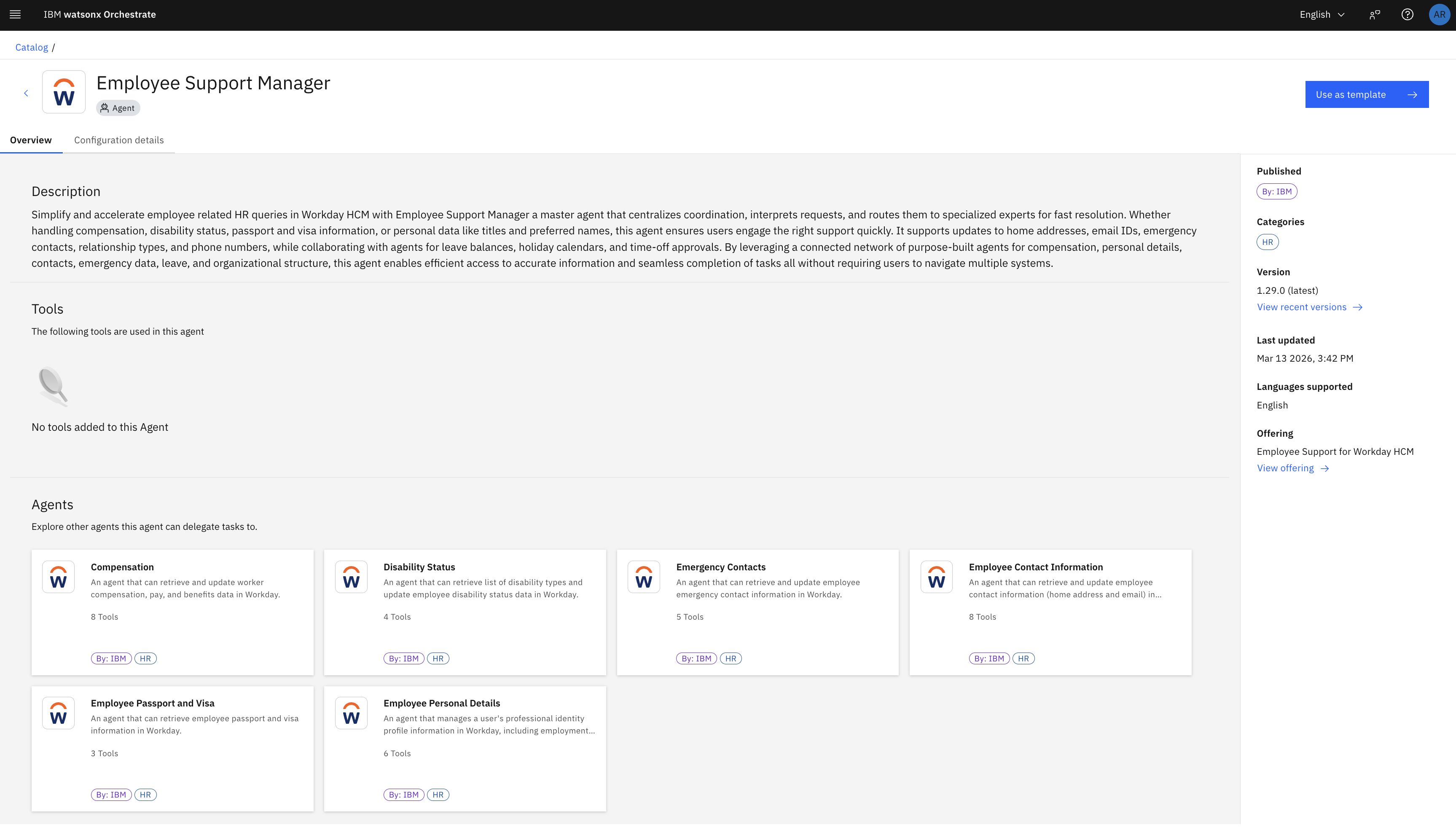
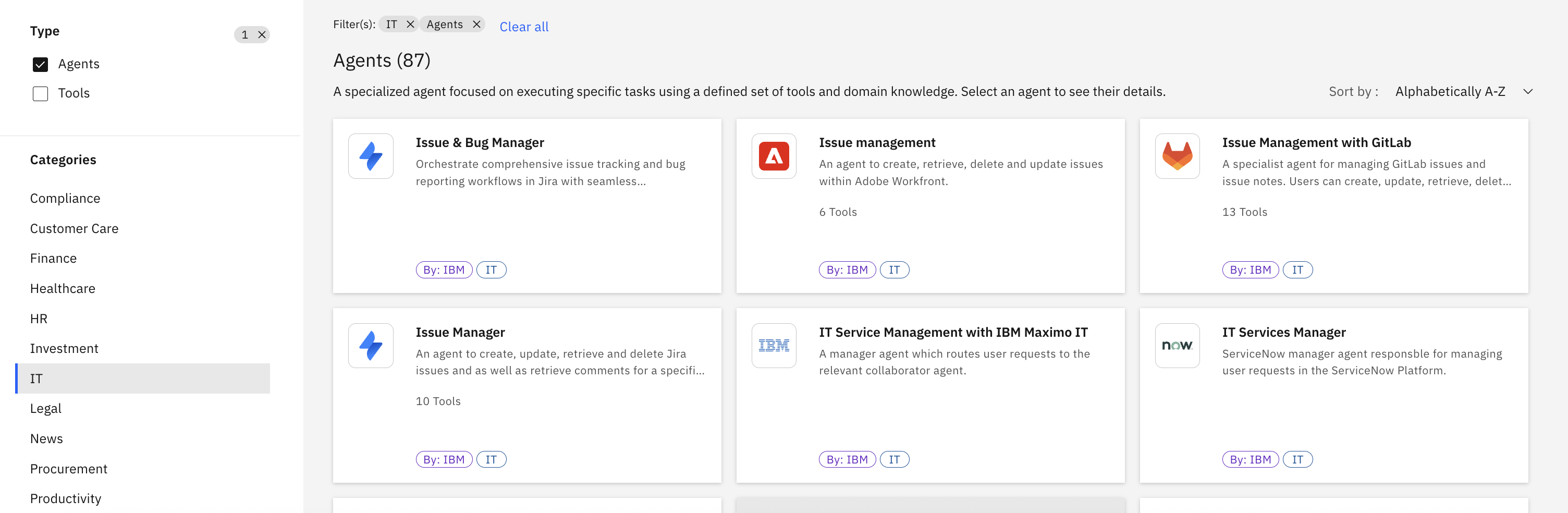
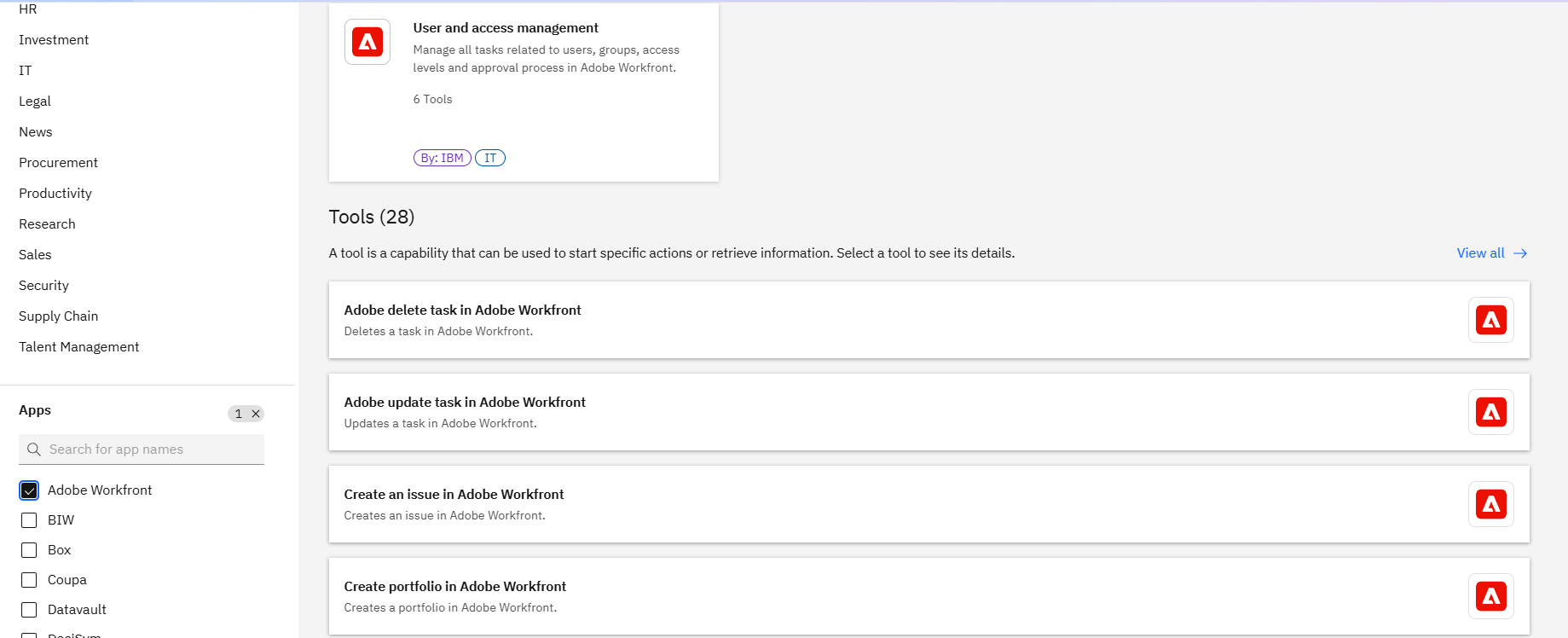
IBM® watsonx™ Orchestrate® leverages AI to automate complex workflows. The solution helps build, deploy, and manage AI assistants and agents. It offers a catalogue of pre-built agents and tools, low-code agent builder, multi-agent collaboration capabilities, and integrations with enterprise apps.
$500
per month per subscription
Agentforce Sales
Score 8.8 out of 10
N/A
Salesforce' Agentforce Sales (formerly Salesforce Sales Cloud) is the company's flagship CRM platform. The AI CRM for Sales features data built right in.
$25
per month per user
Pricing
IBM watsonx Orchestrate
Salesforce Agentforce Sales
Editions & Modules
Essential
$500
per month per subscription
Essentials
$500
per month Per subscription
Standard
Enterprise
Standard
Enterprise
per month Per subscription
Starter
$25.00
per month per user
Professional
$80.00
per month per user
Enterprise
$165.00
per month per user
Unlimited
$330.00
per month per user
Agentforce 1 Sales
$550
per month per user
Offerings
Pricing Offerings
IBM watsonx Orchestrate
Agentforce Sales
Free Trial
Yes
Yes
Free/Freemium Version
No
No
Premium Consulting/Integration Services
No
No
Entry-level Setup Fee
Optional
Optional
Additional Details
IBM watsonx Orchestrate can be deployed and run on IBM Cloud, AWS, or on-premises. Prices shown are indicative, may vary by country, exclude any applicable taxes and duties, and are subject to product offering availability in a locale.
Well it is very much user friendly, It has AI support also, as well as there is now no need to do thorough programming every time, with simple prompts we can achieve great flows, We can integrate whole IBM ecosystem, ultimately allowing us to utilize best of all worlds. Best …
Copilot works well for Microsoft related environment, with easy user onboarding and offboarding and usage of other microsoft related applications, but IBM watsonx Orchestrate will not only suits for Microsoft it suits well for cross platform and complex workflows. SNOW will …
IBM agnostic platforms are built for controlled environments like ours which heavily relies on on-premise automation integrations. For RACF and mainframe duties, low-code but user friendly curves are needed to ensure IT works with business seamlessly.
I think this product's got a lot more use cases from a business standpoint. I find the other products are very based in end users and also the orchestrator has a lot more agnostic connections to a lot of products, whereas Microsoft is very Microsoft dominated and the other …
The other solution provides far more capabilities but at a much higher price and far more complexity. The IBM watsonx Orchestrate tool is less expensive (about 25% of the other solution) while being good enough for what we needed and being easy to use.
Strong ITSM and HR workflow automation with governance, ServiceNow excels in IT/HR but lacks flexibility for cross-departmental use cases such as demand planning, finance close, or procurement analytics. Orchestrate supports a broader set of enterprise functions beyond IT …
Based on my experience, I’ve used Odoo — it’s an open-source ERP system. It’s not exactly the same as Salesforce or Sales Cloud, but it serves a similar purpose. And I feel that Sales Cloud is better. Personally, I find it easier to use and better than what Odoo offers, …
Over the years, I’ve helped many people move from different sales solutions — like Dynamics, HubSpot, and Act, which was one of the first ones. I’ve supported a lot of organizations in moving from those platforms to Salesforce.
So I've evaluated, implemented Microsoft Dynamics in the past. I've used Oracle CRM solutions. I've used Daylight, which is a very niche CRM system the last couple of years. And I've evaluated a variety from Legacy Microsoft Ones to Zoho and Sugar when making implementation …
Actually, we have not. By the time I joined my company, we already had Sales Cloud. It was already there and the decision was made. I'm sure that there were other small companies that the upper management team evaluated very quickly, but they came to a decision very quickly. I …
Raiser's Edge, CSING. Those are the primary ones. There's no competition at all. I mean, in terms of tracking duplicate contact, I mean contacts ability to be secure and provide the right access for different levels. Salesforce was able to do that. Oh yeah. Yes. Whereas the …
We have used HubSpot and we have used jojo CRM. So the customer who cannot afford the licensing model of Salesforce, jojo CRM is a very good platform and another for assembly level, hub Spot does the work as well.
Salesforce is magnificently more robust and functions much better when managing complex sales cycles with multiple individuals and products. With simple sales cycles and few products, Excel is a strong contender.
Salesforce CMS stacks up as a Customer management system because it has a more user friendly snd intuitive interface. The UX is better and more modern. It can be customised and extended. There are always learning opportunities and updates for the system so it keeps on …
Salesforce more so compliments these products, rather than stacks against them. We don't have any products similar to Salesforce CMS, so in lieu of that, these are the products we were using that mesh the easiest with Salesforce CMS in terms of proceeding through the …
In my opinion, Salesforce CMS is the most complex of these offerings, and probably the most complex platform of its kind. It was selected by another stakeholder - I would likely have chosen something less expensive and more intuitive to use. The robust feature set is amazing, …
We used the Catalyst product of Totango. It was not great as it was hard to navigate, and it did not offer any reporting capabilities at all, nor did it speed up our day-to-day tasks.
For starters, most enterprise-grade organizations and Customers struggle to align their current IT estate and landscape with fast-moving, agile, AI-driven automation and development initiatives. All tooling, governance, structure, and frameworks available to support and facilitate the incorporation of this new but still cross-system technology layer are essential to minimize the risks of data leaks, unauthorized access, unbridled token consumption, and other issues. For some businesses and organizations with a handful of systems or a smaller footprint, the platform could be a bit too complex.
In the end, I think we can always make it fit — and that’s one of the powers of Salesforce. Because of its flexibility and wide range of possibilities, you can really make it work for almost any need. The key, though, is to make thoughtful decisions upfront and plan carefully how you set it up. If you do that, you’ll end up with a truly flexible and effective system.
New and improved natural language processing yielding better results helps the assistants understand the intention behind the query.
Preserves context of communication, allowing the customers to establish inquiries on the website and continue on the mobile app without having extra informational input.
Intelligent conversations mean that complex paths that are branched based on the user's inputs allow for a much more natural flow of the conversation than fixed scripts.
I’d say the only thing that can be a bit tricky — and I know Tableau helps address this — is that sometimes we’re limited in how deep we can go with the data in terms of reporting. It would be great to have a bit more robustness within the app itself. However, we’ve figured out our workarounds, and overall, I think it’s a fantastic product — which is why I’ve been working with it for 23 years.
IBM Watson simply works well for my organisation. We were able to design, build, and deploy a fully integrated chatbot in a matter of months. The basic building blocks (intents, skills, dialogue nodes, integration) are relatively straightforward for a technical developer to work with. The bot now supports retail customers in 3 different countries on both web and app based channels. We plan to further develop the bot to expand the way it interacts with customers through voice to text, and optical character recognition, as well as an improved UI.
There are days when I wish we hadn't switched, but I know that if we put in the time, we will get to where we want to be with the software and that it has many more capabilities than anything else we looked at. However, the amount of time and onboarding we need to do is also far greater than we realized/were told when we originally bought the product. They told us we should hire onboarding support, but at the end, after we had already reached our budget maximum for this, so it's been slower than we had hoped.
With the growing use of AI and chatbots, it's very easy to use, and the conversational language makes it easier than keyword searches in a document. The contextual language processing is impressive. It's easy to integrate into our internal portal. The use of this tool would depend on each company's security and data sensitivity.
All in all, it's a great product that use all day, every day. It's aesthetically pleasing overall and specifically provides information in a clean, concise way. It's easy to manipulate and seems to play well with the other products I use such as Pardot, Gmelius, and our company's proprietary data system. It increases my efficieny in my admin tasks so I have more time to focus on revenue-generation and account management. It's also easy to use from everywhere where it be on a university campus, in a hotel room, one of a million Starbucks, or at home
All Force.com apps run on world-class data centers with backup, failover, and disaster-recovery facilities. Force.com has had a proven 99.9 percent uptime record for years. Accordingly, I only recall our instance of Salesforce having one unscheduled, brief down time over 6 years. I can't remember for sure, but it may have been due to our Internet Service Provider (ISP) versus Salesforce itself. Also, Salesforce does it's best to keep customers in the loop:
Trust.salesforce.com is the salesforce.com community's home for real-time information on system performance and security. On this site you'll find:
Live and historical data on system performance Up-to-the minute information on planned maintenance Phishing, malicious software and social engineering threats Best security practices for your organization Information on how we safeguard your data
To develop chatbots based on client provided flow what kind chatbot required for client either button or free text chatbots. we will decided accordingly flow and develop chatbot using IBM Watson. We will integrated custom components if required which is not present in library. IBM Watson library anyone can easily learn and develop chatbots.
For a SaaS provider, I'd rate their performance to be one of the best. At times, reporting tends to slow down if the data set is very large, which is the case in any system. But, that's a very rare phenomenon
We've rarely had to engage support, but they've always been prompt in responding and very attentive. Support experiences have been extremely positive (but we're mostly happy that we just don't have any cause to routinely need support in the first place!).
The overall support has been good. More and more features are being released quite frequently. Very small features are also making big difference in how the tool can be adapted and used better. If there is anything we need or are stuck, the support team sets up a call and helps in resolving the issue/provides workarounds.
I attended two training sessions. I would rate them a 4 as an advanced user. It was very basic – great for someone new – would give 8+ for new person.
I had 3 years of experience at the time. I skipped basic and went onto advanced and still not helpful. A lot of it was best practices that didn’t feel relevant for our business
I have gone through multiple. The content that’s delivered is quite basic – I wish they had more advanced training.
We are grandfathered into premium support plus training. We get unlimited access to instructor led and online training for free. We have taken advantage of this
Just from an organizational standpoint - we standardized our data prior to moving to Salesforce. But we essentially standardized it wrong. That's created a big disgusting mess for us know that I'll have to deal with as the Admin. Be sure you think through use cases prior to doing something like that - seek outside opinions on how the data will work best, especially depending on what else you're going to integrate with Salesforce.
I think this product's got a lot more use cases from a business standpoint. I find the other products are very based in end users and also the orchestrator has a lot more agnostic connections to a lot of products, whereas Microsoft is very Microsoft dominated and the other products are very technical and not business focused.
Based on my experience, I’ve used Odoo — it’s an open-source ERP system. It’s not exactly the same as Salesforce or Sales Cloud, but it serves a similar purpose. And I feel that Sales Cloud is better. Personally, I find it easier to use and better than what Odoo offers, especially in terms of customization and achieving business objectives. That’s where Salesforce Sales Cloud really stands out in comparison to Odoo.
From past 3+ years I am using IBM Watson in our current project easily can implement and manage and monitor user how their using. Is there and update also just update dialog is just enough to change no need to touch any other templates. Multiple language will support, and action and dialog speak recognize chatbot we can create as per client requirement. Overall, as of now good experience with IBM Watson.
It's very scalable as it has a ton of features (but you do need an admin who understands how to leverage these features). Because of the various features, we've also needed to host onboarding sessions with our users so that they can familiarize themselves with the platform, which isn't always super user-friendly or intuitive.
It enhanced cost efficiency as digital automated workflows helped us reduce manual FTEs.
It is costing us integration overheads, which have a negative impact, including increased change management effort.
Overall, it is a balanced approach, as we hope that in the long run, we will achieve significant positive ROI, which will significantly improve organizational efficiency.
It helps us achieve our objectives, especially now with Agentforce — we can get more insights to help our sellers sell more. It’s really nice because it’s almost like you can use the standard part of Salesforce to train your agents and teach your sellers how to improve their sales. So that’s really nice.