Chose Jaspersoft
As per the basic evaluations, both provides same features in our context of use.

| Product | Rating | Most Used By | Product Summary | Starting Price |
|---|---|---|---|---|
 Jaspersoft | N/A | Jaspersoft commercial edition is an embedded business intelligence suite designed to be built-into SaaS products as an integrated reporting engine. It provides reports and dashboards for customer-facing applications without requiring app developers to build their own reporting engine. | N/A | |
 Oracle Database | N/A | Oracle Database, currently in edition 23ai, is a converged, multimodel database management system. It is designed to simplify development for AI, microservices, graph, document, spatial, and relational applications. | $0.05 per hour | |
 PostgreSQL | N/A | PostgreSQL (alternately Postgres) is a free and open source object-relational database system boasting over 30 years of active development, reliability, feature robustness, and performance. It supports SQL and is designed to support various workloads flexibly. | N/A |
| Jaspersoft | Oracle Database | PostgreSQL | ||||||||||||||||||||||
|---|---|---|---|---|---|---|---|---|---|---|---|---|---|---|---|---|---|---|---|---|---|---|---|---|
| Editions & Modules | No answers on this topic |
| No answers on this topic | |||||||||||||||||||||
| Offerings |
| |||||||||||||||||||||||
| Entry-level Setup Fee | No setup fee | No setup fee | No setup fee | |||||||||||||||||||||
| Additional Details | Jaspersoft offers flexible pricing for ISVs and SaaS per customer or by CPU core. | — | — | |||||||||||||||||||||
| More Pricing Information | ||||||||||||||||||||||||
| Jaspersoft | Oracle Database | PostgreSQL | |
|---|---|---|---|
| Considered Multiple Products |  Jaspersoft  Milan Paunovic Senior Web Developer Chose Jaspersoft Mostly because of better looking reports than Microsoft. Other useful scenario for us was adhoc reports which reduced our development time. We were not satisfied about Microsoft reporting services improvements over the years, and hoped to get more from Jaspersoft. Simply when … |  Oracle Database  Paolo Borghi Oracle Business Intelligence Consultant Chose Oracle Database Even if is quite expensive, Oracle Database 12c is way better than most of its competitors thanks to Oracle experience and skills on database technologies. Oracle Database has always guaranteed the best data recovery and fault management policies, thanks to Oracle's RAC …  Arthur Zubarev Senior Data Platform Consultant Chose Oracle Database Oracle Database is among the easiest to integrate with, program against, have a reliable cluster with DR, and has the most understood and well-documented databases. It suits really well if the software shop is primarily Java-based, and deals with large volumes of data with a …  Ken Turner Oracle Database Administrator Chose Oracle Database Oracle is much more advanced and more reliable.  yixiang Shan Strategic Planning And Engineering Advisor Chose Oracle Database Oracle completed solution and support is of cause better than open source solutions, we also choose other NoSQL database and Graph database, to address some very particular business use cases  Ciprian Onofreiciuc Senior Consultant Chose Oracle Database it was not my choice for Oracle 12C, but during the years I've learned on the advantages. If I would choose the Oracle 12C, I'll take it for the possibility to start from Standard and to go to enterprise based on a business case of use. I really like the possibility to have the …  Sean Scott Oracle Database Administrator Chose Oracle Database We're still in evaluation but based on cost and affordability vs. performance for our specific needs (running a $500M retail e-commerce shop) Oracle 12c loses. Licensing and support of Enterprise Edition would equate to a significant percentage of our annual revenue and we …  Miguel Angel Merino Vega Analista de Sistemas Chose Oracle Database Well, Oracle is a solid database and as I mentioned, is for the first quartile of project complexity. The other solutions mentioned databases have more specific goals and respond to reduced complexity. For example MySQL or PostgreSQL are widely used for startups. On the other … | PostgreSQL  Ron Ballard Consultant and author Chose PostgreSQL In my experience using all of these products over many years, PostgreSQL is better than any of them in reliability, performance, productivity, cost, scalability and interoperability across operating systems.  Aurpa Fiza Software Application Developer Chose PostgreSQL In this case, Postgres is preferred because it handles large data sets and requires fewer hardware resources than its competitor, MySQL. Compared to PostgreSQL, Microsoft products are excellent, but the installation process for MS SQL is lengthy. PostgreSQL has an advantage …  Anson Abraham Data Czar Chose PostgreSQL  Moris Mendez Ing. de Sistemas Informaticos Chose PostgreSQL Although the competition between the different databases is increasingly aggressive in the sense that they provide many improvements, new functionalities, compatibility with complementary components or environments, in some cases it requires that it be followed within the same … |
| Jaspersoft | Oracle Database | PostgreSQL | |||||||||||||||||||||||||||||||
|---|---|---|---|---|---|---|---|---|---|---|---|---|---|---|---|---|---|---|---|---|---|---|---|---|---|---|---|---|---|---|---|---|---|
| BI Standard Reporting |
| ||||||||||||||||||||||||||||||||
| Ad-hoc Reporting |
| ||||||||||||||||||||||||||||||||
| Report Output and Scheduling |
| ||||||||||||||||||||||||||||||||
| Data Discovery and Visualization |
| ||||||||||||||||||||||||||||||||
| Access Control and Security |
| ||||||||||||||||||||||||||||||||
| Mobile Capabilities |
| ||||||||||||||||||||||||||||||||
| Application Program Interfaces (APIs) / Embedding |
| ||||||||||||||||||||||||||||||||
| Relational Databases |
|
| Jaspersoft | Oracle Database | PostgreSQL | |
|---|---|---|---|
| Small Businesses |  Yellowfin Score 8.7 out of 10 |  InterSystems IRIS Score 8.0 out of 10 |  InfluxDB Score 8.8 out of 10 |
| Medium-sized Companies |  Reveal Score 10.0 out of 10 | InterSystems IRIS Score 8.0 out of 10 |  SQLite Score 8.0 out of 10 |
| Enterprises |  Kyvos Semantic Layer Score 9.5 out of 10 |  SAP IQ Score 10.0 out of 10 | SQLite Score 8.0 out of 10 |
| All Alternatives | View all alternatives | View all alternatives | View all alternatives |
| Jaspersoft | Oracle Database | PostgreSQL | |
|---|---|---|---|
| Likelihood to Recommend | 7.3 (119 ratings) | 9.0 (190 ratings) | 8.0 (55 ratings) |
| Likelihood to Renew | 8.0 (23 ratings) | 9.0 (6 ratings) | 9.0 (1 ratings) |
| Usability | 7.9 (16 ratings) | 7.4 (5 ratings) | 8.3 (9 ratings) |
| Availability | 8.0 (3 ratings) | - (0 ratings) | 9.0 (1 ratings) |
| Performance | 7.0 (3 ratings) | - (0 ratings) | 7.0 (1 ratings) |
| Support Rating | 7.0 (26 ratings) | 7.0 (5 ratings) | 9.3 (7 ratings) |
| In-Person Training | 8.0 (4 ratings) | - (0 ratings) | - (0 ratings) |
| Online Training | 6.5 (7 ratings) | - (0 ratings) | - (0 ratings) |
| Implementation Rating | 7.8 (15 ratings) | 9.6 (3 ratings) | 9.0 (1 ratings) |
| Configurability | 7.0 (2 ratings) | - (0 ratings) | - (0 ratings) |
| Ease of integration | 7.0 (2 ratings) | - (0 ratings) | - (0 ratings) |
| Product Scalability | 8.0 (3 ratings) | - (0 ratings) | 8.0 (1 ratings) |
| Vendor post-sale | 8.0 (2 ratings) | - (0 ratings) | - (0 ratings) |
| Vendor pre-sale | 8.0 (2 ratings) | - (0 ratings) | - (0 ratings) |
| Jaspersoft | Oracle Database | PostgreSQL | |
|---|---|---|---|
| Likelihood to Recommend | Jaspersoft
 Himanshu Bhardwaj Senior Quality Assurance Analyst | Oracle
| PostgreSQL Global Development Group
Ron Ballard Consultant and author |
| Pros | Jaspersoft
| Oracle
| PostgreSQL Global Development Group
Aurpa Fiza Software Application Developer |
| Cons | Jaspersoft
| Oracle
Arthur Zubarev Senior Data Platform Consultant | PostgreSQL Global Development Group
|
| Likelihood to Renew | Jaspersoft
 Craig LaValle Director of Data Services | Oracle
| PostgreSQL Global Development Group
 Ojoswi Basu Sr. Tableau Solution Consultant |
| Usability | Jaspersoft
 Gerald Meachem Senior Software Analyst | Oracle
 Lisandro Fernigrini Master Software Developer (Database Architect) | PostgreSQL Global Development Group
|
| Reliability and Availability | Jaspersoft
| Oracle No answers on this topic | PostgreSQL Global Development Group
Ojoswi Basu Sr. Tableau Solution Consultant |
| Performance | Jaspersoft
| Oracle No answers on this topic | PostgreSQL Global Development Group
Ojoswi Basu Sr. Tableau Solution Consultant |
| Support Rating | Jaspersoft
 Ashley Lee CSR/Project Management for Software Development | Oracle
| PostgreSQL Global Development Group
 Javier Blanque Technology Risk and Information Assets Manager |
| In-Person Training | Jaspersoft
Ashley Lee CSR/Project Management for Software Development | Oracle No answers on this topic | PostgreSQL Global Development Group No answers on this topic |
| Online Training | Jaspersoft
 Davide Marzucco Post Provisioning & Deployment Manager | Oracle No answers on this topic | PostgreSQL Global Development Group
Ojoswi Basu Sr. Tableau Solution Consultant |
| Implementation Rating | Jaspersoft
| Oracle
 Omar Faruq Head of Database Operations | PostgreSQL Global Development Group
Ojoswi Basu Sr. Tableau Solution Consultant |
| Alternatives Considered | Jaspersoft
| Oracle
 Deepjyoti Bhowmick Senior Data Engineer | PostgreSQL Global Development Group
Moris Mendez Ing. de Sistemas Informaticos |
| Scalability | Jaspersoft
| Oracle No answers on this topic | PostgreSQL Global Development Group
Ojoswi Basu Sr. Tableau Solution Consultant |
| Return on Investment | Jaspersoft
 Robert Mills Sr. Software Architect | Oracle
| PostgreSQL Global Development Group
 Don Burks Technical Lead |
| ScreenShots | Jaspersoft Screenshots   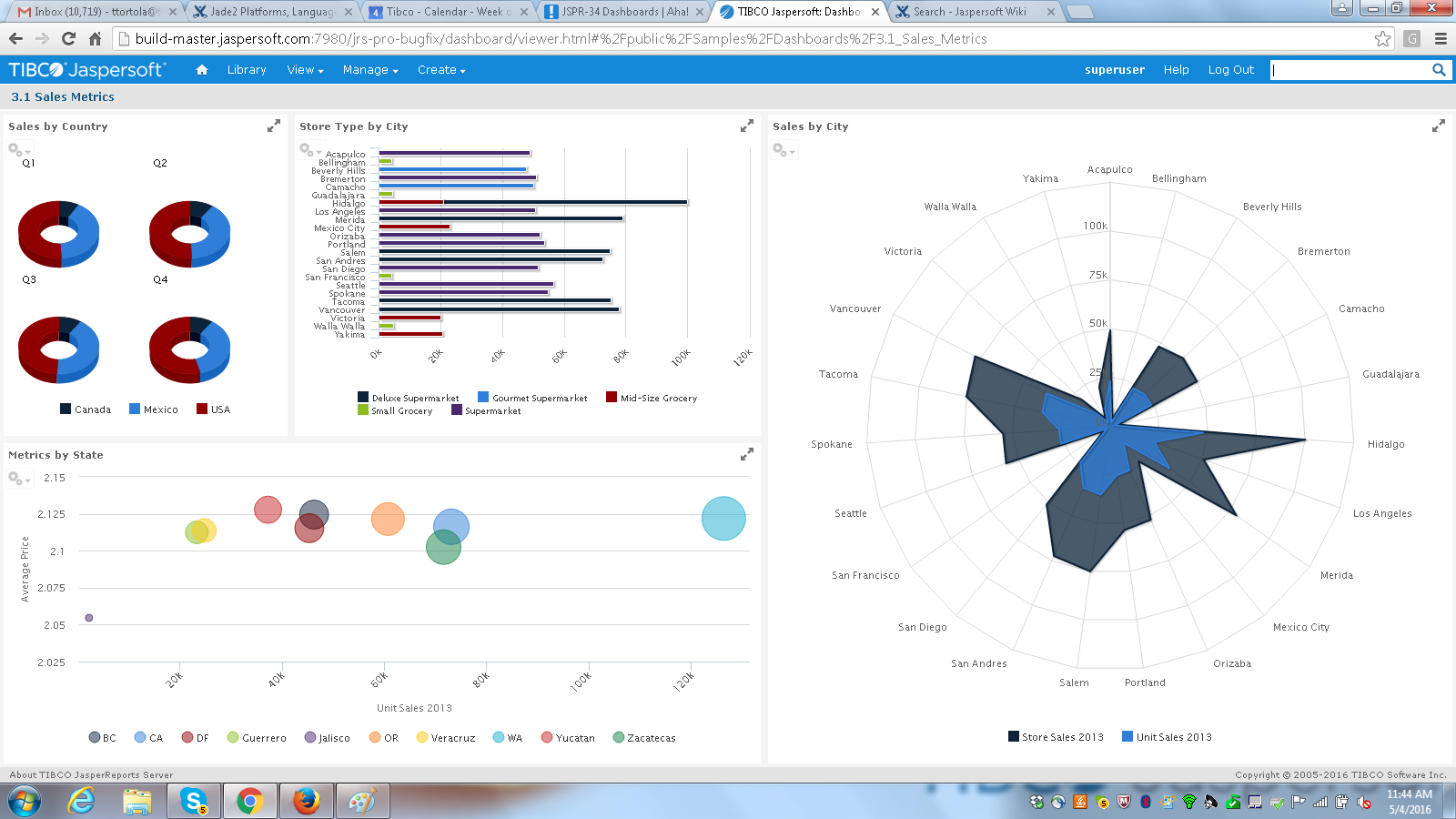 |