Desktop Central from ManageEngine is a client desktop management with patching, remote control, and configuration.
$795
per year per user
Salt
Score6.2 out of 10
N/A
VMware Salt is an Infrastructure Automation & Configuration Management platform that provisions, configures, deploys, and manages infrastructure components at scale. The solution utilizes an event-driven automation engine to enforce compliant software states across virtual machines, servers, containers, and network devices.
The VMware Salt solution is comprised of software components from both VMware and the open-source Salt Project While the Salt Masters and Salt Minions are a part of the open…
For small businesses, it is also free, which, for what it offers, is really helpful. It works better than similar products, such as SCCM, both within and outside the internal network. I do not see scenarios in which it could be less appropriate.
SaltStack is a very well architected toolset and framework for reliably managing distributed systems' complexity at varied scale. If the diversity of kind or number of assets is low, or the dependencies are bounded and simple, it might be overkill. Realization that you need SaltStack might come in the form of other tools, scripts, or jobs whose code has become difficult, unreliable, or unmaintainable. Rather than a native from-scratch SaltStack design, be aware that SaltStack can be added on to tools like Docker or Chef and optionally factor those tools out or other tools into the mix.
A de minimis incentive was given to thank the reviewer for their time. The incentive was not used to bias or drive a particular response, nor was the incentive contingent on a positive endorsement. More Info
We set alerts when a devices gets low on disk space. That is automatic and creates a ticket in ME SDP. We are then able to Add space to a VM Desktop, and then go thru ManageEngine Endpoint Central to extend the drives so the entire process can be done without interruption to the end user.
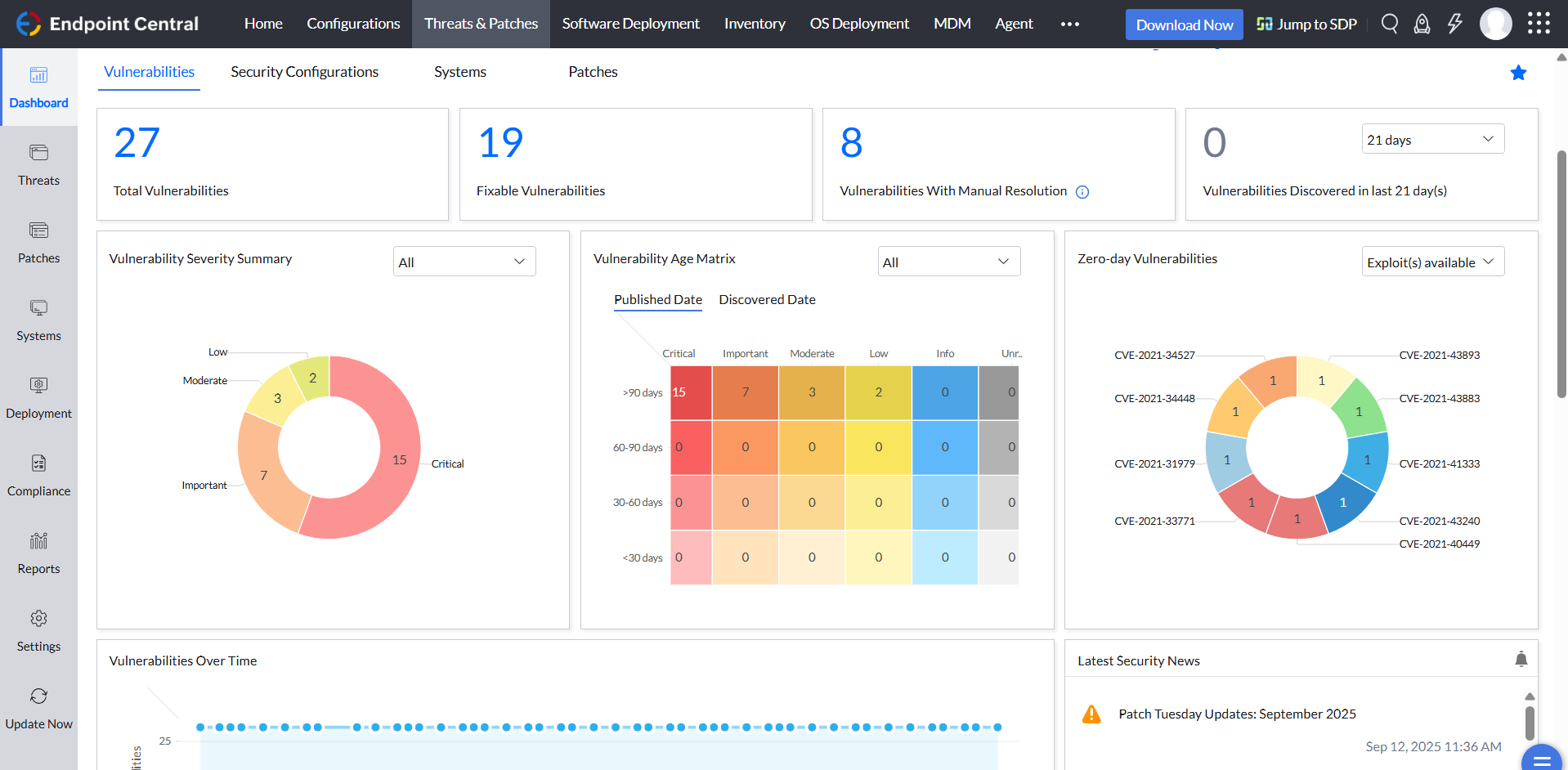
Using the patch scans we can easily see what patches have been installed for all manufacturers not just Microsoft, without having to physically go to the device. It also allows us to choose which patches we want to push out and automate the process so we can be hands off, freeing up out time for other things.
Remote access to devices. This allows us to remotely make changes, not just via remote control but also make registry changes and clean up space without going to the device and without interruption to the end user.
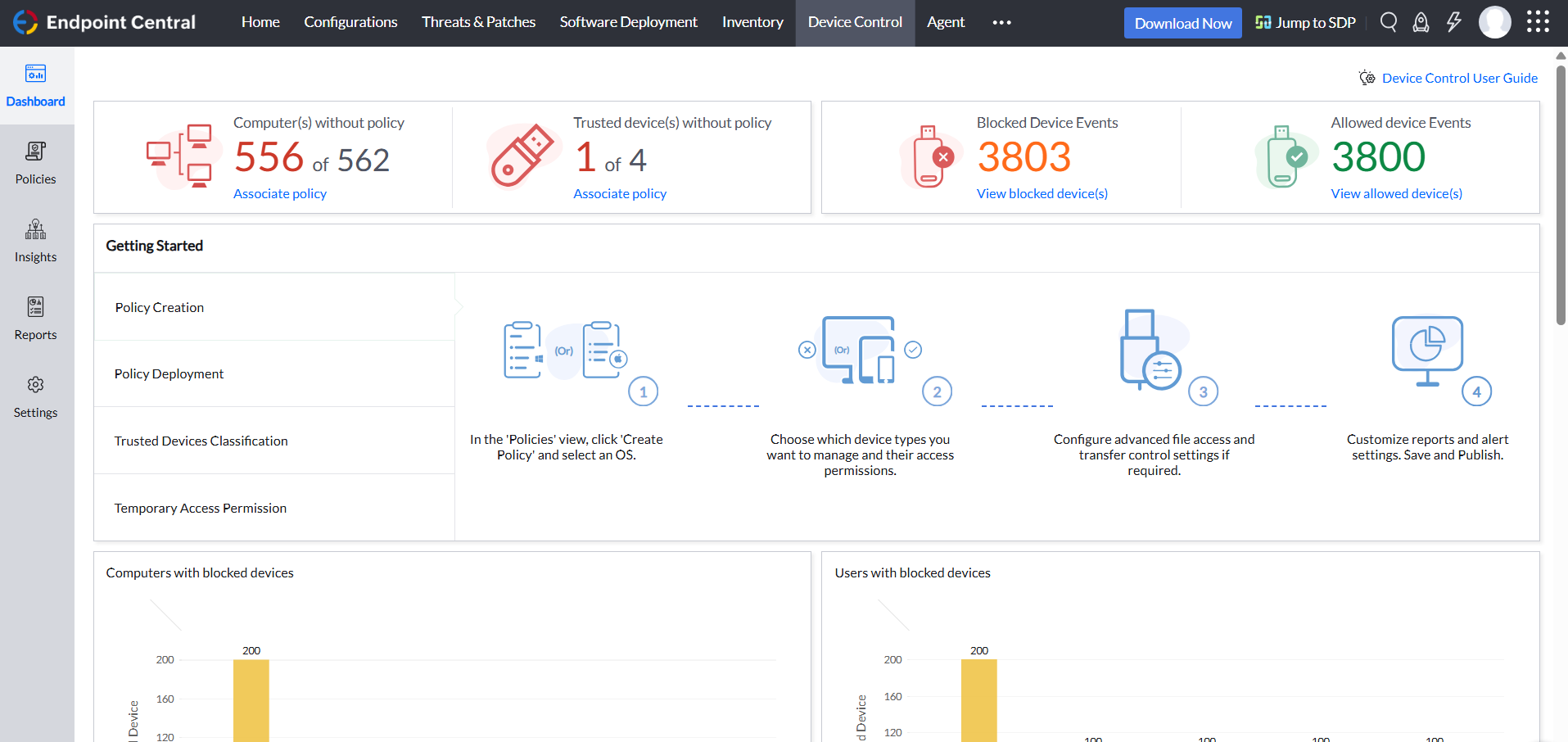
Alerts. We have set up to get email alerts when new hardware is plugged into any computers. This lets us know if someone is bringing in un-authorized equipment (thumb drives, hubs, etc) to better manage what is/is not on our network.
A de minimis incentive was given to thank the reviewer for their time. The incentive was not used to bias or drive a particular response, nor was the incentive contingent on a positive endorsement. TR verified that a representative sample of customers was invited. More Info
Targeting is easy and yet extremely granular - I can target machines by name, role, operating system, init system, distro, regex, or any combination of the above.
Abstraction of OS, package manager and package details is far advanced beyond any other CRM I have seen. The ability to set one configuration for a package across multiple distros, and have it apply correctly no matter the distrospecific naming convention or package installation procedure, is amazing.
Abstraction of environments is similarly valuable - I can set a firewall rule to allow ssh from "management", and have that be defined as a specific IP range per dev, test, and prod.
A de minimis incentive was given to thank the reviewer for their time. The incentive was not used to bias or drive a particular response, nor was the incentive contingent on a positive endorsement. More Info
A de minimis incentive was given to thank the reviewer for their time. The incentive was not used to bias or drive a particular response, nor was the incentive contingent on a positive endorsement. More Info
A de minimis incentive was given to thank the reviewer for their time. The incentive was not used to bias or drive a particular response, nor was the incentive contingent on a positive endorsement. More Info
ManageEngine is considered an excellent product due to its comprehensive suite of solutions for IT management, with ManageEngine Endpoint Central specifically excelling in endpoint management. The platform stands out for its user-friendly interface, robust features, and versatility in addressing diverse IT needs. It offers organizations a centralized solution for endpoint security, patch management, software deployment, and asset management
Not using WNS to communicate with the endpoint console is a big plus. We now use Workspace One, and WNS can be really annoying at times. After deployment, it cleans itself, which is important for us because our current solution leaves the package on the computer and requires maintenance. The remotely script command is a lifesaver.
A de minimis incentive was given to thank the reviewer for their time. The incentive was not used to bias or drive a particular response, nor was the incentive contingent on a positive endorsement. More Info
The immediate chat support is great and very helpful. However, if you need escalated support or have a deeper need that the chat tool can't help with, you will experience significant wait times and slow responses. The time zone difference becomes painful to the point of often just giving up.
We haven't had to spend a lot of time talking to support, and we've only had one issue, which, when dealing with other vendors is actually not that bad of an experience.
It seems that the services offered with the purchase change from what is covered to what is an additional cost. Somethings I thought we had ended up requiring an additional purchase if we wanted to continue using the feature.
A de minimis incentive was given to thank the reviewer for their time. The incentive was not used to bias or drive a particular response, nor was the incentive contingent on a positive endorsement. More Info
I was not a part of the initial selection process, but I understand the issue was related to cost per endpoint. As a user of the other solutions I would say that the other solutions do have other strengths that ManageEngine is missing. The remote access tools are superior but at the end of the day you get what you pay for.
A de minimis incentive was given to thank the reviewer for their time. The incentive was not used to bias or drive a particular response, nor was the incentive contingent on a positive endorsement. More Info
We moved to SaltStack from Puppet about 3 years ago. Puppet just has too much of a learning curve and we inherited it from an old IT regime. We wanted something we could start fresh with. Our team has never looked back. SaltStack is so much easier for us to use and maintain.
A de minimis incentive was given to thank the reviewer for their time. The incentive was not used to bias or drive a particular response, nor was the incentive contingent on a positive endorsement. More Info
A de minimis incentive was given to thank the reviewer for their time. The incentive was not used to bias or drive a particular response, nor was the incentive contingent on a positive endorsement. TR verified that a representative sample of customers was invited. More Info
We manage two complex highly available self-healing (all infrastructure and systems) environments using SaltStack. Only one person is needed to run SaltStack. That is a HUGE return on investment.
Building tooling on top of SaltStack has allowed us to share administrative abilities by role - e.g. employee X can deploy software Y. No need to call a sysadmin and etc.
Recovery from problems, or time to stand-up new systems is now counted in minutes (usually under eight) rather than hours. This is a strategic advantage for rolling out new services.
A de minimis incentive was given to thank the reviewer for their time. The incentive was not used to bias or drive a particular response, nor was the incentive contingent on a positive endorsement. More Info