
Miguelangel Nuñez
Analista de Soporte
Chose MongoDB
Mongo is very easy to use and have a low learning path

| Product | Rating | Most Used By | Product Summary | Starting Price |
|---|---|---|---|---|
 MongoDB | N/A | MongoDB is an open source document-oriented database system. It is part of the NoSQL family of database systems. Instead of storing data in tables as is done in a "classical" relational database, MongoDB stores structured data as JSON-like documents with dynamic schemas (MongoDB calls the format BSON), making the integration of data in certain types of applications easier and faster. | $0.10 million reads | |
 RavenDB | N/A | RavenDB is a NoSQL Document Database that is fully transactional (ACID) across the database and throughout clusters. The database minimizes the need for third party addons, tools, or support to boost developer productivity and get projects into production fast. Users can setup and secure a data cluster deploy in the cloud, on-premise or in a hybrid environment. RavenDB offers a Database as a Service solution, allowing users to pass on all… | N/A | |
 SAP HANA Cloud | N/A | SAP HANA is an application that uses in-memory database technology to process very large amounts of real-time data from relational databases, both SAP and non-SAP, in a very short time. The in-memory computing engine allows HANA to process data stored in RAM as opposed to reading it from a disk which means that the data can be accessed in real time by the applications using HANA. The product is sold both as an appliance and as a cloud-based software solution. | $0.95 per month Capacity Units |
| MongoDB | RavenDB | SAP HANA Cloud | ||||||||||||||||||||||
|---|---|---|---|---|---|---|---|---|---|---|---|---|---|---|---|---|---|---|---|---|---|---|---|---|
| Editions & Modules |
| No answers on this topic | No answers on this topic | |||||||||||||||||||||
| Offerings |
| |||||||||||||||||||||||
| Entry-level Setup Fee | No setup fee | No setup fee | Optional | |||||||||||||||||||||
| Additional Details | Fully managed, global cloud database on AWS, Azure, and GCP | — | Includes a one year free trial. | |||||||||||||||||||||
| More Pricing Information | ||||||||||||||||||||||||
| MongoDB | RavenDB | SAP HANA Cloud | |
|---|---|---|---|
| Considered Multiple Products |  MongoDB Miguelangel Nuñez Analista de Soporte Chose MongoDB Mongo is very easy to use and have a low learning path | RavenDB  Jeremy Holt Managing Director Chose RavenDB  Alan Doherty Co-founder Chose RavenDB We have evaluated or used three other databases in the process of building our product. Amazon Aurora (MySQL)  Lucas Recoaro Solutions Architect Chose RavenDB The use and implementation of RavenDB is way easier than MongoDB.  Parthesh Pandya Senior Marketing Associate Chose RavenDB RavenDB is just smarter than the competitors. The mapping reduction sorting is head and shoulders above everything else I've used. Nothing really approaches comparable in terms of complexity. Because of the searching of predetermined categories, read efficiency is terrible. …  Sina Zaimaran Chief Technology Officer Chose RavenDB Being that ACID and cluster transaction support is a big plus against all of them. Cool prices on Azure and AWS is another plus. The ability to search between millions of documents.  Alex Klaus Tech Lead / Architect Chose RavenDB Better .NET integration among all of them  Wallace Turner Architect/Senior Developer/Team Leader Chose RavenDB RavenDB has a richer API, has security out of the box (via certificates), produces indexes automatically and updates them when data changes. | SAP HANA Cloud  Azeem Aftab SBA (Salesforce) Chose SAP HANA Cloud SAP HANA database is attacking the established leaders in the database market: Oracle, Microsoft, IBM and Teradata. That is a pretty bold move and a lot of people might fear to bet on the newcomer. The fact that all of them are following SAP with in-memory database features …  Gene Baker Vice President, Chief Architect, Development Manager and Software Engineer Chose SAP HANA Cloud HANA is basically a database platform. I think of it as going full circle back to being mainframe-like. HANA is a platform with everything you need if you chose to deploy it that way. I feel we went to distributed because of the cheap cost but needed many machines to get …  Robert Forster SAP ERP Solution Architect Chose SAP HANA Cloud HANA has the best SAP Integration.  Dhruba Jyoti Nag Associate Chose SAP HANA Cloud There are many alternatives to SAP HANA if we consider functionality. Most of them, just like HANA, have their own niche place of specialization. But SAP HANA is at the forefront when it comes to performance comparison in its area of expertise which is business intelligence and … |
| MongoDB | RavenDB | SAP HANA Cloud | |||||||||||||||||||||||||||||||
|---|---|---|---|---|---|---|---|---|---|---|---|---|---|---|---|---|---|---|---|---|---|---|---|---|---|---|---|---|---|---|---|---|---|
| NoSQL Databases |
| ||||||||||||||||||||||||||||||||
| Relational Databases |
|
| MongoDB | RavenDB | SAP HANA Cloud | |
|---|---|---|---|
| Small Businesses |  IBM Cloudant Score 7.4 out of 10 | IBM Cloudant Score 7.4 out of 10 |  InterSystems IRIS Score 8.1 out of 10 |
| Medium-sized Companies | IBM Cloudant Score 7.4 out of 10 | IBM Cloudant Score 7.4 out of 10 | InterSystems IRIS Score 8.1 out of 10 |
| Enterprises | IBM Cloudant Score 7.4 out of 10 | IBM Cloudant Score 7.4 out of 10 |  SAP IQ Score 6.1 out of 10 |
| All Alternatives | View all alternatives | View all alternatives | View all alternatives |
| MongoDB | RavenDB | SAP HANA Cloud | |
|---|---|---|---|
| Likelihood to Recommend | 10.0 (79 ratings) | 8.1 (24 ratings) | 9.3 (358 ratings) |
| Likelihood to Renew | 10.0 (67 ratings) | 9.5 (5 ratings) | 10.0 (15 ratings) |
| Usability | 10.0 (15 ratings) | 8.2 (20 ratings) | 9.3 (77 ratings) |
| Availability | 9.0 (1 ratings) | - (0 ratings) | 7.3 (2 ratings) |
| Performance | - (0 ratings) | - (0 ratings) | 7.3 (2 ratings) |
| Support Rating | 9.6 (13 ratings) | 8.1 (21 ratings) | 8.8 (253 ratings) |
| Implementation Rating | 8.4 (2 ratings) | 7.3 (1 ratings) | 7.3 (3 ratings) |
| Configurability | - (0 ratings) | 10.0 (1 ratings) | 7.3 (2 ratings) |
| Contract Terms and Pricing Model | - (0 ratings) | - (0 ratings) | 7.3 (1 ratings) |
| Ease of integration | - (0 ratings) | - (0 ratings) | 7.3 (2 ratings) |
| Product Scalability | - (0 ratings) | - (0 ratings) | 7.3 (2 ratings) |
| Professional Services | - (0 ratings) | - (0 ratings) | 7.3 (1 ratings) |
| Vendor post-sale | - (0 ratings) | - (0 ratings) | 7.3 (2 ratings) |
| Vendor pre-sale | - (0 ratings) | - (0 ratings) | 7.3 (2 ratings) |
| MongoDB | RavenDB | SAP HANA Cloud | |
|---|---|---|---|
| Likelihood to Recommend | MongoDB
 Kendal Droddy Senior System Engineer | RavenDB
Parthesh Pandya Senior Marketing Associate | SAP
|
| Pros | MongoDB
 Ronald Melendez Desarrollador de software | RavenDB
| SAP
|
| Cons | MongoDB
 Joshua Weaver Developer | RavenDB
 Josh Close CEO | SAP
|
| Likelihood to Renew | MongoDB
 Jon Kern Manager Strategic Products | RavenDB
Alan Doherty Co-founder | SAP
|
| Usability | MongoDB
 Jose Manuel Ortega Software Engineer && Security researcher | RavenDB
 Richard Norman Software Architect | SAP
|
| Reliability and Availability | MongoDB No answers on this topic | RavenDB No answers on this topic | SAP
|
| Performance | MongoDB No answers on this topic | RavenDB No answers on this topic | SAP
|
| Support Rating | MongoDB
 Mehmet Fatih Onal Technical Architect | RavenDB
| SAP
|
| Implementation Rating | MongoDB
 Tom Maiaroto Sr. Platform Developer / UX Designer / Optimization Engineer | RavenDB
Sina Zaimaran Chief Technology Officer | SAP
|
| Alternatives Considered | MongoDB
 Oleg Chumin Java Software Engineer | RavenDB
| SAP
|
| Contract Terms and Pricing Model | MongoDB No answers on this topic | RavenDB No answers on this topic | SAP
|
| Scalability | MongoDB No answers on this topic | RavenDB No answers on this topic | SAP
|
| Professional Services | MongoDB No answers on this topic | RavenDB No answers on this topic | SAP
|
| Return on Investment | MongoDB
 Jeff Sherard Senior Leader | RavenDB
Josh Close CEO | SAP
 Nishant Kumar Lead Engineer |
| ScreenShots | MongoDB Screenshots     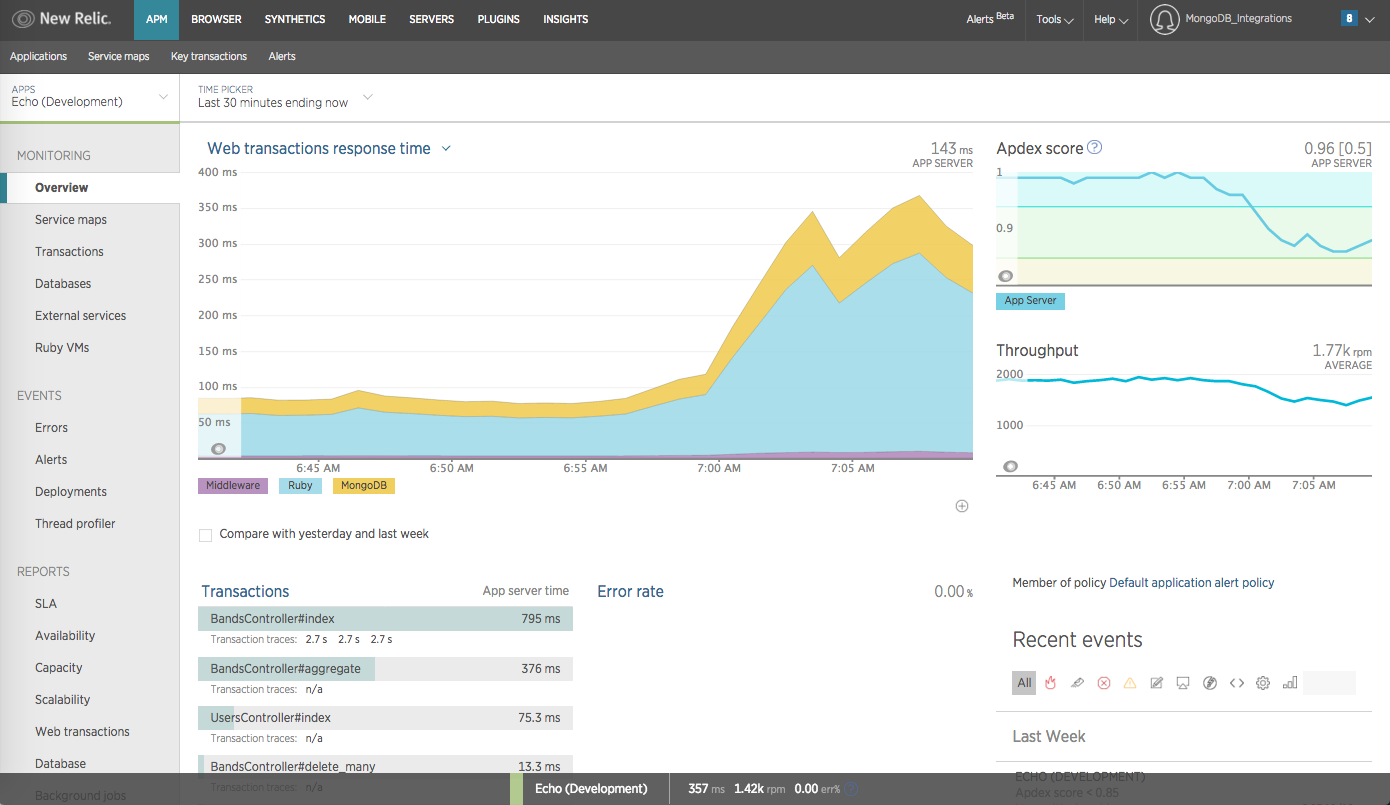 |