Norce Commerce, replacing the former Storm Commerce or (earlier) enferno, is a commerce engine with modern APIs. Norce Commerce is built with a composable architecture to fit into any system landscape.
N/A
Shopify
Score 8.7 out of 10
N/A
Shopify is a commerce platform designed for both online stores and retail locations. Shopify offers a professional online storefront, a payment solution to accept credit cards, and the Shopify POS application to power retail sales.
$39
per month
Shopify Plus
Score 8.9 out of 10
N/A
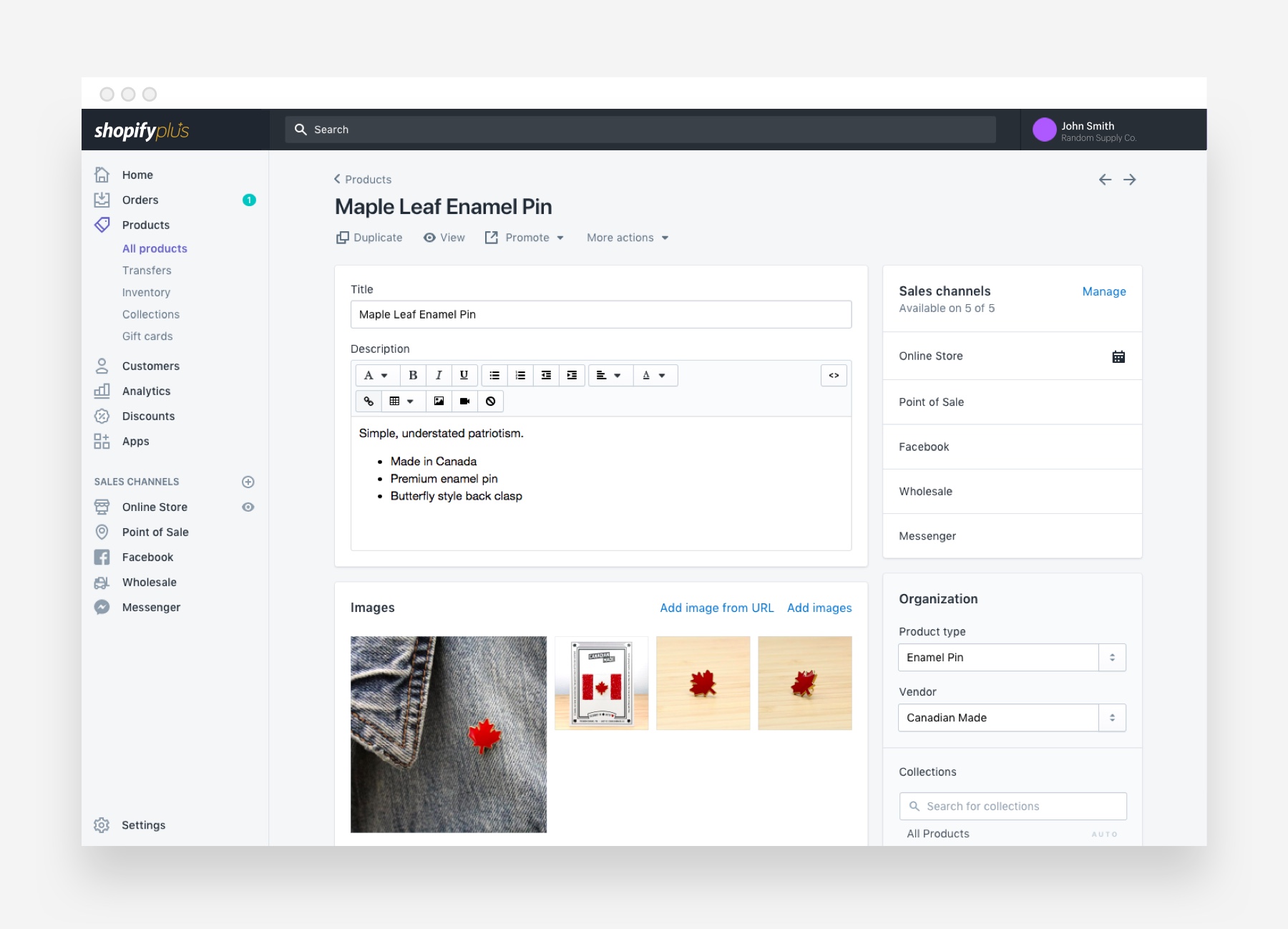
Shopify Plus is an eCommerce solution built for enterprise-level companies that enables them to sell online and offline across social channels like Facebook , Pinterest, and marketplaces like Amazon and eBay.
Shopify out of the box had more features and did what we were looking to do that BigCommerce could not do without extensive customizations using a third-party vendor. That made it a very easy choice to switch to Shopify. Most of the customizations needed in Shopify we were able …
I havent had a very detailed look at the others. But for us, to migrate the whole infrastructure to something else doesnt make sense. We are happy with Shopify.
Shopify is the best tool in the ecosystem because with all the apps in its sphere, you can do almost anything. It also has the best checkout experience one can ask for in the Ecommerce / website space. I think when it comes to shipping inventory and theme management it’s the …
Shopify allows for companies to quickly and easily get online and selling. However, the more you want to customize the platform, the more you'll realize that other platforms (such as Wordpress + WooCommerce) end up being better because you have access to all of the core code …
Initially we built our website on Godaddy. There was not much SEO functionality and website user experience wasn`t great either. Hence, we migrated to Shopify and everything changed for the better.
WooCommerce may be a good option for a developer or simple websites for service based businesses (e.g., electrician/cafe/etc). If you are selling a physical or digital product and require the ability to customize your store with any frequency or to track performance etc then I …
Shopify is not as user-friendly or attractive as Squarespace. Also, the interface is much more challenging due to the way the digital download variants system has been designed (requiring third party app). I find Shopify to be slightly superior to Wix for product selling - …
I have been in e-commerce for over 15 years now, and Shopify is overall the best website platform that I have used. I have used AmeriCommerce, StoresOnline/Crexendo, BigCommerce, Weebly/Square, Wix, Wordpress, GoDaddy and others - Shopify is the best in most …
Big Commerce and SAP Hybris are two other platforms we've investigated and Shopify is by far easiest to use and customize. While it doesn't do everything out of the box, the apps do fill in many gaps. The cost however, is probably the biggest selling point against these other …
I am semi familiar with Wix. I prefer the Shopify interface for its ease of functionality and I think the platform is just more realistic in terms of what a business wants to see on the back end.
Shopify is so much easier to use, and much more user-friendly than both BigCommerce and Magento. The reporting, product management, and app marketplace are much better as well. Shopify also integrates with other systems very easily with apps and sales channels, so it saves a …
For e-commerce, Shopify provides a greater range of capabilities and integrations, including inventory management, shipping, and payment choices, and marketing tools. It offers more apps and customization possibilities accessible to businesses. Shopify helps you better organize …
We did not evaluate other products because of Shopifys name recognition and overall great reviews. I had heard of Wix as another option for website creation and building, but Shopify is a lot more complex for our business needs and fulfills our need for a platform where we can …
The old platform that I used could not help us to meet our requirements. It was not helping us properly, then I got to know about Shopify and started using it. After 1 month [of] usage of Shopify we could understand that this is the best platform [for E-commerce] to make …
Shopify is easy to use. You do not need to install many plugins for it, and if you are using Woocommerce, you will have to install some plugins. With Shopify, you get a high speed hosting and CDN (content delivery network) which will make your website fast. The checkout is also …
Shopify is easy to navigate and export shipping data to other shipping management tools. We have multiple clients (70+) using Shopify and rarely have issues. With others, we seem to have trouble daily with export to our shipping management tools. In addition to export issues, …
Shopify is the full-fledged complete package. It is equipped with all the superb features. Shopify is one of the most used cloud-based e-commerce store creation platforms available in the market for medium and small businesses. Shopify is the best store creation tool with …
Adobe Business Catalyst was used before Shopify but we ended moving away from the platform and we constantly ran into issues. The support wasn't like Shopify, nor was the platform as reliable. Shopify handles alot more, alot better but we found the constant need to add add-ons …
Shopify Plus offers a lot more scalable technical foundations. Magento and Woocommerce sites can be difficult to innvoate on top of and not have the security that Shopify Plus offers. Often Woocommerce sites are cobbled together with third party tools and plugins that can …
A direct connection to our ERP sets Shopify Plus apart for other platforms we've evaluated. The integration with our ERP eliminates manual data entry, reduces fulfillment errors, and ensures accurate stock visibility company-wide.
Shopify Plus is better than both due to how the platform is build and how easy it is to interact and do stuff in there. It seems more modern than both of the other platforms stated above. It is also not as heavily code based as the other two platforms. It's easier to find what …
Shopify is more robust and has more functionalities than its competitors like BigCommerce and Kibo. It offers the best UI in the business and the most exhaustive app marketplace ecosystem. It is more cost effective than big system and doe snot require large teams of developers …
Shopify Plus is far more scalable and stable. It is much easier to implement, and the time to value is much shorter. Development resources are plentiful and skilled, and the product's user base is so massive that significant testing has been done prior to releasing any updates …
Significant improvement. Magento did not have a B2B setting, so you needed to remember and alter the prices manually, and you could not create draft orders, so if you sent a customer a quote and they called up to pay, you then had to quickly create the order whilst the customer …
Shopify Plus, once existing data imported awkwardly, handles so much of the basics of running an online shop in way that you know you can rely upon. It still requires many more third party tools to be able to use best-in-class analytics and AB testing.
Shopify Plus is the best choice for DTC-oriented brands, especially if you are a leaner team and want more hands-on customization vs relying on an agency to manage your website backend.
Shopify Plus is the most advanced and most widely accepted "DIY" website tool. While WordPress has some capabilities and is certainly cheaper, it is still a blogging platform with e-commerce capabilities added later, and you can tell that's what it is when you use it. …
Shopify Plus's ease of use compared to Sticky.io was the biggest reason we had switched, and just the sheer customization and available apps allow you to adjust your store without needing to spend weeks custom developing tools.
A far more professional approach to e-commerce in general. Servers and the core SSL are taken care of and you're left with a whole host of tools to sell, sell and sell.
Shopify is a much easier and more intuitive platform to use.
The mobile focus is outstanding from the other competitors and the capability to modify the store without previous code or experience makes them the best e-commerce platform.
Shopify Plus is better supported, more powerful, and has much more ability for customization. Shopify as a platform is also much more stable than others and offers excellent customer support. New features are constantly being rolled out and it has a very large community.
Shopify Plus is an all in one service. You are able to keep track of invoices and payments. Shopify Plus also offers options for shipping and connects your tracking number to you order which allows for easy tracking. Your tracking number is also a link which makes it even easier.
Shopify Plus is the least expensive option. Apps/plug ins are vast, inexpensive, and relatively easiest to integrate Least amount of customization, but good for teams with small dev support
Shopify had the quickest go-to-market and most robust API among the products we compared. CommerceCloud required a VERY LONG integration phase that we just didn't have time for. BigCommerce fell short on the number of features and API coverage that we needed. Overall Shopify …
Netsuite SuiteCommerce, which has a very high cost of ownership, and Magento, which although powerful can be expensive and is too complex for the average eComm requirements. Too flexible can be bad in some cases.
Shopify Plus offers a more robust solution than Woo commerce and is easier to train on than Big Commerce. Woo commerce is freeware with no support. Big Commerce offers more SEO features and is a more powerful solution, but harder to remote train users on - lots more …
Shopify Plus is WAYYYYYY better than anything else that we have used, and it's not even close. The websites are faster and more reliable, both of which are critical to running an online business. The cost to run is way less. We are running five websites on Shopify Plus for less …
I selected Shopify Plus because the clients found it easy to use to manage their website, whenever they needed an update of their website. Shopify Plus is great when it comes to e-commerce websites and should only be used for e-commerce.
Our experience with SFCC was fairly poor. SFCC was very expensive, and the ecosystem of partners is very expensive. SFCC is a bit more mature but the time to execute is significantly slower.
Shopify Olus is more of a SAAS than the self-managed Magento solution. With this comes a host of benefits such as hosting, security, updates, and new technology that you no longer have to worry about. Specifically, with Shopify Plus, scripts can be very powerful and when …
Shopify is perfect for companies who are looking to run a simple-to-medium base e-commerce system and aren't looking to get too fancy with integrations. Those companies, though, that have more complex integrations (especially with checkout) might be better off using another e-com system out there where you have access to the full core code.
Shopify Plus makes order management simple and less error prone. Connecting our ERP allows us to seamlessly manage our product listings, fulfill orders, and sync customer data. Limitations to the number of product variants requires attention from our staff to make sure our products sync without issue. Other than being arbitrary, there's really no need to limit the number of product variants.
Scales incredibly well. Forget about hardware concerns, load balancing, downtime, etc. and focus on eCommerce. We've seen merchants go from a few thousand dollars per month to having million dollar days, all on Shopify without having to worry about performance or scaling systems.
Great new features consistently being added, ahead of the curve on almost everything
Solid API to build on and work with, a few annoying quirks here and there for super complex use cases but overall very well documented and works well
Most Merchant Success Managers are good and genuinely want to be helpful
A fantastic user interface, very logical and easy to use
Tons and tons and tons of out of the box integrations. Easily the best integration marketplace of the e-commerce platforms. There's an app for that.
Basic requests for store management are not out of the box. Shopify puts a lot of stock in their apps and app partners to bring some of the features that I expected to be out of the box. I've used Shopify for multiple clients and ran into roadblocks for each when we were unable to do basic things. Sometimes the apps are free and it's no big deal. Other times you have to pay for another service to do something as basic as set up stock out reports and notifications.
Their support/team communication is poor. Again, working on multiple stores with license on all their levels and the support was consistently unresponsive or unhelpful.
If you're a partner managing multiple stores, the log-in between the partner dashboard and your individual stores is confusing. I'm often found in a loop searching for the right place to log in because you can't access the stores you are a partner on in the same way as the other Shopify stores. Seems minor, but it's a frustrating thing I encounter often.
The Account Managers/Reps have become more scripted and seem like they are busier and handling more clients than before. It doesn't seem as personal and special anymore like when we first upgraded to Plus.
Shopify still has missing features in their software that might not have an app in their app marketplace available that fills this void.
The 24/7 support doesn't seem as dedicated as they once were.
Nothing we have used in the past or have seen thus far even comes close to offering what we get with Shopify Plus, especially for the price. You cannot even come close to getting what we are getting at the price we pay. We are beyond thrilled and Shopify Plus meets and exceeds all of our needs and expectations. We love it!
It is fairly easy to use Shopify regardless of what task you are attempting to perform. Most things are customizable to a degree without requiring coding ability. I have very limited coding experience and have still been able to navigate my way around changing features of the website that require edits to the code with the use of AI and trial-and-error. This previously wasn't possible with the WooCommerce platform.
It is extremely easy for merchants to get to know how Shopify Plus works. Comparitive to other platforms such as Magento and WooCommerce it is extremely lean and easy to operate, meaning clients who migrate over to it find it very intuitive to use. There is also a lot of guides and up to date information online
In terms of support I give Shopify a 9 out of 10 because they're always very friendly and thorough, and they personally can't solve my problem for me they always point me in the proper direction with the proper information I need to move forward
Shopify offered us several trainings to setup a Shopify store, how to build a brand, SEO, product photography etc. All this content have been super helpful in our journey.
Shopify out of the box had more features and did what we were looking to do that BigCommerce could not do without extensive customizations using a third-party vendor. That made it a very easy choice to switch to Shopify. Most of the customizations needed in Shopify we were able to do ourselves.
Shopify Plus is an all in one service. You are able to keep track of invoices and payments. Shopify Plus also offers options for shipping and connects your tracking number to you order which allows for easy tracking. Your tracking number is also a link which makes it even easier.
It got the store up quickly so the client could start selling. She was previously selling products on Etsy and Facebook and wanted to consolidate everything onto one website, so the main thing Shopify solved was to reduce the store owner's time in managing all her products on multiple sites. Also, we had previously built a website on Wix with all the custom functionality and branding she needed - a truly great, high-end website - but it performed so slowly that it was unusable. So the speed at which Shopify can be set up and then works on the page is appreciable.
The website was manageable by the client - she could figure the system out herself after a while so she saved money on costs for hiring developers. She did have to hire developers to customize some of the plug-ins but costs are all relative; it wasn't a high investment compared to building a full e-commerce website. With the complexity and size of her product base and the functionality and branding she wanted to have in a website, and the potential of her business, she would have needed to invest well over $10,000 to get to where she really needs to be. In the end she kept the budget under $5000.00.
Costs kept climbing with plug-ins having to be added with everything. My client became more involved in building the website and began to try multiple plugins, and she did not have the skill base to evaluate the plugins functionalities so she chose plugins that did not do everything she needed, and then ended up paying the plugin developers to customize the plugins. So on one hand, it's pretty amazing to be able to bring up an e-commerce website as quickly as a week or so, but on the other hand if you need anything customized or deeper functionality in regards to product searching and filtering on the web page, and management on the backend, it quickly goes beyond the skills of the average person to manage, and above their expected budget as well. In the end my client really did not get anything close to the functionality for the website we had originally envisioned.
Shopify was the easiest way we could find to bring the client's products to a global market. We evaluated several other platforms and the functionality simple did not seem to be adequate, so Shopify seemed like the only solution that could do enough of what we needed and still stay within this client's budget. Really the problem in this project was not platform per se but that the budget wasn't large enough. Shopify managed to provide a solution for an ecommerce store with thousands of products on a tiny budget, so in the sense of pure functionality it provided the best value of all the platforms we evaluated. The solution still isn't big enough for this client's business though so, without having insights into this client's post-build sales results, my guess is that because her new website did not make her products easier to sort through, and she likely didn't have much more budget left to invest in SEO and other marketing of the website, her sales probably didn't increase substantially as a result of having built the website. So I think this project all in all did not likely have a high ROI.
Definitely makes selling on multiple platforms easy, saving us time and effort.
Keeps all of our business in one place, saving us money on other apps to manage each aspect.
Automatically flags potential fraudulent orders, preventing us from accidentally shipping to a scam.
During our busiest months, we don't see any slowdowns, which allows us to go full throttle with all ads and marketing without worrying about whether or not the software can handle it.