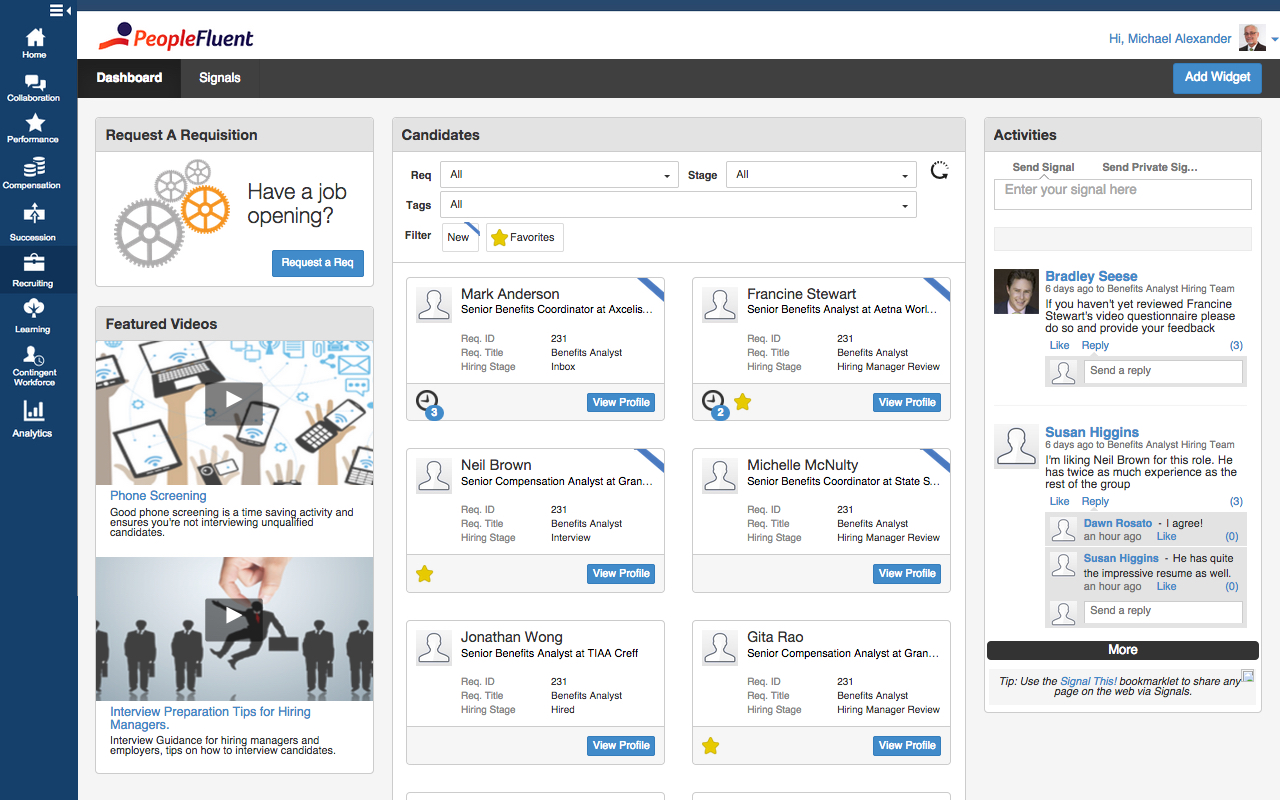
PeopleFluent includes modules for recruiting, performance management, compensation, learning, succession, and vendor management, as well as workforce planning and diversity. These modules can be purchased separately or bundled, and integrate with other HR systems.
N/A
SilkRoad Recruiting
Score8 out of 10
N/A
SilkRoad offers OpenHire, a recruiting and ATS system. It offers recruiting access through social media channels, data security, and EEO compliance for mid-sized to large businesses. It is a component of SilkRoad’s Lifesuite product line.
PeopleFluent has eliminated the use of paper reviews. It is also eliminated the use of scanning, emailing or interoffice mail. It is a great tool for communication and I highly recommend it. However, in some ways, the product can be improved. Some processes are tied to each other and could function in tandem. For example, while completing the self-review, the employee has to capture multi-raters. If self-review is submitted without listing multi-rater names then multi-rater review has to be captured separately on paper. In my opinion, these two processes can be different. Multi-raters should be added/removed/modified after submitting self-review.
A de minimis incentive was given to thank the reviewer for their time. The incentive was not used to bias or drive a particular response, nor was the incentive contingent on a positive endorsement. More Info
I think OpenHire is best for a small company (max about 2500 employees). The more employees you have the more HR people you should have and this can get expensive. I know most larger companies are using more advanced systems as well (Workday). During the selection process be sure to determine how many OpenHire users you would need. Ask whether your managers will be willing to work in the system as well or whether HR would have to own the entire process. If you are EEOC compliant, make sure you ask about diversity posting, APP tracking of applicants, and reporting needs. If you require an onboarding tool, SilkRoad offers RedCarpet. I found it to be very complex and hiring managers refused to use it. If you require an onboarding tool, definitely look into it. The demo may look great but there were a lot of implementation steps done to make it work and it just didn't fit our company culture. So make sure it fits yours.
A de minimis incentive was given to thank the reviewer for their time. The incentive was not used to bias or drive a particular response, nor was the incentive contingent on a positive endorsement. More Info
It was very easy to go through resumes, choose the people you wanted to interview and set up the interviews.
It is great at keeping track of people that have come through hiring process in the past so you do not waste time on those that have already been declined or are sent in by multiple vendors.
The handling of time sheets and expense reports is very easy to manage.
The ease of use when it comes to create requisitions from a hiring managers side of things is definitely a positive. It's very much user intuitive and the specifications can be completely customized as to what a company would like to appear within said requisition.
Candidate correspondence is an absolute breeze as you can custom load templates into the system that can be edited at any time through an administrator in your company instead of having to go through a technical support team on the other side of things.
Overall, it's a pretty no muss no fuss system to use as there's not a great layer of complication about it and like most things, spaced practice and consistent exposure to it tend to iron out those rough edges. From an administration standpoint, adding in locations and hiring managers is incredibly simplistic along with reporting functionality.
Candidate folders have come a long way in the system and are much more user friendly at this point than when I began using the system some four years ago. It's very easy to shift candidate profiles between folders and edit on the fly.
A de minimis incentive was given to thank the reviewer for their time. The incentive was not used to bias or drive a particular response, nor was the incentive contingent on a positive endorsement. More Info
The interface is a little confusing. I'm not sure if it's something that can be fixed in implementations, or if it's inherent to PeopleFluent, but there are almost too many tabs asking for too much information. A lot of it can be repetitive as well.
Changing your password/resetting your password seems to be nightmarish. It requires an organization ID as well as security questions, and forces you to reset your password far too often. I really dislike that feature.
Honestly, PeopleFluent itself looks pretty outdated. I feel as though the entire application really needs a facelift to be more current.
A de minimis incentive was given to thank the reviewer for their time. The incentive was not used to bias or drive a particular response, nor was the incentive contingent on a positive endorsement. More Info
OpenHire's user roles can create issues depending on how your company's hiring process flows. For example, at one company, the hiring managers were extremely involved in screening candidates yet the system seems very geared towards use of centralized recruiters who distribute candidates. The lack of ability to customize roles and security to match our managers' needs created additional burden on HR as well as frustration from hiring managers.
I experienced several problems uploading documents to accompany a candidate's offer. There was a limit on the number, size and type of attachments that could be included, and there was no alternative (as vetted with OpenHire) besides sending a separate correspondence to the candidate. I found this to appear unprofessional to the candidate as well as creating an extra step in the process for HR/recruiting.
The requisition process had a few issues which created inefficiencies in the process. Firstly, for times when you need to post a role confidentially outside of your standard process, there was no way to designate the req as 'confidential'. Instead, you had to use the 'executive' status which created issues (ie: inaccurate data in reporting). Secondly, OpenHire was unable to upload the company directory of emails in the requisition approver fields so rather than being able to select from a drop-down or using a 'smart' field, you had to type each approver's email out manually thus increasing the potential for error and delay in the process.
A de minimis incentive was given to thank the reviewer for their time. The incentive was not used to bias or drive a particular response, nor was the incentive contingent on a positive endorsement. More Info
PeopleFluent continues to develop an already high quality product and works to continually improve the user experience. The different modules integrate well, and the administrative functions are easy to understand and perform resulting in less time spent with KTLO functions. They provide world class customer service and work hard to keep you engaged as a customer.
It was a great solution for the company in all aspects, especially the cost. The company was not in a position to afford a solution such as Oracle PeopleSoft. The only reason we did not renew OpenHire was we got acquired by a much larger organization and started utilizing the tools that the parent company had available
A de minimis incentive was given to thank the reviewer for their time. The incentive was not used to bias or drive a particular response, nor was the incentive contingent on a positive endorsement. More Info
PeopleFluent seems to have all the functionality one would need, but it can be a bit overwhelming. Depending on the client implementation, it can be downright confusing and not intuitive. My 6 rating comes from the fact that it seems like the system can be configured to actually be confusing and not make sense. I think a VMS should be set up not to allow a customer to configure it in such a way as to not really work, or to allow users to circumvent steps. I also really don't like the "organization key" that needs to be entered every time you log in. Why is a login and password good enough for 99% of the systems out there, but PeopleFluent requires an extra field?
A de minimis incentive was given to thank the reviewer for their time. The incentive was not used to bias or drive a particular response, nor was the incentive contingent on a positive endorsement. More Info
It's not a bad system to use, there just seems to be so much click through to get one task achieved. Once you know all the little routes and pieces it gets easier.
A de minimis incentive was given to thank the reviewer for their time. The incentive was not used to bias or drive a particular response, nor was the incentive contingent on a positive endorsement. More Info
I would rate this ATS system a 9 as there's some room for improvement as mentioned prior. I really love the design and its functionality buttons and the way I can integrate it with other systems. I would really love to see a more detailed reporting metrics long with super candidate filters when searching profiles.
A de minimis incentive was given to thank the reviewer for their time. The incentive was not used to bias or drive a particular response, nor was the incentive contingent on a positive endorsement. More Info
The support for Silkroad is awful. I know they are working on it and it seems to be slightly better but it's still not great. I have had multiple cases I have never heard from them on, others I have had to follow-up multiple times and one that took a year
A de minimis incentive was given to thank the reviewer for their time. The incentive was not used to bias or drive a particular response, nor was the incentive contingent on a positive endorsement. More Info
Its great, its very versatile and stacks up very well against the competition. In terms of usability and ease of use, anyone can quickly learn how to use PeopleFluent. Again, the faults against the system would be when a client who is running the tool customizes it to their liking. Not to mention it's a very popular tool that i have had the pleasure of working in twice now with two different organizations.
A de minimis incentive was given to thank the reviewer for their time. The incentive was not used to bias or drive a particular response, nor was the incentive contingent on a positive endorsement. More Info
NeoGov is a more simple system but just being able to require specific documents has been a huge time saver for us. Other elements in NeoGov aren't as robust but still it saves me a lot of time compared to OpenHire.
A de minimis incentive was given to thank the reviewer for their time. The incentive was not used to bias or drive a particular response, nor was the incentive contingent on a positive endorsement. More Info
I do believe that goal setting and the workflow of following up, going through the process yearly is as good as you make it. If you set good goals, or help your team make good goals then the experience can go well. Otherwise it's just another thing that an employee is doing to make their manager happy.
I am not sure the cost of the product, but if it is really expensive I am not sure that we are getting fully what we should be for what the product offers. Make sure you are using what is offered.
A de minimis incentive was given to thank the reviewer for their time. The incentive was not used to bias or drive a particular response, nor was the incentive contingent on a positive endorsement. More Info
A de minimis incentive was given to thank the reviewer for their time. The incentive was not used to bias or drive a particular response, nor was the incentive contingent on a positive endorsement. More Info