
Srinivas Perumandla
Senior SAP BI Consultant
Chose SAP HANA Cloud
I did not used any inmemory databases other than SAP HANA.

| Product | Rating | Most Used By | Product Summary | Starting Price |
|---|---|---|---|---|
 SAP HANA Cloud | N/A | SAP HANA is an application that uses in-memory database technology to process very large amounts of real-time data from relational databases, both SAP and non-SAP, in a very short time. The in-memory computing engine allows HANA to process data stored in RAM as opposed to reading it from a disk which means that the data can be accessed in real time by the applications using HANA. The product is sold both as an appliance and as a cloud-based software solution. | $0.95 per month Capacity Units | |
 SAP Lumira Discovery | N/A | SAP Lumira Discovery is SAP’s data visualization and discovery application. It facilitates data discovery, visualization, and analysis by assisting users with creation of dashboards, infographics, presentations, data facets, tag clouds, and more. | $185 per user |
| SAP HANA Cloud | SAP Lumira Discovery | |||||||||||||||
|---|---|---|---|---|---|---|---|---|---|---|---|---|---|---|---|---|
| Editions & Modules | No answers on this topic |
| ||||||||||||||
| Offerings |
| |||||||||||||||
| Entry-level Setup Fee | Optional | No setup fee | ||||||||||||||
| Additional Details | Includes a one year free trial. | — | ||||||||||||||
| More Pricing Information | ||||||||||||||||
| SAP HANA Cloud | SAP Lumira Discovery | |
|---|---|---|
| Considered Both Products | SAP HANA Cloud Srinivas Perumandla Senior SAP BI Consultant Chose SAP HANA Cloud I did not used any inmemory databases other than SAP HANA.  Saurabh Raheja Senior Systems Engineer Chose SAP HANA Cloud SAP hana is best utilised for data management at the backend. Therefore using SAP HANA at the backend and utilising SAP BO's reporting tools at the front end for visualising the data in a better presentable form is an example.  Vivek Gupta BI Consultant Chose SAP HANA Cloud - Large Scale enterprise wide reporting is possible - Security is very tight - Real time data processing |  SAP Lumira Discovery  Leonardo Hernandez SAP Consultant Chose SAP Lumira Discovery we choose SAP Lumira because comes from SAP and we trust in the quality of their products, also we saw a very potetial tool for out clients to explore their data and add value to their erp implementation  Kuldeep Vaishnav SAP B1 Functional Consultant Chose SAP Lumira Discovery In India, users are already using this product and have got adapted to it. It's tough because it is not as beneficial as Lumira, but to bring a change in an Indian company is hard to implement.  Anil Kumar Sahu Technical Architect Chose SAP Lumira Discovery Lumira is more tightly coupled with the SAP HANA data source. It is more suitable for doing real time data analysis. Saurabh Raheja Senior Systems Engineer Chose SAP Lumira Discovery SAP lumira is easy to use and user friendly UI.  tarini goyal Senior Software Design Engineer Chose SAP Lumira Discovery Data Analysis is best suited with Lumira compared with any other product. Visualisation and decision making is best thing you would recommend using Lumira for.  John Krech President/Founder/Inventor Chose SAP Lumira Discovery I have looked at many visualization tools and Lumira was the easiest to deploy, quickest to deploy, and had a very easy to use UI.  Josh Anderson User Experience Manager Chose SAP Lumira Discovery Lumira is better at visualization than Analysis Office but does not allow as much in depth analysis. Also it's much easier to consume quickly with Lumira as you don't have to build a query to pull the data. Design studio is more flexible but dashboards and visualizations need to …  Timothy Johnson Consultant Chose SAP Lumira Discovery Lumira is behind in functionality with tableau and Qlikview. However it is catching up  Jamie Oswald Manager - Data Analytics & Engineering Chose SAP Lumira Discovery I actually prefer Lumira because it integrates better with my current business intelligence investment, it's free for me to use, and it allows me to use my enterprise data as well as other data I can pull in and merge with it.  Sandeep Reddy Tippana HANA Modeler Chose SAP Lumira Discovery SAP Lumira is easy to use but the functionality of Lumira lacks in many ways. Lumira is lagging behind when compared with the amount of features Tableau is providing. But, Lumira has the edge in connecting with OLAP data sources like SAP BEx queries and also connecting to SAP … |
| SAP HANA Cloud | SAP Lumira Discovery | ||||||||||||||||||||||||
|---|---|---|---|---|---|---|---|---|---|---|---|---|---|---|---|---|---|---|---|---|---|---|---|---|---|
| Relational Databases |
| ||||||||||||||||||||||||
| BI Standard Reporting |
| ||||||||||||||||||||||||
| Ad-hoc Reporting |
| ||||||||||||||||||||||||
| Report Output and Scheduling |
| ||||||||||||||||||||||||
| Data Discovery and Visualization |
|
| SAP HANA Cloud | SAP Lumira Discovery | |
|---|---|---|
| Small Businesses |  InterSystems IRIS Score 7.9 out of 10 |  Yellowfin Score 8.7 out of 10 |
| Medium-sized Companies | InterSystems IRIS Score 7.9 out of 10 |  Reveal Score 10.0 out of 10 |
| Enterprises | SAP IQ Score 10.0 out of 10 |  Kyvos Semantic Layer Score 9.5 out of 10 |
| All Alternatives | View all alternatives | View all alternatives |
| SAP HANA Cloud | SAP Lumira Discovery | |
|---|---|---|
| Likelihood to Recommend | 9.6 (308 ratings) | 9.0 (105 ratings) |
| Likelihood to Renew | 10.0 (11 ratings) | 6.0 (1 ratings) |
| Usability | 9.6 (29 ratings) | 8.0 (15 ratings) |
| Availability | 3.6 (1 ratings) | 5.0 (2 ratings) |
| Performance | 3.6 (1 ratings) | 4.0 (2 ratings) |
| Support Rating | 9.1 (251 ratings) | 1.0 (12 ratings) |
| In-Person Training | - (0 ratings) | 6.0 (1 ratings) |
| Online Training | - (0 ratings) | 6.0 (1 ratings) |
| Implementation Rating | 9.1 (2 ratings) | 4.0 (4 ratings) |
| Configurability | 3.6 (1 ratings) | 4.0 (2 ratings) |
| Ease of integration | 4.5 (1 ratings) | 4.0 (2 ratings) |
| Product Scalability | 4.5 (1 ratings) | 4.0 (2 ratings) |
| Professional Services | - (0 ratings) | 5.0 (1 ratings) |
| Vendor post-sale | 4.5 (1 ratings) | 8.0 (1 ratings) |
| Vendor pre-sale | 3.6 (1 ratings) | 5.0 (2 ratings) |
| SAP HANA Cloud | SAP Lumira Discovery | |
|---|---|---|
| Likelihood to Recommend | SAP
| SAP
|
| Pros | SAP
| SAP
|
| Cons | SAP
| SAP
 Darian Rawson Senior Designer |
| Likelihood to Renew | SAP
| SAP
 Pritama Kundu Manager - Business Integrator |
| Usability | SAP
| SAP
|
| Reliability and Availability | SAP
| SAP
 Ravi Ada Founder + CTO |
| Performance | SAP
| SAP
Ravi Ada Founder + CTO |
| Support Rating | SAP
| SAP
|
| In-Person Training | SAP No answers on this topic | SAP
Ravi Ada Founder + CTO |
| Online Training | SAP No answers on this topic | SAP
Ravi Ada Founder + CTO |
| Implementation Rating | SAP
| SAP
Ravi Ada Founder + CTO |
| Alternatives Considered | SAP
| SAP
|
| Contract Terms and Pricing Model | SAP
| SAP No answers on this topic |
| Scalability | SAP
| SAP
Ravi Ada Founder + CTO |
| Professional Services | SAP
| SAP No answers on this topic |
| Return on Investment | SAP
 Nishant Kumar Lead Engineer | SAP
 Rehan Kanuga Data Analyst |
| ScreenShots | SAP Lumira Discovery Screenshots 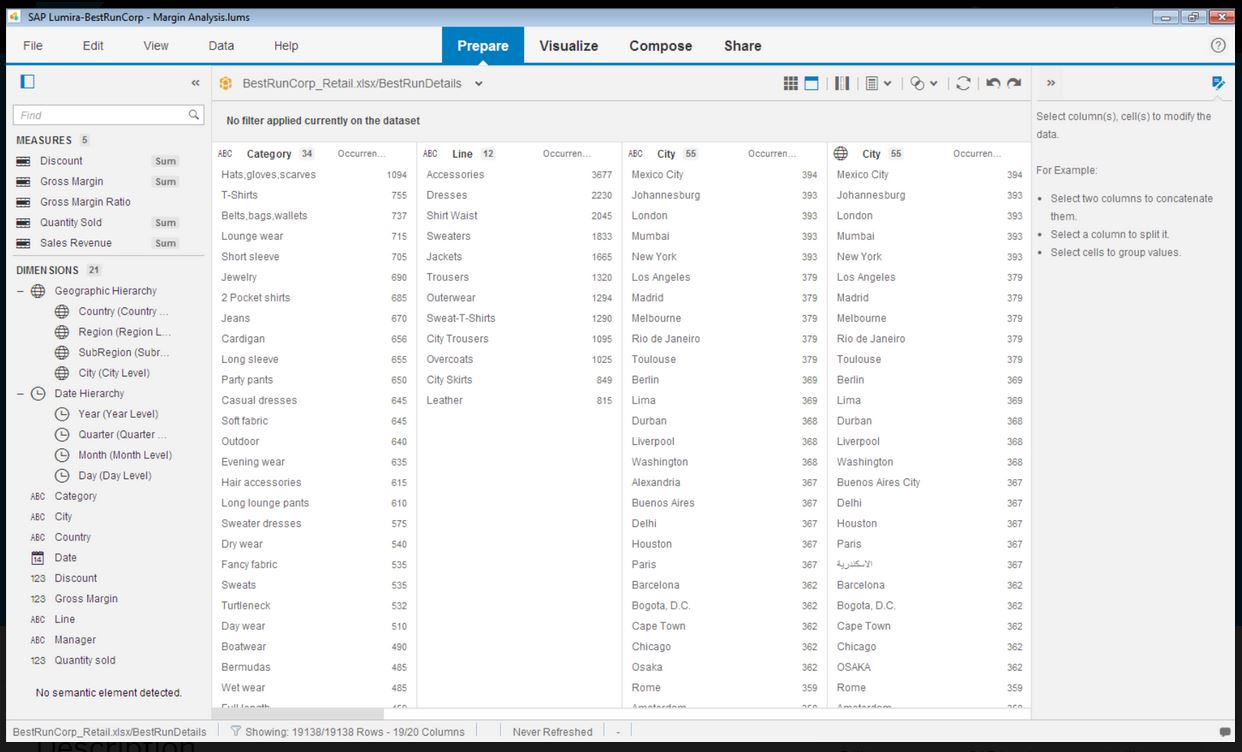     |