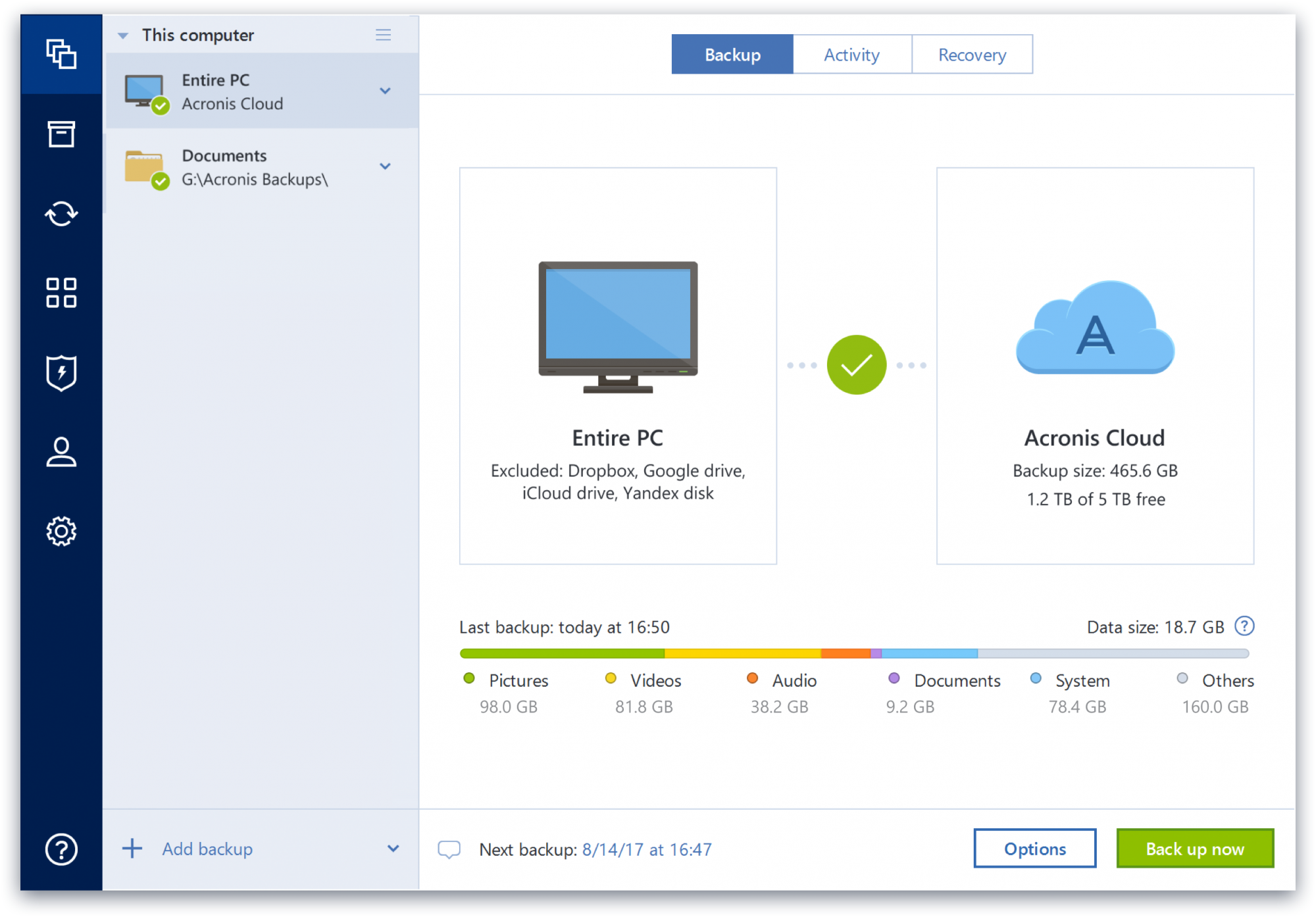
Acronis True Image is a backup, cloning, cyber protection and privacy tool suite for home users.
N/A
Kaspersky Endpoint Security
Score 7.3 out of 10
N/A
Kaspersky Small Office Security (formerly Kaspersky Work Space Security) is antivirus / endpoint security software from Russian company Kaspersky.
$29.99
per month
Sophos Intercept X
Score 8.7 out of 10
N/A
Sophos Endpoint Protection (Sophos EPP) with Intercept X is an endpoint security product providing an antivirus / antimalware solution that when upgraded with Intercept X or Intercept X Advanced provides advanced threat detection and EDR capabilities.
$28
per year per user
Pricing
Acronis True Image
Kaspersky Endpoint Security
Sophos Intercept X
Editions & Modules
No answers on this topic
Essential Suite
$29.99
per month
Advanced Suite
$39.99
per month
Premium Suite
$44.99
per month
Intercept X Advanced
$28
per year per user
Intercept X Advanced with XDR
$48
per year per user
Sophos Managed Threat Response
$79
per year per user
Offerings
Pricing Offerings
Acronis True Image
Kaspersky Endpoint Security
Sophos Intercept X
Free Trial
Yes
No
No
Free/Freemium Version
No
No
No
Premium Consulting/Integration Services
No
No
No
Entry-level Setup Fee
No setup fee
No setup fee
No setup fee
Additional Details
—
—
Pricing is for a 3-year commitment. Government and Education pricing available.
More Pricing Information
Community Pulse
Acronis True Image
Kaspersky Endpoint Security
Sophos Intercept X
Considered Multiple Products
Acronis True Image
Verified User
Administrator
Chose Acronis True Image
Acronis fits in with the rest of our software as it saves us a ton of time and money. Usability is incredibly intuitive - and a new employee can be taught the ins and outs in less than 15 minutes. The software is also updated regularly to improve the security and functionality …
Kaspersky is a leader in endpoint protection, but its ties to potential adversaries are unsettling. Kaspersky has a great threat research team and quickly identifies malicious software and its signature. Its web-based protection is also top notch. This is a great product but as …
Sophos is much more user friendly and scalable for partners who wish to [centralize] all security across the IT industry, from email security, server security, phish threat management and more.
In our analysis we discovered that for the price and feature set, Sophos was able to rise above the rest. Pricing is always a large consideration, however it isn't the only consideration - the feature set that Sophos Endpoint Protection provided over its competitors made the …
Sophos had the most mature cloud solution, mixing good work flows with strong capabilities. While many of the endpoint protection solution are very comparable when on-premise, it has been our experience that the cloud solutions can differ widely in terms of capabilities and …
Sophos has top of the line definitions, and support response for new threats (that goes undetected for days or even months with the competition). We selected Sophos, because they are aligned with our company objectives, we always look for NextGen Protection and tools, and …
Acronis Cyber Protect is great for any small/mid-sized business. The price point makes it attractive to all budgets >$100/year for 5 device deployments. Competitors offer less and charge more! Very happy with the suite of products, and renewals are simple and straightforward as well. I hope they don't change a thing!
I think Kaspersky is well suited for large and small companies. Larger companies can take advantage of the KSC (Kaspersky Security Center) servers to help manage a large network. The KSC has many good features to help monitor the health of the organization. It does a good job with updating and deploying remotely. It has inventory features, and can even deploy non-Kaspersky software packages uploaded to the center. KSC can become a source of good information about [your] network that can be seen at a glance. IT departments are normally smaller than they need to be. KSC helps with larger and smaller companies because of this. A small company would appreciate the amount of information and management that can be done through KSC without needing extra help. If the company is small enough that they don't have servers on-site, there is a cloud version. I have not used that to know how it differs from the local KSC.
To be frank, this product is fairly expensive. So I would recommend this to companies that are mid-sized or larger to condone the cost of the purchase. It does save me a significant amount of time in my day - being able to glance at the dashboard and see if there are any outstanding issues that require my attention, as not much digging must be done to accomplish this. So for our company, with a short-staffed IT department, it's incredibly helpful to us. We also qualify for Educational pricing which brings the cost down - which helps tremendously
The Security Center is laid out very well and makes it easy to install and manage the client endpoint protection on servers and workstations.
The way security policies are defined and managed is very easy to understand.
The client programs seem to be lighter and smaller on the client systems than others I have used in the past. Using fewer resources is always an advantage.
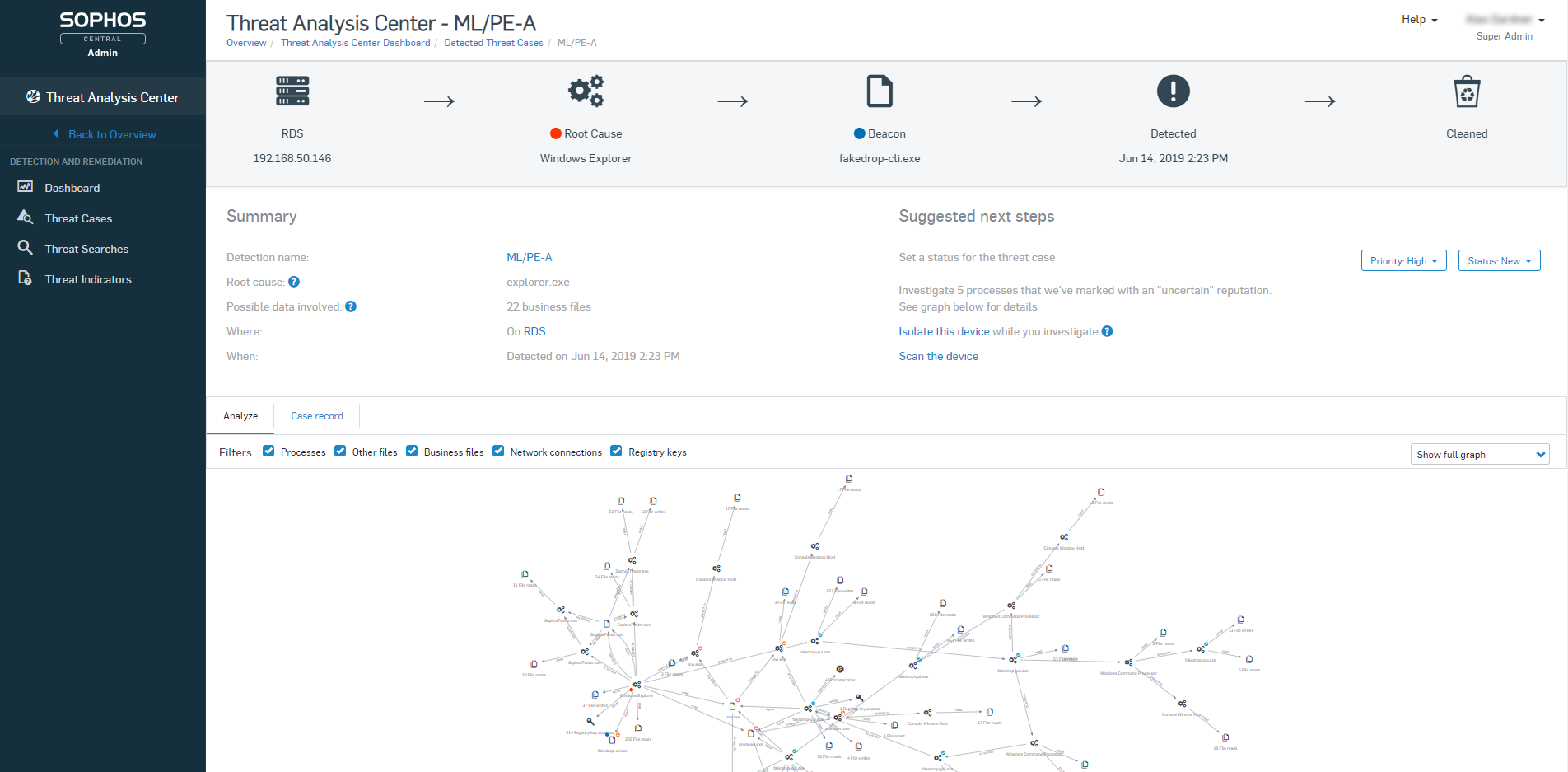
Sophos Intercept X is great at preventing malware infections and rolling back their effects. I have seen this happen hundreds of times since we installed it
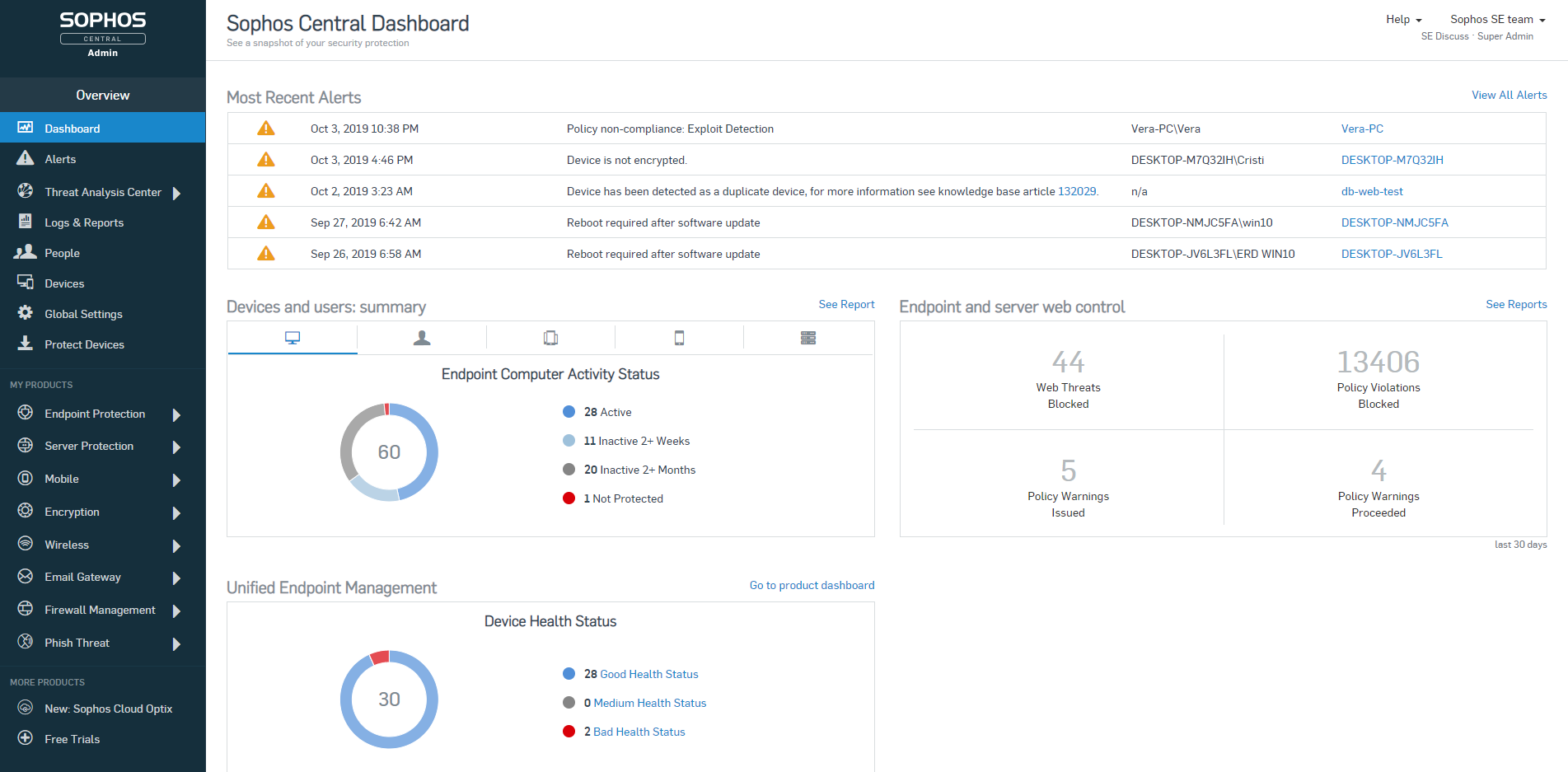
When combined with Sophos Central, you have an easy to use dashboard where you can manage all installations from a single pane of glass.
It's easy to deploy on machines and stays updated.
Good reporting features including alerts sent to the admin if there's ever something wrong with it.
Some features have actually become more complicated over the years. One that comes to mind is creating a backup plan that can execute daily to an external USB media that is changed daily (older versions would back up to the, for example, "F" drive regardless of which drive was attached - newer versions identify each drive uniquely, and a backup task created with a given external drive will fail due to the lack of media presence if the drive is replaced).
Error messages could be less cryptic.
Support turnaround time and live assistance could be faster.
Sophos OOTB policies are very strict and they don't offer anything less strict without you creating new custom policies. I'm sure this is deliberate because the product starts you out in the safest way possible but it means that you will have lots of calls to your tech support desk when you first deploy it unless you do somewhat extensive testing beforehand.
Sophos Intercept X is currently broken (at least the DLP component) by having secure boot turned on in the UEFI/BIOS. If any user wants to be able to write data to a USB drive or floppy from their PC (yes we still have a couple users who need to use floppies) we have to turn off secure boot on their PC, even if the DLP policy for that user/PC combination specifies that the user and PC are allowed to write to USB/floppy. This would be a very serious problem if it weren't for the fact that we have very few users who need to write files to USB. For us it's OK but I bet it would be a deal-breaker for others.
I don't see a whole lot of evidence that Intercept X is any different than any other anti-virus, so maybe their admin alerts just don't clearly identify when they have identified a zero-day threat or maybe we just haven't had any zero-day threats.
The product is stable and accurate in detecting security threats. There are very few or no false positives in detecting security threats or unusual behavior and has very sharp heuristics. The product does the job very well including saving us money in getting 3rd party patch management tools as the business is already using Microsoft System Center Configuration Manager which is Microsoft product specific and the product patches these third party products e.g Adobe Flash Player
Protect my system from data loss and also can manage multiple devices via online cloud from any where and also can set Multifactor authentication for more secure login access. Archive any backup which will use less space and we can transfer it to any other space also so it is very easy as server admin to manage acronics utilities
I will give Kaspersky a score of 9 out of 10 for scalability, as it allows businesses to easily expand their security infrastructure. This means it won't cost them a lot to add further protection and security. It won't also require them to purchase other hardware and services for their required protection.
The usability has never been a problem. Sophos Intercept X is a program you can install and let protect your company without much intervention. Apart from a few policies, Sophos will keep you protected better than most any product on the market. Sophos Intercept X works quite well when you are looking to "tighten your grip" on user's access to websites, programs, and add-ons.
I've used the on-premise server. I've only experienced one time that we couldn't open the console, and that was a server issue. It seems to be a dependable solution. It's there, and it's stable.
Users don't notice any slowdown with the antivirus running on their systems. There have been issues when the systems have missed a scheduled scan, and it was checked to run at [a] first available time, they will start a full scan at startup. This has caused some lag. Normally there are also some issues with the workstation, but it is something to note.
Beyond a single instance, I haven't had to approach Acronis' support. I needed a new key following the death of my previous workstation, and they rapidly supplied it. I've heard from colleagues that they've quickly answered any questions that've been asked. If I need something, I'll generally frequent FAQ pages first, although Acronis actually has instructional videos to help users get started, which is forward-thinking. Great software that fills a vital niche for Windows systems.
I give the maximum grade because we have no complaints; we never had any failure, serious error, and serious threat to the company. All of its features work very well. The great advantage of having a product supported by an industry-leading security company is that regularly updated security protocols will protect the system against all emerging threats.
Most of the support reps are fantastic. There have been a few though that have had to be escalated via Account Manager when they haven't followed up but this is a rare instance, and often followed up by the Support Manager for APAC.
Make sure to provide awareness campaigns on changes that will be implemented and WHY the business is doing it and the benefits reaped. Benefits reaped is very important for the justification of why things have to change and emphasizing the importance of security. This will reduce user disgruntlement and total bitterness on use of their workstation or laptop
IDrive is incredibly faster than Acronis on cloud backup. After Acronis' failures on cloud storage I moved to IDrive for peace of mind. IDrive can also do local backups, and either variant of system state, server, outlook, exchange, etc. It does not however have the ability to do a full image of a bitlocked machine like Acronis, so I'm continuing the local imaging with Acronis.
Kaspersky is a leader in endpoint protection, but its ties to potential adversaries are unsettling. Kaspersky has a great threat research team and quickly identifies malicious software and its signature. Its web-based protection is also top notch. This is a great product but as with everything has its place.
Webroot Endpoint Protection is not even in the same league as Sophos Intercept-X. I have tested and compared both sides by side, run simulations and it's not even close. Plus the Sophos central management is so much better. Easier to view user activities and apply policies and remediate threats. Sophos is the clear winner between these two products.
The Windows version is generally reliable and only ran into one issue thus far. Restores are easy and there are many features. On MacOS, it's a completely different story. There is significant resource leakage related to the updater app that can bog down part of a CPU core continuously until it is disabled. The mobile backup feature also needs to be disabled via UNIX command line or CPU usage will go up when a mobile device on the same network like an iPad or iPhone's screen is turned on.
You can create groups and create different policies for each group. You can customize many parts of the software before it is deployed. You can create different tasks and schedules based on the groups. It is customizable.
Once our technical and commercial areas got certified, the ROI over the time spent, is great. Actual customers, and/or new ones with other tools, feel safe and advised, once they get in touch with us.
When Sophos EndPoint is being compared against Web Management Tools (competitors), we have failed to deliver, nevertheless, there is a version of Sophos Central (Cloud) which achieves this requirement at 100% and more, since is Cloud Based (on AWS).
We are grateful to be on Sophos "Radar" as a Platinum Partner, and "The Americas" valued partner, we have seen our business grow, thanks to this kind of technology, throughout the years.