airfocus offers a modular product management platform. It provides a solution for product teams to manage and communicate their strategy, prioritize their work, build roadmaps, and connect feedback to solve the right problems. airfocus allows users to customize the platform to fit the various ways that teams work. airfocus offers a 14-day trial.
$15
user/month
Trello
Score 8.2 out of 10
N/A
Trello from Atlassian is a project management tool based on a Kanban framework. Trello is ideal for task-management in a to-do list format. It supports sharing boards and cards across users or teams. The product offers a free version, and paid versions add greater automation, collaboration, and administrative control.
$6
per month per user
Zenhub
Score 7.3 out of 10
N/A
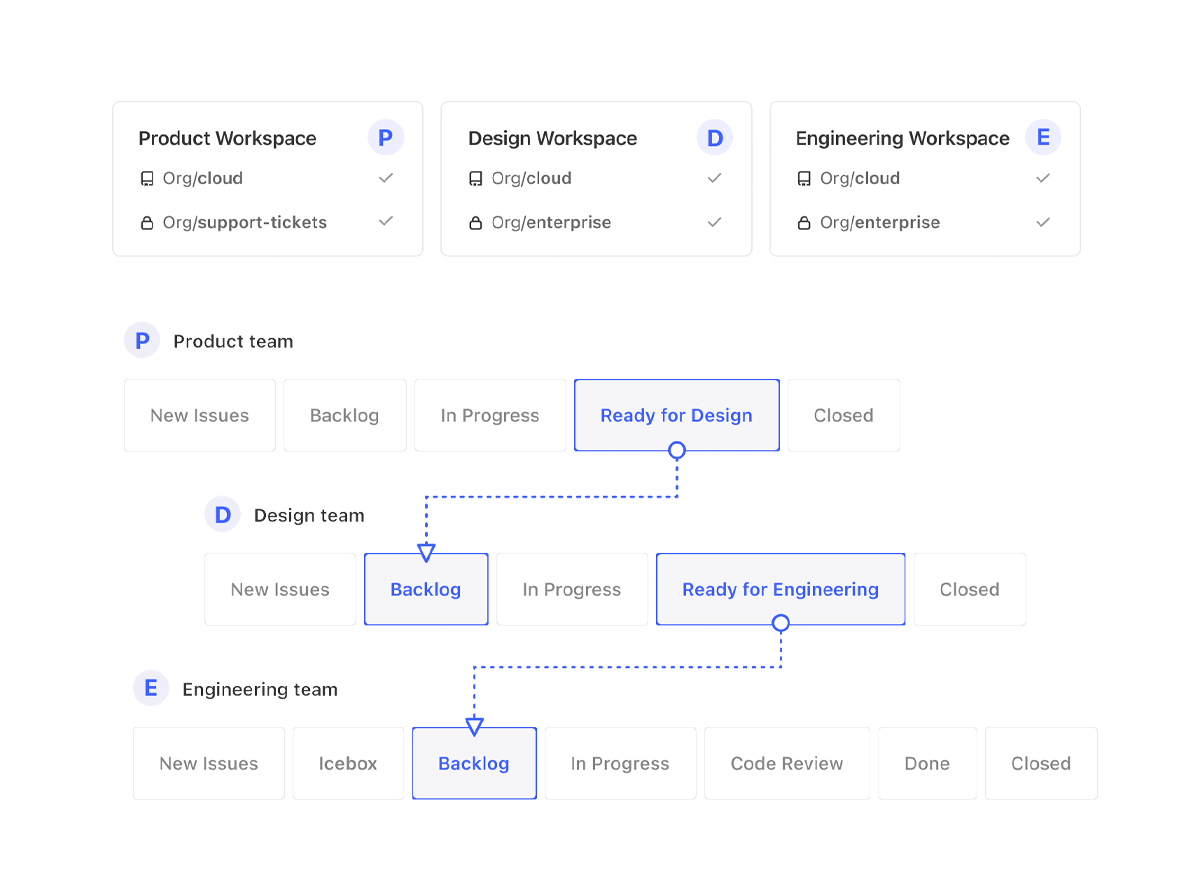
ZenHub is a project management solution that runs native within GitHub with collaboration boards, file sharing, and pipeline selection.
Zenhub is purpose built for Github users and provides just the tools you need to run Agile sprints without any extra complexity or fluff. Azure is a much more "enterprise" solution in which you drown in all of the available options, very similar story with Jira (pricing is also …
Way better than competition if you use github because it seamlessly integrates without doing anything. You don't need to duplicate your issues, etc. As long as your devs already use github and github issues this will be a no brainer and simple to implement. With JIRA or Trello …
airfocus is a scalable platform, very useful for any organization, especially for our IT department since it facilitates decision making, helps to establish different priorities, and helps to execute your sprints easily in a simple and visual way.
For teams or individuals with lots of individual tasks/details to track, Trello is perfect! It basically removes the need for a paper checklist. For those that need an overall project management tool that requires less tasks and more overarching goals, collaboration amongst various teams, and gantt charts I would suggest monday.com
If you have more than 2 developers this thing is basically a requirement within github to manage sprints if you use agile methodology. Why use a different website entirely when you can run your entire board right from github itself? I've tried other solutions but basing everything on github issues makes it so no duplicate work has to take place. If the UX quirks and mobile were fixed this would be 10/10 for me! If you're only one or two devs on a team it may be overkill to use, but if you're going to scale it's better to put the process in early.
Product prioritization was made simple by compiling stakeholder input on projects to determine the proper order to execute differing projects. Priority poker-like features are a huge timesaver.
Creating roadmaps could not be easier in airfocus. Creating new projects is intuitive and you can customize settings that allow you to automatically add projects to the overall roadmap. There are a number of choices for the roadmap templates also which is nice depending on individual product managers' needs and expertise.
Perhaps the most useful feature(s) of airfocus are the collaboration tools. The ability to build out product roadmaps with the entire team's input saves countless hours of in-person prioritization meetings and has made refinement meetings with engineering team go much more smoothly.
I am very likely to renew Trello, because it doesn't cost anything to do so. I am also very likely to use Trello's upgraded features in the future because a lot of my team's data is stored on there and they have already gotten used to the platform. Trello is very easy for new team members to pick up, making the onboarding and usability very streamlined.
Trello is incredibly intuitive, both on desktop and mobile right away. It is also full of helpful features that make it even easier to use, and is flexible enough to suit almost any organizational need. Onboarding for the software is thorough, but concise, and the service is frequently updated with even more QOL improvements.
Once it's up and running it's easy to use. It needs a little consideration to get set up perfectly for your own needs, but that is the same for any feature-rich software.
They answered every single question we had in a timely fashion and furthermore, they went out of their way to make sure we had all the time we needed to fully evaluate the product. I think the fact that they truly valued customer feedback to improve the product made them feel more like a partner then just an off-the-shelf solution
I haven't reached out to their support very often and their support is very limited anyway for the free users. They do have tons of great articles and videos in their Help Center and constantly send emails with updates and add-ons to the product. The fact that I've barely ever had to contact their support team means that they've developed a great product.
Support is good, but quite honestly, I haven't needed any support since 2015. As I remember, I was required to open a ticket and had to wait a few days for resolution. I give it a rating of 8 because of the lag in getting a solid resolution, but it was resolved adequately.
For our small business, getting a few of us started well on Trello was the key, I think. As long as a couple of us were really comfortable with the interface, we could lead others and help them with any questions. From now on, anyone who works with us just naturally uses Trello for information sharing - it's just part of what we do.
It's easy to use, it's customizable. It is ideal for managing multiple product lists, it is transparent and helps keep any work team centralized. It has an intuitive interface, special to track the time to our established goals.
Trello is more simple and not as "robust" as the other tools, but it's easier to use and manage and understand and ACTUALLY get stuff done with. It's simplicity is part of the beauty of using it. You don't need a million options that nobody uses, you just need to get stuff done.
I have used Workfront in the past, which in my experience, is best with a traditional waterfall methodology, similar to Microsoft Project and the other more traditional project management software projects. ZenHub is truly designed around the agile methodology. Other products that claim they are agile oriented seem to just be adjusting and tweaking their traditional product to include a few agile features.
We know exactly what the impact/effort is of our projects, so we don't waste time on projects or features that won't drive meaningful revenue or increased brand affinity.
Trello keeps me organized, focused, and on track. I could filter the Trello board to only see my issues and understand what I needed to work on and when.
Trello helped our team implement an agile structure. It's a very simple kanban method of viewing all of your team's tasks and statuses. You can completely customize the columns to your team's specific workflow and create tags relevant to your work.
Trello helps reduce unnecessary communications between teams. When I want to request translations, I simply create a card on the localization Trello board -- no need to directly message anyone on the team, and I can watch the status of the card change from "in progress" to "in review" to "translated," all without having to directly ask for updates.