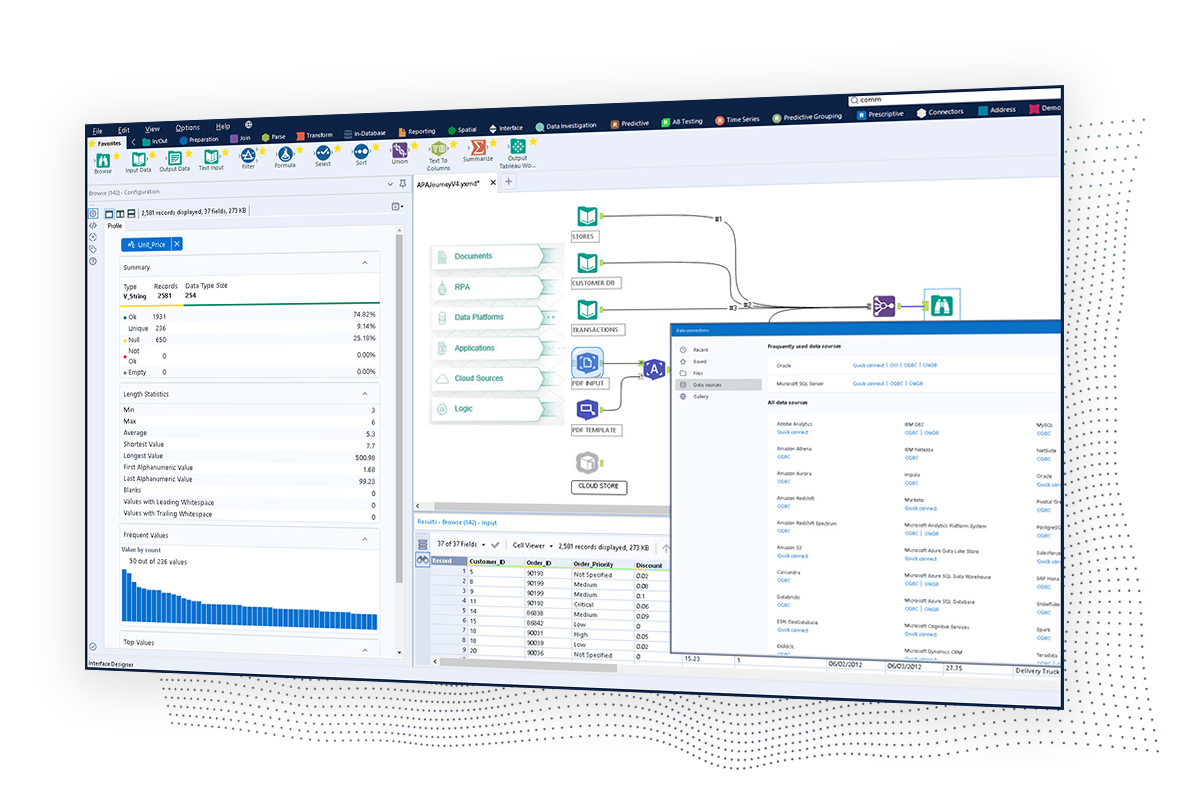
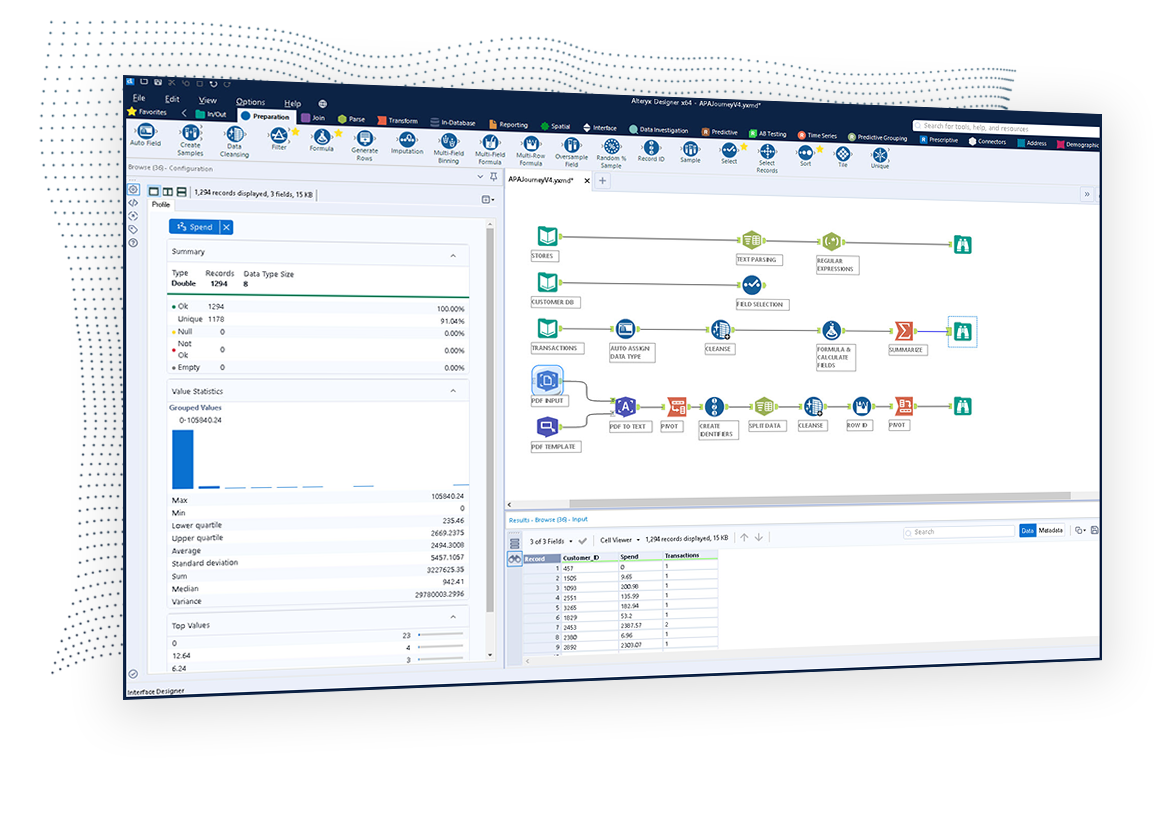
The Alteryx AI Platform gives organization automated data preparation, AI-powered analytics, and machine learning with embedded governance and security. Its self-service functionality, with self-service data prep, machine learning, and AI-generated insights, gives enterprise teams with a simplified user experience allowing everyone to create analytic solutions that improve productivity, efficiency, and the bottom line. Alteryx Designer can be used to automate every analytics step…
$14,850
per year 3 users (minimum), cloud edition
Oracle Database
Score 8.4 out of 10
N/A
Oracle Database, currently in edition 23ai, is a converged, multimodel database management system. It is designed to simplify development for AI, microservices, graph, document, spatial, and relational applications.
$0.05
per hour
SAP HANA Cloud
Score 8.9 out of 10
N/A
SAP HANA is an application that uses in-memory database technology to process very large amounts of real-time data from relational databases, both SAP and non-SAP, in a very short time. The in-memory computing engine allows HANA to process data stored in RAM as opposed to reading it from a disk which means that the data can be accessed in real time by the applications using HANA. The product is sold both as an appliance and as a cloud-based software solution.
There's no need to write any codes unless very specific requirements. tremendously flexible and visual masterpiece on what actions one wants to perform. easy to interpret and follow for an unfamiliar person as have simple naming and definitions. wide use of the tool in some …
Oracle 12c is good for all business applications but still consider Microsoft SQLServer for internal/other applications to save on cost.
Verified User
Consultant
Chose Oracle Database
Oracle Database is best in business, consistent, and robust. Even the standard version is sufficient for the best performance. The main thing is I have never seen corruption and in my opinion, it is best when used with Linux.
Verified User
Consultant
Chose Oracle Database
Teradata being the biggest competitor is by far the fastest DBMS in my experience, along with speed Teradata also offers a better price for their enterprise grade solutions. A company looking at oracle should also consider scaling and maybe decide to invest on big data …
Oracle Database performance was not that up to that mark to analyze data and do analysis. Also Oracle we had to indexing, fragmentation to keep its health good.
Really, it is appropriate for any kind of company. For everyone to be successful and make wise business decisions, effective data analytics are essential. Any research analytics firm can benefit greatly from it. It won't be of much use to a modeling agency; instead, a business …
SAP HANA surpasses Oracle thanks to its breadth, better usability in my opinion, and is being adopted by an increasing market share of our clients regardless of industry. The enterprise-level of the tool is particularly impactful to handling their large data sets and …
SAP HANA is the Next-Gen platform or database for real-time analytics and applications. It helps various businesses and organizations to analyze business operations that are based on Big Data (a huge volume of data) in real-time at the speed of lightning, even sub-seconds. It’s …
The choice of the SAP HANA solution was mainly determined by the choice of the new company ERP, which having been SAP, naturally led to the choice of its DB solution.
We found HANA is more flexible than ORACLE in terms of DB management and administration. We also used oracle DB replication for DC DR data syncing and HANA is more convenient and flexible for DR data replication.
SAP HANA is better than all the databases, it gives the power and speed to analyze billions of records, access data on cloud, easiest conversion and migration from any database to HANA. Easy to manage and configure.
Similar to other big DBMS, but better or equal at stability and technical maintenance. Better or equal at documentation. There is room for improvement at SQL path analyzing.
SAP HANA has better agility and data processing capabilities compared to Oracle. It can process a large amount of data in a short amount of time. This saves a lot of time making the process efficient and effective. When it comes to space, the storage management provided by SAP …
If we did not use SAP HANA, we would have used an Oracle 12c database. We selected HANA since it was recommended for Suite on HANA. So far SAP HANA has proven to be a great fit for our systems that are on Suite on HANA. All future systems we implement will be on SAP HANA.
SAP HANA uses the sheer power of in memory analytics based on columnar compression of data in the back-end resulting in an overall decreased footprint of the data resulting in a paradigm shift. The traditional RDBMS database would rely heavily on additional indexes to retrieve …
I would 100% recommend Alteryx to a friend, for me its friendly interface is the best, it has all the tools I need without the headache that programming is. It can be used for simple or complex analysis, so honestly, I don’t see a scenario where it wouldn’t suit. I’ve used Alteryx to make simple things I could do in Excel, for example, but it was less complex and faster to do in Alteryx, so why not? Its a very versatile tool.
We migrated from NoSQL to an Oracle database. One of the reasons was robust backup and recovery options available in the Oracle database, which provide zero data loss. A transactional database like Oracle is a better fit for our use case than NoSQL. On a large scale, deployment was evaluated as a cheaper option than the NoSQL engine. This conclusion came even after considering Oracle license is expensive.
I think if you have a large organization, it's probably the product and the marketplace to go to. We're a large management consulting firm operating in four to seven countries. And generally speaking, I think that's the size and the scope where it scales best. I can't speak to smaller companies, but I can't see smaller companies leveraging the benefits as much as a larger organization can.
Pulling data from multiple disparate data sources.
Allows users to see the data at every step of the workflow to be able to cleanse, analyze, and optimize the data.
Provides an analytics platform that is easy for users of all levels to thrive in whether they are just starting out in their analytics journey or they have a master's degree in Data Science.
Real-time reporting and analytics on data: because of its in-memory architecture, it is perfect for businesses that need to make quick decisions based on current information.
Managing workload with complex data: it can handle a vast range of data types, including relational, documental, geospatial, graph, vector, and time series data.
Developing and deploying intelligent data applications: it provides various tools for such applications and can be used for machine learning and artificial intelligence to automate tasks, gain insights from data, and make predictions.
Steeper Learning Curve: Alteryx can have a steep learning curve for users who are new to the platform or have limited experience with data analytics. Enhancements to the user interface and user onboarding resources could help make the learning process more intuitive and accessible to a wider range of users.
Enhanced Data Visualization Capabilities: Alteryx offers basic data visualization capabilities, but there is room for improvement in terms of advanced visualizations and interactive dashboarding features. Adding more sophisticated chart types, interactive widgets, and customization options would enhance the data visualization capabilities within the platform.
Improved Error Handling and Debugging: Alteryx provides error handling mechanisms, but enhancing the error reporting and debugging capabilities would be beneficial. Improved error messages, better visibility into data flow, and debugging tools could help users troubleshoot and resolve issues more efficiently.
Requires higher processing power, otherwise it won't fly. How ever computing costs are lower. Incase you are migrating to cloud please do not select the highest config available in that series . Upgrading it later against a reserved instance can cost you dearly with a series change
Lack of clarity on licensing is one major challenge
Unless S/4 with additional features are enabled mere migration HANA DB is not a rewarding journey. Power is in S/4
We've developed a working partnership with Alteryx. As an enablement suite, we're continuing to innovate and deliver great products with use of Alteryx in our solutions. Alteryx use expands to our global product development teams and is in use in multiple parts of our organization. Alteryx also delivers Experian demographic content to other clients in their product offering. We're highly likely to renew, but that decision is way above my pay grade.
There is a lot of sunk cost in a product like Oracle 12c. It is doing a great job, it would not provide us much benefit to switch to another product even if it did the same thing due to the work involved in making such a switch. It would not be cost effective.
We would rate our likelihood of renewing at 9/10. SAP HANA Cloud has proven to be a highly reliable and scalable data platform that consistently delivers strong performance. Its seamless integration with our overall SAP landscape, combined with improved analytics and real-time data capabilities, makes it a core part of our long-term technology strategy.
I've found that while some things might take a little longer to create, the flexibility of Alteryx allows you to perform any function needed. I haven't found a use that was not available in Alteryx yet. APIs and XMLs can be created to perform certain functions. In addition, CMD line commands can be sent using Alteryx to perform certain functions as well.
Many of the powerful options can be auto-configured but there are still many things to take into account at the moment of installing and configuring an Oracle Database, compared with SQL Server or other databases. At the same time, that extra complexity allows for detailed configuration and guarantees performance, scalability, availability and security.
It is very useful solution which provides you speedier data processing, real-time analytics. It helps you manage diverse data types. It also offers you excellent disaster management. It has user friendly interface which helps you navigate system and transactions easily and perform task smoothly.
I use many programs and compared to others, Alteryx virtually never goes down, freezes up or gives an application error. Over a 4 year time period that I have used this program, any of these may have happened 3 times. It is an incredibly stable program that I feel completely confident in.
I already gave the example of journal entries created in less than a second. What else can I tell you about.... I can tell you those 2 journal entries have historically had to be split into separate accounting systems so the outputs had to be very different (D365 vs Intacct) such that they are exactly ready for uploading. I can tell you I used to have some tire and battery queries hitting a line item detail table and they took hours to run UNTIL I asked IT for a view in SQL and now they're ready in about 5 minutes total. I guess I'd say if anything does take a long time - do some research with others and figure out what would speed them up
Stellar, bar-none. Some of the best support folks of any vendor. The Alteryx Community is the most responsive and supportive. On the rare occasion of a release issue or bug, we've been able to get quick help to solve the core problem. Alteryx does not play the blame game. They genuinely help the users solve their issues or respond to questions
1. I have very good experience with Oracle Database support team. Oracle support team has pool of talented Oracle Analyst resources in different regions. To name a few regions - EMEA, Asia, USA(EST, MST, PST), Australia. Their support staffs are very supportive, well trained, and customer focused. Whenever I open Oracle Sev1 SR(service request), I always get prompt update on my case timely. 2. Oracle has zoom call and chat session option linked to Oracle SR. Whenever you are in Oracle portal - you can chat with the Oracle Analyst who is working on your case. You can request for Oracle zoom call thru which you can share the your problem server screen in no time. This is very nice as it saves lot of time and energy in case you have to follow up with oracle support for your case. 3.Oracle has excellent knowledge base in which all the customer databases critical problems and their solutions are well documented. It is very easy to follow without consulting to support team at first.
However, I am not the right person to answer this as we have another department to handle support and contact the service provider for any support required. Although i will say that they are the quick respondent and knows how to handle querry of the customers and provide quick and better support.
1st level of trainings which I've attended in Paris was easy and I was already knowing %90, that learning could have been an e-learning instead of in-person
Very good, detailed online trainings which you can take at your own pace, and strong certifications exists, certifications are extremely detailed and hard...
There is really not much to it (the installation, that is). Once you get it installed, along with any of the add-ons (demographics, R, etc.), you are up and running almost immediately. There is really no additional setup. You can immediately begin blending data, running demographics, performing spatial queries, running predictive analysis, etc. And for many of these functions, the learning curve is quite easy.
Overall the implementation went very well and after that everything came out as expected - in terms of performance and scalability. People should always install and upgrade a stable version for production with the latest patch set updates, test properly as much as possible, and should have a backup plan if anything unexpected happens
Professional GIS people are some of the most risk-averse there are, and it's difficult to get them to move to HANA in one step. Start with small projects building to 80% use of HANA spatial over time.
Alteryx is MUCH more user friendly. both provide the ability to code within them, but Alteryx has much nicer interface. The formula tools have a more simple language that is easier to learn than formulae in SSIS. Alteryx is easy to read with multi colored tools identifying what each one does. It also allows for macros. You can build your own tool to process records of data or batch records together.
Because of a rich user base and support for any critical issue, this is one of the best options to choose. In case the project has a TCO issue, it can compromise and choose Postgres as the best alternative. SQL server is also good and easy to code and maintain but performance is not as good as the Oracle
I have deep knowledge of other disk based DBMSs. They are venerable technology, but the attempts to extend them to current architectures belie the fact they are built on 40 year old technology. There are some good columnar in-memory databases but they lack the completeness of capability present in the HANA platform.
Individual analysts can quickly generate results using their own copy of Alteryx Designer. But using the Server and developing macros for more complex needs can be time consuming.
Error handling - allows controls to be built into workflows easily and allows them to be isolated and spat into control reports that can be easily reviewed and audited, thanks to the ability to create multiple outputs in one go.
Time-saving - saved huge amounts of time, especially when moving Excel processes into Alteryx.
Product development - allowed my firm to create products that we have been able to market and sell to clients.