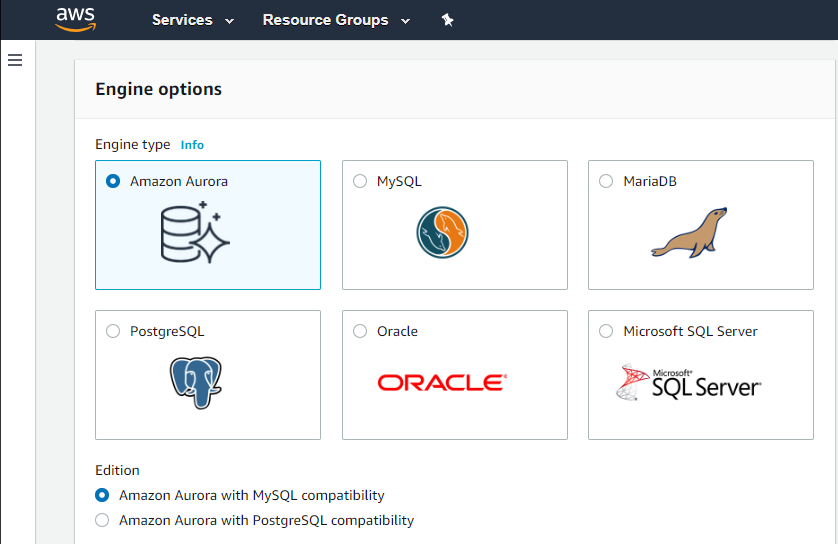
Amazon Relational Database Service (Amazon RDS) is a database-as-a-service (DBaaS) from Amazon Web Services.
N/A
Couchbase Server
Score 8.6 out of 10
N/A
Couchbase Server is a cloud-native, distributed database that fuses the strengths of relational databases such as SQL and ACID transactions with JSON flexibility and scale that defines NoSQL. It is available as a service in commercial clouds and supports hybrid and private cloud deployments.
N/A
MySQL
Score 8.3 out of 10
N/A
MySQL is a popular open-source relational and embedded database, now owned by Oracle.
N/A
Pricing
Amazon Relational Database Service (RDS)
Couchbase Server
MySQL
Editions & Modules
Amazon RDS for PostgreSQL
$0.24 ($0.48)
per hour, R5 Large (R5 Extra Large)
Amazon RDS for MariaDB
$0.25 ($0.50)
per hour, R5 Large (R5 Extra Large)
Amazon RDS for MySQL
$0.29 ($0.58)
per hour, R5 Large (R5 Extra Large)
Amazon RDS for Oracle
$0.482 ($0.964)
per hour, R5 Large (R5 Extra Large)
Amazon RDS for SQL Server
$1.02 ($1.52)
per hour, R5 Large (R5 Extra Large)
No answers on this topic
No answers on this topic
Offerings
Pricing Offerings
Amazon RDS
Couchbase Server
MySQL
Free Trial
No
Yes
No
Free/Freemium Version
No
Yes
No
Premium Consulting/Integration Services
No
Yes
No
Entry-level Setup Fee
Optional
Optional
No setup fee
Additional Details
—
—
—
More Pricing Information
Community Pulse
Amazon Relational Database Service (RDS)
Couchbase Server
MySQL
Considered Multiple Products
Amazon RDS
Verified User
Employee
Chose Amazon Relational Database Service (RDS)
Initially, we planned to move everything to Dynamo DB, however, we had our initial architecture with MySQL, so we thought it would be a good option to migrate and use AWS RDS which seemed to be a good idea actually. I feel the security and the placing it in a VPC, is one …
Amazon Relational Database Service manages MariaDB and MySQL, so if you need to use those databases, then Amazon Relational Database Service will manage everything from the installation to the incremental updates needed for operation. Not having to worry about maintaining a …
We've evaluated using [Amazon Relational Database Service (RDS)] against same-capability configurations with MySQL/MariaDB, PostgreSQL, and even Amazon Redshift (though, we haven't evaluated redshift in quite some time). Assuming RDS checks all the boxes for the requirements of …
We used to have On-Premises servers with Microsoft SQL Server and MySQL databases. We used that for years, and we had a hard time and a lot of work involved in securing and updating the server. And not no mention that growth involves a lot of calculations and extra costs. …
At first GCP was considered, but it not very intuitive to use and maintain. We then wanted to run MySQL instances on EC2, which would have been a little cost effective but having limited man power and hassle of patching, scaling and backup led us to select more managed service.
These tools are not necessarily competing products. They integrate seamlessly once identity access is established and used to easily manage and support our MySQL RDS instances.
Running MySQL RDS was a simpler solution than running standalone MySQL servers as the semi-managed nature of RDS saved us the need to install, maintain, secure, and backup our database servers. Using MySQL RDS was in addition to running MongoDB Atlas workloads and allowed us to …
With the latest serverless technology Amazon Relational Database Service (RDS) has an edge over all its competitors, it works really fast with high log retention.
MongoDB is nosql database and some clients prefer it. In our presentation we try to persuade them to use RDS with its pros and cons. The type of selection depends upon the actual need.
Every traditional rational Database requires server installation & accessing needs to be monitored periodically manually. But Amazon provides easy-to-access and monitor health and scale-up and scale-down option just by clicks without adding any additional hardware.
Oracle Autonomous Database is designed for Oracle Database workloads, making it suitable for organizations with existing Oracle investments. RDS supports various database engines. Autonomy and Automation: Oracle Autonomous Database places a strong emphasis on automation for …
Actually you can have most of these tools through AWS Relational Database Service as they are basically those technologies provided as a service. It is way better to have those products provided as a service through a huge and reliable infrastructure like AWS.
It's hard to identify how Amazon RDS stacks up against the databases they support, because to install and use a relational database in a production environment you need a Database Administrator to help install, configure and manage. Amazon RDS keeps the details simple enough …
RDS implements the databases we were interested in and allows us to focus on the application and not the management. AWS handles setting up the server and the database as well as upgrading the software when necessary. Security is simple, using security groups to allow or deny …
Amazon Relational Database Service will probably give you everything you need from a traditional manual DB setup, except everything is managed for you. The only downside is having to pay the premium for the service; however, the trade-off of not having to deal with the …
RDS provides all the features of databases you could host yourself, without all of the maintenance and headaches required, while providing more flexibility and lower TCO.
Honestly, there aren't a lot of great alternatives to RDS, and most likely the real alternative is just running an instance on your local box. While lots of other services (like Rackspace) offer hosted database solutions, RDS in my opinion, is the clear winner on price, …
Automated snap-shotting every 24 hours is, again something that I could just set up in minutes with a few clicks, though we also backup on cron jobs to elsewhere, and, because of our industry we have a HUGE "forensic logs" that initially live in the database but get archived …
Our other application components are all hosted within Amazon's systems already, and the tight coupling of RDS with the security groups and virtual private cloud offerings made locking down privacy and security much easier than integrating with an outside provider. The deeper …
Redshift is massively scalable but has some limitations that we weren't willing to accept (no JSONB). It also has its own distinct flavor of SQL, and there isn't as much content online about Redshift's flavor of SQL versus postgres'. In the end, we just didn't need to kind of …
The project we are developing with Couchbase, was very inconsistent for few years of the beginning. We had to change data model multiple times. We knew this before starting the project. So we had to choose a NoSQL solution. We also wanted a syncing solution. After some research …
The Apache Cassandra was one type of product used in our company for a couple of use-cases. The Aerospike is something we [analyzed] not so long time ago as an interesting alternative, due to its performance characteristics. The Oracle Coherence was and is still being used for …
Couchbase's server is more scalable than MongoDB, as MongoDB degrades its performance if the number of users grows. Also, Couchbase allows us to integrate more third-party applications, Couchbase’s query language extends ANSI SQL.
MySQL provides the option to reduce support and maintenance cost when P0 Level 1 support is not really needed for databases used for noncritical use cases and workloads. Other versions that include Microsoft SQL, Amazon RDS, etc don't provide such options and are overkill. …
We chose MySQL because of its open-source nature and its compatibility with various systems, languages, and databases. It is easy to use and fast. Additionally, it has been in the market for more than 30 years now which makes it a reliable option when compared to its …
MySQL offers best conditions for a rapid adoption at the organization. Also because it's free software, you can scale up in implementations without worrying about licenses fees.
After Oracle bought MySQL, I have pivoted some projects to use MariaDB instead, which is a fork of MySQL and maintained by the community and original developers of MySQL. This is free under the GNU GPL, and is not impacted by decisions Oracle makes for MySQL. RDS has the …
MySQL has it's pros / cons. The best things about MySQL are that it is open-source/free and has such a vast community of users. If you want a free database MySQL is the quickest to use, but if you're trying to build a strong foundation for your company, I prefer Postgres. If …
MySQL is a standard across many industries and is familiar to most developers as a result. When comparing to something like MongoDB, most developers are more familiar and comfortable with MySQL. When comparing to something like Oracle, MySQL clearly wins in the expense …
There are so many SQL solutions, it's difficult to compare them all. MySQL has a huge community and suite of tools to help it. However, it doesn't have quite the upside as the paid solutions. It's comparable to something like Postgres and all depends on the tools and support …
MySQL is open source, readily available, with no licencing issues. Adding a new web product to my existing setup is relatively straight forward. In order to set up a SQL Server site,significant IT and licencing costs are involved. We are implementing some SQL Server back ends …
If your application needs a relational data store and uses other AWS services, AWS RDS is a no-brainer. It offers all the traditional database features, makes it a snap to set up, creates cross-region replication, has advanced security, built-in monitoring, and much more at a very good price. You can also set up streaming to a data lake using various other AWS services on your RDS.
Best suited when edge devices have interrupted internet connection. And Couchbase provides reliable data transfer. If used for attachment Couchbase has a very poor offering. A hard limit of 20 MB is not okay. They have the best conflict resolution but not so great query language on Couchbase lite.
MySQL is best suited for applications on platform like high-traffic content-driven websites, small-scale web apps, data warehouses which regards light analytical workloads. However its less suited for areas like enterprise data warehouse, OLAP cubes, large-scale reporting, applications requiring flexible or semi-structured data like event logging systems, product configurations, dynamic forms.
Automated Database Management: We use it for streamlining routine tasks like software patching and database backups.
Scalability on Demand: we use it to handle traffic spikes, scaling both vertically and horizontally.
Database Engine Compatibility: It works amazingly with multiple database engines used by different departments within our organization including MySQL, PostgreSQL, SQL Server, and Oracle.
Monitoring: It covers our extensive monitoring and logging, and also has great compatibility with Amazon CloudWatch
It is a little difficult to configure and connect to an RDS instance. The integration with ECS can be made more seamless.
Exploring features within RDS is not very easy and intuitive. Either a human friendly documentation should be added or the User Interface be made intuitive so that people can explore and find features on their own.
There should be tools to analyze cost and minimize it according to the usage.
The N1QL engine performs poorly compared to SQL engines due to the number of interactions needed, so if your use case involves the need for a lot of SQL-like query activity as opposed to the direct fetch of data in the form of a key/value map you may want to consider a RDBMS that has support for json data types so that you can more easily mix the use of relational and non-relational approaches to data access.
You have to be careful when using multiple capabilities (e.g. transactions with Sync Gateway) as you will typically run into problems where one technology may not operate correctly in combination with another.
There are quality problems with some newly released features, so be careful with being an early adopter unless you really need the capability. We somewhat desperately adopted the use of transactions, but went through multiple bughunt cycles with Couchbase working the kinks out.
Learning curve: is big. Newbies will face problems in understanding the platform initially. However, with plenty of online resources, one can easily find solutions to problems and learn on the go.
Backup and restore: MySQL is not very seamless. Although the data is never ruptured or missed, the process involved is not very much user-friendly. Maybe, a new command-line interface for only the backup-restore functionality shall be set up again to make this very important step much easier to perform and maintain.
We do renew our use of Amazon Relational Database Service. We don't have any problems faced with RDS in place. RDS has taken away lot of overhead of hosting database, managing the database and keeping a team just to manage database. Even the backup, security and recovery another overhead that has been taken away by RDS. So, we will keep on using RDS.
I rarely actually use Couchbase Server, I just stay up-to-date with the features that it provides. However, when the need arises for a NoSQL datastore, then I will strongly consider it as an option
For teaching Databases and SQL, I would definitely continue to use MySQL. It provides a good, solid foundation to learn about databases. Also to learn about the SQL language and how it works with the creation, insertion, deletion, updating, and manipulation of data, tables, and databases. This SQL language is a foundation and can be used to learn many other database related concepts.
I've been using AWS Relational Database Services in several projects in different environments and from the AWS products, maybe this one together to EC2 are my favourite. They deliver what they promise. Reliable, fast, easy and with a fair price (in comparison to commercial products which have obscure license agreements).
Couchbase has been quite a usable for our implementation. We had similar experience with our previous "trial" implementation, however it was short lived.
Couchbase has so far exceeded expectation. Our implementation team is more confident than ever before.
When we are Live for more than 6 months, I'm hoping to enhance this rating.
I give MySQL a 9/10 overall because I really like it but I feel like there are a lot of tech people who would hate it if I gave it a 10/10. I've never had any problems with it or reached any of its limitations but I know a few people who have so I can't give it a 10/10 based on those complaints.
One of Couchbase’s greatest assets is its performance with large datasets. Properly set up with well-sized clusters, it is also highly reliable and scalable. User management could be better though, and security often feels like an afterthought. Couchbase has improved tremendously since we started using it, so I am sure that these issues will be ironed out.
I have only had good experiences in working with AWS support. I will admit that my experience comes from the benefit of having a premium tier of support but even working with free-tier accounts I have not had problems getting help with AWS products when needed. And most often, the docs do a pretty good job of explaining how to operate a service so a quick spin through the docs has been useful in solving problems.
I haven't had many opportunities to request support, I will look forward to better the rating. We have technical development and integration team who reach out directly to TAM at Couchbase.
We have never contacted MySQL enterprise support team for any issues related to MySQL. This is because we have been using primarily the MySQL Server community edition and have been using the MySQL support forums for any questions and practical guidance that we needed before and during the technical implementations. Overall, the support community has been very helpful and allowed us to make the most out of the community edition.
Amazon Relational Database Service (RDS) stands out among similar products due to its seamless integration with other AWS services, automated backups, and multi-AZ deployments for high availability. Its support for various database engines, such as MySQL, PostgreSQL, and Oracle, provides flexibility. Additionally, RDS offers managed security features, including encryption and IAM integration, enhancing data protection. The pay-as-you-go pricing model makes it cost-effective. Overall, Amazon RDS excels in ease of use, scalability, and a comprehensive feature set, making it a top choice for organizations seeking a reliable and scalable managed relational database service in the cloud.
The Apache Cassandra was one type of product used in our company for a couple of use-cases. The Aerospike is something we [analyzed] not so long time ago as an interesting alternative, due to its performance characteristics. The Oracle Coherence was and is still being used for [the] distributed caching use-case, but it will be replaced eventually by Couchbase. Though each of these products [has] its own strengths and weaknesses, we prefer sticking to Couchbase because of [the] experience we have with this product and because it is cost-effective for our organization.
MongoDB has a dynamic schema for how data is stored in 'documents' whereas MySQL is more structured with tables, columns, and rows. MongoDB was built for high availability whereas MySQL can be a challenge when it comes to replication of the data and making everything redundant in the event of a DR or outage.
So far, the way that we mange and upgrade our clusters has be very smooth. It works like a dream when we use it in concert with AWS and their EC2 machines. Having access to powerful instances along side the Couchbase interface is amazing and allows us to do rebalances or maintenance without a worry