Apica is an observability cost optimization provider helping IT teams gain complete control over their telemetry data economics. Apica Ascent processes all observability data types including metrics, logs, traces, and events while optimizing observability costs.
N/A
Databox
Score 10.0 out of 10
N/A
Databox is business intelligence software built for teams that need fast, actionable insights.
$199
per month
Geckoboard
Score 9.0 out of 10
Mid-Size Companies (51-1,000 employees)
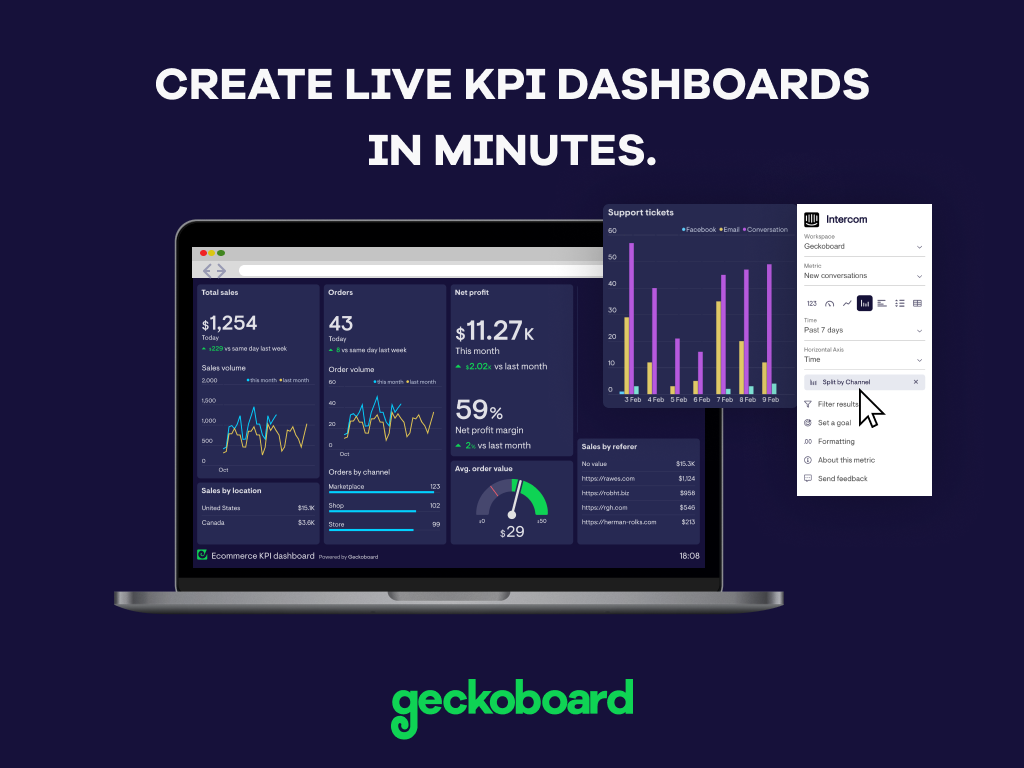
Geckoboard enables users to create real time dashboards using data from over 80 cloud services. It integrates with other products such as: AWeber, Basecamp, Campaign Monitor and HubSpot.
Much cheaper and seems to do at least as good of a job while having a similar integration stack. I also appreciate the efforts Databox go to on their blog and podcast to help educate people on all things data and metrics.
As I use this for only my area, it is very well suited to what I need it to do. Apica Synthetic monitors two different web applications in a time interval that is easily customizable for uptime and latency. These are critical indicators for a cloud-based point-of-sale system. We need solid uptime and limited latency across the enterprise.
I believe Databox can be an asset for any company. We are a small company, but I can see the value for large companies too. Databox is a great fit for departments or organizations that need to put their data into a readable form without needing a ton of reports. Databox allows you to save time and put together a nice report without having to do too much extra work. Once it is set up, it basically runs on its own at the frequency you set. I personally receive a daily report and have it sent to the respective people on the day of our meeting so we can quickly review it.
Great value for the money. Excellent for smaller agencies with multiple projects and teams in a smaller space. We can quickly roll out mobile displays to help with a particular deployment push or monitoring a clients website engagement. It's also useful for showing live data without requiring analytics to run reports from a CRM, etc.
It's very clunky. Infrastructure is large and very difficult to upgrade.
SaaS and On-premise versions are different. There is an LDAP integration but users can only be assigned to one group (i.e. department). If you are in 2 departments, you need 2 separate logins.
Update: they now offer federated logins
It filled a gap in monitoring for us, but we're looking to move on.
Some types of data can only be reported on for 1-2 months back. Unless I'm misunderstanding the function of the software this seems really weird. I can't figure out how to report on Activities more than 2 months ago
We trust the results that Apica Synthetic has achieved. Real-time alerting is critical to our clients and with limited resources, we can't handle many false positives; Apica Synthetic is the only solution that provides both of those features.
Databox is an intuitive, well-designed platform that can be used by non-technical marketers. It is easy to learn, and while set up takes time, usability is high and the team has enjoyed creating custom dashboards and clients have also given us great feedback regarding its usability and value. While other BI tools are much more complex to navigate, Databox is a breeze.
With a simple interface and available templates, creating basic dashboards is easy. Obviously depending on the data you want to visualize, there may be higher learning curves. That being said, they have a huge amount of integrations and extensible frameworks. If you are using anything made in the past ten years there is an API function or integration that can get it talking to the platform. As such, it's pretty easy to hit the main data points you want and get it on a cheap display in front of your team.
I have really enjoyed using Databox and have seen the value of it in many ways. They also continue to improve the functions of it and grow their integrations and templates. I look forward to continuing to use Databox in the future, potentially even finding ways to incorporate it into other departments to help them with reporting as well.
The support levels vary based on the level of plan that you have but that's to be expected. Virtually everything except the Enterprise plan has basic chat/email support. While they are responsive they are not going to be much assistance in helping you figure out API calls or implementing 3rd party integrations. That is to be expected and the support community can pretty much get you in the right direction if you look.
We were using different monitoring tools for different requirements (e.g.,Nagios and Checkmk for infrastructure issues) and we were in need of a tool for service and API monitoring for which we were using ThousandEye. But alerts were 60-70% valid irrespective of conditions like network issues. But Apica Synthetic's alert mechanism is a perfect fit for our department. It helped us to reduce unnecessary/false alerts and a number of wrong tickets.
Databox is unique in its ability to report from multiple data sources. Google Analytics is the standard when it comes to web metrics, but it's just one of the tools that integrates with Databox. Tableau is fantastic for data visualizations and reporting, but it's much more expensive than Databox, so it's not ideal for everyone. Tableau is also superior with customization
My department is not charged for Apica Synthetic so no ROI, but from a customer service perspective, we can react to an outage and repair it faster than our customers can report the outage.
Our vendor's own monitoring tools are not as accurate nor as timely as ours. They rely on us telling them, from Apica Synthetic, that they have an issue.
While we originally used this as an internal IS tool, we eventually have expanded it to be used by nearly every department.
Because pricing is monthly, we can grow or decrease our usage based on our current client needs.
Because it is low cost and easy to deploy, we can utilize it in place of considerable resources in analytics and reporting by delivering snapshots of data without pulling reports.