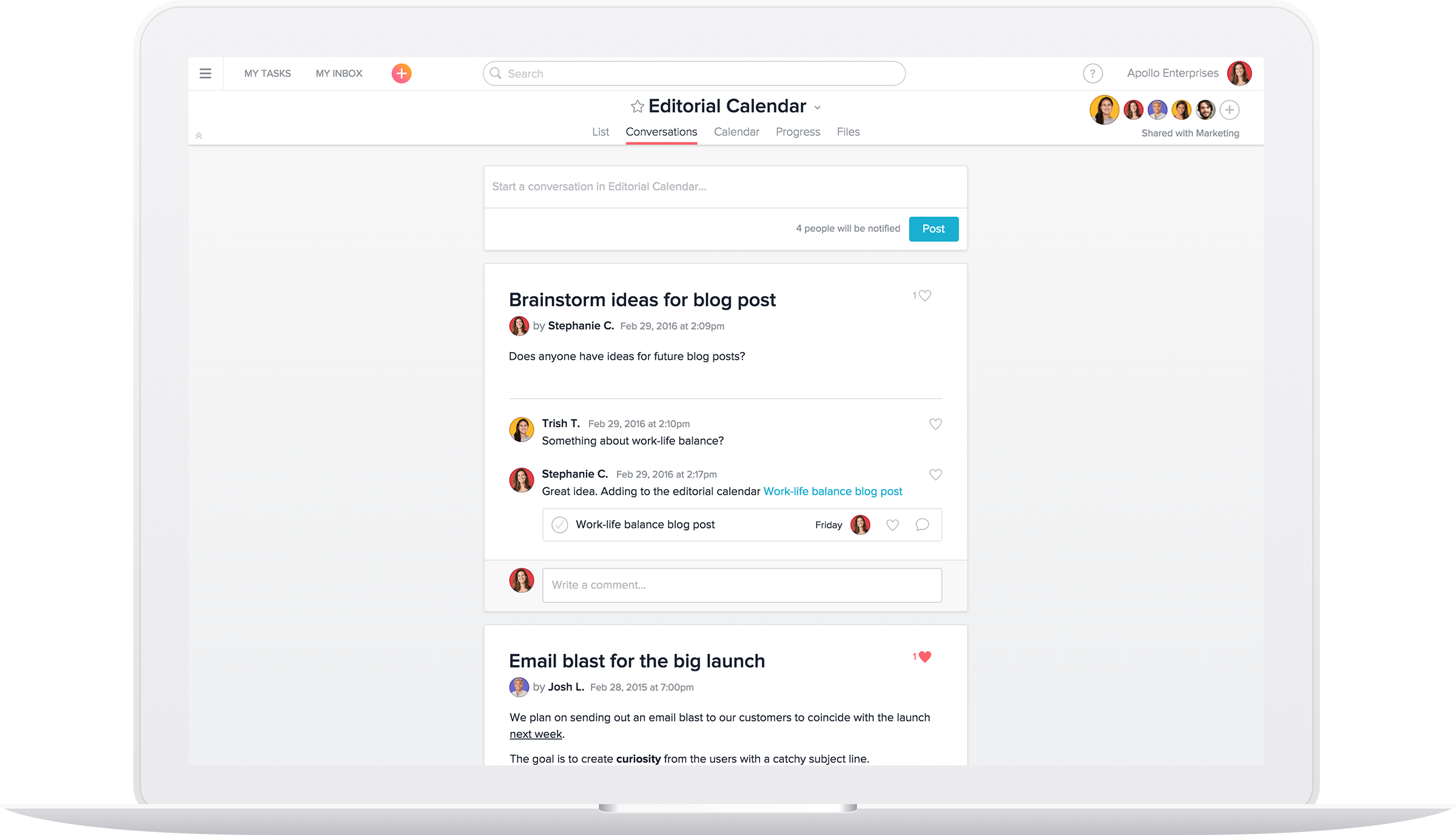
Asana is a web and mobile project management app. With tasks, projects, conversations, and dashboards, Asana lets an entire team know who's doing what by when, enabling workload balancing. Users can also add integrations for GANTT charts, time tracking and more.
$13.49
per month per user
Azure DevOps
Score 8.1 out of 10
N/A
Azure DevOps (formerly VSTS, Microsoft Visual Studio Team System) is an agile development product that is an extension of the Microsoft Visual Studio architecture. Azure DevOps includes software development, collaboration, and reporting capabilities.
$2
per GB (first 2GB free)
Microsoft To Do
Score 8.6 out of 10
N/A
Microsoft To Do replaces the former Wunderlist task management tool.
N/A
Pricing
Asana
Azure DevOps
Microsoft To Do
Editions & Modules
Starter
$13.49
per month per user
Advanced
$30.49
per month per user
Enterprise
Contact Sales
Personal
Free
Azure Artifacts
$2
per GB (first 2GB free)
Basic Plan
$6
per user per month (first 5 users free)
Azure Pipelines - Self-Hosted
$15
per extra parallel job (1 free parallel job with unlimited minutes)
Azure Pipelines - Microsoft Hosted
$40
per parallel job (1,800 minutes free with 1 free parallel job)
Asana is the best of both worlds because it allows multiple views of your tasks and dashboards for project managers to review. Some of the competitors only allow one way of working, which can be a roadblock for users who are less flexible in their workflow. Getting all users to …
Ease of use and access are what initially put Asana ahead of other options available. We have stuck with Asana because of the flexibility in solving a variety of challenges that would otherwise fall to a spreadsheet or piles of paper, and the load it has taken off of the team …
We tried Trello, Wunderlist, and Producteev, but at the time, none of them had the feature set that Asana offers. The main requirement we had was the ability to create projects and subtasks with individual due dates and assignments. Asana was the only one that allowed us to …
Asana is a great balance of simplicity and robustness. JIRA is simply too robust for my team's needs - it is more appropriate for a software team. We did not need the capabilities to customize automated workflows. Our development process is waterfall, so a PM software centered …
Outlook Outlook can track tasks. However, it's not very collaborative; you can send tasks to other people but you can see what them after that. This feature as part of Outlook was a disaster. The only benefit that currently exists is that it was free; it never really fit in …
Azure DevOps
Verified User
Program Manager
Chose Azure DevOps
One of the foremost reasons that acted in favor of Azure DevOps was its all-in-one packed web portal which enabled easy access to all the CI/CD tools and kits. Customizable screens, notifications via Teams/mails, project views, etc. Most other tools/products offer only part of …
Compared to other tools we have used, Microsoft STS has been a much more complete tool. Communication, collaboration, tracking, management, automation, testing, speed to production—all these areas have been improved since we started using Microsoft STS. We have been looking for …
Wunderlist is a good straightforward to-do list that doesn't have anything super extra attached to it. It comes with an app (unlike Trello), and easy to learn (unlike Asana). Trello and Asana are better for complex tasks but take a while to set-up. Wunderlist is the most …
Reason I went with Wunderlist is a simpler build. Applications like Asana or Trello are more large scale for milestones on projects with multiple calibrations across the project. I did not need to overcomplicate things, I needed a simple easy solution that gets the job done, …
Microsoft To-Do simply put just does to-do lists very well. I don't want the visual components of software like Trello or ClickUp, and I had used Asana in previous roles and just found it to have too much going on. I also didn't like the notification system of Asana, constantly …
Verified User
Director
Chose Microsoft To Do
While I have tried a number of other to-do lists, Wunderlist is easy to use and free. Most other to-do lists that I have tried I have used for a day or two and the have deleted and returned to Wunderlist. Part of it is that I am used to this tool, but I think it is also just …
I think each of this products has its pros and its cons, but the only right way to pick the best one is to try them all. This kind of software is used on a daily basis, and you end up interacting a lot more than you would think of, so you really need to use one software that …
Relocated to this task manager after a year of paid subscription on another service. I chose the most suitable for me the functionality of the free version of the service. A great thing.
Wunderlist wins with simplicity. Where other software pile on the features, here we have something that sticks to its mission of being a central location for collaboration on tasks.
The usability of Asana is broad since it's available in a variety of platforms that are widely used nowadays. I think that it would be great for people who are constantly on the move and switching devices, since it has allowed me to work from my phone, too. I also think that Asana has proven itself to handle a large quantity of work
Azure DevOps works well when you’ve got larger delivery efforts with multiple teams and a lot of moving parts, and you need one place to plan work, track it properly, and see how everything links together. It’s especially useful when delivery and development are closely tied and you want backlog items, code and releases connected rather than spread across tools. Where it’s less of a fit is for small teams or simple pieces of work, as it can feel like more setup and process than you really need, and non-technical users often struggle with the interface. It also isn’t great if you want instant, easy programme-level views or a very visual planning experience without putting time into configuration.
I think Microsoft To Do is helpful for people who don't need a lot of customization in a task manager. I prefer using 3rd party task managers that allow me to create projects with tasks and subtasks. But for a team that already uses Microsoft products and doesn't want to learn or invest capital in another task manager, Microsoft To Do covers the basics and syncs with your calendar.
Through it, we were able to communicate and cooperate with the rest of the team to complete the work in the required manner and at the appropriate time.
Wunderlist is what you need for your to do lists. It's really simple to use.
Allows you to set due date to your lists, share them with your team and/or create a folder to divide and organize all your list set
Also, Wunderlist is compatible with all platform and devices. So you can always be updated on your list or work on them from wherever you are and with all the devices you have.
I did mention it has good visibility in terms of linking, but sometimes items do get lost, so if there was a better way to manage that, that would be great.
The wiki is not the prettiest thing to look at, so it could have refinements there.
I don't think our organization will stray from using VSTS/TFS as we are now looking to upgrade to the 2012 version. Since our business is software development and we want to meet the requirements of CMMI to deliver consistent and high quality software, this SDLC management tool is here to stay. In addition, our company uses a lot of Microsoft products, such as Office 365, Asp.net, etc, and since VSTS/TFS has proved itself invaluable to our own processes and is within the Microsoft family of products, we will continue to use VSTS/TFS for a long, long time.
It is very user-friendly. Takes a new employee an hour to start figuring out how the system works. That's an important factor. You don't want to encounter the issue where employees need a week to understand how the system works. For example, JIRA, I tried using it for a week and I still don't understand the complicated layout. Asana has a simple interface. Once you see it, you get it type of program.
It's a great help to get more information about new feature release and stay updated on what the dev team is working on. I like how easy it is to just login and read through the work items. Each work item has basic details: Title, Description, Assigned to, State, Area (what it belongs to), and iteration (when it’s worked on). See image above.They move through different states (New → Discovery → Ready for Prod → etc.).
User friendly, easy to configure, and VERY simplistic. I particularly use heavily the phone app feature. While others in the room are on social media, I am reviewing my tasks and this triggers other tasks I know I need to get done. I like the sense of accomplishment of moving things to the completed pile as well.
I haven't had to use their support so I can't rate it. The fact that I haven't needed them reflects the ease of use of the product. I would recommend that any new users schedule a complete demo of the product to ensure that they are using it to it's fullest (there's a lot of useful features).
When we've had issues, both Microsoft support and the user community have been very responsive. DevOps has an active developer community and frankly, you can find most of your questions already asked and answered there. Microsoft also does a better job than most software vendors I've worked with creating detailed and frequently updated documentation.
I have not had an issue where I needed to reach out to Wunderlist, but I know their contact and online chat is easy to access and feel confident that they would be helpful. My only worry is Wunderlist is becoming Microsoft to-do in May 2020, and I believe the app will become worse after that.
Asana is a top-tier project management software that helps us organize and track projects from start to finish. It allows us to apply tasks/to-dos to multiple projects without duplication, divide complex projects into smaller tasks, and track project progress. It also helps us organize work on Kanban boards or linear lists. It stands out from the crowd in a big way compared to the competition.
Microsoft Planner is used by project managers and IT service managers across our organization for task tracking and running their team meetings. Azure DevOps works better than Planner for software development teams but might possibly be too complex for non-software teams or more business-focused projects. We also use ServiceNow for IT service management and this tool provides better analysis and tracking of IT incidents, as Azure DevOps is more suited to development and project work for dev teams.
It's a small tool compared to bigger project management software, but we found that they work perfectly together. It helps you declutter the larger PM tools, keep your smaller tasks in-line and make sure they get completed. When you're working in a creative agency, ideas and tasks are flying around, so having a tool like this that keeps you accountable and reminds you of your tasks is a must!
We have saved a ton of time not calculating metrics by hand.
We no longer spend time writing out cards during planning, it goes straight to the board.
We no longer track separate documents to track overall department goals. We were able to create customized icons at the department level that lets us track each team's progress against our dept goals.