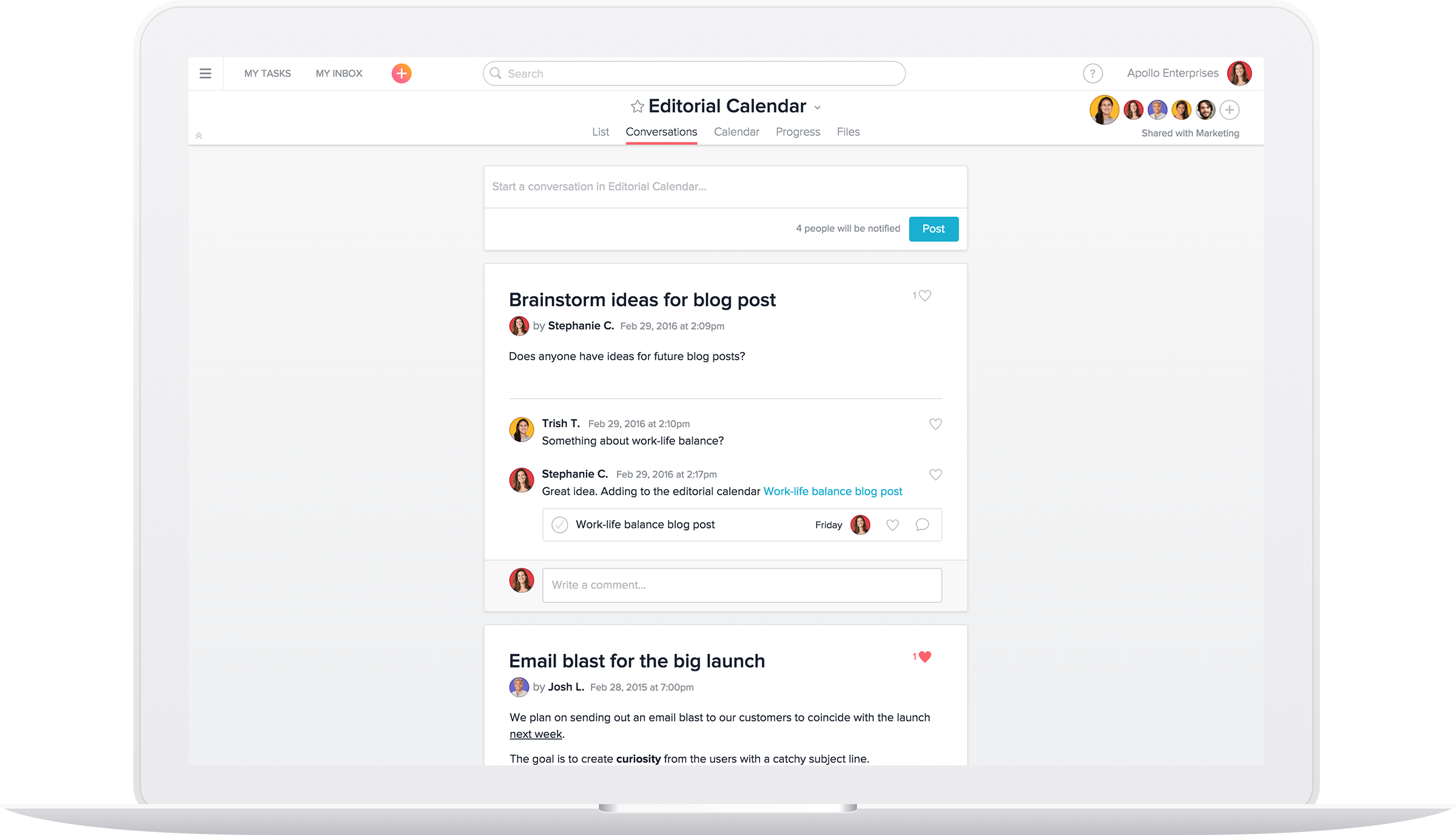
Asana is a web and mobile project management app. With tasks, projects, conversations, and dashboards, Asana lets an entire team know who's doing what by when, enabling workload balancing. Users can also add integrations for GANTT charts, time tracking and more.
$13.49
per month per user
Microsoft To Do
Score 8.6 out of 10
N/A
Microsoft To Do replaces the former Wunderlist task management tool.
N/A
OmniFocus
Score 8.0 out of 10
N/A
OmniFocus is a project management platform for iOS: Mac, iPad, and iPhone. It has features such as task management, Siri capture, and workflow automation.
Asana is the best of both worlds because it allows multiple views of your tasks and dashboards for project managers to review. Some of the competitors only allow one way of working, which can be a roadblock for users who are less flexible in their workflow. Getting all users to …
Ease of use and access are what initially put Asana ahead of other options available. We have stuck with Asana because of the flexibility in solving a variety of challenges that would otherwise fall to a spreadsheet or piles of paper, and the load it has taken off of the team …
We tried Trello, Wunderlist, and Producteev, but at the time, none of them had the feature set that Asana offers. The main requirement we had was the ability to create projects and subtasks with individual due dates and assignments. Asana was the only one that allowed us to …
Asana is a great balance of simplicity and robustness. JIRA is simply too robust for my team's needs - it is more appropriate for a software team. We did not need the capabilities to customize automated workflows. Our development process is waterfall, so a PM software centered …
Outlook Outlook can track tasks. However, it's not very collaborative; you can send tasks to other people but you can see what them after that. This feature as part of Outlook was a disaster. The only benefit that currently exists is that it was free; it never really fit in …
Wunderlist is a good straightforward to-do list that doesn't have anything super extra attached to it. It comes with an app (unlike Trello), and easy to learn (unlike Asana). Trello and Asana are better for complex tasks but take a while to set-up. Wunderlist is the most …
Reason I went with Wunderlist is a simpler build. Applications like Asana or Trello are more large scale for milestones on projects with multiple calibrations across the project. I did not need to overcomplicate things, I needed a simple easy solution that gets the job done, …
While all the task apps are very similar in design and scope, there's a simplicity to Wunderlist that beats the others. OmniFocus is great if you want the most options, and you've got complicated projects to manage, but for my business, Wunderlist does the job, does it well, …
Microsoft To-Do simply put just does to-do lists very well. I don't want the visual components of software like Trello or ClickUp, and I had used Asana in previous roles and just found it to have too much going on. I also didn't like the notification system of Asana, constantly …
Verified User
Director
Chose Microsoft To Do
While I have tried a number of other to-do lists, Wunderlist is easy to use and free. Most other to-do lists that I have tried I have used for a day or two and the have deleted and returned to Wunderlist. Part of it is that I am used to this tool, but I think it is also just …
I think each of this products has its pros and its cons, but the only right way to pick the best one is to try them all. This kind of software is used on a daily basis, and you end up interacting a lot more than you would think of, so you really need to use one software that …
Relocated to this task manager after a year of paid subscription on another service. I chose the most suitable for me the functionality of the free version of the service. A great thing.
Wunderlist wins with simplicity. Where other software pile on the features, here we have something that sticks to its mission of being a central location for collaboration on tasks.
Wunderlist is simple to use and great for team work. Wunderlist helps us to track our work progress.
OmniFocus
Verified User
Consultant
Chose OmniFocus
While Asana and others are more conducive to groups, OmniFocus is the best stand-alone task manager in almost all aspects. The visual appearance, flexibility, ability to script, predefined views, reporting, and performance.
I have used Wunderlist and Trello but OmniFocus is my go to tool. Wunderlist is a bit too simple for my tastes; it's fine for things like shopping lists but wasn't well suited to more complex projects. And it takes time to use, since there are fewer keyboard shortcuts. Trello …
The closest analog to OmniFocus is Todoist. OmniFocus, however, runs circles around Todoist and every other to-do list and reminder system. OmniFocus is not just best in class, it is in a class by itself.
I feel somewhat incompetent saying more about how powerful OmniFocus is. …
The usability of Asana is broad since it's available in a variety of platforms that are widely used nowadays. I think that it would be great for people who are constantly on the move and switching devices, since it has allowed me to work from my phone, too. I also think that Asana has proven itself to handle a large quantity of work
I think Microsoft To Do is helpful for people who don't need a lot of customization in a task manager. I prefer using 3rd party task managers that allow me to create projects with tasks and subtasks. But for a team that already uses Microsoft products and doesn't want to learn or invest capital in another task manager, Microsoft To Do covers the basics and syncs with your calendar.
1) Great for managing your work and personal activities. 2) One of the best implementations of the Getting Things Done method. 3) Not really suited for collaborative work management; OmniFocus is managed on a per-user basis so you can't share/assign tasks.
Through it, we were able to communicate and cooperate with the rest of the team to complete the work in the required manner and at the appropriate time.
Wunderlist is what you need for your to do lists. It's really simple to use.
Allows you to set due date to your lists, share them with your team and/or create a folder to divide and organize all your list set
Also, Wunderlist is compatible with all platform and devices. So you can always be updated on your list or work on them from wherever you are and with all the devices you have.
Ease of viewing what tasks need to be done at the present moment and the sorting of those tasks by availability, due date, start date, needed resources, and project.
The visual interface is really nice to work with, the UX/UI is intelligent and intuitive.
It's the most extensible software I've used. There is a community of people that publish compatible scripts for Omnifocus at no charge.
The code is robust and I've almost never had a bug or a glitch that resulted in issues.
The software syncs in the cloud between MacOS and iOS seamlessly and faster than other To-Do software. The sync aspect is available free of charge.
The development team at Omnifocus is on top of bugs and they have been adding releases regularly to increase functionality and performance.
While OmniFocus adheres to the GTD (Getting things done) principles, it can be used in almost any manner and you aren't stuck with just that methodology.
I would really like to see graphic presentations of how I allocate my time, what categories of tasks don't get accomplished, etc.
I would like to see OmniFocus include Gantt chart functionality, such as allowing me to see how long it took me to accomplish a task from start to finish. Allowing me to actually input time spent, and seeing it on a Gantt chart, would be icing on the cake.
It is very user-friendly. Takes a new employee an hour to start figuring out how the system works. That's an important factor. You don't want to encounter the issue where employees need a week to understand how the system works. For example, JIRA, I tried using it for a week and I still don't understand the complicated layout. Asana has a simple interface. Once you see it, you get it type of program.
User friendly, easy to configure, and VERY simplistic. I particularly use heavily the phone app feature. While others in the room are on social media, I am reviewing my tasks and this triggers other tasks I know I need to get done. I like the sense of accomplishment of moving things to the completed pile as well.
I haven't had to use their support so I can't rate it. The fact that I haven't needed them reflects the ease of use of the product. I would recommend that any new users schedule a complete demo of the product to ensure that they are using it to it's fullest (there's a lot of useful features).
I have not had an issue where I needed to reach out to Wunderlist, but I know their contact and online chat is easy to access and feel confident that they would be helpful. My only worry is Wunderlist is becoming Microsoft to-do in May 2020, and I believe the app will become worse after that.
OmniFocus has excellent user forums. They're active as well as mature, since the product has been around for years. I've never needed to actually contact customer support because OmniFocus is popular enough that I've always been able to find an answer in the forums, or in an article, or in a YouTube video.
Asana is a top-tier project management software that helps us organize and track projects from start to finish. It allows us to apply tasks/to-dos to multiple projects without duplication, divide complex projects into smaller tasks, and track project progress. It also helps us organize work on Kanban boards or linear lists. It stands out from the crowd in a big way compared to the competition.
It's a small tool compared to bigger project management software, but we found that they work perfectly together. It helps you declutter the larger PM tools, keep your smaller tasks in-line and make sure they get completed. When you're working in a creative agency, ideas and tasks are flying around, so having a tool like this that keeps you accountable and reminds you of your tasks is a must!
OmniFocus is built for the user with a lot going on - consequently, it does a great job at organizing lots of things in a manageable workload. It's perfect for taking a project and breaking it down into small tasks for yourself or teams. Once you get past the learning curve, it's quick at adding new tasks. Overall, it's an excellent product.
OmniFocus keeps our tasks moving forward. Using a free script you can search all your current projects for projects that have no next step assigned to it to ensure nothing falls through the cracks.
When we serve our clients, the attention to detail we are able to give them comes from accurate tracking of what we need to deliver.
We complete projects 25% faster than before and we can see where the bottlenecks are immediate. We have also been forced to document tasks in a more concrete manner which allows for better execution.