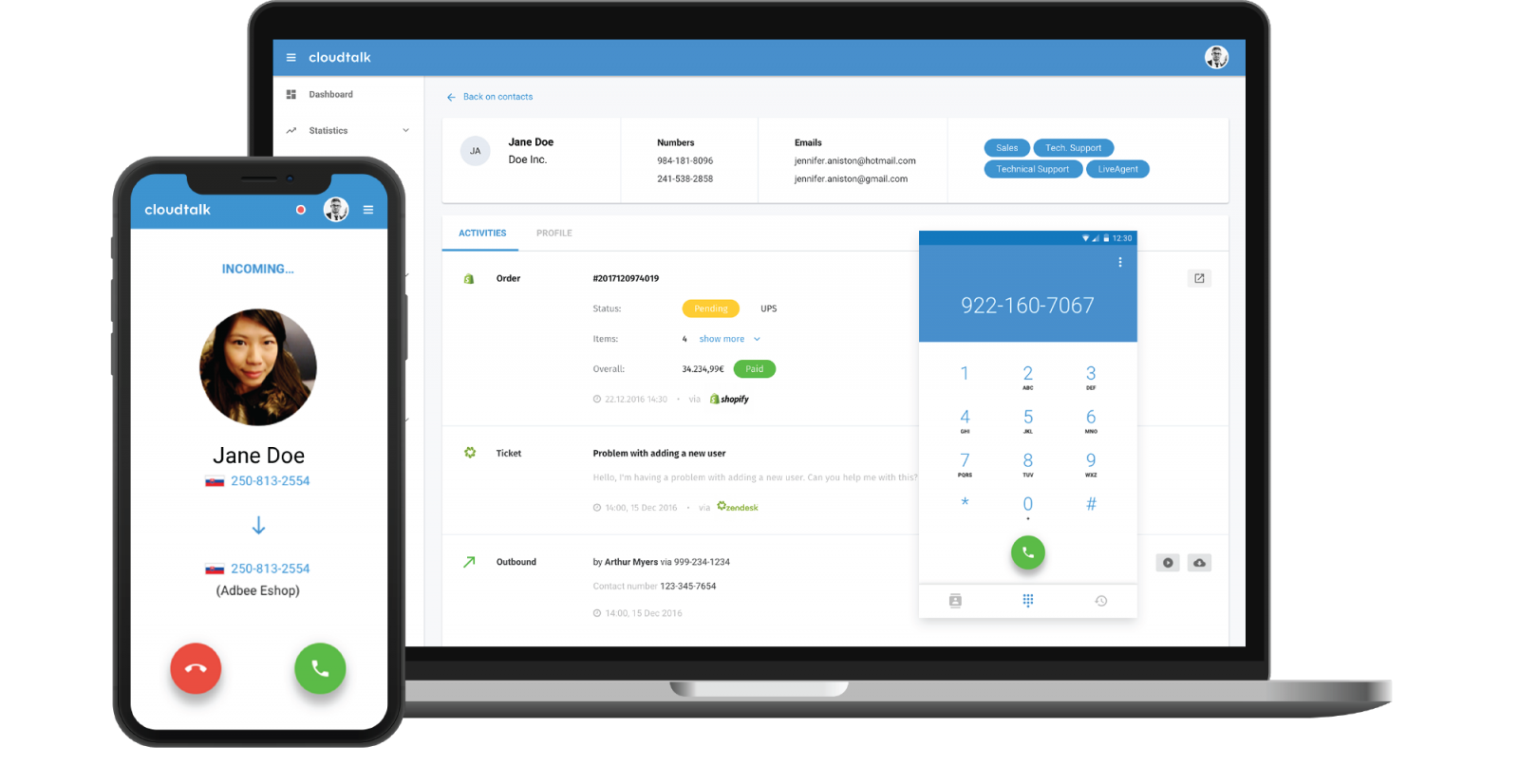
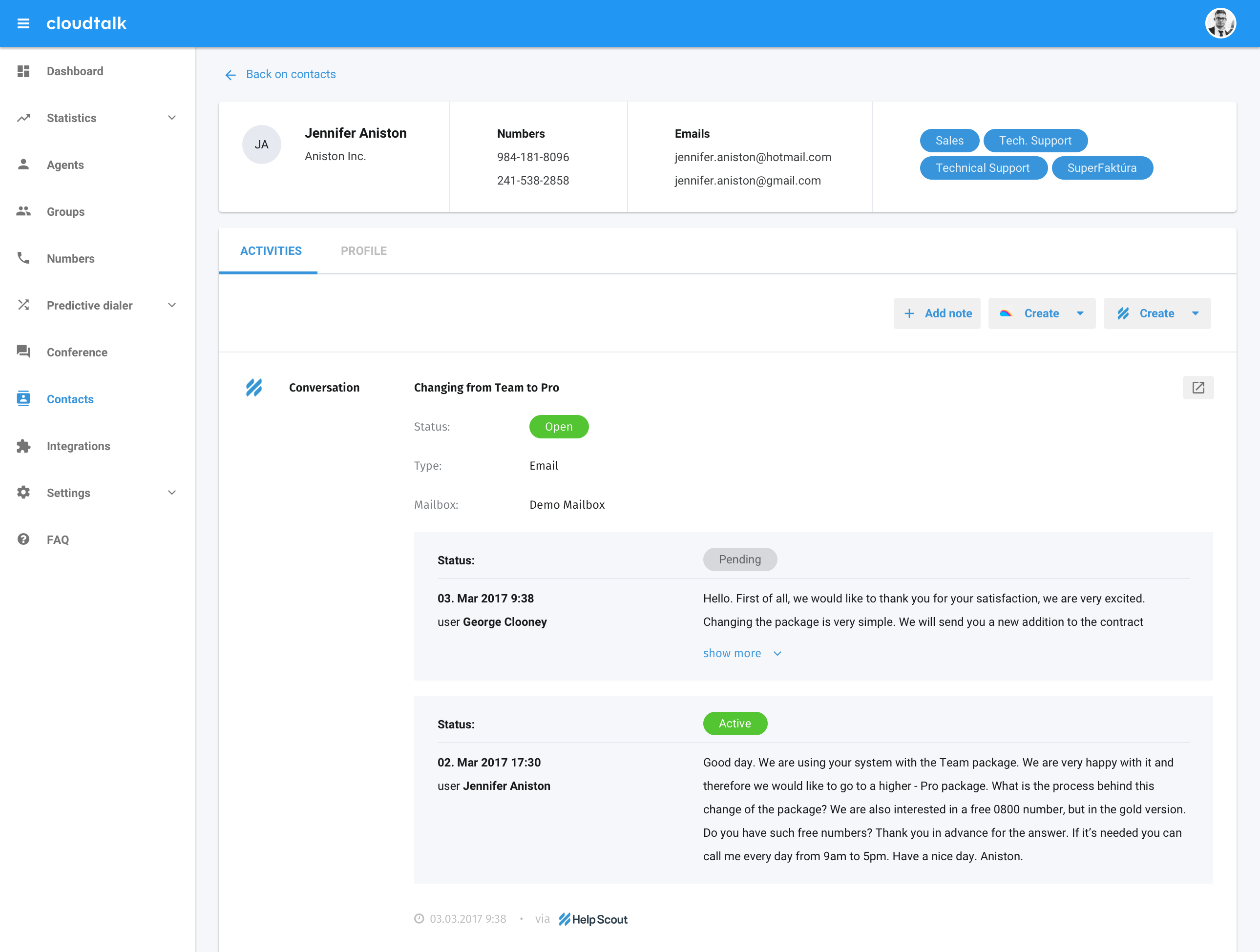
CloudTalk is cloud-based call center software for sales and support teams of all sizes, looking to improve customer experiences through more personalized, data-driven customer interactions. The vendor aims to help teams communicate clearly and efficiently. With CloudTalk users can get local, mobile or toll-free numbers from more than 140+ countries across the world. The vendor says they offer integration with important tools (such a CRM, Helpdesk, or…
$27
per month per user
Skype (discontinued)
Score 7.1 out of 10
N/A
Skype (the personal edition or Skype free) was a web meeting, video conferencing, and VoIP software, now superseded by Microsoft Teams' free edition and unsupported from May 2025.
We were recommended CloudTalk basically from everybody in our network so we reached out directly to them at first and since they had everything we were looking for, feature-wise, and also were in our budget, we didn't really consider other vendors on the market. The …
There were several services suitable for our needs. CloudTalk was chosen because of its simplicity, complexity, and brief time needed to use this service. No broad technical knowledge is required to start and operate CloudTalk.
Better value for the money (by far). And besides that, all the features we needed, CloudTalk has them. Shoutout to their support for answering all the questions we had and to their CSM team for giving us a quick demo on the same day when we requested it. Recommended solution!
Cloudtalk is well-priced for what we need from it. The fact that it has many features that we plan to use in the future is a deciding factor, and that gives it a big advantage. So the biggest impact was the comprehensiveness of the solution and the integration with the CRM.
International growth marketing specialist / Lead generation & International PR
Chose CloudTalk
We tried dealing with Aircall, but their solution didn't seem so flexible and the initial adoption cost was way out of our context. We learned later that the solution was in fact more flexible than we thought, but were disappointed by the little quality of their before-sales …
So much better, much cleaner design. Much less complicated setup process. Has a much more up-to-date program. You can use the browser version or the stand-alone app, both are far more fleshed-out pieces of software. It is also much more reliable, haven't had the app crash even …
CloudTalk is a lot more intuitive and provides more features and analytics than 3CX. The fact it allows for integration as well means we can stay on top of all of our missed calls and know exactly what client rang linking them to their company account.
RingCentral has major issues syncing in real-time. The Web app and the desktop app never showed the same numbers. Often I'd have to wait hours for reports to update and then still had no confidence in the information presented.
CloudTalk is significantly more affordable, easy to setup and the trial month was very helpful to ensure it was what we needed. AirCall can probably do a lot more but I cannot tell you what and I don't believe we need more as we are not a complex business that needs multiple …
The pricing is more interesting and the fact they have a product easy to use with integrations with both our Sales and Support CRM's made us chose them. We were also told that a lot of the features we needed would be implemented in the soon future so let's see if it happens.
I have been using WhatsApp quite often for private and sometimes professional usage and in the past Skype and ICQ. WhatsApp is for free but I would say that CloudTalk provides a higher quality while talking so if I should choose between them for messages is WhatsApp very easy …
The first thing is cost. CloudTalk was a lot cheaper than others. The other thing I noticed is that there were a lot of unwanted or unnecessary features with the other ones that didn't really matter to us, but were more [than] able to ask a higher price per seat. However, the …
It was a gamble if I'm being honest, plus this is a very nuanced and intricate topic. We didn't necessarily substitute one for the other, it was a much needed state of affairs where we needed the call monitoring and agent tracking pros of CloudTalk more so than ever before.
The integration of CloudTalk with Pipedrive makes the native Pipedrive call system practically unnecessary. The latter does not allow searching for calls or generating indicators as well achieved as in CloudTalk.
Before CloudTalk, we used Pipedrive. It also works really well, but it does not have the option of analytics. You could not check things like how many calls were made during the day or a specific time period. That, for me, is the most valuable feature of CloudTalk--all the data …
It's the perfect complement to the other services we use as it permits us to get in contact with our clients in order to not only have good communication inside of the company but also outside the company with our clients. It really rounds up the whole package. It's just the …
CloudTalk service is immediately available once a profile is created and payment is made. Five9 indicated it would take up to 2 weeks to have full access to the service.
Though it was not my decision from switching from Circleloop, when we had originally used CircleLoop it gave some issues with internal transfer and taking calls which heavily affected us. With CloudTalk we can now successfully make outbound calls without any problems.
CloudTalk has a better value for the money spent and has been easier to set up than other peers in that regards as well as better overall integration with already existing Software that we have been using for years in our company. At the end, the communication with CloudTalk …
CloudTalk is much more configurable. It is very easy to send proactive SMS messages with CloudTalk whilst with Zendesk Talk this can only be done through a workaround. Zendesk does not provide Chinese virtual numbers either and outbound calls were not working to Chinese numbers …
Selected Skype because it was the only platform that was available for such purposes for video conferencing or audio conferencing. Since Microsoft, the tech giant, backed it, it was assured that it would work great in terms of productivity, with utmost security measures for all …
All of these other products have kept up with advancements in VoIP and communication technology and have expanded their portfolio of grouped services with their applications while Skype has been pretty stagnant
We use Skype in combination with Grasshopper. While Grasshopper acts as a routing toll free number with extensions, if we are making calls directly, we do it through Skype.
Skype's desktop and mobile apps are easier to use, and provide unlimited local calls at a flat, …
Teams is more professional, Calendar integration with Outlook is possible so that is plus point as compared to Skype. Many people use Teams and are comfortable on it so it is good for us. But yes, Skype is the only business communication tool which enables calling on mobile …
Skype is great for one on one calls and easy catch ups. However, when it comes to talking in a more professional setting and in a group setting, we have gone with other communication services. Skype is great for video conferencing with one other person though and I would …
As a whole business, we did not go with Skype. But for selected use cases we did. These scenarios were based upon what technology the other parties had access to. They were comfortable using Skype so we adapted to using it. We have used it to connect classes on site and off …
Skype is a great app for various purposes, such as texting, calling, video chatting, and even holding virtual meetings. Regardless of connection speed, it provides the best quality and user experience. Skype's user base, reliability, and ease of use are unrivaled, and because …
As WhatsApp business is not useful as skype because there are certain features which were not as useful as those available on skype. Whatsapp has a file size limit while transferring data, it doesn't have screen sharing which is a big drawback, and cannot be used as a …
Skype is more user-friendly and has a better-suited option for us, plus its acceptability is unique and very much welcomed all over. Professionals are already adhered to interphase and using for their personal use and no such training costs were involved as in this region its a …
It’s extremely user-friendly. Truthfully I use multiple different applications that serve similar purposes depending on what our partners are familiar working with. Skype has had pretty dependable connectivity compared to others I’ve used. Also very simple to set up and share …
As a business messaging solution, Skype for Business has been replaced by Microsoft Teams which has been a significant upgrade. But the normal Skype hasn't really changed or developed much over the years leading to a steady decline in its customer base as well. A few years back …
Skype is inexpensive and easy to use, and all of us may access it through the internet. Because of concerns about privacy and security, I value Skype's longevity much. With this system, we can deal with people in distant locations since it is more dependable regularly. The …
Microsoft Teams is more suitable for teams who share information in Channels. It also allows simple management of tasks and projects through the integrated Kanban Board. Zoom and Webex Meetings are more suitable for holding Webinars. Zoom is easy to use for holding meetings …
Skype was used literally only cause it was included in the Microsoft Suite and we did not need to pay for another service. However, after using it for some time and constantly running into audio/video issues (especially during client presentations when sharing powerpoint, …
Skype overall is easier to use than a lot of comparable collaboration tools on the market. It really doesn't require formal training to use, and most users get used to all the features of the platform pretty quick overall. Some other collaboration tools may offer more …
Lee's functionality than Zoom, more glitches and log in complications than Google, but affordable and familiar for most of our clients and staff, which makes it an easy tool for a nonprofit. In general, we use Zoom and Google more but Skype is still a useful tool.
Skype works better than Google Hangouts simply because everyone in the organization has a skype address that comes from being an employee here. Not everyone has a google account, so it's hard to meet or use Google tools. The university has also worked with Zoom so that we can …
Skype is more user-friendly than these other products. Skype has a simple, easy-to-understand user interface that even newcomers to audio/video conferencing can understand intuitively. While Skype and Zoom offer similar features, they are loaded down with extras: more buttons …
Team meetings are easy with Skype. Demo presentations are another thing where it stands out from the rest of its competitors. Reminders are another thing done here. Video conferencing and screen sharing is very much improved through Skype and Skype for Business desktop and …
When trying to video chat using other apps, and the call is breaking, after switching to Skype, usually the call/video quality is better. In comparison to UnerConference, uberconference has web client (no need to install software). Also has conference rooms, where you can log …
We have Cisco Jabber, Zoom and Rocket. Chat rolled out across organizations but they all lack the flexibility and attractiveness of Skype when it's coming to day-to-day work and solving business needs, even though they possess some important features and characteristics that …
I'm not a fan of Zoom. It tries to steer you towards downloading an app even though you can simply log into a meeting via your browser (though it hides the latter functionality as hard as it can). I was an invitee to a reoccurring Zoom meeting and lost the invite link after a …
Cloudtalk is by far the best value-for-price software out there for call center solutions. Packed with features, very accessible, kind and accessible customer support, and cheap, especially when compared with their competitors for the same range of features. Easy entry-level software, especially if you're a startup that doesn't want to make big initial commitments but needs a solution that scales with the business.
Skype is an excellent choice for phone calls, both local and international, and is also one of the most affordable solutions for business office line. It is simple to use and get started with and provides a call experience on mobile that is similar to a regular phone call. It is not the ideal tool for team chat. For text-based team communication, a separate dedicated tool is still ideal
Perfect for chatting via text. Has emojis, file sharing, audio sharing, and even video sharing capabilities.
Good for video chats. You can do 1 on 1 sessions with a good quality video.
Privacy is also another important function they have. They allow for private conversations between users.
Ability to delete conversations with sensitive information you may not want seen by users not authorized. Can share confidential information via Skype.
Customizable profiles to fit your company culture.
CloudTalk is super easy to use and has a great quality. It helps to communicate with the clients easily and we can feel that the sound quality is high, while speaking to the client and while listening to the recordings. This is for our department essential in our day to day work.
Skype is not as good as Facetime in terms of ease to glance at it and figure out how it works. I think that's a result of Skype trying to be too many things at once. A lot of the menu and UI could be streamlined, and I would jettison some of the additional functions that have been tacked on over the years to simplify. That being said, while some options are slightly hard to find, they all work flawlessly once found.
They are skilled, experienced, and anytime I need something and contact the support time, I get the right person who understands my needs and reacts to them accordingly. So far I was only pleasantly surprised by the level of support these guys provide and coming from a customer service oriented background myself, I can only say keep it up guys, you are doing a fantastic job!
I am not aware of the current support level for Skype for business, as I have never used even though I have the product. However, the support for Skype's personal paid users is not where it could be. Users who pay for Skype features do not have a clear path to reach out to support. So, rating 6, can be better as soon as I need to use Skype for business support and get a good experience. I will say that I will renew Skype for Business subscription, which is a significant inconsistency on my end. The explanation is that Skype for Business comes bundled with Office for Business, with no additional cost, so why not.
It was a gamble if I'm being honest, plus this is a very nuanced and intricate topic. We didn't necessarily substitute one for the other, it was a much needed state of affairs where we needed the call monitoring and agent tracking pros of CloudTalk more so than ever before.
Selected Skype because it was the only platform that was available for such purposes for video conferencing or audio conferencing. Since Microsoft, the tech giant, backed it, it was assured that it would work great in terms of productivity, with utmost security measures for all data, conversations, work materials, and personal information.
Skype has contributed to increased efficiency for remote collaboration, especially now due to the ways things are and having so many remote employees. Without this tool, or any collaboration tool, business could not move forward.
I think Skype is the cost effective solution also between it and the other competitors out there. I'm not privy to the exact costs, but it strikes me as the cheaper option.
The only negative impact I would say is its lack of functionality and customization for larger organizations or groups that have employees spread out or require inter-departmental collaboration.