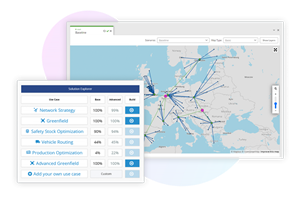
Coupa’s cloud-native Business Spend Management
(BSM) platform provides end-to-end processes
that helps drive collaboration
across for every business leader from supply chain, procurement,
finance, treasury, compliance, and IT and supply chain
leaders to help their companies to get the visibility and control they need to
spend smarter, mitigate risk, and improve
resilience. A
unified platform approach frees up IT from complex integrations to help
leaders deliver on these goals.
$549
per year
SAP Business Network
Score8.4 out of 10
N/A
SAP Business Network is a comprehensive B2B collaboration platform that connects people, processes, and systems across multiple enterprises, digitizing transactions, and creating transparent, resilient, and sustainable supply chains.
Lider Comercial in Sales at Comercial Pozuelo (Consumer Goods, 201-500 employees)
Chose SAP Business Network
NetSuite is the most similar, unlike Coupa which is more financially focused; however, SAP is a more robust, mature, and reliable platform. My clients also use it because integrations are easier for me.
Netsuite es el más parecido, a diferencia de Coupa que es mas financiero, …
A de minimis incentive was given to thank the reviewer for their time. The incentive was not used to bias or drive a particular response, nor was the incentive contingent on a positive endorsement. More Info
Verified User
Chose SAP Business Network
Similar but Coupa has less features and simpler to navigate for first time users
A de minimis incentive was given to thank the reviewer for their time. The incentive was not used to bias or drive a particular response, nor was the incentive contingent on a positive endorsement. More Info
python developer in Research & Development at ArrangeWithMe (Computer & Network Security, 11-50 employees)
Chose SAP Business Network
SAP Business Network stands out compared to all other platforms like Oracle SCM, Ariba, and Coupa due to its comprehensive visibility, robust collaboration tools, and extensive supplier network. Unlike Oracle SCM, which is optimized for its own -heavy supply chains, SAP …
A de minimis incentive was given to thank the reviewer for their time. The incentive was not used to bias or drive a particular response, nor was the incentive contingent on a positive endorsement. TR verified that a representative sample of customers was invited. More Info
Corporate Credit Risk Analyst in Finance and Accounting at ICBC Argentina (Financial Services, 5001-10,000 employees)
Chose SAP Business Network
SAP Business Network was selected after we compared Oracle Supply Chain Management Cloud and Coupa Risk Assess. While they had good features, SAP Business Network was hands down better in credit risk monitoring and provided better integration with our existing systems. It had a …
A de minimis incentive was given to thank the reviewer for their time. The incentive was not used to bias or drive a particular response, nor was the incentive contingent on a positive endorsement. TR verified that a representative sample of customers was invited. More Info
Verified User
Chose SAP Business Network
I have not personally used these software, but I know they were considered at one point before using SAP Business Network. And based on my knowledge of what they do, here are some brief descriptions: Ariba Network by SAP: Focuses on procurement and supply chain management, …
A de minimis incentive was given to thank the reviewer for their time. The incentive was not used to bias or drive a particular response, nor was the incentive contingent on a positive endorsement. More Info
A de minimis incentive was given to thank the reviewer for their time. The incentive was not used to bias or drive a particular response, nor was the incentive contingent on a positive endorsement. More Info
A de minimis incentive was given to thank the reviewer for their time. The incentive was not used to bias or drive a particular response, nor was the incentive contingent on a positive endorsement. More Info
Software Manager in Information Technology at Flash.co (Information Technology & Services, 11-50 employees)
Chose SAP Business Network
SAP Business Network helped us find out about the problem also helped us in very effective tracking and Since we already use SAP S/4HANA and other SAP modules, SAP Business Network provided the most seamless integration, ensuring smooth data flow across procurement, finance, …
A de minimis incentive was given to thank the reviewer for their time. The incentive was not used to bias or drive a particular response, nor was the incentive contingent on a positive endorsement. More Info
Business Analyst in Marketing at Cabify (Information Technology & Services, 1001-5000 employees)
Chose SAP Business Network
SAP Business Network is strongly recommended by me to any organization that has an aspiration of doing the following: So far we have integrated well with our current systems, used a clean and simple to understand eyes design, and collaborated well with multiple teams, all of …
A de minimis incentive was given to thank the reviewer for their time. The incentive was not used to bias or drive a particular response, nor was the incentive contingent on a positive endorsement. TR verified that a representative sample of customers was invited. More Info
Verified User
Chose SAP Business Network
SAP Business Network is not my favorite. It was selected due to its historic presence and public industry use.
A de minimis incentive was given to thank the reviewer for their time. The incentive was not used to bias or drive a particular response, nor was the incentive contingent on a positive endorsement. TR verified that a representative sample of customers was invited. More Info
Verified User
Chose SAP Business Network
We have to follow our buyers on the various networks and procurment systems - SBN stands out because of the ease of work and level of control you have on your buyer integration and documents that are interchanged between us and the buyers
A de minimis incentive was given to thank the reviewer for their time. The incentive was not used to bias or drive a particular response, nor was the incentive contingent on a positive endorsement. More Info
Suitable: Simple indirect procurement. Low cost; short cycle implementation. Less Suitable: Complex procurement scenario requiring serious vendor collaboration. End-to-end integration. Direct Material Procurement, especially when planning, quality inspection, and other miscellaneous activities are involved, requires handling various special statuses and updates to meet industry- or country-specific requirements.
A de minimis incentive was given to thank the reviewer for their time. The incentive was not used to bias or drive a particular response, nor was the incentive contingent on a positive endorsement. More Info
SAP Business Network provides an end-to-end experience to connect and be transparent with suppliers from across the globe. There is no other product that can be compared to this and that has a wide range of offerings such as SAP Business Network. Although it is versatile and supports many business use cases the learning curve is deep and it will be difficult for new suppliers to get used to the platform. If you are suppliers with whom you just have one transaction and need to maintain the track record for those details, it's better not to use SAP Business Network because the suppliers will not be willing to learn to use the platform to submit the invoices just for one purchase order. But there is a solution for this as well you can ask the suppliers to submit the invoices to you through email and send paper invoices from SAP buying and invoicing. The PO and invoice will be sent to a private supplier account. Your supplier doesn't have to login but you still get to maintain the details on SAP Business Network. Even in these cases, SAP Business Network has a solution in the form of a private account.
A de minimis incentive was given to thank the reviewer for their time. The incentive was not used to bias or drive a particular response, nor was the incentive contingent on a positive endorsement. More Info
Coupa is easy to use, however, we had to teach our end users about procurement. They are not used to conducting an RFP, onboarding a supplier, or preparing a PO. This is the change management that our employees had to be prepared to understand. The Shelby Group helped us with the implementation.
The hardest part was the integration between NetSuite and Coupa. We wanted to have a dynamic tight integration between the two solutions. If we adjusted the chart of accounts or added a new supplier we wanted it to be able to done in both systems and be available immediately in both systems. We used a partner called SuiteSkies to accomplish this dynamic integration.
We’ve been able to manage the implementation and maintenance with a very lean IT group.
A de minimis incentive was given to thank the reviewer for their time. The incentive was not used to bias or drive a particular response, nor was the incentive contingent on a positive endorsement. More Info
Real-time order tracking: When a purchase order is created, suppliers can confirm it directly in the system. We can then see the status immediately without having to chase them via email.
Supplier interaction: Vendors can upload shipping details, update delivery dates, or report issues directly on the platform.
Analytics and insights: Aystem provides dashboards that show spend by category, supplier performance, and payment cycle.
A de minimis incentive was given to thank the reviewer for their time. The incentive was not used to bias or drive a particular response, nor was the incentive contingent on a positive endorsement. More Info
Support Team - A little slow in responding. I think the tool is so configurable that they struggle with figuring out what is causing certain issues that are being submitted on the portal.
I'd love for the Sourcing Module to be able to support larger events. There seems to be a limit on the number of lines each event can support and as a growing retailer, our store count dictates we have room to grow and that each store is represented in the bid process.
Would like to see the ability to issue multiple POs for a single item to multiple locations. The tool may do this but I know I can't and it may be due to how we interface with our ERP.
A de minimis incentive was given to thank the reviewer for their time. The incentive was not used to bias or drive a particular response, nor was the incentive contingent on a positive endorsement. More Info
It takes new users some time to go through the interface, especially if they have not dealt with similar software before.
It may still appear that customization options are somewhat restricted compared with other websites.
In addition, small businesses or start-ups could face higher subscription costs and, in full force, limit themselves to the quality of the social network.
A de minimis incentive was given to thank the reviewer for their time. The incentive was not used to bias or drive a particular response, nor was the incentive contingent on a positive endorsement. TR verified that a representative sample of customers was invited. More Info
A de minimis incentive was given to thank the reviewer for their time. The incentive was not used to bias or drive a particular response, nor was the incentive contingent on a positive endorsement. More Info
I will give it a 9, one is deducted for business inspection and improvement i feel that they are in the right direction and streamlined our flow of business agility also helped us get the R.o.i and helped with more sales and visibility over business and its metrics.
A de minimis incentive was given to thank the reviewer for their time. The incentive was not used to bias or drive a particular response, nor was the incentive contingent on a positive endorsement. More Info
-Could be easy or hard to use depending on corporate policies and compliance. At times, errors and cryptical message associated with them could drive users mad.
A de minimis incentive was given to thank the reviewer for their time. The incentive was not used to bias or drive a particular response, nor was the incentive contingent on a positive endorsement. More Info
There is still a ton of flexability on the customer's end of the platform, which makes standard onboarding for suppliers a challenge. Customers are allowed to ask for things, or customize certain things that are not standard for us, so we have to have special rules set up to complete an integration. There are also some limitations to automate invoice rejections that happen on the platform when a customer rejects an invoice
A de minimis incentive was given to thank the reviewer for their time. The incentive was not used to bias or drive a particular response, nor was the incentive contingent on a positive endorsement. More Info
-Support is generally speaking OK (not great). The user community is quite active, and the response time is acceptable. I would certainly hope there's more user-generated content (like in SAP, Oracle, and Linux, etc.), but I suppose Coupa is still not large enough, and the incentives are not yet there.
A de minimis incentive was given to thank the reviewer for their time. The incentive was not used to bias or drive a particular response, nor was the incentive contingent on a positive endorsement. More Info
A de minimis incentive was given to thank the reviewer for their time. The incentive was not used to bias or drive a particular response, nor was the incentive contingent on a positive endorsement. More Info
Good performance from SAP as key deployment partner; collaboration and deployment with additional business partner for data provision and business partner onboarding was rather difficult, slowing down the project progress and overall success perception
A de minimis incentive was given to thank the reviewer for their time. The incentive was not used to bias or drive a particular response, nor was the incentive contingent on a positive endorsement. More Info
Concur was a lot easier and more user friendly for employees doing expense reports on their phone. That is not the case with Coupa. You must use your laptop to do expenses and our managers don't always have enough time to do that while out in the field working. This has caused some issues.
A de minimis incentive was given to thank the reviewer for their time. The incentive was not used to bias or drive a particular response, nor was the incentive contingent on a positive endorsement. More Info
SAP Business Network stands out compared to all other platforms like Oracle SCM, Ariba, and Coupa due to its comprehensive visibility, robust collaboration tools, and extensive supplier network. Unlike Oracle SCM, which is optimized for its own -heavy supply chains, SAP Business Network provides a more versatile, end-to-end solution, enabling transparency and responsiveness across diverse industries. Compared to Ariba.
A de minimis incentive was given to thank the reviewer for their time. The incentive was not used to bias or drive a particular response, nor was the incentive contingent on a positive endorsement. TR verified that a representative sample of customers was invited. More Info
A de minimis incentive was given to thank the reviewer for their time. The incentive was not used to bias or drive a particular response, nor was the incentive contingent on a positive endorsement. More Info
SAP Business Network's streamlined supply chain and procurement processes have significantly reduced operational costs and improved resource allocation, leading to enhanced overall efficiency.
The platform's robust analytics have provided valuable insights, facilitating data-driven decision-making and enabling us to make more informed strategic choices, ultimately contributing to improved business performance.
Implementing and integrating the SAP Business Network initially required a substantial financial investment, impacting short-term cash flow and potentially delaying other critical business initiatives.
A de minimis incentive was given to thank the reviewer for their time. The incentive was not used to bias or drive a particular response, nor was the incentive contingent on a positive endorsement. More Info