Dataloader.io delivers a cloud based solution to import and export information from Salesforce.
$99
per month
Maia by Matillion
Score 8.5 out of 10
N/A
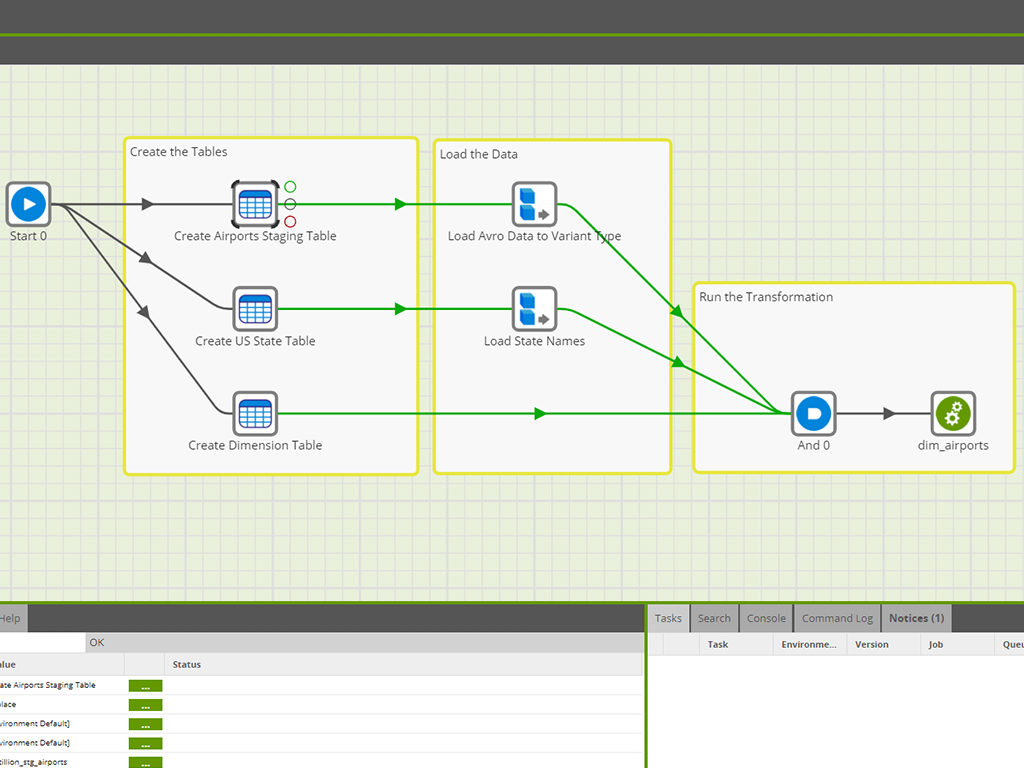
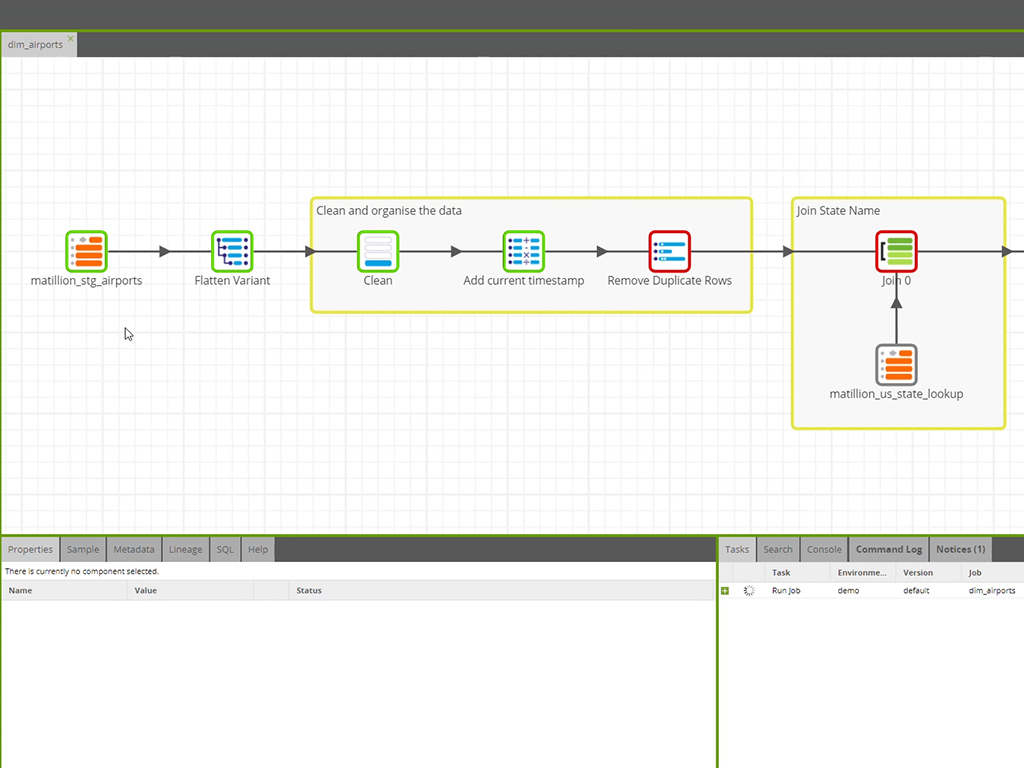
Maia by Matillion is an autonomous data engineering platform designed to automate the lifecycle of data pipelines through AI-driven orchestration. The solution functions as an enterprise "digital workforce" that translates natural language requirements into production-ready DataPipelines, leveraging a Pushdown Architecture to execute transformations natively within cloud data warehouses.
N/A
Talend Open Studio (discontinued)
Score 9.7 out of 10
N/A
Talend Open Studio was an open source integration software, used to build basic data pipelines or execute simple ETL and data integration tasks. Qlik and Talend discontinued the service in early 2024, and it is no longer available.
$0
per month
Pricing
Dataloader.io
Maia by Matillion
Talend Open Studio (discontinued)
Editions & Modules
Professional
$99.00
per month
Enterprise
$299.00
per month
No answers on this topic
No answers on this topic
Offerings
Pricing Offerings
Dataloader.io
Maia by Matillion
Talend Open Studio (discontinued)
Free Trial
No
Yes
No
Free/Freemium Version
No
No
Yes
Premium Consulting/Integration Services
No
Yes
No
Entry-level Setup Fee
No setup fee
No setup fee
No setup fee
Additional Details
—
Billed directly via cloud marketplace on an hourly basis, with annual subscriptions available depending on the customer's cloud data warehouse provider.
I have used salesforce inspector also for operations like import and export of data from custom objects but it doesn't work well when you have data in huge numbers. Instead of using Salesforce Inspector, one should go for Dataloader.io if the number of records is huge to be …
Removes most of the complexity around setting up and preparing things. If you could describe with words what needs to be done to move data from A to B, the implementation in Matillion would probably be the most similar in terms of simplicity of understanding what you are doing …
Matillion is much easier to set up and easier to work for the team. Offers a lot more connections which are easier to set up. Environment variables make it easy to set up once and job creation is easy. We use Metadata tables to just loop through the list of tables that need to …
Before the ETL tool we made the decision to stick to Redshift as a database. Compared to listed products (that I used) I would say that the decision was easy if we consider the sync with AWS and Redshift, cloud-based solution, team collaboration, built-in scheduling, and …
Matillion had out of the box support for most of the third party tools we have, plus it integrates well with our data warehouse platform. We found it to meet our use cases after a trial period. It's customizable when you know what you are doing. The use of global and local …
Matillion ease of use and feature set along with integration capabilities and built in integrations are definitely a step ahead than the other tools and it provides the ability for us ti integrate with refshift, Snowflake and on premise data sources and hence becomes a …
Our organization hires present college students in an apprenticeship role, so it was important to us that whatever tool we use to be easy to train on. We also preferred that it integrate well with Snowflake since we had decided that we wanted to use that as our data storage …
Replacing data. If we've put something in a category or a bucket that is no longer named that anymore because we've evolved with the times and we want to rebrand everything, it makes it way easier to do a quick import with the new terms.
Great: Need to query simpler APIs, or utilize well known services such as GSheets etc.? Matillion has got some of the best and easiest to use connectors out there. Not so great: Do you need have a competent CI/CD flow that you will be able to update / compare from Matillion as well as other sources at the same time? Good luck, you will need to be extra careful, as you might have to have a deeper dive into your servers Terminal each time you have a git conflict.
For quick daily integrations Talend is a very good tool and it makes development time so short and easy. Citizen developers who are not great programmers can pick up and start using Talend Open Studio within weeks. It's well suited for all kinds of data migration between various systems. It is less appropriate for smaller synchronous services where you need to trace the complete transaction and how data moved between them. It's also less appropriate for small data movements where other tools can be easier to use and manage.
Extracting Salesforce attachments in original file format! I do not know of a tool that can do this better, or more efficiently! This is a huge benefit to companies that would like to extract attachments from Salesforce for tasks like data migrations.
Cross-object data extract within one file. You can pull data from related objects as long as there is a populated lookup from the object you are extracting, to another object (Child or Parent).
UI is simple and requires very little to no training. Given the acquisition of Mulesoft by Salesforce, I would not be surprised if DataLoader.IO is rolled out as the new global data loading tool for Salesforce.
At the moment, I can't find a way to rename jobs. This would be useful to organize what was previously created hastily by techs in a rush.
A preview of the job, especially upserts, would take a great deal of stress away from some of us (especially those who are not so confident in their ETL practice).
A native vlookup equivalent may be a welcome addition.
Matillion is brilliant at importing data -- it would be amazing to have more ways to export data, from emailed exports to API pushes.
Any Python that takes more than a few lines of code requires an external server to run it. It would be great to have more integration (perhaps in a connected virtual environment) to easily integrate customized code.
Troubleshooting server logs requires quite a bit of technical expertise. More human readable detailed error handling would be greatly appreciated.
The community is not that up to date and forum is not that great in response. Probably we should make people aware of the tool more on how to use and its implementations.
Talend crashes when transforming a lot of data (millions of rows).
Proper training documentation is a must for talend which is currently lagging. This will help users to learn more about Talend and use it effectively.
It is easy to use and doesn't require a security token, so I enjoy using it. It also doesn't require any download or installation, which is sometimes a blocker to gettingthings done if the company has limits. also, the dataloader.io is easy for other people to pick up, so others can have visibility into the data jobs that have occurred
With the current experience of Matillion, we are likely to renew with the current feature option but will also look for improvement in various areas including scalability and dependability. 1. Connectors: It offers various connectors option but isn't full proof which we will be looking forward as we grow. 2. Scalability: As usage increase, we want Matillion system to be more stable.
There is no licence requirement for Talend Open Studio. So, this is not relevant question. However, if you are asking whether we will use Talend in future. Yes. We will continue to use it. It's very powerful free tool which caters to all our extra, transform, load capabilities. We just love Talend for it's great functionality and ease of use.
Dataloader definitely skews towards a more technical userbase. Users should be adept at manipulating data in spreadsheets and decipher JSON formatted error messaging. Additionally, there is a good amount of time need to set up the environment to map to the pertinent fields we are trying to adjust. While I would not recommend the typical account manager to use Dataloader, a typical operations manager should have no issue.
We are able to bring on new resources and teach them how to use Matillion without having to invest a significant amount of time. We prefer looking for resources with any type of ETL skill-set and feel that they can learn Matillion without problem. In addition, the prebuilt objects cover more than 95% of our use cases and we do not have to build much from scratch.
Talend Open Studio is based on Eclipse and is full of redundant procedures to do one thing, like when installing libraries. Sometimes I cannot manually download the libraries that it can't find.
Many times, Talend freezes. When you give a cancel command, it takes several minutes to stop. It also takes a great toll on our PC with 16 GB of ram and I7 CPU, even in idle status. If you are downloading Maven Jar/Libraries, you cannot do anything and have to wait until the task is finished.
The utility itself is very self-explanatory and has enough information to guide you through the process. It has an intuitive experience for those familiar with data loading/exporting utilities. Outside of this, they have a Zendesk help center to log support requests and provide documentation to help guide you troubleshoot any issues that may be occurring.
Overall, I've found Matillion to be responsive and considerate. I feel like they value us as a customer even when I know they have customers who spend more on the product than we do. That speaks to a motive higher than money. They want to make a good product and a good experience for their customers. If I have any complaint, it's that support sometimes feels community-oriented. It isn't always immediately clear to me that my support requests are going to a support engineer and not to the community at large. Usually, though, after a bit of conversation, it's clear that Matillion is watching and responding. And responses are generally quick in coming.
Talend Open Studio is free and we are not using the enterprise version which comes with licence and support. So, mostly depend on the open source community for any issues that we face. The document is good and we didn't have to use any support so far. We did evaluate the enterprise version and so far sticking to the free version.
I have used salesforce inspector also for operations like import and export of data from custom objects but it doesn't work well when you have data in huge numbers. Instead of using Salesforce Inspector, one should go for Dataloader.io if the number of records is huge to be dealt with.
Fivetran offers a managed service and pre-configured schemas/models for data loading, which means much less administrative work for initial setup and ongoing maintenance. But it comes at a much higher price tag. So, knowing where your sweet spot is in the build vs. buy spectrum is essential to deciding which tool fits better. For the transformation part, dbt is purely (SQL-) code-based. So, it is mainly whether your developers prefer a GUI or code-based approach.
Informatica has a limited number of components that you can use. This places a heavy limitation on the capabilities of Informatica. On the other hand, Talend allows you to create your own custom components using Java. For businesses that need to perform a wide variety of data operations, it can be quite useful to have the option of creating your own custom components to satisfy business needs.
We're using Matillion on EC2 instances, and we have about 20 projects for our clients in the same instance. Sometimes, we're struggling to manage schedules for all projects because thread management is not visible, and we can't see the process at the instance level.
HUGE time saving. When we need to clean or review data, we used to have to do it line by line. This can do the work within excel and make cleanup/management an afternoons work as opposed to a week.
Rollback what you did/change/deleted is relatively simple if you remember to back up the data you are manipulating.
I delivered projects the client did not believe were possible, and I provided intermediate value by providing visibility to hidden data problems in their systems they could not detect before.
I was able to work 3 projects at a time, pausing gracefully in one while switching to the other, with minimal effort.