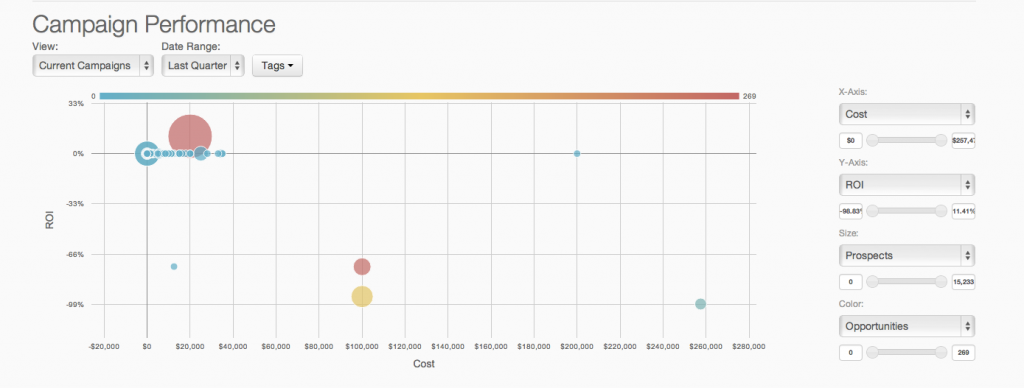
eTrigue DemandCenter is a marketing automation and channel marketing-as-a-service platform. Its key features include CRM integration, email marketing, real-time lead alerts, A/B email testing, and litmus email visualization testing.
$600
per month
Salesforce Marketing Cloud
Score 7.8 out of 10
N/A
Marketing Cloud is an AI-powered, cloud-based digital marketing platform within the Salesforce Customer 360 ecosystem. Marketers can segment their audience, deliver personalized messages, track campaign performance, engage leads and accounts, and optimize strategies based on real-time insights.
$1,250
per month per installation
Pricing
eTrigue DemandCenter
Salesforce Marketing Cloud
Editions & Modules
eTrigue DemandCenter pricing begins at:
$600
complete
Account Engagement
$1,250
per month
Engagement
$1,250
per month
Intelligence
$3,000
per month
Loyalty Management
$20,000
per month
Personalization
$100,000
per year
Data Cloud for Marketing
$108,000
per year
Offerings
Pricing Offerings
eTrigue
Salesforce Marketing Cloud
Free Trial
Yes
Yes
Free/Freemium Version
No
No
Premium Consulting/Integration Services
Yes
Yes
Entry-level Setup Fee
No setup fee
No setup fee
Additional Details
—
—
More Pricing Information
Community Pulse
eTrigue DemandCenter
Salesforce Marketing Cloud
Considered Both Products
eTrigue
Verified User
Manager
Chose eTrigue DemandCenter
eTrigue is far better than other marketing systems we have used because of the drag-n-drop, advanced search, ability to launch campaigns when all assets are not ready, and THE BEST SUPPORT I HAVE EVER USED. We tried Marketo and Pardot, then tested Act-on. With the other …
In 2010, we evaluated Marketo and Pardot alongside eTrigue. And eTrigue was considered the 'Cadillac' of MA tools. More recently, we've checked out Eloqua and Hubspot. All of these are more-or-less clones, having all the same core features. Except for HubSpot, which should be …
Salesforce Marketing Cloud
No answer on this topic
Features
eTrigue DemandCenter
Salesforce Marketing Cloud
Email & Online Marketing
Comparison of Email & Online Marketing features of Product A and Product B
eTrigue DemandCenter
6.3
16 Ratings
19% below category average
Salesforce Marketing Cloud
7.4
170 Ratings
3% below category average
WYSIWYG email editor
7.015 Ratings
7.6121 Ratings
Dynamic content
6.013 Ratings
7.8152 Ratings
Ability to test dynamic content
8.612 Ratings
6.9111 Ratings
Landing pages
7.015 Ratings
7.4120 Ratings
A/B testing
6.010 Ratings
7.3150 Ratings
Mobile optimization
5.011 Ratings
6.8110 Ratings
Email deliverability reporting
4.016 Ratings
7.6131 Ratings
List management
6.015 Ratings
8.0128 Ratings
Triggered drip sequences
7.04 Ratings
7.494 Ratings
Lead Management
Comparison of Lead Management features of Product A and Product B
eTrigue DemandCenter
6.3
16 Ratings
21% below category average
Salesforce Marketing Cloud
7.9
123 Ratings
1% above category average
Lead nurturing automation
6.015 Ratings
8.1108 Ratings
Lead scoring and grading
7.012 Ratings
7.9109 Ratings
Data quality management
6.014 Ratings
7.6115 Ratings
Automated sales alerts and tasks
6.014 Ratings
8.2100 Ratings
Campaign Management
Comparison of Campaign Management features of Product A and Product B
eTrigue DemandCenter
6.8
14 Ratings
9% below category average
Salesforce Marketing Cloud
7.4
113 Ratings
0% below category average
Calendaring
8.611 Ratings
7.7102 Ratings
Event/webinar marketing
5.014 Ratings
7.296 Ratings
Social Media Marketing
Comparison of Social Media Marketing features of Product A and Product B
eTrigue DemandCenter
6.6
11 Ratings
12% below category average
Salesforce Marketing Cloud
7.3
87 Ratings
2% below category average
Social sharing and campaigns
5.011 Ratings
7.582 Ratings
Social profile integration
8.38 Ratings
7.138 Ratings
Reporting & Analytics
Comparison of Reporting & Analytics features of Product A and Product B
eTrigue DemandCenter
6.7
16 Ratings
8% below category average
Salesforce Marketing Cloud
7.6
123 Ratings
4% above category average
Dashboards
7.016 Ratings
8.0117 Ratings
Standard reports
6.016 Ratings
7.6122 Ratings
Custom reports
7.013 Ratings
7.399 Ratings
Platform & Infrastructure
Comparison of Platform & Infrastructure features of Product A and Product B
The platform is most scalable-- works for small and large companies alike. Key for most of our clients is the little to no IT support required to implement and run the platform. I would definitely explore this when looking at a marketing automation platform beyond the "batch and blast" solutions. We've yet to have an issue working with our clients' sales and/or marketing teams to implement. And most of our clients work in the platform independent of the programs we run; are able to set up acampaign, upload lists and/or pull for CRM, and run reports on their own in very short turn.
I think the product, by definition, is meant for marketing — and we use it exactly for that, for running campaigns. That’s the best-suited use case for the product. I don’t think it’s really meant to be used for anything else — that’s just not how it’s designed.
I've never been too crazy about the reporting within DemandCenter. There is always a solution for any type of report I'm seeking, but it involves report designing (choosing data points dragging/dropping columns & rows) which is made difficult by the lack of descriptions & values for the data points. To their credit, they did release a new suite of simplified (and pretty) reports, dubbed "Marketing Effectiveness". Relegating the older, complicated (yet super-flexible) reports as "Business Analytics".
The UI will be a little unfamiliar at first. That is, where you think you should be clicking, you'll need to double-click or drag-and-drop. And I would say DemandCenter has always (and still does) have an issue with UI elements that are "windows within windows" or modal windows with scrolling. But, at least these UI components are consistent throughout the entire application - so once you're used to it, you can actually achieve some pretty impressive speeds.
One of DemandCenter's greatest features is being squished down to uselessness: Derived Data. As mentioned, I scrub our data on a regular basis, and this means filling/appending data, or extrapolating to fill missing data. DC released a feature called "Derived Data" that scours useful info from the prospect's IP address (mostly geographical info). Now, while you can create campaign & list conditions based on derived data, there is no easy way to simply extract that oh-so-valuable derived Country or State and have it map those values to the standard fields. Or at least let you export derived data. They have plans to fix this - but for now it's like dangling candy in front of a baby.
We have tried other systems and eTrigue is the easiest to use, easiest to train new people on, and most responsive support team we have ever experienced. They ask our input on new features they are developing, and have implemented some of our suggestions in their product rollouts. We get new features almost every month. We get live support without any cost, and they return our phone calls within an hour every time. They treat us like a true partner.
As of right now we have not seen any other program that integrates as seamlessly into our Salesforce platform. We have barely scratched the surface of all the features and use cases. It would be irresponsible to make a move to another platform in the near future. We have not come up against any limitations that would prompt a need to switch
You won't find another solution that has as many features as Salesforce Marketing Cloud Interaction Studio. We all know Salesforce, we all know how big they are and it's not for nothing... Their tools do most of the things you want, need and even imagine. Using it is complicated, but the usability is infinite.
Upgrades and timing of the upgrades were communicated well and planned during off hours for our work. If we did have a campaign scheduled during that time, it would kick-off after the system was back active. There were a few unplanned system down times, but it was a rare occurrence and those times were also short in duration.
Though the make up of MA apps is not built this way today, it would be nice to see them become more real-time. The integration between Salesforce and Pardot is not a true real-time integration. If I modify something in Salesforce, those changes are not automatically reflected in Pardot immediately. There is a delay of about 15 minutes before the systems sync. This delay, although not long, is less than ideal We would love the systems to be integrated real time such that changes are propagated from one system to the other immediately.
They are really responsive and more than not solve the problem or give you insight to how you can manage the solution yourself. I do find however sometimes a long delay on the more complex issues when they need to loop in other departments. but overall a good experience with support
The trainers at the Pardot user conference (Elevate and Connections) were very knowledgeable and presented the material well. Again, the content was targeted to more of a new user audience, and was not really relevant for folks who had been using the product for 2+ years.
Pardot's online training touches on all topics briefly and vaguely without much indepth exploration into how a final outcome could look, such as Nurturing Campaigns, Email templates, landing page templates, etc... The only true way to uncover Pardot's full capabilities is to have Front End design and coding experience. Without this key skill set, I would not recommend Pardot to another business.
You will need to think about which users you want to have each role, and the features allowed in each role. You should watch the training videos before you get live training. It saved us several hours as they had already answered 90% of our questions.
From an IT perspective, once you set up the Javascript beacon and start collecting data there is a waiting game. During this time you can start labeling your site actions which can be labor intensive for a single person, but you don't really have the final end-users on the platform yet. We did a lot of training so users were experienced, but it wasn't until they had their first tasks to accomplish that they started using the system and had questions. I'd recommend setting up some immediate goals for an end-user to start segmenting for the purpose of displaying message campaigns so you can jump start end-user action.
Constant Contact offered now tracking, lead alerts. Marketo wasn't as flexible-- for example not easy to schedule campaigns in advance, to launch in the future. Also liked the interface and the DemandCenter lead alert format more than Marketo.
We use Salesforce Marketing Cloud for lead management, generating reports, tracking customer and dealer information, inputting orders, and more. I prefer HubSpot for email marketing and automation because it is easier to use and the emails are designed much better. We currently use Salesforce and HubSpot, and we are very happy to have both, as they have different pros/cons.
Prior to this, we had no solution and literally were doing things on paper in a world where technology is outpacing paper. Having this process optimized has made it easier for the sales and marketing people to change information. From the training perspective, it has allowed us to see holes in where we could create additional support training, so the ROI here has been a lot more than just the optimization of a process.
We get the upper hand on follow-up with return visitors... not by reverse DNS lookup or pattern match but by direct cookie validation. Inside sales productivity is boosted by 33% easy with eTrigue.
The alerts and data are lightning fast, giving marketing immediate feedback on campaign data and prospects.
Salesforce Marketing Cloud allows us to more efficiently reach out to a higher number of prospects.
Salesforce Marketing Cloud allows us to nimbly communicate important messages in a timely fashion to facilitate conversion.
Salesforce Marketing Cloud allows us to track who is opening our messages so that we can stop sending to those not interested and focus on the most engaged audiences.