HappyFox is a web-based customer support ticketing system hosted in the cloud. It helps track and manage all customer support requests across multiple channels like email, chats, social media and phone in a centralized ticket support system.
$29
per month per user
LogMeIn Resolve
Score9.1 out of 10
N/A
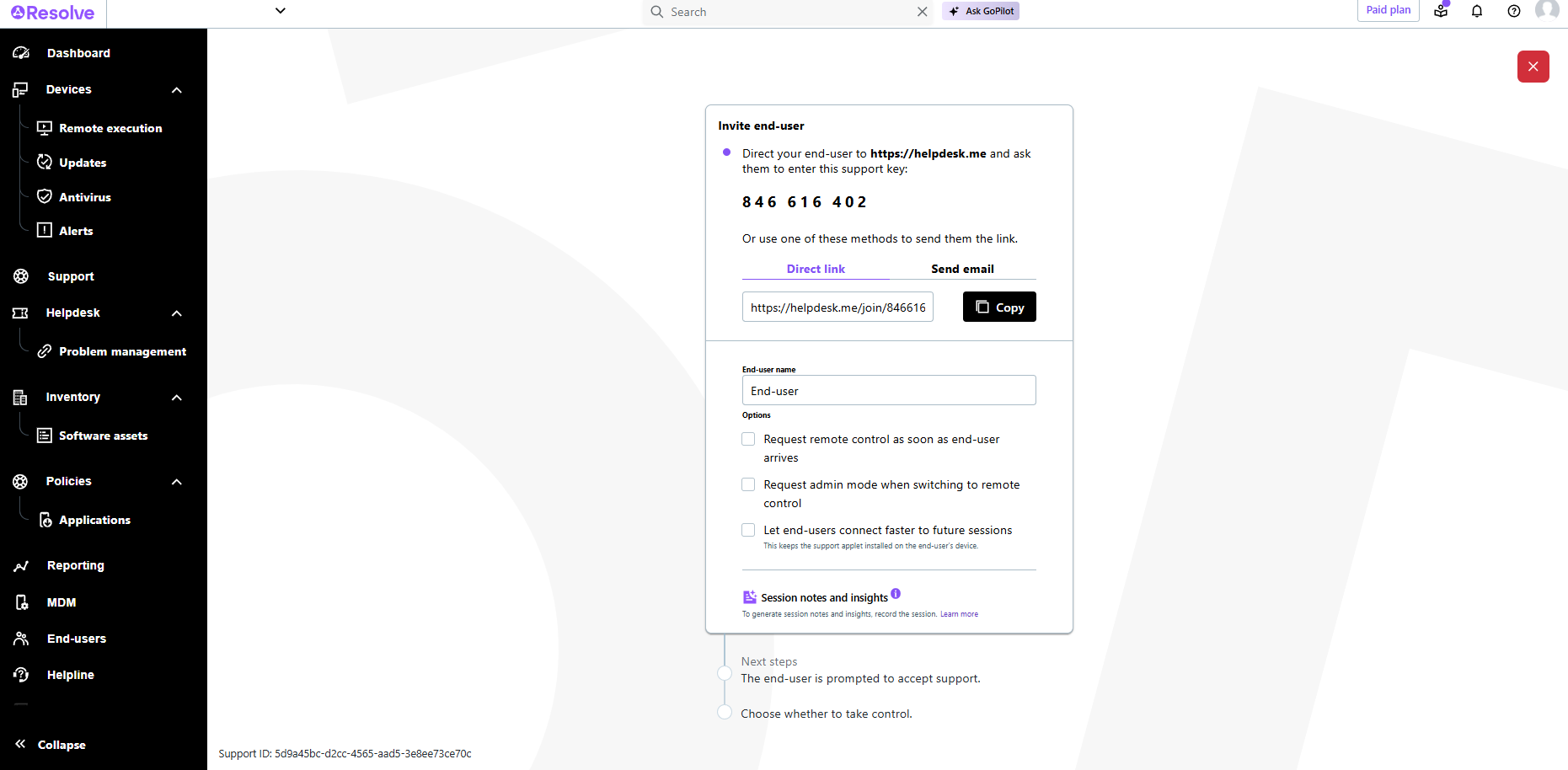
LogMeIn Resolve is an IT management and support solution designed to help organizations take control of their IT infrastructure. The platform combines features like remote monitoring, access, and support with tools such as ticketing, AI-assisted task automation, and patch management.
$29
per month
Pricing
HappyFox Help Desk
LogMeIn Resolve
Editions & Modules
Basic
$29
per month per agent
Team
$69
per month per agent
Enterprise Plus
$89
per user/per month
Pro
$119
per month per agent
Growth - Unlimited Agents
$23988
per year 20,000 Tickets / year
Scale- Unlimited Agents
$47988
per year 150,000 Tickets / year
Scale Plus - Unlimited Agents
$71988
per year 1,000,000 Tickets / year
Enterprise Pro
Contact Sales
Starter
$29
per month
Growth
$55
per month
Advanced
$78
per month
Premium Endpoint Management
$78
per month
Complete
$94
per month
Offerings
Pricing Offerings
HappyFox Help Desk
LogMeIn Resolve
Free Trial
Yes
Yes
Free/Freemium Version
No
No
Premium Consulting/Integration Services
No
No
Entry-level Setup Fee
No setup fee
No setup fee
Additional Details
Discounts are offered for annual and biannuall billing on per agent plans.
Volume discounts are available. MDM is available as a standalone or as an add-on. Discount available for annual billing.
Happy Fox works well in companies that want a full look at all of their tickets in one place. It may be better suited to smaller companies who can check or double check their tickets and have the time to spare. For bigger companies, I think there are better, more robust solutions.
A de minimis incentive was given to thank the reviewer for their time. The incentive was not used to bias or drive a particular response, nor was the incentive contingent on a positive endorsement. More Info
LogMeIn is well-suited for scenarios where remote support is needed. For example, a user submits a ticket about having an issue with Microsoft Word being unable to open documents on their PC. Since this is just a software issue on the device, LogMeIn is great for being able to fix the issue. Scenarios, I would say LogMeIn Resolve is not as well-suited for inventory management. But that's only because my organization has a proprietary system to manage assets.
A de minimis incentive was given to thank the reviewer for their time. The incentive was not used to bias or drive a particular response, nor was the incentive contingent on a positive endorsement. More Info
Smart Rules - Easily create triggers that run based on a variety of criteria. This allows for easily moving tickets through our process. An awesome example is our manager's ability to assign tickets to technicians right from their email simply by responding to the ticket in a certain way. This prevents the opening of a web browser or the mobile app to complete basic functions. Removing one step from the process has already saved us countless hours.
Easy to use and clean interfaces all around. Whether it's the web interface, mobile web interface, or one of the mobile apps, HappyFox is all around intuitive. Plenty of things can be made to be updated in two or fewer clicks (Assigned to, due date, priority).
HappyFox allows our users to easily create tickets on behalf of customers. Any person who has previously contacted the Help Desk is stored as a contact and can be referenced again quickly.
While the portal they provide is basic, it can be quite heavily customized with color schemes and logos. Ours ended up looking better than almost anything else we host both internally and externally. It's clean, simple and provides an easy way for users to input a ticket.
Between the Smart Rules and SLAs it's easy to make sure every ticket gets the attention it deserves. Automatic reminders can be sent to technicians based on criteria. Reports can be run to ensure that service levels are being met. These two things alone have greatly increased the quality of service.
Allows easy, comprehensive access to Apple products via web-based applet. (It does require customer input and cooperation.)
It allows me to resolve issues remotely, most times within minutes instead of hours, without a physical location visit.
It allows the customer to view my activity, giving them peace of mind that nothing untoward occurs during my interaction. I also use the record feature so all sessions are recorded, especially on rare occasions when there is an issue or question from the session.
A de minimis incentive was given to thank the reviewer for their time. The incentive was not used to bias or drive a particular response, nor was the incentive contingent on a positive endorsement. TR verified that a representative sample of customers was invited. More Info
There are a few features that I would hope to be standard that are not yet accessible. For instance, having different time zones isn't a choice, and clients aren't able to create their own reports, only staff can. So, my staff is required to run those reports for our clients.
A de minimis incentive was given to thank the reviewer for their time. The incentive was not used to bias or drive a particular response, nor was the incentive contingent on a positive endorsement. More Info
The user interface is clunky and difficult to use in terms of CRITICAL functions that lie at the core of any remote access solution.
ctrl + key combos are currently terribly implemented and difficult to use - since this is one of the most common keys used in Windows - this presents MASSIVE usability issues that impede my workflow all day every single day.
And now - in a recent development - SHIFT + key combos are currently terribly implemented and difficult to use - since this is one of the most common keys used in Windows - this presents MASSIVE usability issues that impede my workflow all day every single day.
Things like frequently used key combos and shortcuts should work the same via remote access solutions as they do on a hardware keyboard. Anything else is an annoyance and an impediment to workflow and productivity.
A de minimis incentive was given to thank the reviewer for their time. The incentive was not used to bias or drive a particular response, nor was the incentive contingent on a positive endorsement. More Info
The way we have our implementation customized has allowed us to tailor the application to exactly how we would like to use it. We didn't have to change our procedures and fear the potential of poor adoption. Instead we customized the application to be used the way we already ran our help desk. From there on out we reaped the benefits of quicker resolutions, increased transparency, and much happier end users. After setting up Smart Rules, HappyFox does a lot of thinking for us. Tickets go where they need to go, close when they are supposed to close and even remind techs of inactivity. This removes the necessity for micromanagement, which is appreciated by our employees and managers alike
I would say yes, we would definitely renew, everyone likes it in the IT dept, and there are more features we have yet to put to use. I am expanding the Windows update / Endpoint features as I get time, and the remote PowerShell console is unbeatable for me at present when facing remote computers that are not letting create a new remote PSSession.
A de minimis incentive was given to thank the reviewer for their time. The incentive was not used to bias or drive a particular response, nor was the incentive contingent on a positive endorsement. More Info
The interface is clean, intuitive, and easy to navigate. Common actions are easy to locate and exactly where I would expect them to be. Starting a remote session is quick and smooth, which reduces the time users need to wait before receiving support. I also appreciate the single-pane dashboard showing remote access, session details, and device information.
A de minimis incentive was given to thank the reviewer for their time. The incentive was not used to bias or drive a particular response, nor was the incentive contingent on a positive endorsement. TR verified that a representative sample of customers was invited. More Info
Usually available without a problem, although sometimes calls get dropped or users sit in empty meeting rooms while waiting for an admin to arrive, while the call is actually going on.
If you are connected to someone with proper bandwidth, there are no issues at all. With all things, if you connect to someone with dial-up (yes, it still exists), the performance is terrible.
Ive used their tech support a handful of times, and each time they have been able to help me sort out any hiccups or kinks that arise. They have a resourceful knowledge base, and have experts available for training and troubleshooting. I often recommend them to my other coworkers and colleagues because of the ease of use and security
A de minimis incentive was given to thank the reviewer for their time. The incentive was not used to bias or drive a particular response, nor was the incentive contingent on a positive endorsement. More Info
A de minimis incentive was given to thank the reviewer for their time. The incentive was not used to bias or drive a particular response, nor was the incentive contingent on a positive endorsement. More Info
A de minimis incentive was given to thank the reviewer for their time. The incentive was not used to bias or drive a particular response, nor was the incentive contingent on a positive endorsement. More Info
GoToAssist SeeIt was very easy to implement. As long as your techs have a basic understanding of most remote support tools they will be able to understand this product easily.
A de minimis incentive was given to thank the reviewer for their time. The incentive was not used to bias or drive a particular response, nor was the incentive contingent on a positive endorsement. More Info
HappyFox delivered a more cost effective solution and asset management had no limit. The main problem I saw with the various other services I demoed, was the up charges. The pricing seems manageable until you see that they charge for every 100 or so of this and 100 of that. HappyFox is truly a one-stop shop for us.
A de minimis incentive was given to thank the reviewer for their time. The incentive was not used to bias or drive a particular response, nor was the incentive contingent on a positive endorsement. More Info
Although the SolarWinds help desk worked well for our help desk and inventory purposes, it did not provide remote access ability or remote execution of executable files or scripts. We were looking for a product that integrated all of these tasks in order to simplify our day to day IT functions.
A de minimis incentive was given to thank the reviewer for their time. The incentive was not used to bias or drive a particular response, nor was the incentive contingent on a positive endorsement. More Info
A de minimis incentive was given to thank the reviewer for their time. The incentive was not used to bias or drive a particular response, nor was the incentive contingent on a positive endorsement. More Info
A de minimis incentive was given to thank the reviewer for their time. The incentive was not used to bias or drive a particular response, nor was the incentive contingent on a positive endorsement. More Info
A de minimis incentive was given to thank the reviewer for their time. The incentive was not used to bias or drive a particular response, nor was the incentive contingent on a positive endorsement. More Info
A de minimis incentive was given to thank the reviewer for their time. The incentive was not used to bias or drive a particular response, nor was the incentive contingent on a positive endorsement. More Info
LogMeIn Resolve has increased productivity for our support teams with the addition of camera share. Not only are we able to remote into workstations, but with camera share we can utilize end user and customer phones to visually see physical setups to troubleshoot some situations on the fly.
Unattended support now requires the agent to enter in a signature key as an extra layer of security before accessing a device, which further improves the safety of all devices registered for unattended.
A de minimis incentive was given to thank the reviewer for their time. The incentive was not used to bias or drive a particular response, nor was the incentive contingent on a positive endorsement. More Info