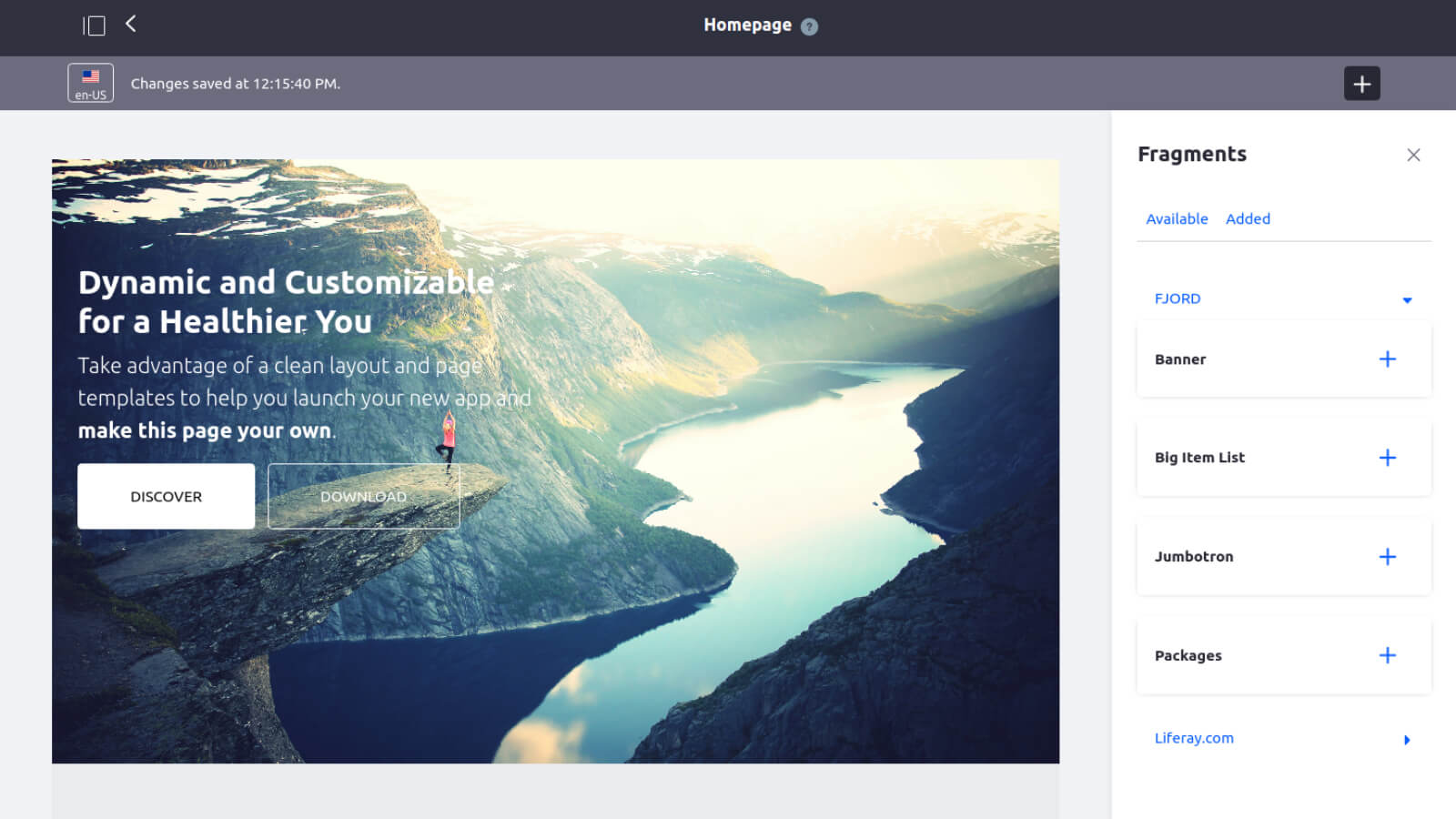
HCL Digital Experience is based on the former IBM Web Content Manager and IBM WebSphere Portal products, acquired by HCL Technologies from IBM in late 2018. The product allows the user to create, manage and deliver engaging omnichannel digital experiences to audiences with responsive content, targeted offers, seamlessly integrated applications and consistent branding across channels (web, mobile, and hybrid mobile/web applications and more).
N/A
Liferay Digital Experience Platform (DXP)
Score 6.6 out of 10
N/A
Liferay Digital Experience Platform is an enterprise-grade platform that enables companies to create and connect personalized digital experiences across web, mobile, social, in store and other touchpoints. It provides the technical foundation (deep integration, security and modularity) for a digital business to orchestrate unique customer experiences, as well as business value features to support a deeper understanding of their customers.
N/A
Salesforce Experience Cloud
Score 8.2 out of 10
N/A
Salesforce Marketing Cloud Engagement (formerly Salesforce Experience Cloud or Salesforce Community Cloud) is an online forum powered by Salesforce that enables businesses to connect with their employees, customers, partner organizations, and prospects. Designed to help facilitate communication and information sharing, customers can ask questions and request help, administrators can integrate data from third-party apps, and employees can collaborate across projects and…
N/A
Pricing
HCL Digital Experience
Liferay Digital Experience Platform (DXP)
Salesforce Experience Cloud
Editions & Modules
No answers on this topic
No answers on this topic
No answers on this topic
Offerings
Pricing Offerings
HCL Digital Experience
Liferay Digital Experience Platform (DXP)
Salesforce Experience Cloud
Free Trial
No
Yes
No
Free/Freemium Version
No
Yes
No
Premium Consulting/Integration Services
No
Yes
No
Entry-level Setup Fee
No setup fee
No setup fee
No setup fee
Additional Details
—
Email sales@liferay.com for pricing information.
—
More Pricing Information
Community Pulse
HCL Digital Experience
Liferay Digital Experience Platform (DXP)
Salesforce Experience Cloud
Considered Multiple Products
HCL Digital Experience
Verified User
Consultant
Chose HCL Digital Experience
IBM Web Content Manager comes with IBM WebSphere Portal. Both [have been] leaders in the portals and content management space for a long time with proven capabilities. Our clients also have other products from the IBM stack and they fit along nicely.
HCL DX does really well at managing and maintaining the site. It allows the business to basically maintain the site while IT spent time developing new and enhanced functions. The main issue I currently have with HCL DX is not directly with the product but it does play a role. It is difficult finding skilled resources to support HCL DX in my experience.
Liferay Portal is a framework which comes with a fine grained security/permission model, (Web) Content Management, Authentication and Authorization, outbox portlets with different features to manage content or users. So if any business application has below questions then I can recommend not to use Liferay as a platform.
Application is big but not content or user driven.
Application with few static contents.
Application with batch transactions(DB) i.e. insert , update db records in batch.
For well-suited, this product is great for your external clientele groups that you would not necessarily want to have a high user fee rate for. So basically general public or a group that will be authorized to come in and just do a few things here and there, but you don't necessarily want them access to all of your systems and your data points for groups that it would not be a great use for. I'd say probably your high level internal staff, they're going to be using a lot of the backend functionality automations, evaluating data, managing data, and doing custom inputs. That's just not what's intended for.
With Version 8.5, IBM Web Content Manager introduced in place editing capabilities which allow authors to make content edits on sections of the page instead of going to the content itself. This feature allows authors to make changes in context of the page and preview changes within the actual look and feel of a live page.
Projects provide a collaborative atmosphere for the author community so that authors can interact and work as a team to manage inter-dependent content changes under one project and publish all changes at once, instead of working separately on individual content changes. This brings awareness across authors in an organization and easy knowledge share.
IBM Digital Data Connector is a cool feature that allows [users] to integrate external content sources onto the portal using IBM Web Content Manager presentation components. This allows UI/UX designers to present integrated external data in any manner they want, manage UI changes with an underlying approval process and leverage syndication to push changes live immediately.
IBM Web Content Manager offers a targeted content feature that allows business users to deliver personalized content to customers based on customer demographic information, browsing history and other transaction related information. Any rules created follow the publishing process thereby making it just a configurable item resulting in less turn around to turn on the feature on a website.
IBM Web Content Manager offers 'multi lingual solution' out of the box which allows content creation for almost all popular languages.
Syndication feature has improved a lot and it now provides a detailed views comprising of 'failed items', 'items that have syndicated successfully, 'items in queue'. Failed items view provides detailed and clear cut information of what resulted in failure helping IT to troubleshoot problems easily.
Easy to use, just like Salesforce's other products. Many users can sit down and figure it out in no time, and with a little training become power users.
Fast and secure - Salesforce is a leader in the cloud world so you get consistently fast results and security that is top notch in the industry.
Accessible from anywhere - if you use cloud CMS already this is a no-brainer, but for those that do in-house CMS still, this is a major difference. Mobile access from anywhere on the planet without a VPN is something you just can't do without the cloud.
IBM Web Content Manager should provide some easily usable connectors through a GUI to connect to bring content from custom data sources including connecting to Salesforce and custom databases.
Should further optimize and enhance creation of rich and responsive content driven UIs on various digital channels.
Should further optimize and enhance content personalization features.
Unlike other CMS platforms like Wordpress and Adobe Experience Manager, Salesforce does not provide a fully featured editor with a drag-and-drop design tool.
Our content creators and marketing team often struggle with permissions and how to distribute content across different experience cloud sites.
Also, there is no side-to-side comparison view for content editors to update the content easily.
IBM products always moves forward to adapt to new requirements and technologies. I have used versions 6, 6.1, 7 and 8 of IBM WCM, and I know IBM is ready to revamp the tool based on emerging needs, and still provide the capabilities to migrate your old system to the newer versions.
Strengths: - Intuitive for Salesforce Users – If you’re already working within the Salesforce ecosystem, the Salesforce CMS is easy to navigate, with a clean UI, drag-and-drop content management, and reusable assets for quick updates. - Seamless Integration – Since it connects natively with Experience Cloud, Marketing Cloud, and CRM, it allows for efficient multi-channel content distribution without needing extra third-party tools. - AI-Powered Personalization – The ability to deliver dynamic content based on user profiles and engagement data is a huge plus, making content delivery more relevant and impactful. Challenges: - Learning Curve for New Users – If you're not already familiar with Salesforce, the interface can feel overwhelming, requiring training to fully leverage all features. - Limited Customization & Workflow Automation – While it works well for structured content, advanced approval workflows and deep editorial customization are limited compared to enterprise CMS platforms like Adobe Experience Manager. - Media & Design Limitations – Salesforce CMS is not as robust for managing rich media-heavy content, which can be frustrating for teams needing more flexibility in multimedia presentation.
Again, since we provide and recommend solutions, I can't speak to every client's individual experience, but can offer general reflections as to keep their collaborations private, that they are satisfied with the experience. We hear a lot about how this system helps to encourage collaborations between their own business partners, customers, and internal members, and enables quality integrations with other products that help drive revenue.
Although support from Salesforce itself can be quite unresponsive sometimes, the community hub is incredibly helpful. The large user base of Salesforce products contribute to troubleshooting and the forums are a powerful tool for finding solutions and possible bugs and response times can be quite fast compared to your regular support channels.
Magento and Prestashop are E-commerce CMS platforms. They are used in a different scale of application than WCM.
Concerning Joomla, it's a useful CMS forsmaller website. Once again this is an other scale of application than WCM Liveray can compete WCM 7 concerning the : ¤ specific development ¤ security ¤ responsive
Liferay Digital Experience Platform (DXP) feels more professional than other similar products I tried or used. With this, I mainly mean the look or aspect when you are editing, setting or configuring anything in the platform, wether you are setting users, roles, creating new pages, adding components to them, or even configuring server or instance related configurations.
Salesforce Experience Cloud was selected due to its tight integration with our existing Salesforce CRM platform. Customization of the portal was much, much simpler compared to Sharepoint - especially with role-based security parameters that are ultimately inherited based on attributes within the Salesforce CRM platform. Salesforce Experience Cloud was a natural fit for this customer-facing purpose.
Its high scalability and flexibility has allowed us to include all essential solutions to meet our business needs while preserving the originality of the brand and helping us to improve the quality of our processes and services within the same friendly and unified environment.
This powerful platform has allowed us to keep the efforts of all our units aligned, from sales, marketing, operations, support and customer service, in a solid collaborative environment.