Iterable is an AI-powered customer communication platform that activates customers across channels in real-time. With intelligent personalization, dynamic content, and a cross-channel suite, Iterable helps brands create seamless, data-driven experiences across email, SMS, push, and in-app notifications.
N/A
Vero Cloud
Score 8.0 out of 10
N/A
Vero Workflows is an email marketing solution built to make customer engagement simpler with features such as in-app behavior tracking, audience segmentation, and workflow automation.
$54
per month
Pricing
Iterable
Vero Cloud
Editions & Modules
No answers on this topic
Starter
$54
per month
Pro
$219
per month
Growth
$549
per month
Enterprise
$1,429
per month
Offerings
Pricing Offerings
Iterable
Vero Cloud
Free Trial
Yes
Yes
Free/Freemium Version
No
No
Premium Consulting/Integration Services
Yes
No
Entry-level Setup Fee
Optional
Optional
Additional Details
—
15% discount applied with an annual subscription, paid upfront.
- Scalability: as I mentioned, Stayforlong serves more than 3 Million travellers in 40 markets and 32 languages. We managed to build a robust CRM strategy with only 2 members on the CRM team, which helped us expand the channels with a really small, lean team. - Real-time relevance: for us, having the latest available offer is a must; we need to offer the rooms that are available in real time, because the inventory is live.
Vero tends to play nice with companies that have their websites as the primary source of truth. This allows them to send as many events as they need and develop more complex workflows that introduce conditionality into Vero emails. However, for those that rely more on Salesforce, it might have more limited applications. The product is fairly easy to use, so it's easy for multiple people on the team to pick it up and do what they need for their respective groups. On the other hand, creating email templates will require some knowledge of HTML/CSS, unless those are copied from another source. That would require another product of course that provides more robust layout editing features and templates.
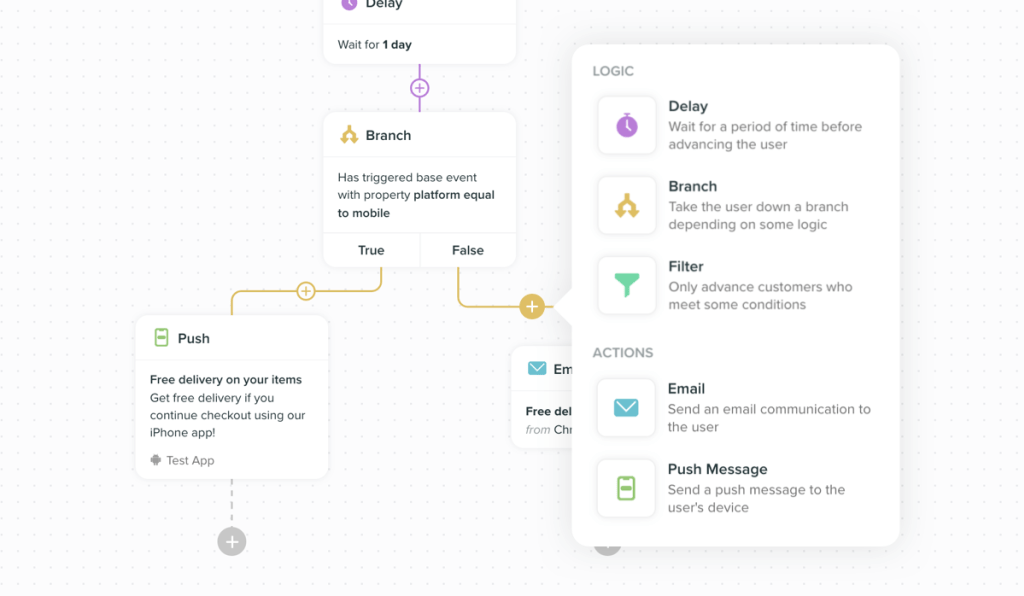
Customer Journey creation - the platform easily creates a visual path for the marketing team to curate messaging based around timing, channel, behavior as well as add split testing logic and exit criteria so we target only the audiences we want.
Customer Success - one of the best teams I've ever had the pleasure of working with. I'm able to move so much quicker because they really create a helpful partnership.
Audience segmentation, the platform is easy to work with even if you're a first time user, they do a great job of visually showing the logic and the and/or/none type rules.
In-app channel, although it works, has some shortcomings in UI functionality or system backend logic, which suggests it is built on an email send-out architecture.
Drag and drop editor has its own limitations - it isn't perfect. You can't create some basic designs.
While Vero offers some WYSIWYG editing, it's on the limited side, as it mostly allows you to edit copy, but not necessarily the layout.
The UI/UX has improved dramatically over the course of the last few years, but it can still lag from time to time and experience sluggishness.
While reliability is really good, it does have lapses from time to time that will introduce delays into emails being sent out. Once or twice, the system went completely down for a period of time.
Its a robust platform that can serve complex business needs. Current and futures. It tries to adapt an newest trends and has good CS and CSM specialists.
Iterable is there like 99.9% of the time. However, when it goes down, it grinds us to a halt. Most of the time, outages are an hour or less, but if that's at a peak time, it can be a nightmare. That said, when the worst does happen, there are frequent updates and an easy situation tracker that give you an estimate of how much longer you'll have to wait for the issue to be resolved.
The API is super quick. The UI can be a little sluggish depending on what you're loading, but overall Iterable performs great. Iterable appears to do a good job of making processes async so that one action isn't blocking another.
I've never experienced any issues with Iterable. As I and my colleagues have learnt the system and it's features, response to questions and advice from our account manager is always quick. Kevin knows the product well, and with the few tricky questions has hasn't been able to answer he's been quick to get back to us.
My understanding is that Mailchimp has evolved a lot since we moved to Iterable 4 years ago, so any comparison is legacy. Keeping that in mind, Iterable is far more sophisticated, especially the journey builder, personalised STO by user and segmentation.
Vero's price tag is far more attractive but for what you will find to be clear and obvious reasons. Vero has no CRM unlike HubSpot and Infusionsoft. Vero also has limited tracking unlike the seemingly endless possibilities offered from HubSpot which as we all know comes with at a significant cost, often not feasible by a small startup company.
We've definitely tested scalability, and it's no line - it works. The process is pretty easy. Most of the times it goes off without a hitch. Any time we do encounter issues, our support team is quick to get on the job and very communicative as they work us through a successful launch.
I do not have hard numbers, as I am not in the department that deals with those kinds of quantifications of impact. However, I do believe the use of Iterable has been a positive thing for us in providing more comprehensive data that is useful when dealing with customer tickets.
The overall costs of using Vero have been much lower than using two comparable products that handle transactional emails and newsletters, respectively. MailChimp has relatively recently integrated their Mandrill product for transactional emails, so that's worth looking at as well.
Using a single product for many things lowers the learning curve, as team members only have to learn one product well, rather than several.
While infrequent, Vero's outages have impacted our operations at times. If absolute reliability is crucial to your business, then you may have to find a larger provider with a more robust infrastructure. As mentioned, though, it hasn't been a big problem for us.