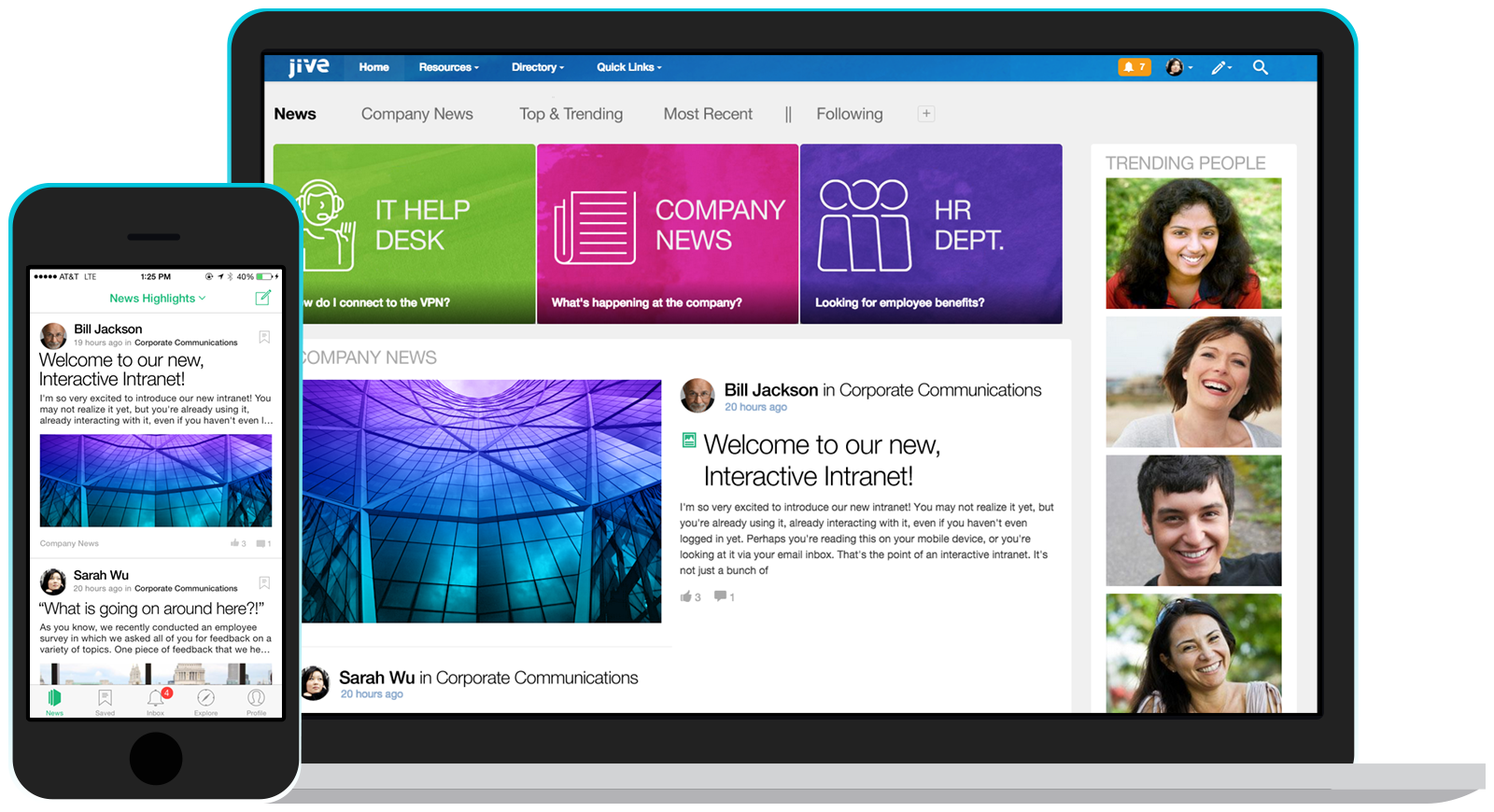
Jive Software, part of the Aurea family of customer experience solutions, provides the gateway to an organization's most important assets – its knowledge and people. Jive's interactive intranet solution promises to connect people, information and ideas to help businesses outpace their competitors. The vendor says the product has more than 30 million users worldwide across every industry, and is consistently recognized as a leader by top analyst firms.
N/A
Microsoft Viva Goals (discontinued)
Score 8.6 out of 10
N/A
Microsoft Viva Goals (formerly Ally, or Ally.io) was a Strategic Goal-Planning & Execution Management software. Ally.io became a Microsoft brand after the October 2021 acquisition, and is slated for retirement December 2025.
$48
per year per user
Slack
Score 9.0 out of 10
N/A
Slack is a group messaging or team collaboration app that aims to simplify communication for businesses. Features include open discussions, private groups, and direct messaging, as well as deep contextual search and message archiving, and file sharing. Slack integrates with a number of other tools, such as MailChimp, Dropbox, and Google Drive. Slack was acquired by Salesforce in December 2020.
The product is free to use, and also has paid plans with more features and greater controls.
The…
$0
Pricing
Jive
Microsoft Viva Goals (discontinued)
Slack
Editions & Modules
No answers on this topic
Microsoft Viva - Learn Module
$48
per year per user
Microsoft Viva - Insights Module
$48
per year per user
Microsoft Viva - Topics Module
$48
per year per user
Microsoft Viva Suite
$108
per year per user
Free
$0
Pro
$7.25*
per month per user
Business+
$12.50*
per month per user
Enterprise
Contact Sales
Offerings
Pricing Offerings
Jive
Microsoft Viva Goals (discontinued)
Slack
Free Trial
No
No
Yes
Free/Freemium Version
No
No
Yes
Premium Consulting/Integration Services
No
No
No
Entry-level Setup Fee
No setup fee
No setup fee
No setup fee
Additional Details
—
—
*Per active user, per month, when paying once a year.
Pro is $8.75 USD per active user when paying month to month. Business+ is $15.00 USD per active user when paying month to month.
More Pricing Information
Community Pulse
Jive
Microsoft Viva Goals (discontinued)
Slack
Considered Multiple Products
Jive
Verified User
Anonymous
Chose Jive
We had a Google phone number set up before and Jive was a lot better option than that. It is more consistent and can be configured much easier and with more advanced settings. Additionally, based on the pricing as well as working with the rep on our account, it was a perfect …
We also use Skype to communicate in our organization. They are both useful for organizational communication. The good thing is in Jive, you will have your own personal timeline. Jive also has a newsfeed or timeline that you can browse where you can see the latest updates from …
Jive provided phone support which can be useful in case of emergency. Jive's initial pricing was free which helped jumpstart the process. It also provided JIRA integration which we needed for certain teams. Jive also had Zendesk integration which was useful for support teams to …
We use Jive to keep in touch and share mass updates/important information to the company. It's a good way to keep up to date on what's going on, read articles others share and get to know each other a little better.
We found that Jive had integrations with the existing IT infrastructure/tools which was nicely aligned with our strategy of playing nice with the existing ecosystem, rather than compete against it. Jive uses a technology stack that is well known by our organisation …
I honestly don't recall what we briefly used before Jive - it wasn't good and didn't last long. I think it was under-utilized because you couldn't really do a whole lot with it. Jive does pretty much everything we need it to do, so for that reason alone, Jive is the superior …
I was not involved in the decision to implement Jive versus competitors. My presumption is that the feature set at the time was attractive compared to options like SharePoint. Useful to note that SharePoint seems to have closed the gap in recent years.
I think Jive is a very unique platform in that it is very user intuitive, and acts just like the social networks we've all grown to love and used to. I think it's a great way for the team in disparate locations to stay in touch, and a great way for management to monitor …
Very powerful collaboration tool, intuitive, easy to use and commonly used by software vendors - so once you are experienced with it you can apply your knowledge using it in many places.
Jive is a little behind the curve in comparison with the latest Microsoft features. Jive's lack of native capabilities to support work that requires process or structure increasingly puts it at a disadvantage.
Jive works more with how people actually work and not how admins think that people should work. For example, relying on a folksonomy of tagging instead of a restricted taxonomy is far more practical with how users actually search for content. By putting the power to the users, …
Without getting into specifics, Jive is relatively strong in terms of more 'ready to deploy' business solutions that require less overhead on the client organization side in terms of IT infrastructure, operational support and ongoing administration and maintenance. While some …
Verified User
Anonymous
Chose Jive
Drupal would be much better suited. They have fast version upgrades and immediate customer support. Jive lacked in all those areas
Verified User
Anonymous
Chose Jive
I have worked on Lithium and Liferay. LifeRay has an advantage that it is opensource and will be cheaper. However it lacks the ton of features provided by Jive. Lithium does not support advanced customizations (except for theming). Jive does have the capability to customize …
Again, Ally ranks very high and this is because they continuously work towards improving their software, platform and solutions. I believe that they have been very innovative and are adding important layers to help keep an OKR program culture relevant and beneficial to its …
Ally and Sigma are very different tools. However, they are both integral to my team's daily work and success. One of their common strengths is the responsiveness of their support team. I always feel that my questions are being answered in a clear and informed way. Another …
Slack was more of a company directive. Teams has its strengths. But Slack definitely seems more mature in terms of features that engineering teams love. Video conferencing is much better in teams.
I think it stacks. I haven't seen those products in the last few years, but I feel like the way Slack has evolved and how much integration it has with Salesforce. I don't think any of the other tools I've seen do that.
In my opinion, the closest to Slack in terms of UI is Discord. But Slack is much more professional with more functionalities that doesn't require very technical knowledge (good for our older staff who began their digital journey within the last decade). In terms of workflow …
better price and less spam with Slack. It was the best decision to switch to this communication platform for our company. We would do it again if given the opportunity.
Teams has an edge over Slack as teams is also a meeting platform Copilot by teams is very well integrated tot eams making it super easy to use AI without extra steps and additional integrations Teams is also great with long messages / rewording messages and any vocabulary …
The other platforms have valuable features (like progress kanbans and storage for big files) but none of them work on their own. Slack is the central hub that we use for all communications, discussions, and meetings.
Slack excels at versatility and ease-of-use. Everyone knows …
In comparison to Teams, I think Slack is a much nicer platform to use. If your technology department allows you to integrate third party applications, it can work really well paired with zoom, sharepoint etc. I think for many mid sized businesses it can be a good fit to enhance …
Slack is better suited for actual work teams rather than communities, so it wins against Discord. About HipChat - in my opinion, it was a dinosaur that is not discounted, and it's obvious why, considering the type of product Slack delivered!
From a corporate standpoint, I don’t really have another example. On a personal level, the closest comparisons would be WhatsApp, Messenger, or KakaoTalk. To me, it feels like — as I said — the corporate WhatsApp. Not that Salesforce wants it to be compared that way or used …
No, I use many. I use Google Meet, I use teams, I use many others. Again, it's the same, not many things, but if I'm repeating myself, it's all about sharing the information, how quickly it's effective, the quality is good, the huddle is fine, you can share all the, so all the …
Microsoft Teams feels clunky in comparison to Slack. Slack feels more versatile and intuitive, and much more tech minded then Microsoft Teams does. I would say Microsoft Teams may have the advantage if your business is fully with Microsoft (ie the full Office suite), but other …
I've dabbled with Microsoft Teams and Zoom's chat features in past roles at startups. Teams integrates well with Office but feels clunky for quick searches and daily chats. Zoom is great for video but lacks robust file sharing and app integrations.
Slack wins for us with its …
Teams and Slack both have Pros and Cons. We use both for communicating. Microsoft Teams is good from the prospective that you can set up Distribution Groups and Private Groups for sharing out links from One Drive and Sharepoint. The integration is built in so that all the …
Slack holds up fairly well with the others. They all have the same basic features. Where they do differ is the execution. You can tell that for Teams and Discord, they had Slack in mind when they were designing their system. These two would be the closest to Slack, even in …
The applications i have used earlier is not much user friendly, I can not do video calls in groups and tagging system is not available accross the company. Feedback and survey or process updated delivery feature makes Slack different than other companies. Slack is really time …
I like Slack better than ClickUp, because I would spend 30-60 minutes a day updating my ClickUp tasks. The way ClickUp was used was very micromanaging. I billed by the hour, so I was willing to put in the time to alert the boss what tasks I was working on.
Teams is better to schedule meetings with and integrates with Outlook well, but that leads to duplicate notifications for things, which is distracting and a waste of time. Messaging in Teams not great compared to Slack, and has the potential to have people outside your …
Ease of use is a game-changer. Slack works so intuitively. People started collaborating automatically, and digital communities started to appear. We haven't seen that kind of engagement with other tools or workflows. It makes working together fun, and that is something that …
It's just an actual messaging soft ware to use, compard to other that can be underwhelming or just not useful when your company is growing, Slack keep unity and option for communication that caters anyone, depending on what they feel comfortable and with what type or works they …
Slack offers great user interface that is easy to navigate through. Customer support team are very user freindly and helpful. The pricing of Slack is fairly affordable compared to other product. Great integration capabilities with other products and the search feature is …
To me, there is no competition between Slack and Microsoft Teams. In my opinion, Slack crushes MS Teams in every regard and is a pleasure to use. I think MS Teams on the surface looks like it has a comparable feature set, but when you actually USE the app, there's no question: …
The content in the news section isn't totally responsive - meaning if I have a small window taking up half my screen, the images for the headline articles may not load properly and when I maximize that window, it's left with ugly half-loaded images. Also, the collaboration feature for Office documents is great in theory but tends to cause more pain than it's worth to just download the document and open it separately in Word or Excel.
I believe Ally.io to be one of the best OKR software tools available and it can be deployed easily to small, medium, large enterprises. The tool is easily scalable and its implementation can be deployed without necessarily having a pilot test. I can not find scenarios where it would not be appropriate.
Slack suites well for multiple scenarios. (1) table stacks 1-1 and group conversations. (2) Level of integrations with external systems like, Confluence, Google Docs, JIRA, etc. (3) Nice integration with Claude allows lots of automation possible. (4) Allows external people (outside the company) to participate. This is great for direct customer interactions.
UI/UX can be improved on further--this has been highlighted to them. It is understandable, as they are still growing.
Different filters for view options are missing at this point. As a result, it becomes difficult to get customized reports/views. For example, the tree view of OKRs does not show the entirety of the tree on one page; it keeps breaking to the next page. This has also been highlighted and they are working on a release for the same.
Permissions for making changes at different levels (company, team, and individual) should be worked on to ensure that individuals cannot add goals at the company level.
Undoubtedly Slack’s search function is powerful but sometimes it is difficult to find specific messages or files in very active channels with high message volumes. This needs an improvement.
I have experienced notification issues on my phone. I am not receiving notifications and have missed important updates as a result. I tried uninstalling and reinstalling the app, but the problem still persists.
The Business Plus plan does not include support for data loss prevention or offline backup providers.
There are always external factors that can impact this decision but currently, the Jive platform is maintaining its lead in the market place in this area. If the innovation in this space by Jive continues, then this number will remain high. Integration with other systems and adaptability to changes in the market or in client needs will also make this decision hard to predict more then 6 months into the future
Slack sitll lacks in functionality. It's better than Skype for Business in many ways, but it is still another chat/message board app. It has limits in free version and paid versions. Also Windows app has errors that bother me, for example, I see number on one of my team's icons. It suggests that one of channels has unread messages; I check all channels - no unread messages, but that "1" still appears
My rating was 7. Its intuitive interface and user-friendly features like channels, threads, and integrations make it excellent for team communication and onboarding. However, its usability is held back by the resource-intensive desktop app and cluttered feeling in large workspaces. The mobile app's performance and unreliable notifications have also been noted as weaknesses.
Uptime was OK. But there was one day that the system crashed for a whole day. Our company was unable to operate. And all the plugins to word/excel froze causing those systems to freeze.
Jive posted a statement to the media saying all customers were up, but we were not.
Yes, the app works 24/7. I don't even recall having any period that we could not use since the implementation. Even the maintenance periods are barely noticeable and our work is not impacted by it when it happens.
Slack is a soft app, we don't have many issues with it. I recall one or two people complaining about something during our usage period, but I didn't have a bad experience. When the app is slow, usually the problem is with my computer or my internet. The app works just fine.
They did an OK job when I needed them. Except for the one day the system went down. Jive pointed the finger at the hosting company, and the hosting company pointed the finger at Jive. No reliable information came to us.
Whenever I've had to troubleshoot an issue with Slack (which, to be honest, has not happened very often), their online documentation has been easy to locate, easy to understand, and effective in resolving my issue. Slack's ever-growing popularity also means that there's a large community of practice out there that can be depended upon.
Jive online training is there. It is OK/average. I feel some other companies are doing better. It is not a piece that is required to have a successfully implementation, but it could be useful to improve it
I honestly don't recall what we briefly used before Jive - it wasn't good and didn't last long. I think it was under-utilized because you couldn't really do a whole lot with it. Jive does pretty much everything we need it to do, so for that reason alone, Jive is the superior tool.
Teams and Slack both have Pros and Cons. We use both for communicating. Microsoft Teams is good from the prospective that you can set up Distribution Groups and Private Groups for sharing out links from One Drive and Sharepoint. The integration is built in so that all the Microsoft apps run natively with each other. Slack benefits from organizing different topics in channels that are all under one overarching project. These channels are easily created or destroyed depending on the coding issue at hand.
Improved communication and coordination to move companies from pre-POC, to POC, and then to paid partnership at a faster pace
Increased observability and visibility, in terms of time to detection and time to resolution of issues on production environments
Reduced friction in scheduling and executing synchronous communication, either directly through Slack huddles for quick calls or through the Zoom integration for longer meetings