KickFire’sB2B solutions provide account-level information such as industry, revenue, employee count, and more based on an IP address. KickFire’s proprietary TWIN Caching® technology and robust firmographic database deliver business intelligence for first-party intent, content personalization, account-based marketing, predictive/intent, data enrichment, and much more. KickFire offers IP address intelligence and B2B firmographic data through its LIVE Leads platform, API, and integrations…
N/A
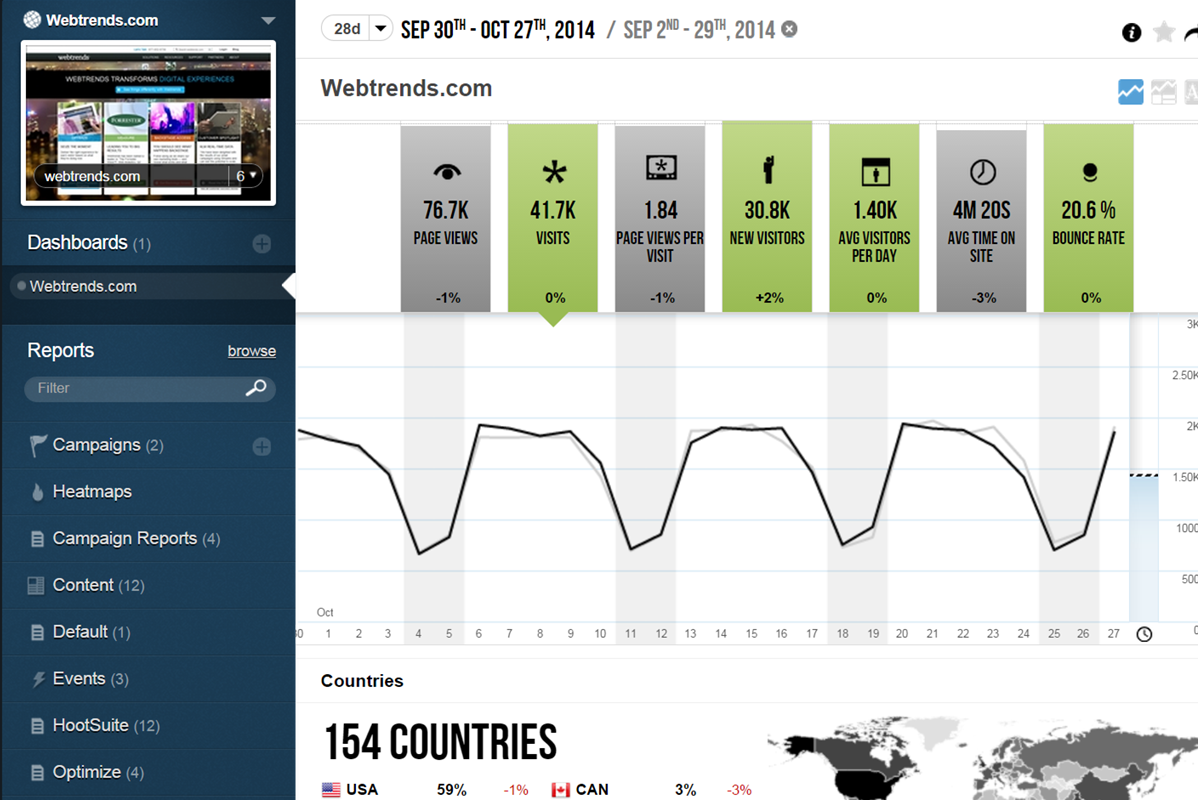
Webtrends Analytics
Score3 out of 10
N/A
WebTrends provides an enterprise web analytics platform and, according to Forrester, has a strong focus on support for mobile and social channels and a very open platform. Webtrends competes directly with Adobe Site Catalyst, IBM Coremetrics. and comScore DigitalAnalytix.
N/A
Pricing
KickFire
Webtrends Analytics
Editions & Modules
No answers on this topic
No answers on this topic
Offerings
Pricing Offerings
KickFire
Webtrends Analytics
Free Trial
Yes
No
Free/Freemium Version
No
No
Premium Consulting/Integration Services
No
No
Entry-level Setup Fee
No setup fee
No setup fee
Additional Details
—
—
More Pricing Information
Features
KickFire
Webtrends Analytics
Prospecting
Comparison of Prospecting features of KickFire and Webtrends Analytics
Feature
KickFire
8.5
2 Ratings
10% above category average
Webtrends Analytics
-
Ratings
Identification of new leads
9.02 Ratings
00 Ratings
List quality
8.02 Ratings
00 Ratings
List upload/download
8.02 Ratings
00 Ratings
Load time/data access
9.02 Ratings
00 Ratings
Sales Intelligence Data Standards
Comparison of Sales Intelligence Data Standards features of KickFire and Webtrends Analytics
Feature
KickFire
7.3
2 Ratings
6% below category average
Webtrends Analytics
-
Ratings
Contact information
6.02 Ratings
00 Ratings
Company information
8.02 Ratings
00 Ratings
Industry information
8.02 Ratings
00 Ratings
Data Augmentation & Lead Qualification
Comparison of Data Augmentation & Lead Qualification features of KickFire and Webtrends Analytics
For small businesses that don't have big budgets for marketing automation, VisiStat is an ideal first step. For companies that have sophisticated systems in place, VisiStat will augment your analytics and provide a deeper dive into your website activity. Since the implementation involves adding javascript to your site, the user should be familiar with how to do this
A de minimis incentive was given to thank the reviewer for their time. The incentive was not used to bias or drive a particular response, nor was the incentive contingent on a positive endorsement. More Info
Scenarios 1. If you want to use web server log files as input to your web analytics, then Webtrends will provides a good product, with great ease of implementation. Don't even think about being cheap on hardware, and make sure Webtrends runs on real servers, not in a VM environment. 2. If you want to use Data Tagging, similar to Google Analytics or Site Catalyst, Webtrends has a powerful product, just be prepared to pay. 3. If you are new to Web Analytics, but it is the strategic direction, start with Webtrends on Premises. Questions to Ask 1. What are you trying to accomplish? 2. Can you place a dollar value on the benefit that you expect/need from Webtrends? 3.Can you live with Webtrends running SaaS?
De-anonymizes website activity at the account (company) level.
Identifies net new target accounts.
Displays click path, time on page, time per session, and engagement level of each de-anonymized website visit.
Gives great daily insight on watchlists you've set up.
Delivers every possible de-anonymized visit with little filtering for accuracy.
More on the watchlists. I really love that you can receive immediate alerts on website visits from accounts you've listed on your watchlists. This way, you never miss the window of opportunity to reach out to your key targets while they are currently on your site.
Salesforce integration is good. KickFire pushes most recent website visits, pages visited, website click path, activity percent change, and more to the given account in Salesforce. You can then create reports and run them regularly to see which accounts are surging in website activity. This is also great for account prospecting, and for planning your sales outreach plan of attack. You can see which bits of your website content are most interesting to the company, and which products they are most interested in.
A de minimis incentive was given to thank the reviewer for their time. The incentive was not used to bias or drive a particular response, nor was the incentive contingent on a positive endorsement. More Info
Control privacy, data sharing and competitive industrial knowledge using Webtrends on premises
Great control over custom reports, custom dimensions and metrics
Flexible tool which allows multiple methods of data capture. To my knowledge it was the first tool with a Tag Builder / Tag Management function built in via a supporting website.
A de minimis incentive was given to thank the reviewer for their time. The incentive was not used to bias or drive a particular response, nor was the incentive contingent on a positive endorsement. More Info
The big downside, the elephant in the room, is that it does not (as of right now) have on-demand segmenting, drilldowns, etc. You have to think of what you want in advance and create those reports then analyze some data. This is huge. You can, of course, re-analyze old data after creating new reports but you still have to wait. (This deficiency may become obsolete with the release of Webtrends Explore later this month (May 2014).)
It has fewer mature integrations with other products and databases than competitors do, although I'm told it works with SharePoint better than anything else does.
Its attribution modeling capability is behind Google Analytics'. In my humble opinion, this could be changed quickly if Webtrends would make some tweaks to its standard visitor history files (i.e. preserve the order in which past visits were sourced beyond the single most recent one, rather than storing all those past sources as a randomized list).
It doesn't incorporate statistical tests, confidence intervals, or statistical associations. However, this same criticism can be applied to its competitors (other than A/B Testing products). It's a tabulation program, as they all are. In this respect, web analytics tools as a group are relatively primitive. Sorry to bring this up as a criticism of Webtrends but it's my pet peeve about the whole industry and I just have to say it. (p.s. take advantage of the heavy-duty Webtrends Scheduled Export functionality to get really granular data that you can feed to a stats program to get significances.)
Although the documentation, help screens, phone support and the knowledge base have improved tremendously in recent years, there is still a pretty steep learning curve because it is different from the tools that entry-level users may have already been exposed to. This can be a shock and many users are alienated at first because they just don't get some of the fundamentals at first. I'd like to see much better help screens that are thoroughly interlinked with the KB and documentation. Having superb online support would make a world of difference with the adoption of this basically powerful tool.
A de minimis incentive was given to thank the reviewer for their time. The incentive was not used to bias or drive a particular response, nor was the incentive contingent on a positive endorsement. More Info
I would be willing to try Webtrends again AFTER some research from other users. I would need to see that users mention better and faster customer support on questions and issues that arise while using the software. The software is capable of vast and incredible things, but if it isnt properly set up and supported during use, it is just a big hassel and waste of everyones time and money.
A de minimis incentive was given to thank the reviewer for their time. The incentive was not used to bias or drive a particular response, nor was the incentive contingent on a positive endorsement. More Info
If I could give it a 0, I would. Not having an intuitive user interface made it impossible to convince non-analytic business users to use the tool on their own. Even as a seasoned analyst, frequent calls were needed to get what should be simple tasks done. Account managers don't understand the tool either, and have to refer you to technical support
A de minimis incentive was given to thank the reviewer for their time. The incentive was not used to bias or drive a particular response, nor was the incentive contingent on a positive endorsement. More Info
A de minimis incentive was given to thank the reviewer for their time. The incentive was not used to bias or drive a particular response, nor was the incentive contingent on a positive endorsement. More Info
The v9 admin interface and v10 reporting interface work as well as expected, but have a tendency to be pokey, especially for bulky reports and whenever you're connected to wifi. I much prefer using the REST API for all reporting for this reason, which simply dumps out the data and doesn't bother with the user interface.
They are very good at solving cases that I bring to them. I'd like to see more proactive support to make sure we are getting the full value out of the solution.
A de minimis incentive was given to thank the reviewer for their time. The incentive was not used to bias or drive a particular response, nor was the incentive contingent on a positive endorsement. More Info
I once went on to Twitter to ask for help from my network of analytics people, and Webtrends themselves responded. They have been an excellent partner in making sure that their product is being used to the best of it's ability and I greatly appreciate that. Both Omniture and Google Analytics, do not have that level of support over social media
The in-person training was comprehensive enough to get you started, but I strongly recommend having a more experienced person when beginning with the tool.
The tutorials are very good and they explain how to get started using the system. The online webinars are very good for advancing your knowledge of the product.
A de minimis incentive was given to thank the reviewer for their time. The incentive was not used to bias or drive a particular response, nor was the incentive contingent on a positive endorsement. More Info
Webtrends provides several free webinars over the course of the year, many of which I would expect to pay for. The people providing the webinars seem to have a good feel for real-world application of the product.
A de minimis incentive was given to thank the reviewer for their time. The incentive was not used to bias or drive a particular response, nor was the incentive contingent on a positive endorsement. More Info
Careful planning and patience. Use a non-public test site to fine tune tags and reporting. Despite best laid plans, there will be surprises when you collect the data, run the analysis and begin generating reports using the tool. Perform a tag audit to ensure tags fire as desired.
I covered this pretty extensively in the cons. The key differentiator here is that KickFire serves up almost all the data (or so it seems) to the end client. The client then has to do their own work on interpreting it. This is good because it means we don't miss out on any website activities, but it's bad because we get a lot of false positives. 6sense uses the confidence score approach I mentioned in the Cons section, which means the match rates of the data we get are much higher. Our experience with Clearbit comes from other tools that are built on it (Bombora, Drift, etc.), and it has not been great. We've seen many more inaccuracies with Clearbit.
A de minimis incentive was given to thank the reviewer for their time. The incentive was not used to bias or drive a particular response, nor was the incentive contingent on a positive endorsement. More Info
Webtrends has its work cut out for itself considering you have the behemoth Google Analytics and Google Analytics Premium having a strong offering and brand recognition for the price of free. After reviewing the paid service I'd suggest you start off with GA as a cheaper alternative that is just as robust, if not much more flexible in regards to the reporting and goal tracking needs for our company.
A de minimis incentive was given to thank the reviewer for their time. The incentive was not used to bias or drive a particular response, nor was the incentive contingent on a positive endorsement. More Info
A de minimis incentive was given to thank the reviewer for their time. The incentive was not used to bias or drive a particular response, nor was the incentive contingent on a positive endorsement. More Info
A de minimis incentive was given to thank the reviewer for their time. The incentive was not used to bias or drive a particular response, nor was the incentive contingent on a positive endorsement. More Info
Webtrends has had a positive impact on site visitation because it allowed us to understand the sources by domain for site traffic and find out ways to increase visits from those domains.
Webtrends has also allowed us to understand areas of optimization on the site, which has had a positive impact on the overall user journey on the site, likely leading to longer site duration and engagement.