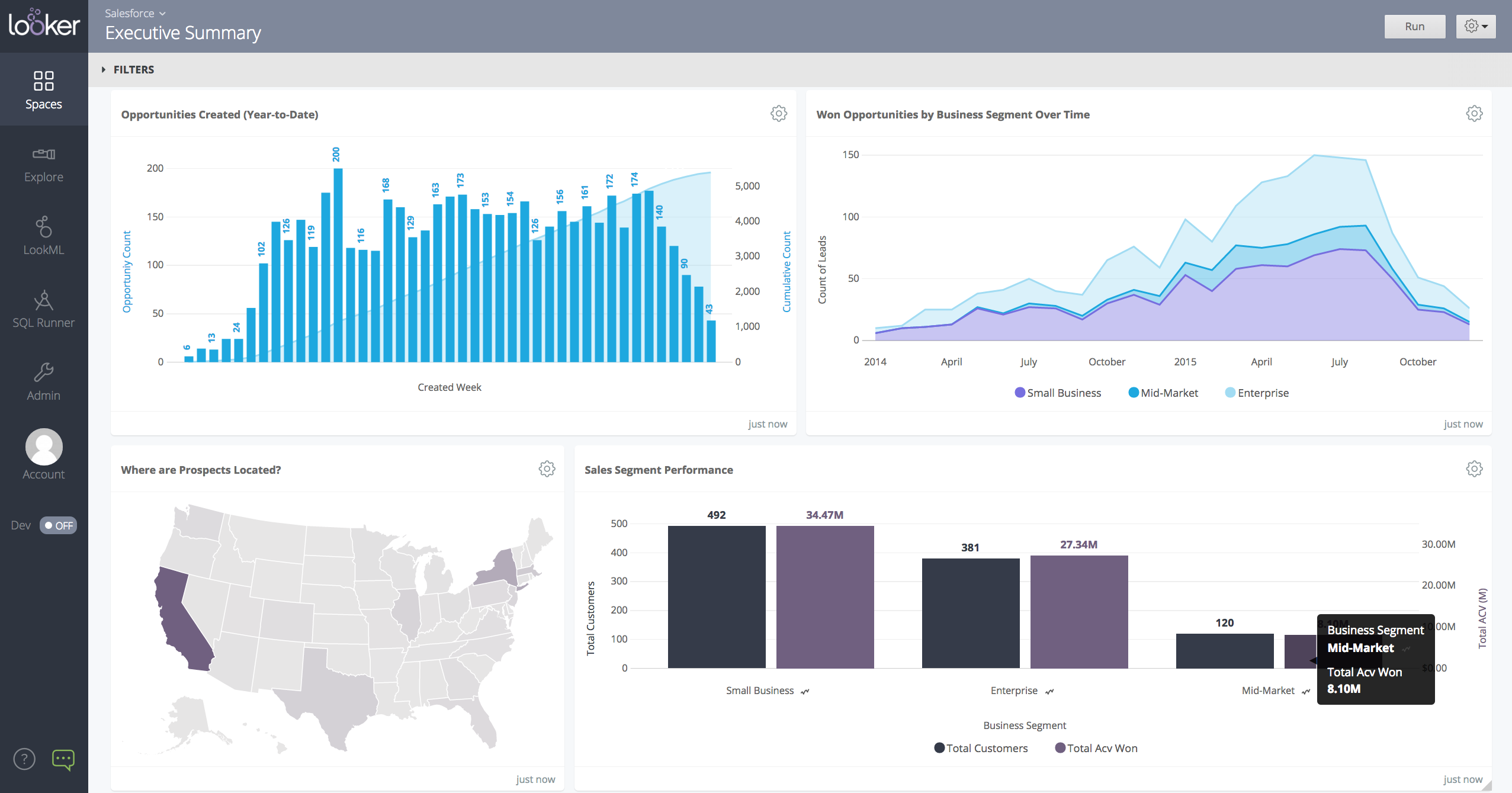
Looker is a BI application with an analytics-oriented application server that sits on top of relational data stores. It includes an end-user interface for exploring data, a reusable development paradigm for data discovery, and an API for supporting data in other systems.
N/A
Tableau Cloud
Score 8.1 out of 10
N/A
Tableau Cloud (formerly Tableau Online) is a self-service analytics platform that is fully hosted in the cloud. Tableau Cloud enables users to publish dashboards and invite colleagues to explore hidden opportunities with interactive visualizations and accurate data, from any browser or mobile device.
$15
per month per user
Pricing
Looker
Tableau Cloud
Editions & Modules
No answers on this topic
Tableau Viewer
$15
per month billed annually per user
Enterprise Viewer
$35
per month billed annually per user
Tableau Explorer
$42
per month billed annually per user
Enterprise Explorer
$70
per month billed annually per user
Tableau Creator
$75
per month billed annually per user
Enterprise Creator
$115
per month billed annually per user
Tableau+
Contact Sales
Offerings
Pricing Offerings
Looker
Tableau Cloud
Free Trial
Yes
No
Free/Freemium Version
No
No
Premium Consulting/Integration Services
Yes
No
Entry-level Setup Fee
Required
No setup fee
Additional Details
Must contact sales team for pricing.
—
More Pricing Information
Community Pulse
Looker
Tableau Cloud
Considered Both Products
Looker
Verified User
Director
Chose Looker
The learning curve for Tableau Cloud was too steep for our team. After watching a couple of YouTube videos, anyone can begin connecting data sources and creating reports with Looker. Looker is also free with Google Workspace, making the decision between Looker and Tableau a …
If you company is using Google suite products, Looker is a no-brainer. Tableau is probably the most flexibly but as a result it has the least governance capabilities. Power BI is kind of old-school in terms of how it feels to use it. I think in general, Looker brings a lot of …
Looker was the most customizable option for our business and cost wise made the most sense. They do have a free tier option that some of the other weren't offering to us at the time. Looker has a great- mobile app solution while Tableau is a desktop-based platform. Tableau also …
Tableau provides additional visual functionality and is great for more in-depth visuals or further data exploration, but it is costly and an extremely robust solution for simple data reporting. Looker can't be beat when it comes to integrating with other G-Suite tools. All in …
Looker Studio is not as robust as Tableau or Microsoft BI. So it does not provide quite as much insight or depth and it has more limitations overall then the other major reporting products. However, it is also free and connects perfectly with other Google products. Plus, all of …
Looker is a great fit for our company because we have collaborative analytics workflows and complicated data ecosystems and because of its strengths in data modeling, integration, and collaboration. Brand name and peer recommendations also helps us to select Looker against …
I choose Looker when I need quick charts. It is easier to start and configure, browser-based, and easy to connect with Google Sheets. This gives it a good competitive advantage when comparing pricing—other similar tools have expensive licenses. In a corporate Google …
We use both Looker and Tableau. It depends on the specific team. However, there is a clear correlation that we use Tableau more often when there are more data sources, including financial data.
Looker is considerably easier to learn than any of the other tools listed above. For example, Tableau does offer a robust selection of visualizations, however setting them up and plotting the data correctly is considerably harder than in Looker. Another major advantage of …
Tableau is also a great BI tool, but it felt a lot less flexible to me in terms of customization of data. As a visual platform, Tabluea is incredible; it can produce unbelievably rich visualizations and dashboards. It's also easier to get set up on Tableau too, but ultimately …
Looker was easier to use, better integration with non-standard datastores, such as Prestodb, and Snowflake, and BigTable. Ease of manageability. Creation of reports faster and easier compared to QlikView. Tableau has better heat maps, however, Looker has better drill down in …
Looker is cheaper, by far. Easier to manage. In the end, Looker was a better choice for us, even with its maintenance warts and the headaches with the APIs. Tableau licensing is difficult to manage, at the very least, whereas Looker is not. User management is much easier to …
Looker is a lot easier to connect with our data pipelines and for users to create their own scalable Explores. Before, analysts would have to create separate Tableau dashboards for each ask, but now with Lookers Explores, some teams are able to self serve and create their own …
Looker empowers users to create their own views/dashboards from its web application. The last time I used Tableau (in 2015), only certain license holders could create content from the desktop application. Everyone else was a view only user. On that theme, we found Looker to be …
Looker stacks up very well against the other tools we have evaluated and used. All the tools have their own pros and cons. Looker had a better edge in terms of visualizations when we chose to use it. After several updates, other tools began to have newer features. Looker still …
Looker ended up as the winning product due to its easy to use and flexibility. It's easy for nontechnical stakeholders to learn how to create their Explores. But Tableau gives us more flexibility in creating highly customized visualizations so analysts still rely on it.
It seems more robust then the other platforms. There is a lot you can do from merging many different data sets together by joining them at like points, to creating visualizations of the data, or by showcasing some important data to any number of people within your organization. …
I would say that Tableau Online has the most sophisticated capabilities, but not the most straightforward UI or path to learn and operate within it quickly. It felt more technical than the other products I used and did not look as good, but I also found that it could answer a …
Senior Vice President of Digital/Chief Digital Officer
Chose Tableau Cloud
Tableau Online is much faster to get data sets integrated and being used, accordingly. From almost day one, we were able to integrate our data warehouse and pull data directly into Tableau Online. This made us aware of some of the data details that we had been missing and were …
Tableau does a great job compared to all of these mentioned tools. Other tools also have a great shape-up of dashboards but obviously all have their advantages and disadvantages. The reason Tableau has an edge over all the other tools is because of its excellent visual design …
When data drives potential for new orders, Looker earns its place in our tech stack. If, on the other hand, we are hoping for pipeline generation, Looker is useful if you are willing to repeatedly go check customer utilizations .... it is not appropriate if you are hoping to automate data analysis for this purpose.
If you're using Tableau as the primary BI tool, then Tableau Cloud is well suited to publish and share the results with a wide(r) audience. It is well suited for various degrees of self-service proficiency, from pure consumers of analytical work to more advanced users who can use web editing for smaller or larger adjustments, and even for desktop power users who will publish their work to Tableau Cloud. It has many good ways to organize the content and make it easily accessible via search, favorites, folders, collections ("playlists for your data"), or history ("recents"). It might not be ideally suited if there are many on-prem sources to be used (even though there are options to connect them) or if you have very special requirements regarding custom server setup, which is limited in a shared cloud environment like Tableau Cloud.
Show visited pages - sessions, pageviews - which programs are viewed the most.
Displays session source/medium views to see where users are coming from.
It shows the video titles, URLs, and event counts so we can monitor the performance of our videos.
It gives a graphic face to the numbers, such as using bar charts, pie graphs, and other charts to show user trends or which channels are driving engagement.
Our clients like to see the top pages visited for a month.
I like the drop-and-drag approach, and building charts is a little easier than it was before.
Tableau Online is completely cloud based and that's why the reports and dashboards are accessible even on the go. One doesn't always need to access the office laptop to access the reports.
The visualizations are interactive and one can quickly change the level at which they want to view the information. For example, one person might be more interested in looking at the country level performances rather than client level. This is intuitive and one doesn't need to create multiple reports for the same.
The feature to ask questions in plain vanilla English language is great and helpful. For quick adhoc fact checks one can simply type what they are looking for and the Natural Language Programming algorithms under the hood parse the query, interpret it and then fetch the results accordingly in a visual form.
I give it this rating because it deems as effective, I am able to complete majority of my tasks using this app. It is very helpful when analyzing the data provided and shown in the app and it's just overall a great app for Operational use, despite the small hiccups it has (live data).
Looker is relatively easy to use, even as it is set up. The customers for the front-end only have issues with the initial setup for looker ml creations. Other "looks" are relatively easy to set up, depending on the ETL and the data which is coming into Looker on a regular basis.
Based on comments from our clients, I awarded it this grade. Non-technical customers frequently compliment us on the ease with which they can utilize Tableau Online. Usability is rarely a source of contention amongst our customers. Few complaints have come from me as a user of our internal products.
Somehow resources heavy, both on server and client. I recommned at least 50Mbs data rate and high performance desktop comouter to be abke to run comolex tasks and configure larger amount of data. On the other hand, the client does not need to worry when viewing, the performance is usually ok
Never had to work with support for issues. Any questions we had, they would respond promptly and clearly. The one-time setup was easy, by reading documentation. If the feature is not supported, they will add a feature request. In this case, LDAP support was requested over OKTA. They are looking into it.
I have not had any issues that require customer support from Tableau at this time, which speaks well to Tableau. I have taken an online course with Tableau and it was very professional and well done, so based on that I would assume a similar level of quality for their customer service.
Looker Studio, you can easily report on data from various sources without programming. Looker Studio is available at no charge for creators and report viewers. Enterprise customers who upgrade to Looker Studio Pro will receive support and expanded administrative features, including team content management. So it's good.
In determining whether to go with Tableau Online versus Alteryx, two important factors stood out in determining our go-to solution. First, while Alteryx is an impressive tool for data cleansing, it did not stack up in terms of data visualization capabilities. Tableau, on the other hand, provided us everything we needed in terms of visualizing our data and analytics. The second factor is cost. Well neither solution would be considered cheap, Tableau was the more cost effective solution for our needs.
Looker has a poignant impact on our business's ROI objectives. As an advertising exchange we have specific goals for daily requests and fill, and having premade Looks to monitor this is an integral piece of our operational capability
To facilitate an efficient monthly billing cycle in our organization, Looker is essential to track estimated revenue and impression delivery by publisher. Without the Looks we have set up, we would spend considerably more time and effort segmenting revenue by vertical.
Looker's unique value proposition is making analytical tools more digestible to people without conventional analytical experience. Other competing tools like Tableau require considerably more training and context to successfully use, and the ability to easily plot different visualizations is one of its greatest selling points.