Microsoft Power BI is a visualization and data discovery tool from Microsoft. It allows users to convert data into visuals and graphics, visually explore and analyze data, collaborate on interactive dashboards and reports, and scale across their organization with built-in governance and security.
$168
per year per user
SAP Analytics Cloud
Score 8.1 out of 10
N/A
The SAP Analytics Cloud solution brings together analytics and planning with integration to SAP applications and access to heterogenous data sources. As the analytics and planning solution within SAP Business Technology Platform, SAP Analytics Cloud supports trusted insights and integrated planning processes enterprise-wide to help make decisions without doubt.
$36
per month per user
Vena
Score 8.1 out of 10
Mid-Size Companies (51-1,000 employees)
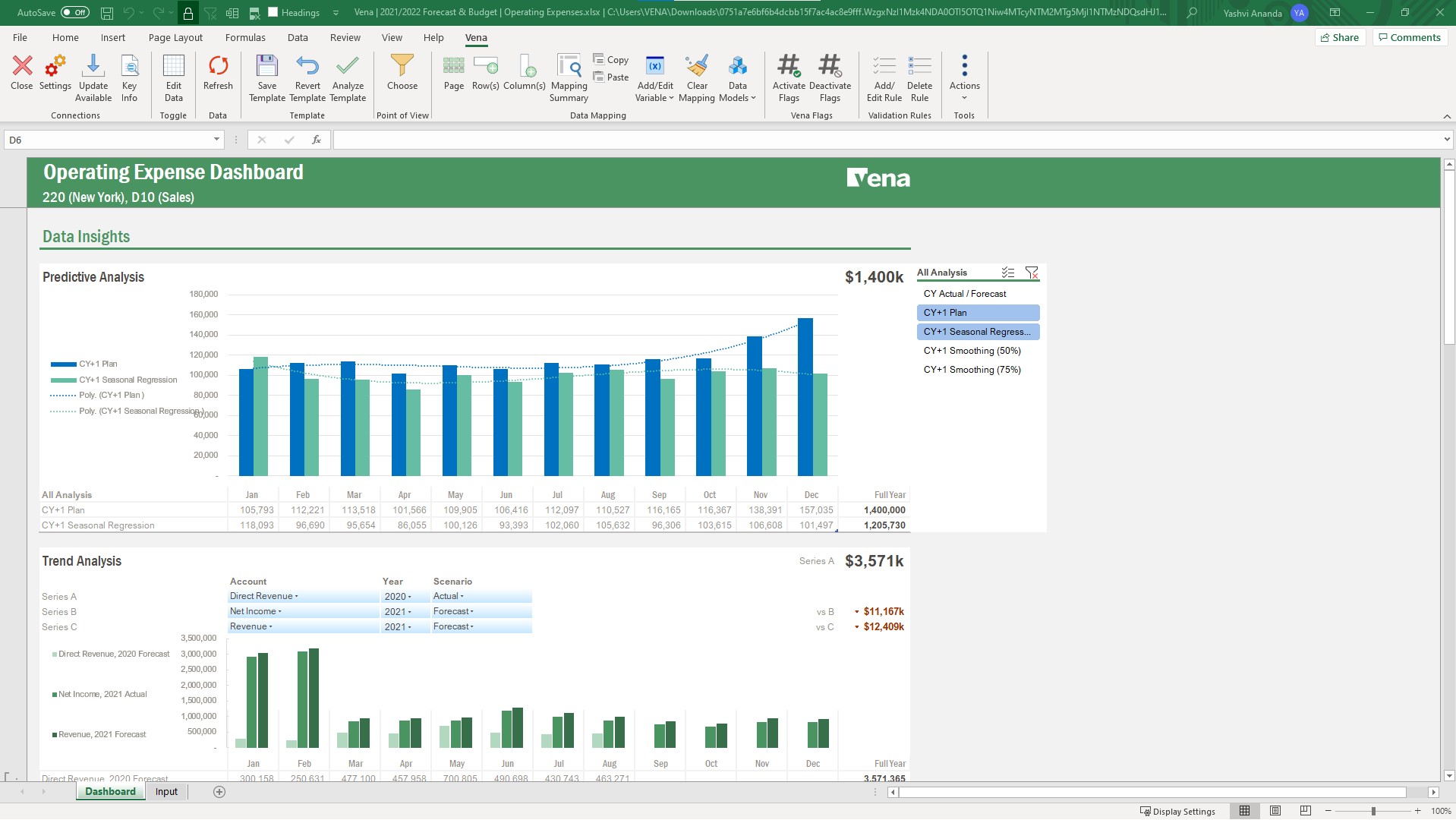
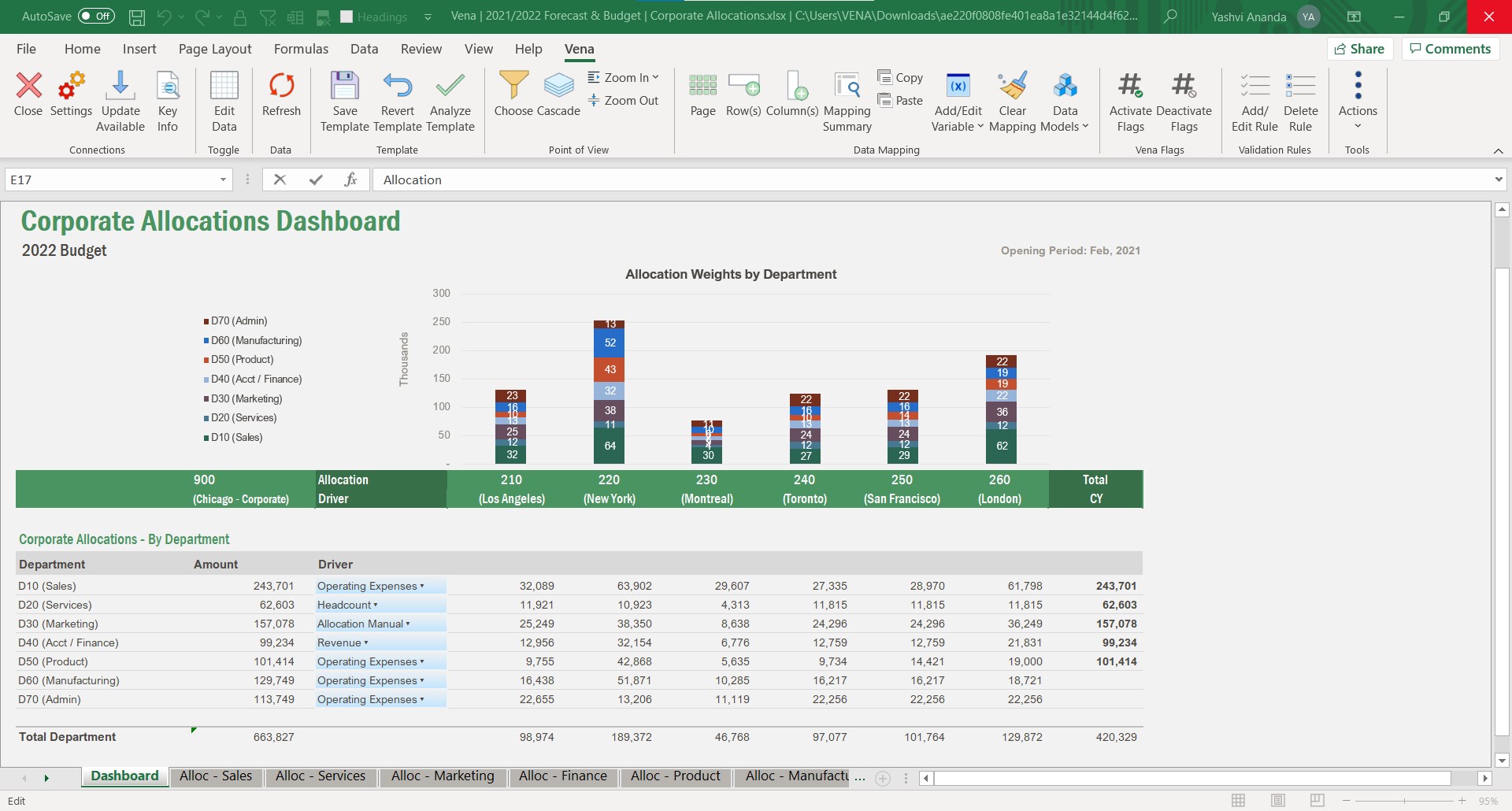
Vena Solutions provides a financial process automation solution to automate Corporate Performance Management, accounting and budgeting, Regulatory & Compliance, and other finance-related processes. It is scaled for medium to large-sized organizations.
N/A
Pricing
Microsoft Power BI
SAP Analytics Cloud
Vena
Editions & Modules
Power BI Pro
$14
per month (billed annually) per user
Power BI Premium
$24
per month (billed annually) per user
SAP Analytics Cloud for Business Intelligence
$36.00
per month per user
SAP Analytics Cloud for Planning
Price upon request
per month per user
Professional
N/A
Complete
N/A
Offerings
Pricing Offerings
Microsoft Power BI
SAP Analytics Cloud
Vena
Free Trial
Yes
Yes
No
Free/Freemium Version
Yes
No
No
Premium Consulting/Integration Services
No
No
Yes
Entry-level Setup Fee
No setup fee
No setup fee
Optional
Additional Details
Power BI Desktop is the data exploration and report authoring experience for Power BI, and is available as a free download.
A 30-day trial with SAP Analytics Cloud is available, supporting analytics enterprise-wide. A trial can be extended up to 90 days on request.
The Professional Plan is the most flexible way to get started quickly and can be added onto as a company grows. The plan includes: Vena Platform, Customer Success Manager, Standard Support and Customer Portal.
Complete Plan includes everything in Professional, plus: Vena Insights, Premium Support, Sandbox Environment, and Expert Managed Services.
For a limited time, new customers who use Microsoft Dynamics 365 Business Central (Online) as their primary ERP can get a free year of Vena and 40% off implementation costs.
Vena also offers special pricing for not for profit organizations. To learn more, speak to an expert.
Power BI is a great tool to create reports and share data. However, it does not have the budgeting, forecasting and predictive modeling tools we need for our Financial Planning and Analysis part of our business. So we also implemented Vena for our financial reporting, …
Power BI stacks up robustly on a visuals standpoint. It has great slicer tools and visuals that are stunning. Content is fresh, easy to transmit and the design of a new dashboard is easy. Power BI is useful in identifying outliers in your data (even data integrity issues). …
Microsoft BI tool does a better job than most of the other software. The reason is excellent visualizations and its capability to connect with various other software and data sources. Tableau does a better job when it comes to tutorials and being more user-friendly. Also …
Like i mentioned earlier, SAP Analytics Cloud is the tool where SAP brought everything together at the right time starting with AI and planning capabilities. With evaluation of different tools for dashboard, this is where SAP made the right decision and this is the tool that is …
SAP Analytics Cloud blends data much better than Mircosoft Power BI because it uses one large dataset in its model instead of the entity-relationship model in Power BI. Everything in Power BI has to be done in the model, which diminishes its capabilities. SAC also has data …
Anaplan is a tool for planning, but with very less reporting options. Integration of Anaplan with SAP source is always a problem and has very less connection possibilities. Even though Anaplan provides very powerful planning features, we have to use multiple tools in the …
I would rate Tableau as number one choice due to intuitive, drag and drop and advanced visualizations. We can build highly customizable reports. Whereas SAP Analytics Cloud(SAC) got less customizable reports but excellent with SAP systems, strong in planning and budgeting tools.
Integration with SAP is the key feature to go for SAC with perks of SAP IQ etc offered from SAP. Usability is quite eased in SAC - makes it easy for users to use and develop their own dashboarding. Cloud is one more feature which enables to the cloud world from SAP and probable …
we have to explicitly publish our data in the form of odata service from SAP system, this require a good amount of work for API development and requirement of SAP Developer skill set. With SAP Analytics Cloud (SAC) this is not needed and the adoption of SAC becomes very easy
All three above examples are market leaders, being an sap consultant and as SAP Analytics Cloud is having tight integration with sap and offers fairly all the important features i use it.
Since we have S4/Hana cloud so accessing data from backend system is seamlessly done in SAP Analytics Cloud with the help of SAP Analytics Cloud cloud connector. We have BI/BW system. Data is loaded into this systems and fetch on SAP Analytics Cloud.
SAC lacks some of the prominent features found in other tools. But a fully functional tool. The way live connections work with SAC and better integration with SAP back-end products makes SAC a preferred choice.
SAC is an extension of our decision to use Datasphere as our Data Warehouse / Data Fabric Solution, which is really an extension of our decision to use SAP as our ERP.
Because the connectivity is natural and is easy to work and develop everything behind the same brand. Also is easy to have all the data under control on this software and easily consume in SAP Analytics Cloud Review. As I said, great advantage of using sap that means all are …
The experience between Vena and Microsoft Power BI is quite different. Vena masters in operating through designed templates that need to be downloaded and viewed. As far as Microsoft Power BI is more dashboard oriented in its presentation. Both have their advantages in their …
Compared to Unit4 FP&A i have found Vena more user friendly in the development.
From a user perspective it is also great that Vena works as a plug in to excel. this keeps the user in an environment where they are familiar with and helps in the learning process
Implementation of any tool like this required a lot of effort and detailed preparation. However, Vena is less complicated than some of the other tools out there. Vena is well suited for the size of our organization and to be managed by a couple finance people with little …
Both the softwares have effectively been integrated together to make my job as an analyst easier. This helps in generating accurate data interpretations and led to better results in sales of our products and improved client services and feedback.
I guess they both compliment each other by integration and by both checks I can get the accuracy in result. And growth in sales by finding the key parameters where we need to work.
Business Development Executive and Lead Generation
Chose Vena
Vena Solutions stands out due to its familiar Excel-based interface, making it easy for our team to adopt without extensive training. Compared to alternatives like Anaplan and Oracle Hyperion, Vena's strong customer support and efficient automation have significantly reduced …
Vena stands out from competitors due to its seamless Excel integration, which allows us to leverage a tool we are already familiar with while adding automation, collaboration, and advanced financial planning. Unlike some platforms that require fully new systems, Vena's …
We evaluated several products over a few years and were comparing everything to our existing Excel templates and manual processes. We didn't pull the trigger on any of the others because it didn't feel like it was worth the investment, both funding and organizational change, to …
Vena being a Excel add in makes it very attractive. Also, there are certain features that Vena had was very fascinating compared to their competitors. It was easy for users to grasp it as it looked and worked just as Excel.
We selected Vena because it offered the following features: API connection with many of our tools (Power BI, Sage Intacct, Salesforce), worked well with both MAC and PC, ability to set up workflows with automated emails, ability to set up permissions by multiple dimensions, …
When debating if we would add Vena Insights to our system, we looked into Tableau and Power BI. Vena was more expensive per user, but because we already pay for Vena for FP&A, it would have ended up costing us more money, time, and effort to maintain a BI system that lives …
Vena blew away Crystal because it was Excel based and had such a flatter learning curve. As a client who has used Vena for 6 years now, I can tell a prospective client that your adoption period should be half if not great than half of what Saint Mary's was, which was less than …
Verified User
Contributor
Chose Vena
As our company grows we need more efficient ways to manage profits, employees, working in a pandemic/hybrid situation across multiple states and more. We have continued to experience rapid growth and found Vena and the Vena partners are the best at simplifying the information …
Verified User
Manager
Chose Vena
BlackLine and Vena are similar in ways that they can help analyze the GL for any variances or discrepancies. At face value, you might think they are separate flows and do not cross. But with the ability to do account recs within Vena, there is indeed overlap. We are in the …
The only tools that are similar are more in the BI realm and Vena provides a much more robust way of interacting with data that the visualization that a BI solution provides. Again, the self-service model of the tool allows for the tool to grow with the individuals of the …
At the end of the day, Vena offered great value without having to involve IT. It was an easy to implement system for us. We could query the data from our financial system and created a process to send it to Vena using Box and Microsoft Power Automation (formerly Flow). Because …
Has significantly improved collation of data and visualisation especially with business across Europe. Has given me the ability to see the Site availability at the click of a button to see which Site is in the "money" and seize opportunities based on Market data
>> Using SAC predictive analytics capabilities for inventory management in a Production line setup has helped generate Purchase Requisitions and Purchase Orders for raw or semi-finished goods without much head-banging into Demand management rules. It does it beautifully with seamless integration with HANA core MM and PP modules, along with BI integration. It has resulted in 30% greater warehouse storage capacity, thereby saving revenue from piled-up inventory and associated manpower costs. >> SAC sometimes shows latency in working out a large data set, thus giving a poor user experience compared to its competition. Also, it may occasionally show misinterpretations when embedding data from 3rd-party systems into the HANA core dataset.
Although I’m having some growing pains with the workforce, it is still much better than maintaining a huge Excel workbook to calculate the workforce, so it lets me answer management questions much faster than I can with my Excel workbook.
Options for data source connections are immense. Not just which sources, but your options for *how* the data is brought in.
Constant updates (this is both good and bad at times).
User friendliness. I can get the data connections set up and draft some quick visuals, then release to the target audience and let them expand on it how they want to.
It makes it easier yo analyse order and related records easily.
We can easily maintain and track the performance of employees in organisation.
Can easily track various aspects for the growth of an organisation thus allowing real time analysis and tracking of organisation's growth and performance.
SAC supports various data sources, but improvements in the ease of connecting to and integrating with certain data repositories, especially non-SAP databases, would enhance the platform's versatility and integration capabilities.
An offline mode for SAC could be valuable for users who need to access and analyze data without an internet connection. Additionally, optimizing performance for large datasets and complex visualizations would contribute to a smoother user experience.
Have another license between power user and contributor that allows building reports that aren't ad hoc, but don't have all the admin rights of a power user.
Have a session on best in class Workforce Planning prior to implementation.
Microsoft Power BI is an excellent and scalable tool. It has a learning curve, but once you get past that, the sky is the limit and you can build from the most simple to the most complex dashboards. I have built everything from simple reports with only a few data points to complex reports with many pages and advanced filtering.
We are planning to review the licensing as we have issues with SAC dealing with huge datasets. Analytics area is good for import models but when we have live connections in place that's when we have issue with SAC dealing with huge datasets in live be it BW or be it HANA models in the backend.
Vena has become an integral part of finance and our daily process. Without it we would take longer to prepare results and decisions will be delayed. Vena has given the whole organization more visibility of results and budgets so that all departments participate more actively in managing their budgets rather than it being the sole responsibility of finance.
Automating reporting has reduced manual data processing by 50-70%, freeing up analysts for higher-value tasks. A finance team that previously spent 20+ hours per week on Excel-based reports now does it in minutes with Microsoft Power BI's automated Real-time dashboards have shortened decision cycles by 30-40%, enabling leadership to react quickly to sales trends, operational bottlenecks, and customer behavior.
I landed on a 7 out of 10 for a few key reasons. The tool is flexible in the sense that we are using very very very (very) little off the shelf solutions and customizing to our needs. Users enjoy having the customized data actions, key variance calculations, and easy to use headcount/salary planning in the same tool. One downside is that users are hard to please when they are used to excel. SAP Analytics Cloud simply is not excel, and the flexibility of excel in a crunch is not there.
I would rate Vena's overall usability as an 8 out of 10. Vena offers a user-friendly interface, especially for those familiar with Excel, making it relatively easy to use. Most features are intuitive. However, some advanced functionalities may require more training or time to master, so it's not a perfect score. Overall, Vena provides a solid user experience that supports efficient financial planning.
I would rate SAP Analytics Cloud an 8 out of 10 for scalability. It offers a flexible, cloud-based architecture that supports expansion across departments and geographies. The platform adapts well to growing data volumes and user needs, making it a strong choice for organizations looking to scale analytics capabilities efficiently.
Vena is seemingly always available. They plan maintenance windows well in advance and always off hours (typically over a weekend) and communicate clearly throughout maintenance about what will be affected. Over 5 years of using the product, I can only remember one time when the platform was unavailable (I believe due to an underlying server hosting issue from their provider), and they resolved the issue and had everything up and running again within 8 hours.
I would rate SAP Analytics Cloud’s performance an 8 out of 10. Pages generally load quickly, and reports run within a reasonable time frame, even with complex datasets. Integration with other systems is smooth and doesn’t noticeably affect performance. Overall, it’s a responsive and efficient tool for business analytics. But
The performance is dependent on how much data and calculations are involved and how complex the security settings are. A simple template or report loads in seconds. A complex template or report can take a while. If there are many users with complex security settings, that will be a factor in the load time.
It is a fantastic tool, you can do almost everything related with data and reports, it is a perfect substitutive of Power Point and Excel with a high evolution and flexibility, and also it is very friendly and easy to share. I think all companies should have Power BI (or other BI tool) in their software package and if they are in the MS Suite, for sure Power BI should be the one due to all the benefits of the MS ecosystem.
Since the implementation stage, the support team has been very helpful and assisting. Even in the later stages, the tech team had quite a rapid response. In general, SAP has provided us with great customer support, let it be for a specific product of SAP or for integration of different modules.
They are very quick to respond when you submit a ticket and typically fix issues quickly as well. I only didn't give this a 10 because there is still an open issue with our Salesforce connection that we've been waiting on now for a few months.
This is the best way to learn and buy-in. The in person effect gives students both a hands on approach but an instruction to be there to customize assistance and understanding. In person also builds greater buy in with your future team on creators. However if your audience is better at on line learning this is another good option.
In hindsight, it would have been easier to have someone there in person. Questions were answered, but with 11 participants, it got a bit chaotic online
The training was structured as a group training to learn the basics of creating a data model and mapping a template. While we had nearly 10 participants, I was the only actual implementer so we probably didn't actually need the training and could have just learned the initial skills from the implementation consultant. Two years later, when we hired a new team member, they completed several modules in Vena Academy (a self paced learning course) which allowed them to get up to speed on the basics with just a bit of supplemental guidance from me as our existing admin.
SAC is a simple solution ad it works fine when connecting it to other SAP tools. On the other hand, connecting it to third party solutions brings difficulties when there's no previous design and the objetives are not clear. It is really important to integrate Business users from the start to provide with valuable business insights
The Vena consultant had great knowledge of both the Vena solution and Excel and Excel functions. He was able to help suggest ways to build our templates that met our requirements using Excel functions we had not previously considered using. And we have been able to use the Excel information he provided in other ways outside of Vena. He was very patient and flexible as we learned the Vena tool and created templates
Microsoft Power BI is free. If I didn't want to create a custom platform (i.e. my organization insisted on an existing platform that I *had* to use), I'd use Microsoft Power BI. For any start-up or SMB, I'd just use Claude & Grok to build it quickly, also for free. Would not pay for Tableau or Sigma anymore. Not worth it at all.
SAP Analytics Cloud and Power BI are both tools that help businesses understand their data, but they have some differences. SAC, made by SAP, works well if your company already uses other SAP products. It's in the cloud, easy to use, and has features for analyzing data, getting insights, and planning for the future. Power BI, made by Microsoft, can be used in the cloud or on your own computers. It fits well with Microsoft tools, is easy to use, and can do advanced data analysis. SAC has built-in planning tools, while Power BI needs extra tools for detailed planning
At the time, we loved that Vena was the only FP&A solution that truly provided MS Excel as the end-user UI, as well as native integration with Certinia (formerly FinancialForce). They also had really powerful controls and permissions, both for users and down to the row level, which allowed us to carefully grant all staff access to their financial data.
Is good for use across multiple locations. It allows users to access data and reports from anywhere, regardless of their location. Can consolidate data from various sources, including different SAP systems and external sources, which facilitates cross-location analysis. SAC enables access to data and models from SAP Datasphere to create new stories. Detailed permissions can be defined for cross-departmental use.
Vena solutios is a software that provides robust tools that help different departments in their statistics and we can visualize a lot of promising and visually attractive data. Vena Solutions' level of scalability is high and sustainable over time thanks to the fabulous technical support that is ready to help us at all times
Many manual data manipulations and exports in Excel have been replaced by the tool, providing management with improved insight into the amount of time spent at each stage of an invoice's lifetime, allowing bottlenecks to be discovered.
We now have more insight into the data, and people with little technical experience can easily build stories.
Automated monthly financial statements saves us 3 hours a month.
Moving reporting away from IT has begun to save hours of IT involvement, which will only grow as we shift more reports to Vena. This frees up IT to work on more important IT initiatives.
Using budget templates saved hours of copy and paste time when gathering inputs from each department.