Microsoft Purview Data Loss Prevention is used to provide intelligent detection and control of sensitive information across Office 365, OneDrive, SharePoint, Microsoft Teams, and on the endpoint. It also helps prevent data loss through identifying and preventing risky or inappropriate sharing, transfer, or use of sensitive data on endpoints, apps, and services.
N/A
Veeam Data Cloud for Microsoft 365
Score8.7 out of 10
Mid-Size Companies (51-1,000 employees)
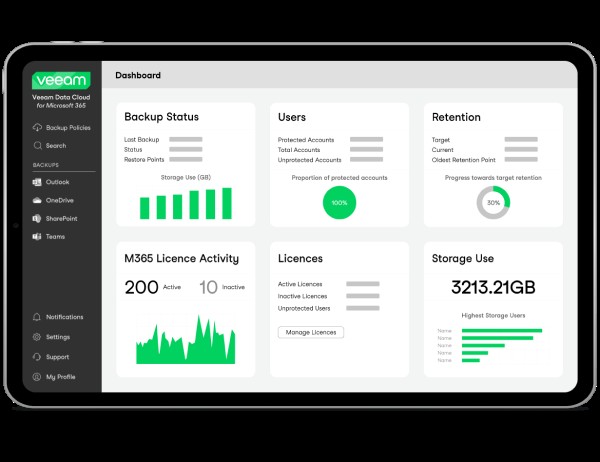
Veeam Data Cloud for Microsoft 365 is a BaaS (Backup as a Service) solution used to back up and restore Microsoft 365 data, including Microsoft Exchange, Microsoft SharePoint, Microsoft OneDrive for Business and Microsoft Teams data.
It's well-suited if you're really deep in the tech stack. If you're an exchange organization that's using the O365 suite, that's in Entra, that's in Azure, it's really great visibility. I think it probably falls apart very quickly if you don't have data from all those planes to feed it.
A de minimis incentive was given to thank the reviewer for their time. The incentive was not used to bias or drive a particular response, nor was the incentive contingent on a positive endorsement. More Info
Analyzing campaign performance is a great area where the Veeam Data Cloud for Microsoft 365 is well-suited, and it’s working well. In the past, when we analyzed campaign performance, we had to use outside vendors, which was a time-consuming, laborious, and costly process.
A de minimis incentive was given to thank the reviewer for their time. The incentive was not used to bias or drive a particular response, nor was the incentive contingent on a positive endorsement. More Info
I think from a coverage standpoint, it's pretty comprehensive. The areas it covers, of course, include the Microsoft stack, but also focus on using the definitive cloud apps integration to extend visibility and control to third-party cloud apps, endpoints, and even Macs. So those are capabilities.
Its comprehensiveness, its simplicity of creating the policies in one place, are definitely one of the plus points the solution has.
A de minimis incentive was given to thank the reviewer for their time. The incentive was not used to bias or drive a particular response, nor was the incentive contingent on a positive endorsement. More Info
A de minimis incentive was given to thank the reviewer for their time. The incentive was not used to bias or drive a particular response, nor was the incentive contingent on a positive endorsement. More Info
The main thing is that, within the product's story, some functionalities were deprecated, and traceability was one of them. That meant that before I could tell or pinpoint on a world map where a particular type of access attempt was happening, and now I cannot do that anymore. So that was useful because I could understand how far out a document made it, and then where the issue was. Was an employee trying to open it at home, or was it an external party altogether? I couldn't do that anymore.
The second bit that has room for improvement, is the fact that we have quite a lot of legacy documents that were labeled. So they are from previous versions of Office. And at the moment, since November last year, the already labeled documents are not being protected by the labels.
A de minimis incentive was given to thank the reviewer for their time. The incentive was not used to bias or drive a particular response, nor was the incentive contingent on a positive endorsement. More Info
I would like the option to remove users from the backup and set them to an alternate storage location/ archive location. Currently, my backups are at 7 TB, and I would like to segment out data with lower data retention requirements.
A de minimis incentive was given to thank the reviewer for their time. The incentive was not used to bias or drive a particular response, nor was the incentive contingent on a positive endorsement. More Info
Veeam Backup for Microsoft 365 just works so well and is so easy to use. I researched multiple options for Office 365 backup and none seemed to be as easy to setup and use as Veeam Backup for Microsoft 365 and the pricing was very comfortable to us. I can't imagine any reason why we would change away from Veeam Backup for Microsoft 365.
A de minimis incentive was given to thank the reviewer for their time. The incentive was not used to bias or drive a particular response, nor was the incentive contingent on a positive endorsement. More Info
I think it is very easy for the end user once it's applied. On the configuration side, there's a learning curve to that, but there's always a learning curve for anything. So I think the product does what it needs to do. It is easy enough to use.
A de minimis incentive was given to thank the reviewer for their time. The incentive was not used to bias or drive a particular response, nor was the incentive contingent on a positive endorsement. More Info
The interface is simple, but powerful. It's easy to setup, easy to use. It's able to restore individual files and emails with ease. Would like to see the wording on some features cleared up, as it's caused us some confusing learning the tool.
A de minimis incentive was given to thank the reviewer for their time. The incentive was not used to bias or drive a particular response, nor was the incentive contingent on a positive endorsement. More Info
A de minimis incentive was given to thank the reviewer for their time. The incentive was not used to bias or drive a particular response, nor was the incentive contingent on a positive endorsement. More Info
We have a lot of data, and pulling backups out of the store sometimes takes a bit of time - but this is within acceptable tolerances. I don't expect restores to be instantaneous, and I can't quantify if the speed is software or data repository.
A de minimis incentive was given to thank the reviewer for their time. The incentive was not used to bias or drive a particular response, nor was the incentive contingent on a positive endorsement. More Info
The setup support we received was extremely helpful. They allowed us to learn as they created the policies and managed the handoff between setup and guided setup very well. This resulted in active, usable policies and us having the knowledge to adapt these as our needs change in the future.
A de minimis incentive was given to thank the reviewer for their time. The incentive was not used to bias or drive a particular response, nor was the incentive contingent on a positive endorsement. More Info
A de minimis incentive was given to thank the reviewer for their time. The incentive was not used to bias or drive a particular response, nor was the incentive contingent on a positive endorsement. More Info
Symantec or now? Brocom. Forcepoint, GPV. I'm trying to think of, there's a couple more. I can't think of the top of my head. I would say closer to the bottom then rather than the top. So because of the fact that yes, it integrates well. But in terms of the actual functionality of DLP, there are other requirements that they just don't have the features for yet.
A de minimis incentive was given to thank the reviewer for their time. The incentive was not used to bias or drive a particular response, nor was the incentive contingent on a positive endorsement. More Info
First and foremost, Veeam's reputation stood out. They have been a leader in the backup vendors for a few years. That reputation along with recommendations from colleagues sold us on Veeam Data Cloud for Microsoft 365. The other vendors that we did demo's with were lacluster in setup and performance. Veeam Data Cloud for Microsoft 365 immediately won us over.
A de minimis incentive was given to thank the reviewer for their time. The incentive was not used to bias or drive a particular response, nor was the incentive contingent on a positive endorsement. More Info
A de minimis incentive was given to thank the reviewer for their time. The incentive was not used to bias or drive a particular response, nor was the incentive contingent on a positive endorsement. More Info
From an ROI perspective, being able to have a robust DLP capability within 365 and with eShare, again, providing the defensive depth and keeping data 365 gives both us as well as our customers an ROI by being able to not use third party repositories to share data externally and by keeping data inside of 365. It gives me much more visibility into my data landscape. One of the things we advise our customers to do when they're starting to explore the advanced capabilities of Microsoft Purview Data Loss Prevention, for example, is to use that DLP product to monitor and understand the flows of sensitive data within the organization. By being able to look at that DLP, identify those sensitive niche types, and see which transactions occur internally within the organization, I get a clearer picture of what I'm doing.
A de minimis incentive was given to thank the reviewer for their time. The incentive was not used to bias or drive a particular response, nor was the incentive contingent on a positive endorsement. More Info
The only real impact is from a compliance standpoint. Our company is expected at a regulatory level to be protecting our data and even though the tenant has little traffic there could still be some regulated data in there. We have to be able to tell an auditor that it's being backed up by an enterprise grade solution, and that's what VDC was intended for.
A de minimis incentive was given to thank the reviewer for their time. The incentive was not used to bias or drive a particular response, nor was the incentive contingent on a positive endorsement. More Info