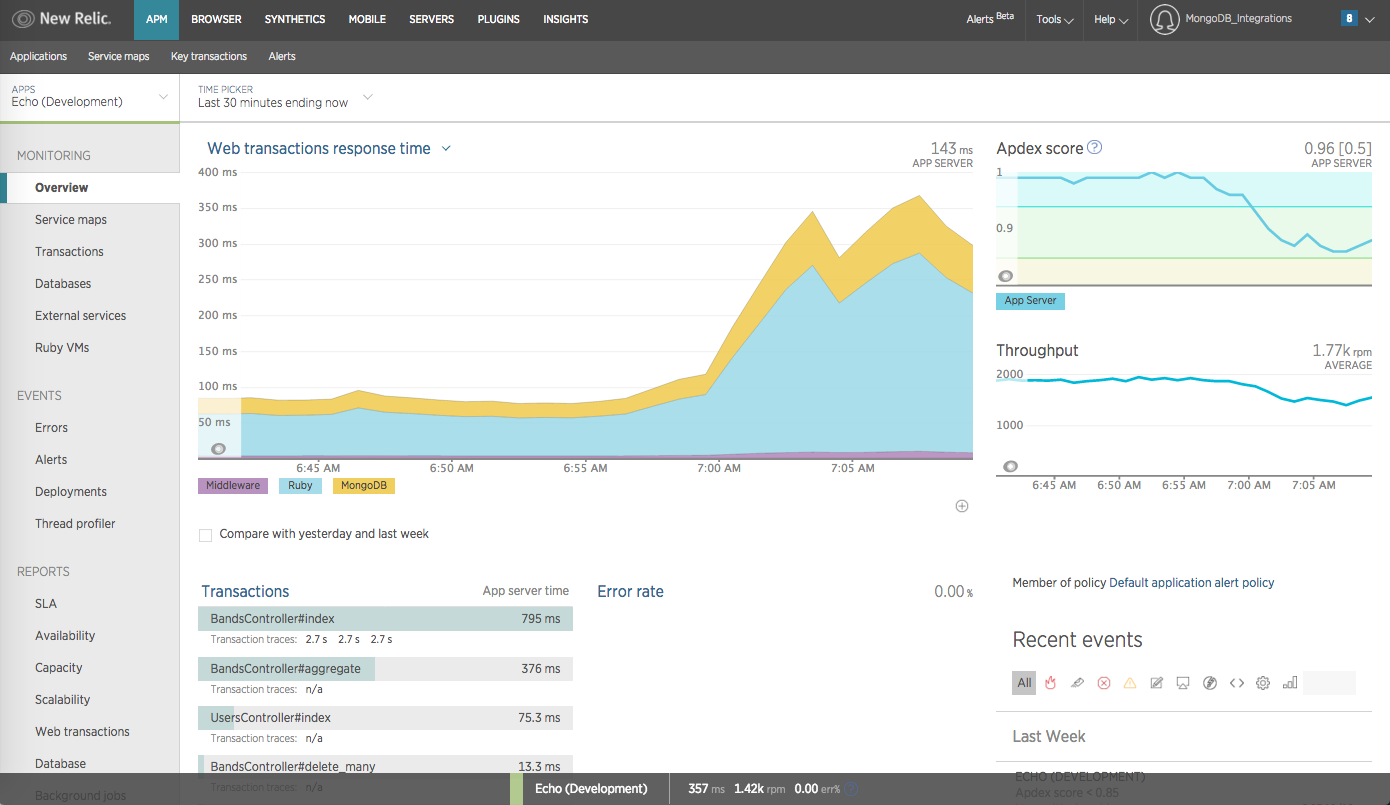
MongoDB is an open source document-oriented database system. It is part of the NoSQL family of database systems. Instead of storing data in tables as is done in a "classical" relational database, MongoDB stores structured data as JSON-like documents with dynamic schemas (MongoDB calls the format BSON), making the integration of data in certain types of applications easier and faster.
$0.10
million reads
OutSystems
Score 6.4 out of 10
N/A
The OutSystems Platform is a Platform-as-a-Service solution for rapid delivery of responsive web and mobile applications. It includes functionalities required to develop, deploy, manage and change web and mobile applications. It is targeted at the delivery of enterprise applications that require integration with backend systems, complex business rules and logic, usable interfaces and flexibility to change. It can be deployed in the cloud, on-premises or in hybrid environments.
$4,000
per month
Power Apps
Score 7.9 out of 10
N/A
PowerApps is a low code / rapid application development product from Microsoft that allows users to quickly build apps.
$20
per month per user
Pricing
MongoDB
OutSystems
Power Apps
Editions & Modules
Shared
$0
per month
Serverless
$0.10million reads
million reads
Dedicated
$57
per month
Basic
$4,000.00
per month
Pro
$10,000.00
per month
Power Apps Premium
$20
per month per user
Offerings
Pricing Offerings
MongoDB
OutSystems
Power Apps
Free Trial
Yes
Yes
Yes
Free/Freemium Version
Yes
Yes
No
Premium Consulting/Integration Services
No
Yes
No
Entry-level Setup Fee
No setup fee
No setup fee
No setup fee
Additional Details
Fully managed, global cloud database on AWS, Azure, and GCP
—
—
More Pricing Information
Community Pulse
MongoDB
OutSystems
Power Apps
Considered Multiple Products
MongoDB
No answer on this topic
OutSystems
Verified User
Engineer
Chose OutSystems
OutSystems is a tool that we developers use to develop an application that is a service studio. We don't need to download any other tool to create our application. Service studio provides all the functionalities related to front end things just like React Native provide, and …
If asked by a colleague I would highly recommend MongoDB. MongoDB provides incredible flexibility and is quick and easy to set up. It also provides extensive documentation which is very useful for someone new to the tool. Though I've used it for years and still referenced the docs often. From my experience and the use cases I've worked on, I'd suggest using it anywhere that needs a fast, efficient storage space for non-relational data. If a relational database is needed then another tool would be more apt.
Well suited for internal exposure of business processes (invoicing, API layer to other systems, customer maintenance etc), whether a UI is required or not. Not so well suited for full fledged web design. An OutSystems application must serve one particular business need, if gets too much functionalities and responsibilities it tends to get chaotic and complex.
Power Apps is ideal for scenarios that are neither too complex nor too large. It is easy to begin development in Power Apps, as it is one of the best tools for low-code development. Power Apps can be implemented for complex scenarios as well, provided there is strong knowledge of the tool and ample time for planning. Our applications benefit from Power Apps' cross-platform support, making it easy to use on any device, including desktops, laptops, and mobile devices.
Being a JSON language optimizes the response time of a query, you can directly build a query logic from the same service
You can install a local, database-based environment rather than the non-relational real-time bases such a firebase does not allow, the local environment is paramount since you can work without relying on the internet.
Forming collections in Mango is relatively simple, you do not need to know of query to work with it, since it has a simple graphic environment that allows you to manage databases for those who are not experts in console management.
Power Apps has formats that are pre-built that don't require any coding which makes it easier to achieve your vision. This does become a challenge if your App needs don't fit into that format.
We deal with a ton of data so the fact that you can connect to any data source in addition to their pre-stablished data connections makes the process a breeze.
The online learning resources and tutorials are helpful as well for those who are tech savvy.
An aggregate pipeline can be a bit overwhelming as a newcomer.
There's still no real concept of joins with references/foreign keys, although the aggregate framework has a feature that is close.
Database management/dev ops can still be time-consuming if rolling your own deployments. (Thankfully there are plenty of providers like Compose or even MongoDB's own Atlas that helps take care of the nitty-gritty.
Price – The licensing model of OutSystems is very expensive and not suitable for small scale developments. This is offset by the time to develop and stability for larger scale developments
Flexibility on PaaS version – The PaaS hosted version of OutSystems limits your flexibility to access the front end and backend database systems which can significantly restrict your options on high data volume developments or where anything requiring slightly out of the ordinary access is required
Same price for PaaS and self-hosted system. Licensing model dictates that you pay the same price even when you host the system on your own hardware which effectively means you pay more to manage the infrastructure yourself
Sometimes the cost of solutions is greater than the benefit. Licensing is expensive relative to the scope of some business user-created personal or team-level solutions.
While there is a starter-kit for Governance, it is complicated to stand up and requires dedicated resources to provide on-going governance operations. Many organizations are not going to be able to dedicate resources to governance and this causes the sprawl, solution duplication, silos, unneeded and unplanned licensing expenses, and a general "wild wild west" environment.
There needs to be better direction and best practices given around Power Platform Environment utilization and optimization.
The accessibility to the platform and ease for business partners to independantly create solutions is both a benefit and a negative. When the business outcome needed is a good fit for PowerApps it is a quick win, but when not a good fit it becomes a frustration for the business partner attempting to make the platform do something it is not well-suited for. The business partner entangles tech teams in the effort which drains resources and provides a lack-luster solution. All of this to say, it would be beneficial to have some tools that business partners could leverage to determine\understand if the type of business outcome they need is well suited to PowerApps or not.
I am looking forward to increasing our SaaS subscriptions such that I get to experience global replica sets, working in reads from secondaries, and what not. Can't wait to be able to exploit some of the power that the "Big Boys" use MongoDB for.
We are very happy with OutSystems and our developers deliver good work. OutSystems lets us build new software on a regulare (2 weekly) basis, which is highly flexible and adjustable. Even without very much experience, our developers manage to build usefull software, which is working a lot better than our previous (legacy) software.
NoSQL database systems such as MongoDB lack graphical interfaces by default and therefore to improve usability it is necessary to install third-party applications to see more visually the schemas and stored documents. In addition, these tools also allow us to visualize the commands to be executed for each operation.
OutSystems has a feature in which we can develop a functionality in a application and can use that functionality in another application without developing it again. That is main plus point for the development team so they can work with different functionalities rather focusing on the same thing again and again. if we want to make any change on the user side then we can make it live with just the deployment using the service center.
PowerApps is a great solution and I have spent the last year familiarizing myself with the platform and building custom applications to complete a whole range of tasks such as asset management, custom invoice generation, and item restriction tracking. We as a company have barely begun to scratch the surface of what can be achieved with PowerApps.
Finding support from local companies can be difficult. There were times when the local company could not find a solution and we reached a solution by getting support globally. If a good local company is found, it will overcome all your problems with its global support.
The tech support is very reachable. Usually by [email] from but also by phone if needed. We had some difficulties at the start with understanding "what our machine was doing" under high performance load. After some good sessions understanding our needs they delivered good solutions for our problems we had in the beginning.
The community forums are extremely responsive to questions asked, there is a good body of online documentation and many community posts to draw from. Although the platform has changed, which means some of the posts are out of date and the solutions provided aren't relevant. Of relevance, I read over 400 articles plus documentation to get this first app built in SharePoint, move it to SQL and make it work exactly the way it should.
The online training material is well designed and explanations are step by step, helping trainees to understand and follow each exercise and new concept.
While the setup and configuration of MongoDB is pretty straight forward, having a vendor that performs automatic backups and scales the cluster automatically is very convenient. If you do not have a system administrator or DBA familiar with MongoDB on hand, it's a very good idea to use a 3rd party vendor that specializes in MongoDB hosting. The value is very well worth it over hosting it yourself since the cost is often reasonable among providers.
In a large company, patiently and consistently work the behind the scenes politics with business and IT partners across the firm. This is transformational - you will need a solid set of key business partners to lock arms together to move forward.
We have [measured] the speed in reading/write operations in high load and finally select the winner = MongoDBWe have [not] too much data but in case there will be 10 [times] more we need Cassandra. Cassandra's storage engine provides constant-time writes no matter how big your data set grows. For analytics, MongoDB provides a custom map/reduce implementation; Cassandra provides native Hadoop support.
I tried to use WordPress with some success. Also looked at Joomla. But when I saw OutSystems I knew I had been wasting my time there. It takes you longer to get going with OutSystems - but even I as a novice realized immediately that Outsystems is simply in another league. Outsystems is powerful. (Can you compare WordPress and Joomla to Outsystems - I don't think so).
1. PowerApps functionality comes with E1 over E3 License without adding extra costs 2. For Nintex you pay (at the beginning) for each workflow, so my intention would be, to do no workflows to prevent additional costs, but I want a platform with a fair price that allows me to create workflows without thinking about the price for each workflow and we use only some workflow and relative easy workflows and forms as a medium-sized company. 3. PowerApps provides a lot of functionality without needing to invest in premium features directly.
Open Source w/ reasonable support costs have a direct, positive impact on the ROI (we moved away from large, monolithic, locked in licensing models)
You do have to balance the necessary level of HA & DR with the number of servers required to scale up and scale out. Servers cost money - so DR & HR doesn't come for free (even though it's built into the architecture of MongoDB
The ease of use of the OutSystems development process has been the biggest ROI for us. We have developed our Framework product and maintained/enhanced it with only 4 workers.
OutSystems has enhanced their product very significantly over the last 4 years. They have gone from a simple to use tool to a very simple to use sophisticated tool that covers the standard mainframe-based computing apps and the apps used on handheld mobile devices all using the same basic set of development tools.