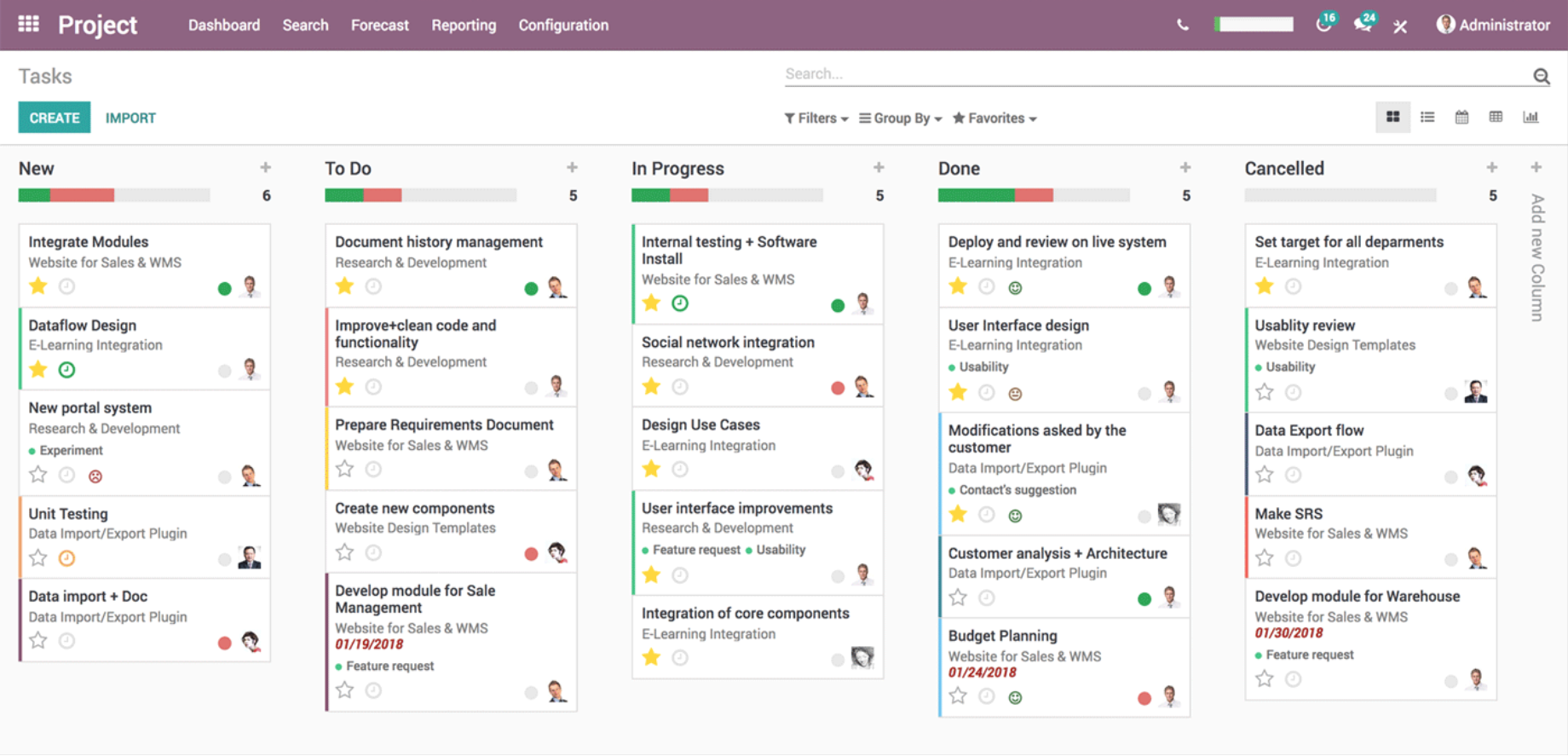
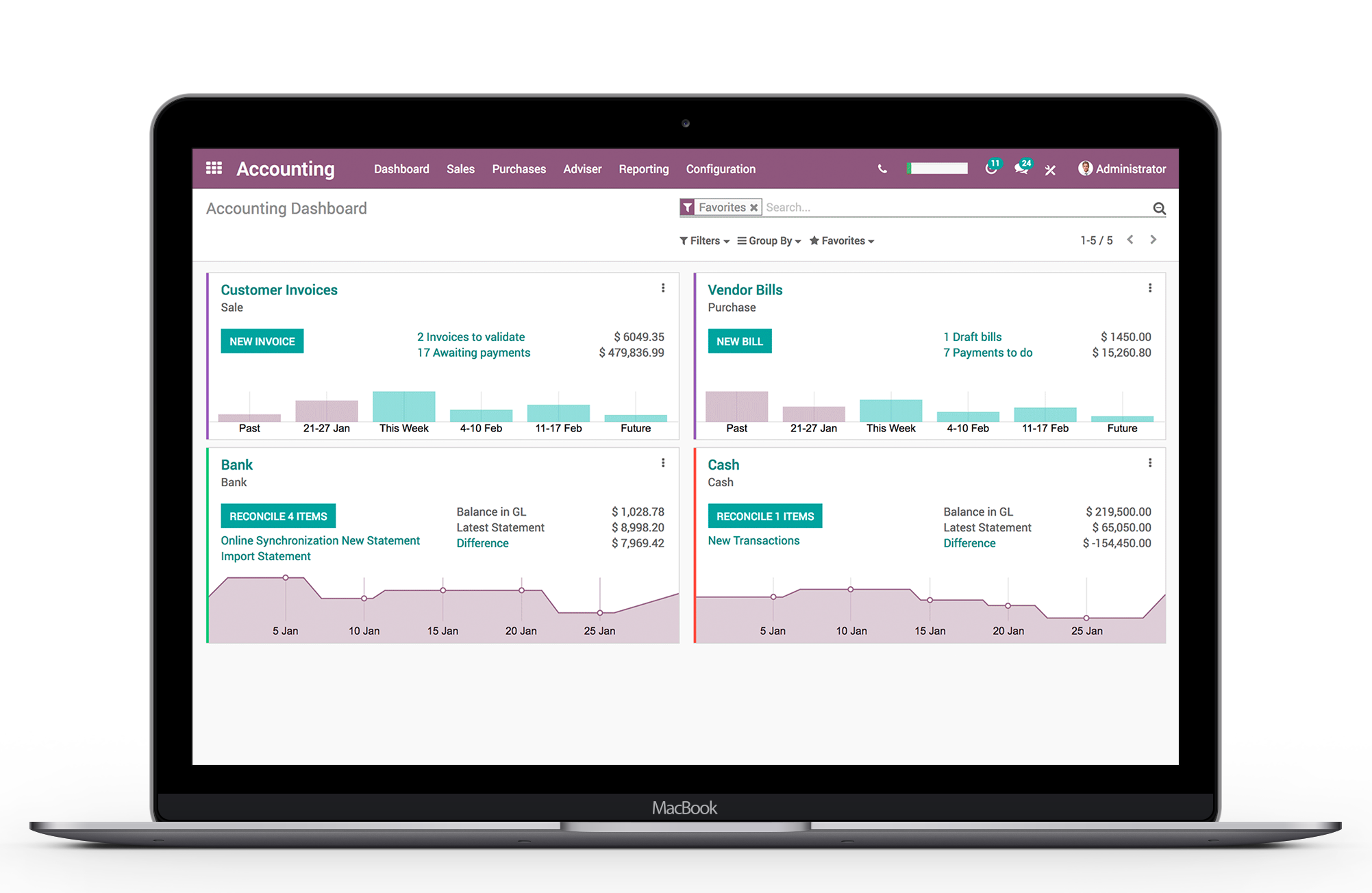
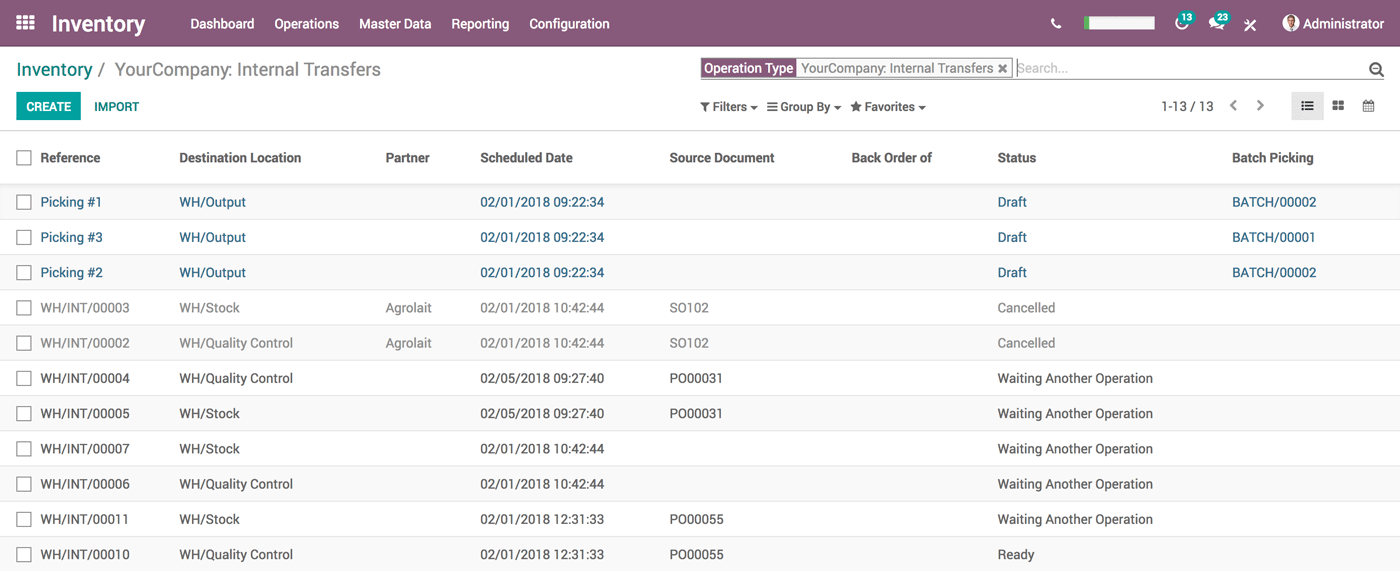
Odoo, from the Belgium-headquartered multinational company of the same name, is a suite of business applications for managing the sales pipeline. It also comprises a PoS and inventory management modules, scaling to a warehouse or retail management solution.
$31.10
per month per user
SAP Cloud ERP
Score 8.6 out of 10
N/A
SAP Cloud ERP (SAP S/4HANA Cloud) is a modular ERP that enables users to run mission-critical operations in real time from anywhere, introduce new business models in any industry, and expand globally. SAP Cloud ERP is a SaaS product and can also be deployed in a hybrid landscape for quicker time to value. SAP Cloud ERP is a foundational component of the
N/A
SAP Predictive Analytics
Score 7.0 out of 10
N/A
SAP Predictive Analytics is, as the name would suggest, a statistical analysis and data mining platform that can be deployed with SAP HANA.
N/A
Pricing
Odoo
SAP Cloud ERP
SAP Predictive Analytics
Editions & Modules
Standard
$31.10
per month per user
Custom
$46.70
per month per user
No answers on this topic
No answers on this topic
Offerings
Pricing Offerings
Odoo
SAP Cloud ERP
SAP Predictive Analytics
Free Trial
Yes
Yes
No
Free/Freemium Version
Yes
No
No
Premium Consulting/Integration Services
Yes
Yes
No
Entry-level Setup Fee
-$49,321,250 per app/ per user/ per month
Required
No setup fee
Additional Details
A discount is offered for new users for the first 12 months of use for the initial users purchased. ($24.90 instead of $31.10 for Standard)
What other products like SAP S/4HANA Cloud have you used or evaluated?Select from the list of products, or give insights on products your peers may not know about in the space below.Describe how SAP S/4HANA Cloud stacks up against them and why you selected SAP S/4HANA Cloud.
In our quest for an ERP solution, we evaluated alternatives such as Oracle ERP Cloud and Microsoft Dynamics 365. However, SAP S/4HANA Cloud's reputation for advanced analytics, scalability, and seamless integration with other SAP solutions made it the natural choice for our …
It is well suited for inventory tracking, shipping and sales work flows. While some customization is needed to make it functional, if done correctly Odoo can serves as a powerful one stop shop for all of a businesses needs. The ease of customization for email templates, both for sales communications and marketing outreach leaves something to be desired. Perhaps our team hasn't explored this fully enough. I have personally found it intimidating in trying to construct a news letter using the email marketing module
It is an appropriate ERP solution for all types of companies. It offers faster data processing, along with modern technologies such as built-in AI, machine learning, and real-time data analytics. It comes with built-in AI that helps reduce manual work by automating repetitive tasks, providing real-time insights, and offering proactive recommendations for important business decisions.
It's a great tool to merge actual data analysis (which Lumira doesn't do that well) with visualization (which Lumira does well) - so it can be seen as Lumira for data analysts. However, a lot of the 'predictive' side is hidden/black box which can be frustrating for those analysts, so you could argue it is too complex for casual users, but too 'black box' for analysts.
The creation of products is extremely simple, I like that it does not complicate you to put a lot of detail, of course if you want to put more detailed information later it allows you to do it without problems
The fact that I can manage my inventory of my warehouse is very convenient, I only generate my stock report of the products we have in stock and taking inventory is easier
The management of opportunities in the CRM is also great, because the guys from the sales department generate their opportunity, place what their client is requiring and we, the logisticians, can automatically generate the quote for what they are requesting, and from there they can only download their quote and send it to their clients.
The software helps in forecasting and identifying potential challenges that would affect our organisation in the near future. This enables us to prepare in advance and also adopt practical and viable measures.
It enables faster and accurate data processing, which enhances decision-making.
It's easily customizable according to specific organizational needs. This promotes overall efficiency and productivity of the organization.
It doesn't require you to have a Ph.D. to build models!
You can use it to address a very large and wide dataset without worrying about sampling.
Automation is in the product DNA. You can prepare your data, ingest it into the "Kernel", then get insights about what was found, decide to publish it and schedule scoring tasks or model refresh in the same product.
Customer service is nonexistent. You will need a 3rd party to assist you.
The system has an open app for integrating with other programs. These are developed by third parties and can be hit or miss in functionality.
The system offers great flexibility; however, it is too much and requires coding. For example, changing a Sales order PDF requires coding to modify the document.
Initial implementation is clunky and seems to require a 3rd party just for setup.
The cost of SAP as an ERP is quite high and the switching costs associated with ERP systems are even higher. That being said moving from one ERP to another only happens once in a great while for large organizations. Those switching costs include retraining, IT hardware requirements, outside consultants and more
Once you complete the training with Odoo, you have a great grasp of how the system works, and most every feature is intuitive- There is rarely a task within Odoo that I get frustrated trying to figure out- I can typically look through the system and find what I need to do, and if I ever do need support, the Odoo Support team is excellent
Mostly great for building trust; however, the system could be more user-friendly. Sometimes the systems are slow. We also need to find a way to simplify user support. It can be very complex to support an SAP system. The confusion/deep expertise creates an ROI issue as professionals can be expensive to hire.
Easy - there is NO SUPPORT (like in ABSOLUTELY NOTHING!!!!!!!). Even for legally mandatory requirements where the system MUST work, they will gladly take a month to get back to you with a NON-answer. We couldn't even get our bank statements correctly into Odoo for 2 months - leading to no reconciliation and the company accounts were a mess (still are!!) as a result - Completely irresponsible. Have not EVEN had an apology from Odoo - they couldn't care less !!
The support system I find great as whenever I run into problems they rectify them quickly as possible they never reacted late the support is just up to the mark for me. They provide many solutions to the problems I faced the [technical] team support is always amazing they [listen] to mean work accordingly.
The documentation provides an explanation about what features are available but not necessarily what's happening behind the scenes. On the other side, the "community" has grown since the acquisition and most questions are properly addressed by SAP folks. Since the "product maintenance" mode announcement was made, there wasn't much new content published except on the Smart Predict side (which is built by the SAP Predictive Analytics team)
SAP requires a lot of internal and external resources to complete its successful implementation. The cloud version requires a deeper understanding of the different capabilities of the local systems (hardware) and the connection towards your local IT team. We found several problems on our systems that we couldn't foresee before the implementation and roll out.
We decided to go with Odoo over Netsuite due to a few factors. Price was a big reason why, Netsuite is the most expensive ERP we vetted. I also did not have a great experience with Netsuite at my last job. I was on the roll out team and it did not work as promised for POS, inventory managing or reporting, it crashed constantly in the middle of using it. Just over all very poor. Considering it is owned by Oracle and the most expensive, you would think it would be able to function on some sort of base level. That company ended up terminating their contract with Netsuite early and going with a different company.
We don't have crashing or error issues. I can complete receives, cycle counts etc and all of my information saves. Visually, Odoo is more satisfying also.
The platform utilizes advanced predictive analytics to anticipate operational bottlenecks and put them out of commission before the problems become larger. We can proactively develop effective strategies that help keep service quality in the face of unexpected changes in the market, or external disruptions, by continuously analyzing historical performance data as well as elements of the current market
We have typically used Spotfire for data analysis but decided to move to SAP Business Objects due to its innate connection with SAP. I found Lumira to be good for visualizations but it is not meant for data analysis. Therefore, we have introduced Predictive Analytics to see if it can fill that gap. So far, it's been far less intuitive than Spotfire to get started, and as far as I am aware so far, it does not bring many additional capabilities. I do, however, like that it utilizes the Lumira look/feel and integrates very well.